Skip to content
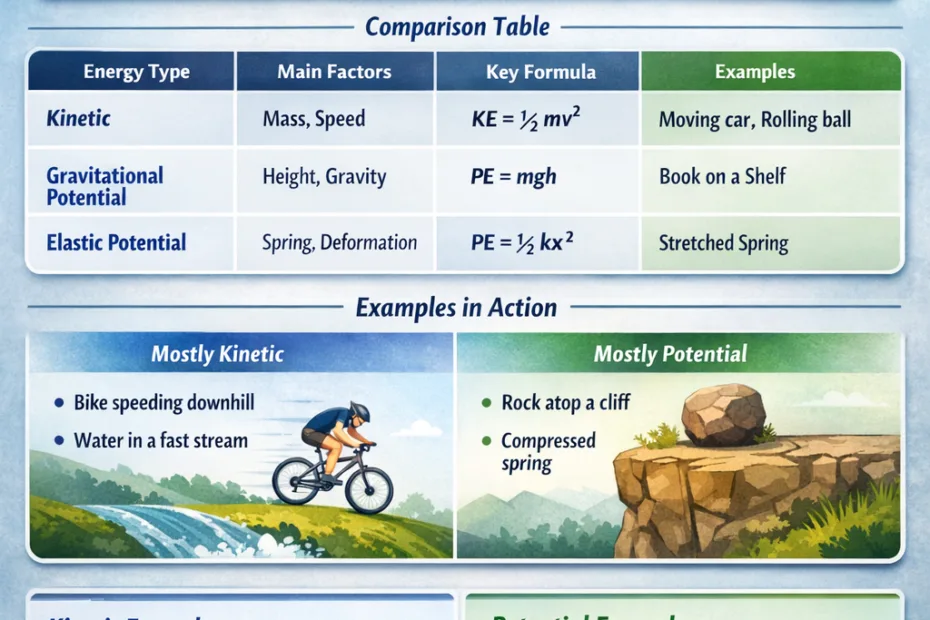
The infographic shows a cyclist and a falling apple to illustrate kinetic and potential energy differences.

Kinetic vs. Potential Energy: Definitions and Examples

Kinetic energy is the energy an object has because it is moving, while potential energy is energy tied to position or configuration within a system (like height in a gravitational field or a compressed spring). Both are measured in joules (J), and in many everyday situations they trade places as things speed up, slow down, rise, or fall [a]🔗. A Practical Way to Think About… Kinetic vs. Potential Energy: Definitions and Examples
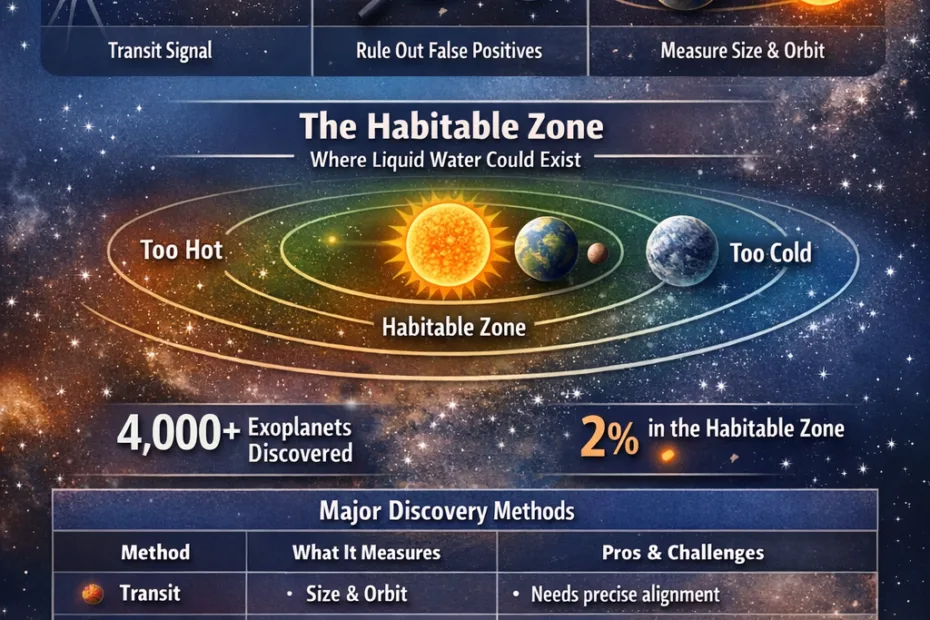
A diagram shows a planet in the habitable zone orbiting a star with Earth-like planets nearby.

Exoplanets: Searching for Earth-like Planets Beyond Our Solar System

An exoplanet is a planet beyond our Solar System, orbiting another star. The search for Earth-like exoplanets is really a search for measurable “Earth-ish” clues—size, orbit, starlight, and sometimes atmosphere—without pretending we already know what the surface is like. [a] ⓘ A Clear Starting Point Most “Earth-like” headlines boil down to three things: small (likely rocky), temperate (not too hot or cold from starlight), and… Exoplanets: Searching for Earth-like Planets Beyond Our Solar System

Enzymes and temperature graph with a blue test tube, illustrating how biological catalysts speed up reactions.

Enzymes Explained: How Biological Catalysts Speed Up Life

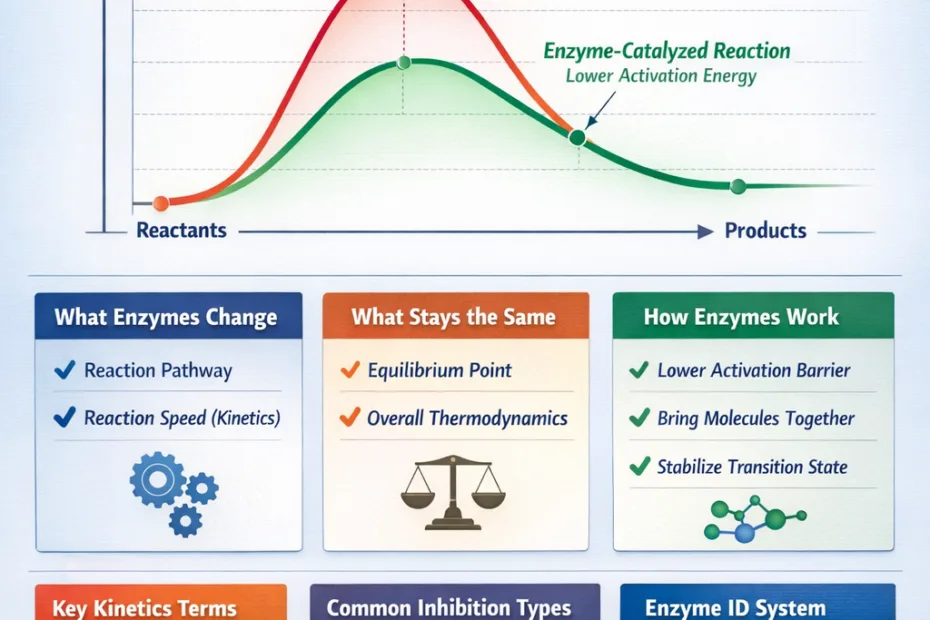
An enzyme is a biological catalyst that speeds up a chemical reaction in living systems without being permanently used up, usually by making it easier for molecules to reach the reaction’s “go” moment (the activation energy step). [a]↗[b]↗[c]↗ A Clear Snapshot Before We Dive In Enzymes are the reason biology can run at real-world speed: digestion, muscle movement, DNA copying, and cell signaling all rely… Enzymes Explained: How Biological Catalysts Speed Up Life

An infographic illustrating the states of matter with colorful representations of solid, liquid, gas, and plas…

The States of Matter: Solid, Liquid, Gas, and Plasma

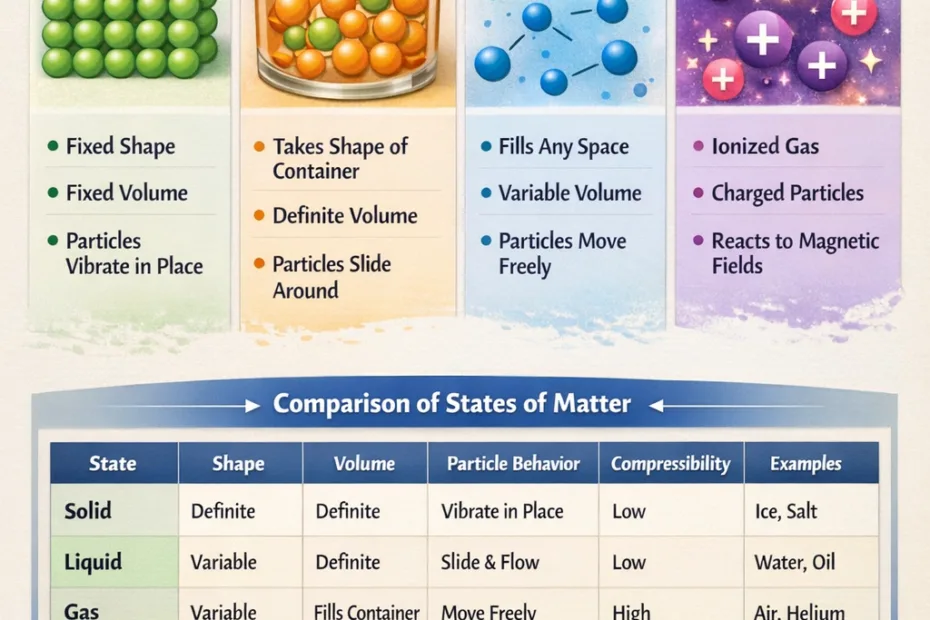
The states of matter are the main physical forms a substance can take—solid, liquid, gas, and plasma—based on how tightly its particles are held together and how freely they move.[a]🔗 A Clear Way to Think About It Solids keep their shape, liquids keep their volume, gases expand to fill space, and plasma behaves like a gas with charged particles that react strongly to electric and… The States of Matter: Solid, Liquid, Gas, and Plasma

A diagram showing nitrogen movement through the ecosystem with arrows linking plants, soil, and bacteria.

The Nitrogen Cycle: How Nitrogen Moves Through the Ecosystem

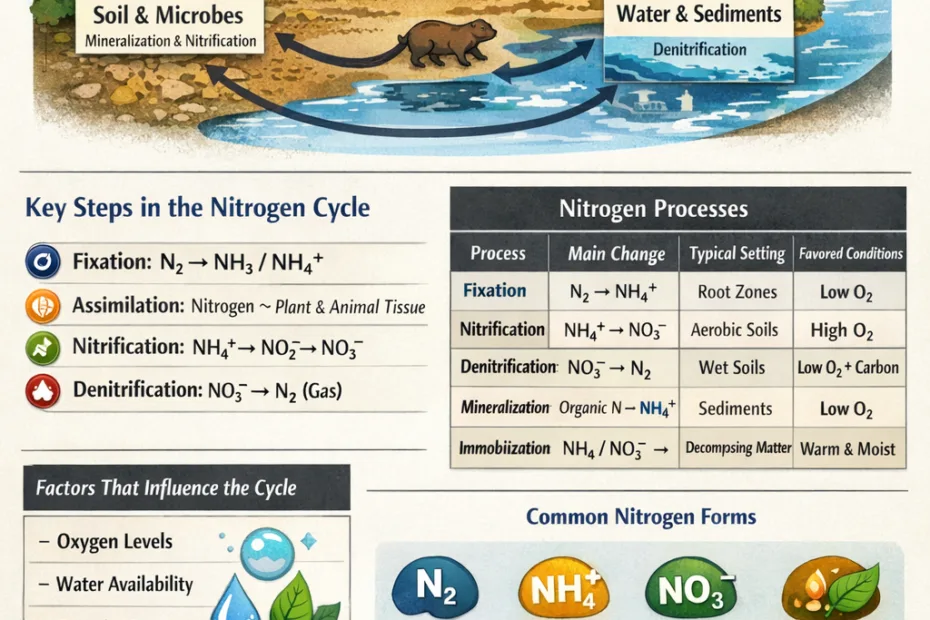
The nitrogen cycle is the natural way nitrogen moves between the air, living things, soil, and water by changing chemical form—most often from inert N2 into “usable” forms like ammonium and nitrate, then back again.[a] 🔗 A Clear Picture First Nitrogen is everywhere, but life can’t use most of it directly. Ecosystems rely on microbes to “translate” nitrogen into forms plants can absorb, then recycle… The Nitrogen Cycle: How Nitrogen Moves Through the Ecosystem

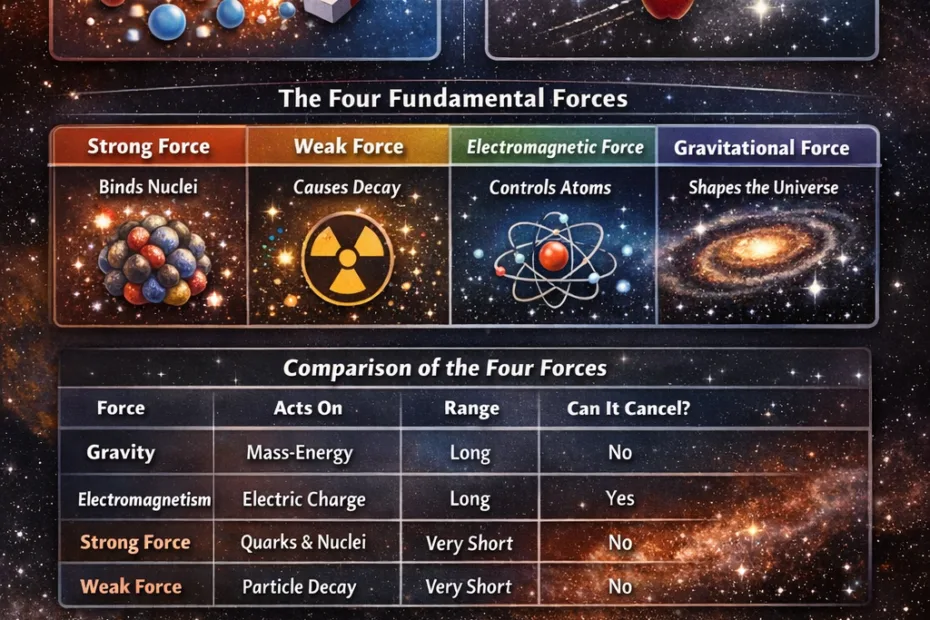
A diagram comparing electromagnetism and gravity, showing a magnetic field and planet with gravity pull.

Electromagnetism vs. Gravity: The Four Fundamental Forces

Electromagnetism is the force behind electric charge and magnetism; gravity is the attraction linked to mass and energy and, in modern physics, to the shape of spacetime. Both can reach across huge distances, yet they behave so differently that one builds atoms while the other builds galaxies. A Clear Starting Point Electromagnetism usually dominates at human scales because it can be extremely strong between charged… Electromagnetism vs. Gravity: The Four Fundamental Forces

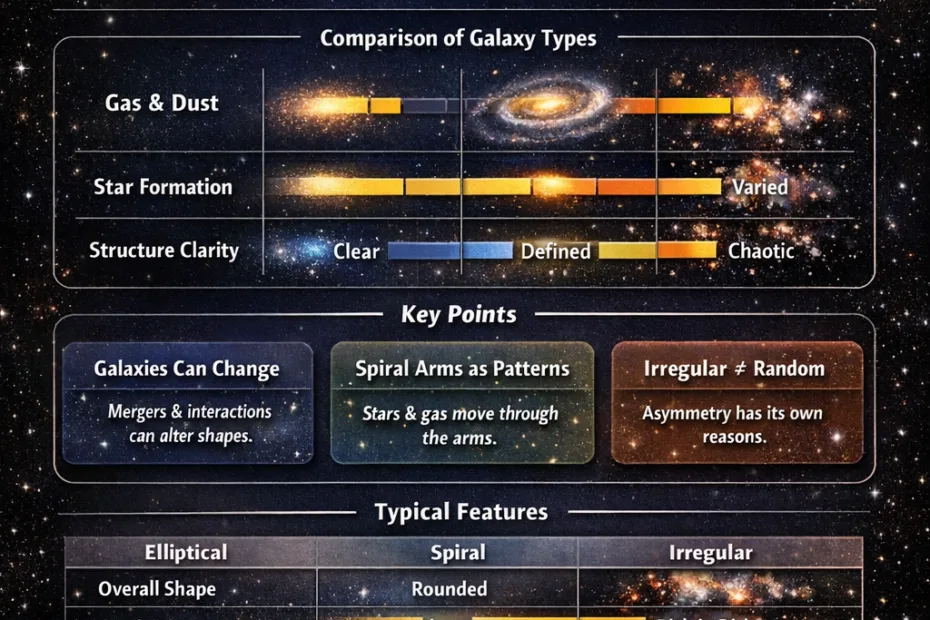
Messier galaxy images show elliptical, spiral, and irregular types in this infographic.

Types of Galaxies: Elliptical, Spiral, and Irregular

A galaxy type is a way to sort galaxies by how they appear in images—mainly their overall shape and visible structure. In everyday terms, most well-known galaxies fall into three broad families: elliptical, spiral, and irregular[a]↗. A Clean Mental Model to Start With Galaxy “types” are about shape and visible layout, not about which galaxies are “better” or “older.” A spiral can be calm or… Types of Galaxies: Elliptical, Spiral, and Irregular

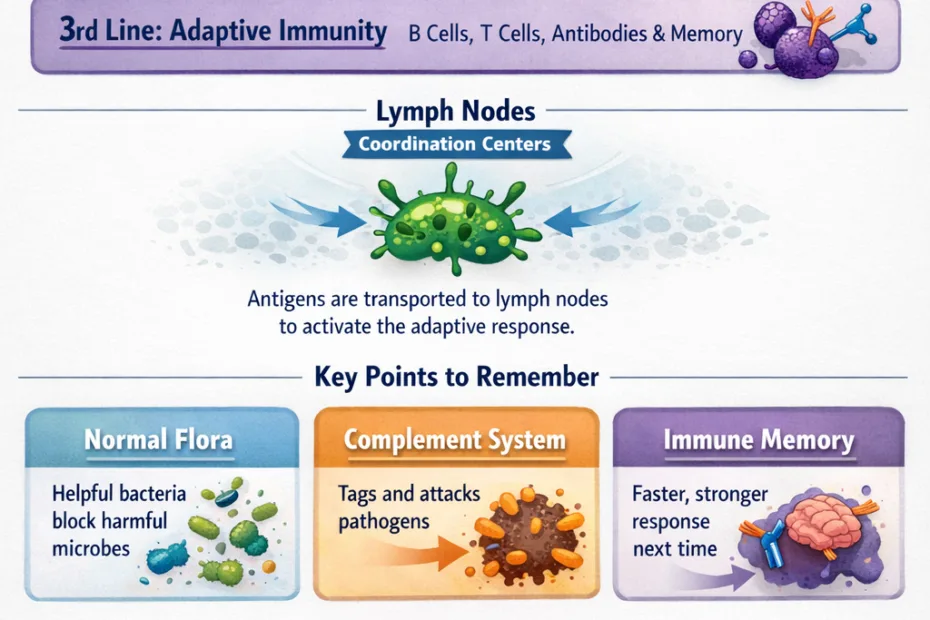
A diagram showing the human immune system's defense lines, with white blood cells attacking pathogens.

How the Human Immune System Works: Lines of Defense

The human immune system is your body’s built-in defense network that recognizes and responds to germs (like bacteria and viruses) and other things that don’t belong. It works through layered “lines of defense”: barriers that block entry, fast internal responses that slow invaders down, and a targeted system that learns and remembers for the next time.[a]↗ “Lines of defense” is a simple way to describe… How the Human Immune System Works: Lines of Defense

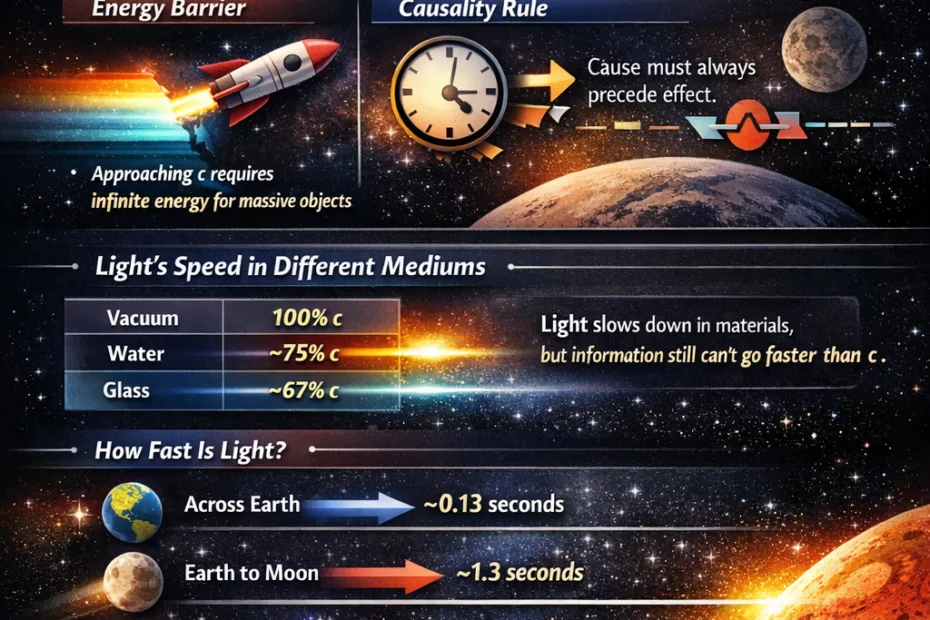
A visual explaining the speed of light with diagrams of planets and colorful light beams in space.

The Speed of Light: Why Nothing Travels Faster?

The speed of light (usually written as c) is the maximum speed at which information, energy, and physical influence can travel through empty space. In modern SI units, it is defined to be exactly 299,792,458 meters per second in a vacuum[a]↗[b]↗. A Clear Starting Point Light feels “instant” at human distances, but physics treats it as a real speed with real consequences. The important part… The Speed of Light: Why Nothing Travels Faster?