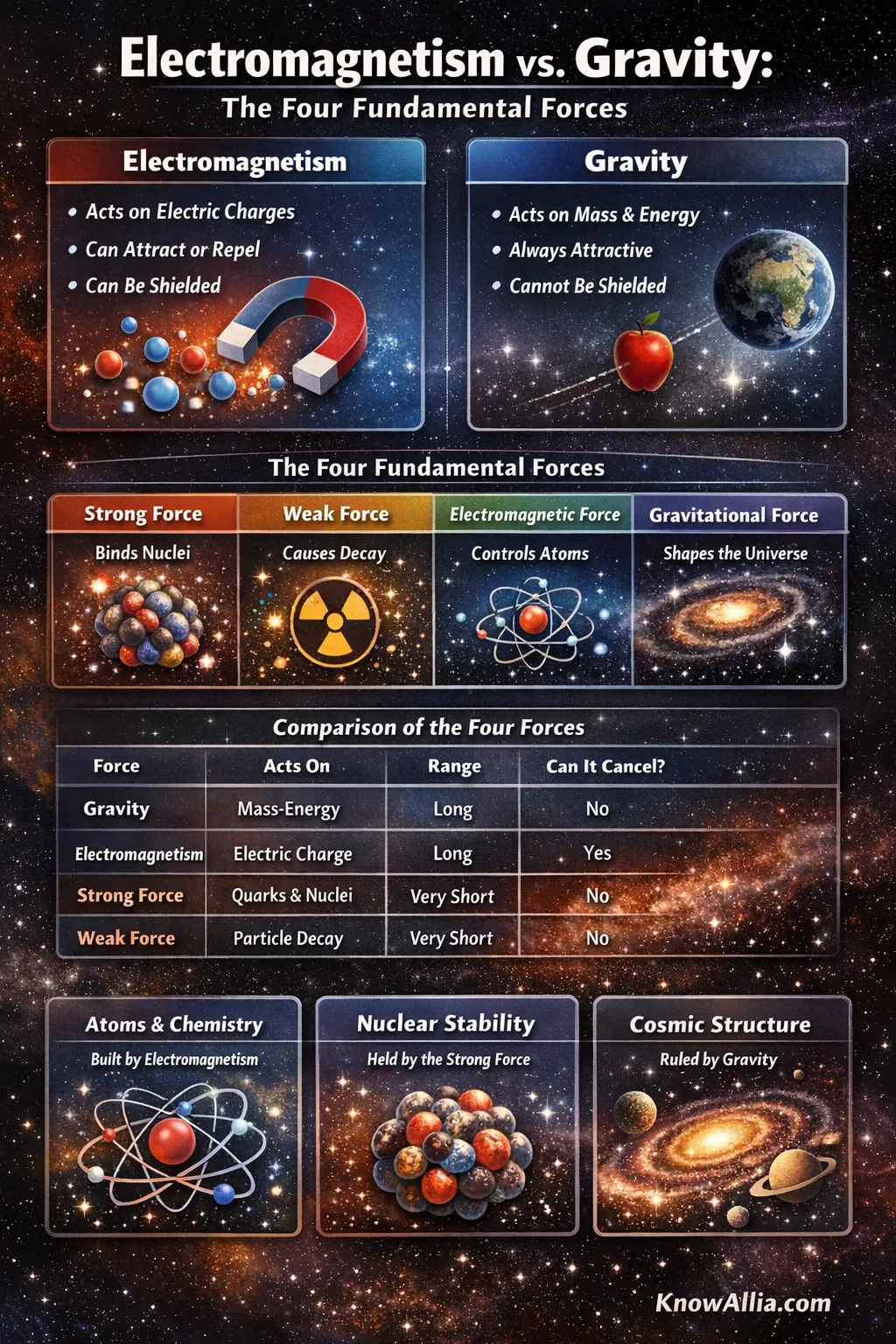
Electromagnetism is the force behind electric charge and magnetism; gravity is the attraction linked to mass and energy and, in modern physics, to the shape of spacetime. Both can reach across huge distances, yet they behave so differently that one builds atoms while the other builds galaxies.
A Clear Starting Point
Electromagnetism usually dominates at human scales because it can be extremely strong between charged particles. Gravity dominates large-scale astronomy because it adds up across enormous amounts of matter and can’t be “neutralized” in the same everyday way.
- Electromagnetism can attract or repel; gravity is (as far as we know) only attractive.
- Electromagnetism is easy to cancel out in neutral objects; gravity keeps stacking with every atom.
- The other two fundamental forces—strong and weak—run the subatomic world, especially inside nuclei.
In this article you’ll learn how these forces work, what they act on, why their “reach” feels so different in daily life, and where the strong and weak forces fit into the same picture—without hand-wavy claims.
What you’ll take away: a practical comparison (what changes motion, what binds matter, what cancels out), plus a clean map of the four fundamental forces and the key terms people often mix up.
What the Four Fundamental Forces Are
Physics groups nature’s “push and pull” into four forces: electromagnetism, gravity, the strong force, and the weak force. Each one has its own job description:
- Electromagnetism shapes atoms and chemistry, powers electronics, and explains magnets.
- Gravity controls orbits, tides, and the large-scale structure of the universe.
- Strong force holds quarks together and helps bind protons and neutrons inside nuclei.
- Weak force drives certain particle transformations, including many kinds of radioactive decay.
When people say “fundamental,” they mean these are treated as the basic interactions—not built out of something simpler in everyday physics models. That said, how you describe a force depends on the situation: classical fields work beautifully for many problems, while particle-based descriptions become necessary at very small scales.
Electromagnetism and Gravity Up Close
Electromagnetism
Electromagnetism acts on electric charge. Because charges come in two signs, the electromagnetic interaction can be attractive or repulsive. The “electric” and “magnetic” parts are tightly linked—changing electric and magnetic fields feed into each other in a way summarized by Maxwell’s equations.[d]↗
A practical takeaway: electromagnetism is why materials stick, wires carry current, and light exists (light is an electromagnetic wave). It’s also why shielding works: you can often rearrange charges in a material to reduce electric fields in a region.
- charge matters directly
- can repel and attract
- often shieldable in practice
Gravity
Gravity is tied to mass and energy. In Einstein’s general relativity, gravity isn’t treated as a “pulling field” in the usual sense; instead, matter and energy affect the geometry of spacetime, and objects follow the paths that geometry allows.[c]↗
In many everyday cases, Newton’s version (gravity as an inverse-square attraction) gives excellent results. General relativity matters most when gravity is intense or precision is critical—think black holes, GPS-level timing accuracy, or subtle effects in astronomy.
- mass-energy is the source
- always attractive in known physics
- not shieldable the way EM is
One Shared Feature People Miss
At a simple “strength vs distance” level, gravity and electromagnetism have a family resemblance: both can follow an inverse-square pattern for point-like sources in classical physics. But the sign of the source makes the key difference: gravity adds, while electromagnetism can cancel.
Electromagnetism vs Gravity in the Everyday World
If electromagnetism can be so strong, why doesn’t it fling you off the ground? The simplest answer is neutrality: most everyday objects contain almost equal positive and negative charge, so their electromagnetic effects largely balance out at macroscopic distances. Gravity, on the other hand, keeps accumulating because every atom contributes mass—and there’s no everyday “negative mass” that cancels it.[b]↗
An analogy: Think of electromagnetism like a room full of tiny speakers where half are playing sound and half are playing the exact opposite sound. From far away, it can get surprisingly quiet. Gravity is more like everyone in the room clapping in sync—each person adds a little, and the total grows as the crowd grows.
Practical Differences You Can Feel
- Attraction vs Repulsion: electromagnetism has two “directions” because charge has two signs; gravity is attractive in all everyday observations.
- Shielding: electromagnetic fields can often be reduced with conductors or magnetic materials; gravity does not have a comparable shield in known physics.
- Dominant scale: electromagnetism rules atoms and materials; gravity rules planets and galaxies.
- Why both can be long-range: both can spread out without an obvious cutoff, yet electromagnetism often looks short-range because neutral matter cancels it so efficiently.
A Concrete Example
A small refrigerator magnet can hold itself up against Earth’s gravity, which shows how strong electromagnetic forces between materials can be at close range. But when you step back and look at Earth and the Moon, it’s gravity that cleanly dominates the story—because the Moon’s overall charge is essentially balanced, while its mass is enormous.
Where the Strong and Weak Forces Fit
The strong and weak forces don’t show up as pushes and pulls in daily life because they mainly act at extremely small distances. Still, they quietly determine what matter is stable, what decays, and how nuclei behave.
The Strong Force
The strong force binds quarks using force-carrying particles called gluons. A distinctive feature is that its effective behavior depends strongly on distance: quarks act almost free when they’re extremely close, but pulling them apart doesn’t “let go” the way ordinary forces do—this is tied to why isolated quarks aren’t observed in normal conditions.[e]↗
- Primary arena: inside protons, neutrons, and nuclei
- Carrier idea: gluons “glue” quarks together
- Everyday footprint: nuclear binding and nuclear energy
The Weak Force
The weak force is famous for being short-range. One key reason is that the particles associated with it (the W and Z bosons) are very massive, which strongly limits how far the interaction effectively reaches at low energies. That’s why “weak” can be a misleading everyday label: the effect is less about being inherently tiny and more about being tightly confined in range.[f]↗
- Primary arena: radioactive decay and particle transformations
- Carrier idea: heavy W and Z bosons
- Everyday footprint: natural radioactivity, neutrinos, and nuclear reactions in stars
How the Four Forces Compare
This table summarizes the core differences in plain language. It’s not trying to replace textbooks—just to keep the big picture straight.
| Force | What It Acts On | Typical Reach | Can It Cancel Out? | Where You Notice It Most |
|---|---|---|---|---|
| Gravity | Mass-energy | Long-range | No known everyday cancellation | Orbits, weight, tides, cosmic structure |
| Electromagnetism | Electric charge | Long-range (often masked by neutrality) | Yes, positive/negative charge balance | Atoms, chemistry, materials, light, electronics |
| Weak Force | Certain particle transformations | Very short-range | Not in the same “plus/minus” sense | Radioactive decay and neutrinos |
| Strong Force | Quarks (and nuclear binding via residual effects) | Very short-range | Not like charge neutrality | Nuclear stability and the structure of hadrons |
A Visual Snapshot of the Four Forces
Where Each Force Tends to “Win”
A compact map from the tiniest scales to the cosmic ones—showing why electromagnetism dominates materials, while gravity dominates astronomy.
Reach and Typical Playground
Nucleus Atom Human Scale Solar System+Strong: binds quarks, helps bind nuclei Weak: decay and particle changes Electromagnetism: atoms, light, materials Gravity: orbits, structure of the universeNot a measurement scale—just a “where you notice it” map.Three High-Impact Facts
Large objects tend to be electrically neutral overall, so their electromagnetic effects cancel at distance, while gravity keeps adding.
Its effects are tightly range-limited and show up most in particle transformations, not in the push-and-pull of daily motion.
General relativity is extremely successful, but a complete quantum description remains an active area of research.
What Builds Atoms
Electromagnetism binds electrons to nuclei and sets the rules of chemistry.
What Stabilizes Nuclei
Strong effects overcome proton repulsion at tiny distances, enabling stable nuclei.
What Shapes the Cosmos
Gravity organizes matter on the largest scales because it always adds up.
Common Misconceptions and Mix-Ups
Better Framing Electromagnetism is long-range, but neutral matter cancels it so well that it often looks short-range in everyday situations.
Better Framing Magnetism is part of electromagnetism. Gravity is a different interaction entirely and is described by spacetime geometry in general relativity.
Better Framing A lot of “weakness” is about range and conditions: the interaction is tied to heavy particles, so its effects fade rapidly with distance at everyday energies.
Key Terms You’ll See
- Field
- A way to describe how a force “fills space,” assigning values (like strength and direction) at each point.
- Charge
- The property that makes particles respond to electromagnetism; it comes in positive and negative forms.
- Mass-Energy
- The source of gravity in modern physics; not just “mass,” but energy and momentum as well.
- Inverse-Square
- A pattern where influence decreases with the square of distance, common in classical point-source gravity and electromagnetism.
- Carrier Particle
- In particle physics language, forces are associated with specific bosons (like the photon for electromagnetism).
Limitations and What We Don’t Know Yet
Physics has remarkably accurate tools here, but there are honest boundaries. General relativity works extremely well, yet it’s widely expected that a complete picture should include a quantum foundation for gravity. The same theory also predicts phenomena like gravitational waves, which are part of modern gravitational physics.[a]↗
On the particle side, the Standard Model organizes electromagnetism, the strong force, and the weak force with specific force-carrying particles. Gravity is typically handled differently, and a graviton is discussed as a possible carrier—but it hasn’t been observed.[e]↗
A subtle but real detail: even “constants” in how we express electromagnetism can change in status when measurement standards evolve. In the modern SI system, some electromagnetic constants are no longer treated as exact fixed numbers in the way many older explanations imply.[g]↗
If you keep those limits in mind, comparisons become clearer: we’re not choosing a “winner,” we’re choosing the right tool for the scale and the question.
FAQ
Frequently Asked Questions
Is electromagnetism always stronger than gravity?
Between individual charged particles, electromagnetic effects can dwarf gravity. In everyday objects, though, positive and negative charges usually balance out, so the net electromagnetic pull at distance can be small while gravity keeps adding across all atoms.
Why can’t we shield gravity like we shield electric fields?
Electric fields can often be reduced by moving charges around in a conductor. Gravity doesn’t work with a “plus/minus” mass that you can rearrange to cancel it, and there’s no known material that blocks gravitational influence the way metals can reduce electric fields.
Does magnetism change gravity?
They are different forces. Magnetism is part of electromagnetism, while gravity is described by spacetime curvature in general relativity. In advanced physics, energy in fields can contribute to gravity, but that’s not the same as magnets “creating” gravity in the everyday sense.
What do the W and Z bosons have to do with the weak force?
They’re the particles associated with the weak interaction. Because they are heavy, weak effects are tightly range-limited at ordinary energies, which is one big reason the weak force feels “hidden” compared to electromagnetism and gravity.
Is there a particle carrier for gravity?
In some theoretical approaches, a graviton is discussed as a possible carrier particle, analogous to how photons relate to electromagnetism. It has not been observed experimentally, and gravity is typically treated through general relativity rather than a completed quantum field picture.
Do any of the forces unify?
There are established theories describing electromagnetism and the weak interaction within a combined theory under certain conditions. A fully unified description that also includes gravity remains an open area of research.
Sources
These references were chosen for reliability (major scientific institutions, government agencies, or universities). Each external link is used only once.
- University of Maryland Physics – Maxwell’s Equations (PDF) (electromagnetism’s classical field summary) [d]↩
- Einstein Online (Max Planck Institute) – General Relativity (gravity as spacetime geometry) [c]↩
- NASA Science – General Relativity and the Nature of Spacetime (gravity’s modern description and known limits) [a]↩
- Fermilab – Questions About Physics: How Strong Is the Strong Force? (comparisons across forces; neutrality and why gravity dominates at large scales) [b]↩
- CERN – The Standard Model (force carriers: photon, gluon, W/Z; graviton as not-yet-found) [e]↩
- Particle Data Group – Review of Particle Physics: Physical Constants (PDF) (SI-era status of electromagnetic constants and definitions) [g]↩