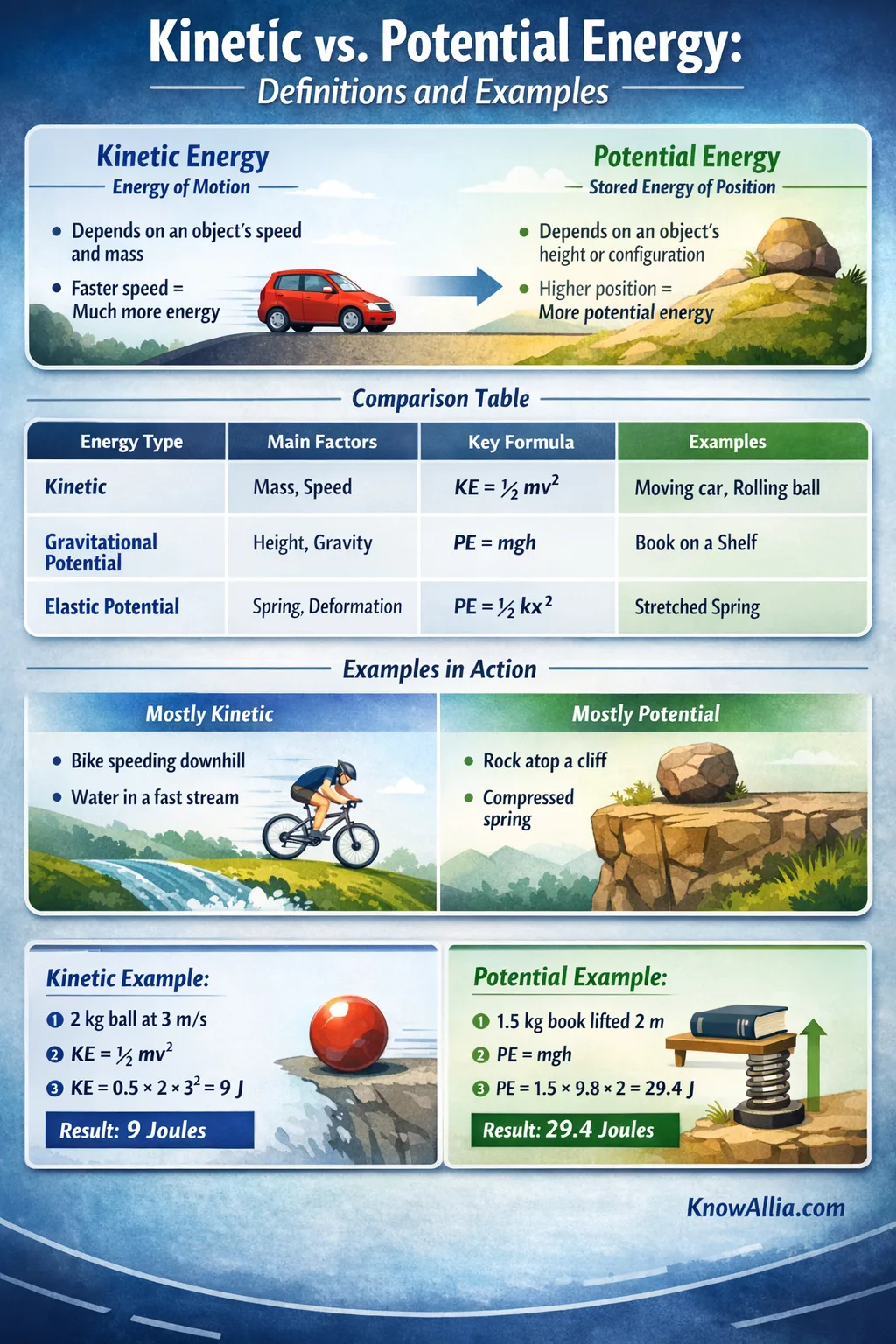
Kinetic energy is the energy an object has because it is moving, while potential energy is energy tied to position or configuration within a system (like height in a gravitational field or a compressed spring). Both are measured in joules (J), and in many everyday situations they trade places as things speed up, slow down, rise, or fall [a]🔗.
A Practical Way to Think About It
Kinetic is “energy of motion.” Potential is “energy that can become motion” because of where something is or how it’s set up. In real life, energy often changes form instead of disappearing [b]🔗.
- Kinetic energy grows fast with speed (double the speed, about four times the kinetic energy).
- Gravitational potential energy grows with height (higher position, more “room to fall”).
- Only energy differences are physically useful for many calculations (especially for potential energy).
What you’ll learn here: clear definitions, where the common formulas come from, what the symbols mean, and how to tell which energy you’re looking at in everyday examples. You’ll also see where people get confused (and how to avoid it) without turning this into a textbook chapter.
Core Idea: Motion vs. Position
Kinetic Energy
Motion Kinetic energy is the energy of a moving object. In many everyday cases, it depends on mass and speed [a]🔗.
- If the object stops (in your chosen frame), its kinetic energy drops to zero in that frame.
- Because speed is squared in the common formula, a small speed increase can mean a big energy jump.
Potential Energy
Position / Setup Potential energy is energy linked to relative position or configuration (like height or a stretched spring). It’s best thought of as a system property, not a magical “battery” inside a single object [e]🔗.
- The zero point is a choice, so the “absolute number” can change.
- What matters in most problems is the change in potential energy [e]🔗.
A simple analogy: think of kinetic energy like money you’re actively spending while walking through a store, and potential energy like store credit loaded on your card. The credit can become spending power, but only when the setup (your position or configuration) lets it convert.
Formulas and When They Fit
The most-used formulas are compact on purpose: they describe idealized situations where one factor dominates. They’re still extremely useful if you keep their “where this works” boundaries in mind [a]🔗.
- Kinetic Energy (Translational)
- KE = 1/2 · m · v2 (for an object moving at speed v) [a]🔗
- Gravitational Potential Energy (Near Earth)
- PE = m · g · h (good approximation when g is roughly constant over the height change) [a]🔗
- Energy Unit
- 1 joule (J) can be described as the work needed to move 1 meter against a force of 1 newton [c]🔗.
| Energy Type | What It Depends On | Common Model | Typical Examples | Notes That Matter |
|---|---|---|---|---|
| Kinetic | Mass, speed | KE = 1/2 mv2 [a]🔗 | Skateboard rolling, a thrown ball, flowing water | Speed is squared, so velocity changes matter a lot. |
| Gravitational Potential | Mass, local gravity, height difference | PE = mgh [a]🔗 | Book on a shelf, cart at the top of a ramp | Zero height is a choice; use differences [e]🔗. |
| Elastic Potential | Spring stiffness, stretch/compression | PE = 1/2 kx2 | Compressed spring toy, trampoline mat under load | Model depends on “spring-like” behavior (linear range). |
A Note on “Stored Energy” Language
People often say potential energy is “stored,” and that’s fine as everyday language. The cleaner idea is: potential energy belongs to a system with interacting parts (like Earth + object). That’s why the reference point is adjustable and the value can be described as relative [e]🔗.
Examples You Can Calculate
Examples help because they force you to name the variables: mass, speed, height, and what counts as “zero.” Here are a few you can picture without special equipment.
Mostly Kinetic
- A bicycle coasting downhill: speed rises, so kinetic energy rises.
- A ceiling fan spinning: motion energy exists even if the fan stays in the same place.
- Water in a fast stream: lots of motion energy spread across many moving molecules and droplets.
Mostly Potential
- A book on a high shelf: height gives gravitational potential energy relative to the floor.
- A stretched spring: the setup can release energy into motion when let go.
- Water behind a dam: position in a gravitational field makes it capable of doing work [e]🔗.
Two Short Worked Examples
Example 1 (Kinetic): A 2 kg ball moving at 3 m/s has kinetic energy:
- Use KE = 1/2 mv2 [a]🔗
- v2 = 32 = 9
- KE = 0.5 × 2 × 9 = 9 J
The same ball at 6 m/s would have about 36 J in the same frame (four times as much, because speed doubled).
How Energy Shifts Between Forms
In an ideal world with no friction or air resistance, the sum of kinetic and potential energy in a system stays constant while energy moves between them. In the real world, part of that mechanical energy typically becomes heat, sound, or other forms [b]🔗.
A Clean Mental Model: Work as Energy Transfer
Work is a specific way energy moves into or out of a system: a force applied over a distance. That’s why physics often links energy changes to work, and why “ability to do work” is a practical definition of energy [b]🔗.
- Lifting an object: work you do becomes an increase in potential energy.
- Letting it fall: gravity does work, increasing kinetic energy.
- Sliding with friction: some mechanical energy becomes thermal energy (you feel warming).
Kinetic and Potential Energy, Shown as a Flow
Height and configuration can become motion, and motion can become other forms when real-world effects (like friction) enter the story.
One Scenario: Rolling Down a Ramp
Top Mid BottomMostly PE PE ↔ KE Mostly KE Conversion as the object moves Some energy becomes heatKey formulas: KE = 1/2 mv² • ΔPE = mgh (near Earth) • All in joules (J)Key Relationships That Help You Predict
Because v is squared, doubling speed makes kinetic energy about four times bigger.
Potential energy depends on a reference level; differences are the reliable part.
Friction and drag usually move some energy into thermal and sound forms.
In practice you measure mass, speed, height, or forces, then compute energy.
When KE Is the Star
Anything that’s moving: rolling, sliding, spinning, vibrating. Translational KE uses 1/2 mv² in many everyday cases.
When PE Is the Star
Anything with “room to move” because of position or setup: height, springs, electric separation. The zero level is a choice.
What Changes the Story
Friction, air resistance, deformation, and sound typically redirect part of mechanical energy into other forms.
Common Confusions and Clear Answers
This topic looks simple until you bump into reference points, frames, and real-world losses. Here are the most common sticking points.
A more accurate view is that potential energy belongs to the system (for example, Earth + object). That’s why the reference level can be chosen and the value is described as relative [e]🔗.
mgh is a near-Earth approximation that works well when the height change is small enough that g is roughly constant. For very large distances, gravity changes with distance and you use a different model [a]🔗.
Kinetic energy depends on your frame of reference. An object can have a lot of KE relative to the ground, but near-zero KE relative to someone moving alongside it. That doesn’t break physics; it just means KE is tied to the chosen reference for motion.
Often it has changed form. Mechanical energy commonly becomes thermal energy (and sometimes sound) through friction or air resistance, which is why “perfect conversion” examples are idealizations [b]🔗.
Key Terms Mini-Glossary
- Mechanical Energy
- The energy tied to motion and position: often treated as KE + PE in simple models [b]🔗.
- Work
- Energy transfer by a force acting through a distance. In many problems, work helps you track how energy changes [b]🔗.
- Joule (J)
- The SI unit used for energy and work [c]🔗.
- Reference Level
- The “zero point” you choose for potential energy. It can be set for convenience, which is why changes matter most [e]🔗.
- Gravitational Potential Energy
- Potential energy due to height in a gravitational field; near Earth, ΔPE is commonly modeled as mgh [a]🔗.
Limitations and Context You Should Know
What We Can’t “Just Assume”
- Potential energy needs a reference choice: without a defined zero level, only differences are meaningful [e]🔗.
- Formulas are models: mgh is excellent for near-Earth height changes, but not a universal gravity formula [a]🔗.
- Energy bookkeeping can expand: in real systems, mechanical energy can shift into heat or deformation; if you ignore those, your “missing energy” may just be energy you didn’t track [b]🔗.
- Energy is often computed: you typically measure mass, speed, height, forces, and distances, then calculate the energy from those measurements.
FAQ
Questions People Usually Ask
Can an object have both kinetic and potential energy at the same time?
Yes. A rolling ball on a ramp has kinetic energy because it moves and gravitational potential energy because it is above your chosen reference level.
Is potential energy always positive?
No. The value depends on the reference level you pick. The useful quantity in many problems is the change in potential energy, not the absolute number [e]🔗.
Why does kinetic energy use v squared?
In the common everyday model, kinetic energy scales with the square of speed, which is why doubling speed makes the energy about four times larger [a]🔗.
When is mgh a good approximation for gravitational potential energy?
It works well for many near-Earth situations where the height change is modest and g can be treated as roughly constant [a]🔗.
Do you measure energy directly in real life?
Often you measure quantities like mass, speed, height, force, and distance, then calculate energy. In many setups, work and power relationships help you infer energy changes [b]🔗.
Where does the energy go when motion slows down?
Commonly into other forms like heat (from friction) and sometimes sound or deformation. In ideal problems you may ignore these, but in real systems they matter [b]🔗.
Sources
These references support the definitions, units, and key claims used above. Tap the letter to jump back to where it first appears in the article.
- [a] University of Wisconsin–Madison – Thermodynamics: Kinetic and Potential Energy (Definitions, KE = 1/2 mv², PE = mgh, units in joules) [a]↩
- [b] OpenStax – Work, Power, and the Work–Energy Theorem (Energy as ability to do work; mechanical energy context; work as energy transfer) [b]↩
- [c] NIST – Joule (Glossary) (SI unit description and equivalent expressions for joule) [c]↩
- [d] Encyclopaedia Britannica – Kinetic Energy (Definition; translational vs rotational kinetic energy overview) [d]↩
- [e] Encyclopaedia Britannica – Potential Energy (Potential energy as a system property; reference point is arbitrary; examples like springs and height) [e]↩