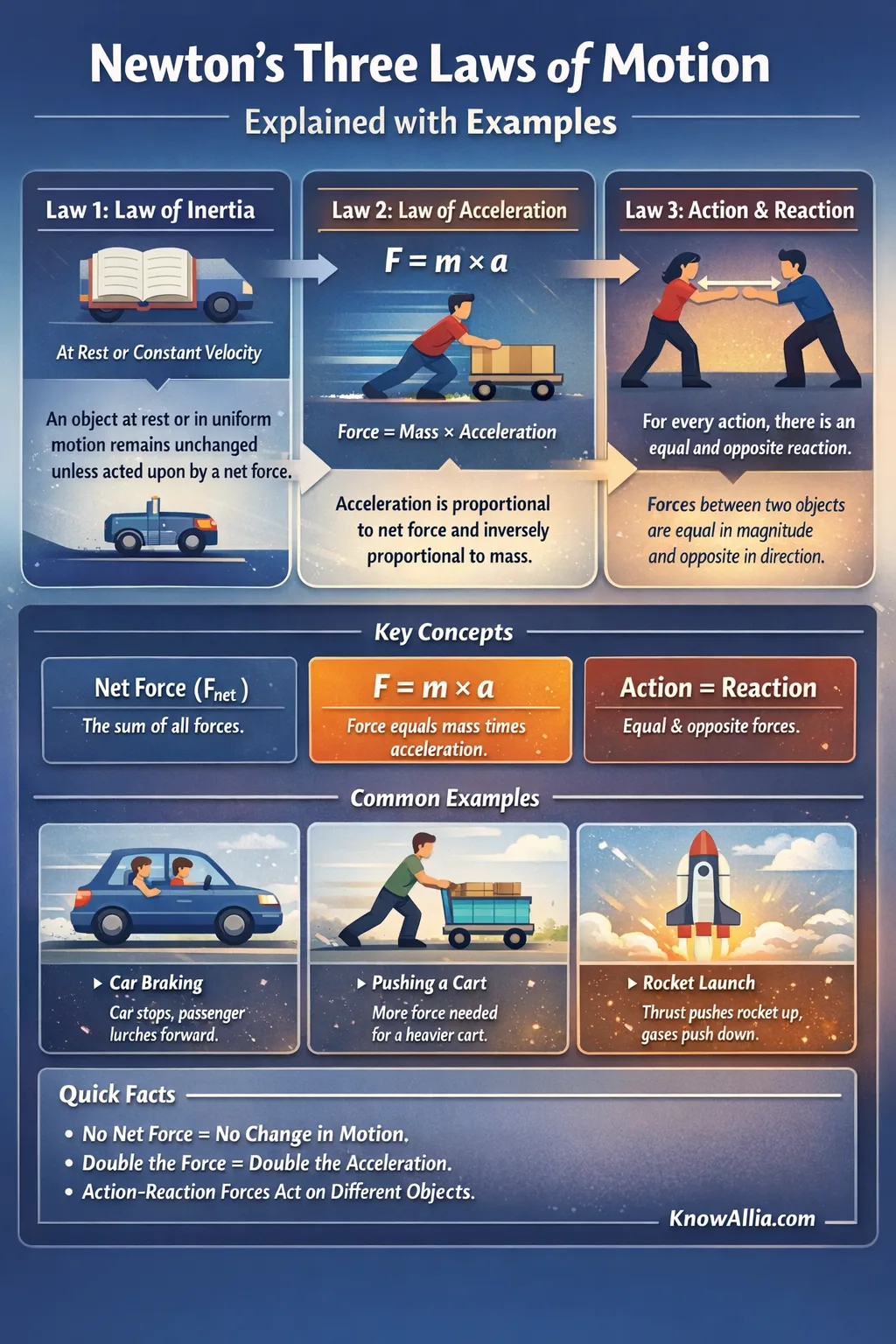
Newton’s three laws of motion are three simple rules that connect forces to how objects move: (1) motion doesn’t change unless there is a net force, (2) net force sets the object’s acceleration, and (3) forces always come in equal-and-opposite pairs between interacting objects.[a]↗
A Clear Mental Picture
These laws don’t replace common sense; they sharpen it. They explain why a smooth-gliding object keeps going, why a heavier object needs more force for the same acceleration, and why you can move forward only by pushing something else backward.
- Law 1: No net force → no change in velocity.
- Law 2: Net force → acceleration (direction matters).
- Law 3: Interactions → equal and opposite forces on different objects.
What you’ll learn here: how each law really works, how to spot the net force in a messy real situation, how to avoid the most common traps (especially with action–reaction), and how people actually use the laws to solve motion problems without guesswork.
What Newton’s Three Laws Say
The three laws describe motion in everyday conditions: objects keep their current motion unless something pushes or pulls on them, the amount of acceleration depends on how big that push is and how massive the object is, and every push is part of a two-way interaction.[c]↗
Law 1: Inertia
If the net force is zero, velocity stays constant (including staying at rest). The key phrase is “net force”, not “no forces at all.”
Law 2: Dynamics
Acceleration points in the direction of the net force, and its size scales like F/m. Double the net force and you double the acceleration.
Law 3: Interaction Pairs
For every force on one object, there’s an equal and opposite force on the other object involved in that interaction.
First Law: Inertia and Inertial Frames
Inertia is an object’s tendency to keep doing what it’s already doing: staying still or moving in a straight line at constant speed. If velocity changes (speeding up, slowing down, or turning), then the net force is not zero—even if the object “looks steady” at first glance.[a]↗
Everyday Examples That Make the First Law Feel Real
- Riding in a car: when the car brakes, your body tends to keep moving forward. The seat belt provides the force that changes your motion.
- A puck on smooth ice: with little friction, it keeps gliding for a long time because there’s very little net force slowing it down.
- A book on a table: it’s not “force-free.” Gravity pulls down, the table pushes up, and the forces balance to a net force of zero.
What “No Net Force” Actually Means
Forces are vectors, so direction matters. “Net force” is the vector sum of all forces on the object. A good analogy is adding arrows on a map: each arrow is a force, and the single resulting arrow tells you what acceleration to expect. If the arrows cancel out, the result is zero and velocity doesn’t change.
Two kinds of balance exist: static equilibrium (at rest) and dynamic equilibrium (moving at constant velocity). In both cases, net force is zero, even though multiple forces may be acting.[b]↗
Second Law: Force, Mass, and Acceleration
Newton’s second law is the “engine” of classical mechanics: net force causes acceleration. In its most familiar form, it’s written as F = m·a, meaning the net force on an object equals its mass times its acceleration. The same force produces less acceleration when mass is larger, and more acceleration when mass is smaller.
The SI Unit Behind the Equation
In the International System of Units (SI), force is measured in newtons (symbol N). One newton is the force needed to accelerate a 1 kg mass by 1 m/s².[d]↗
| Quantity | Symbol | SI Unit | Plain Meaning |
|---|---|---|---|
| Net Force | Fnet | N | The vector sum of all forces on the object. |
| Mass | m | kg | How strongly the object resists acceleration (inertia). |
| Acceleration | a | m/s² | How fast velocity changes (speed or direction). |
| Weight (Gravity Force) | W | N | The gravitational force on an object: often written as W = m·g. |
| Normal Force | Nnormal | N | The support force from a surface, usually perpendicular to it. |
| Friction | f | N | A contact force that resists sliding (or attempted sliding) at a surface. |
Worked Example: A Cart on a Smooth Floor
Imagine a 10 kg cart. You push it with a steady horizontal force of 20 N, and we ignore friction for the moment. The net force is 20 N, so the acceleration is a = F/m = 20/10 = 2 m/s². If you push the same cart with 40 N, the acceleration doubles. If you push a 20 kg cart with 20 N, the acceleration halves.
Small detail that matters: F = m·a is a clean everyday form when mass is constant and we’re using an inertial frame. In cases like changing-mass systems, people often use momentum form to stay precise.[f]↗
Third Law: Action–Reaction Pairs
The third law is easy to say and easy to misread. It does not mean forces “cancel out” on one object. It means that whenever two objects interact, each pushes/pulls on the other with equal strength in opposite directions—always at the same time.
Examples You Can Feel
- Walking: your foot pushes the ground backward; the ground pushes you forward.
- Swimming: your hands push water backward; water pushes you forward.
- Balloon “rocket”: air is pushed backward out of the balloon; the balloon is pushed forward.
How to Spot the Pair Without Guessing
- First, name the interaction (contact, tension, gravity, etc.).
- Then, name the two objects involved in that interaction.
- The pair is “force on A by B” and “force on B by A.” Same type of force, opposite directions.
One place this clears up confusion fast is gravity: Earth pulls you down, and you pull Earth up with the same force. Both are real; the difference is that Earth’s mass is so large that its acceleration is tiny.
Newton’s Laws, Visualized as One Flow
A compact map of how forces translate into motion. Read left to right: stability (Law 1), change (Law 2), and interaction pairs (Law 3).
From Forces to Motion
Law 1 Net force = 0 Velocity stays constant Examples: resting book, steady cruise Law 2 Fnet = m · a Acceleration follows net force mass m net force accelerationExamples: cart push, turning motion, lifts Law 3 Forces come in pairs Equal magnitude, opposite directionA on B B on AExamples: walking, swimming, balloon thrustWhat to Remember
Single forces don’t decide motion; the vector sum does. Balanced forces can still exist while moving.
Same push, different mass → different acceleration. That’s why light objects feel “easier” to speed up.
Action–reaction forces act on different objects. They cancel only if you treat both objects as one system.
Units That Keep You Honest
Force in newtons (N), mass in kilograms (kg), acceleration in m/s². Staying consistent prevents “invisible” errors.[e]↗
Common Real-World Forces
Weight, normal force, friction, tension, and drag. Most problems are just these forces arranged in new ways.
A Frequent Mix-Up
“If I’m moving, there must be a force forward.” Not necessarily. With net force near zero, motion can continue without speeding up or slowing down.
Common Misconceptions and Confusion
Common Mix-Up “If an object is moving, a force in the direction of motion must be acting.”
What’s True A force is needed to change velocity. Motion at constant velocity can happen when the net force is zero (often because forward push balances friction or drag).
Common Mix-Up “Action and reaction cancel, so nothing moves.”
What’s True The pair acts on different objects. They don’t cancel on one object’s free-body diagram; they show up on two different diagrams.
Common Mix-Up “Weight and mass are the same thing.”
What’s True Mass measures inertia. Weight is a force caused by gravity. Same mass, different weight if gravity changes.
Key Terms, in Plain English
- Net Force
- The combined effect of all forces on an object after adding them as vectors (including direction).
- Inertia
- The tendency of mass to resist changes in motion; bigger mass usually means stronger inertia.
- Inertial Frame
- A viewpoint where objects with no net force move at constant velocity (no “extra” forces are needed to explain motion).
- Free-Body Diagram
- A simple sketch of one object with arrows showing all forces acting on it. It’s the cleanest way to avoid missing forces.
- Normal Force
- The support force from a surface. It is not automatically equal to weight; it depends on the situation.
- Action–Reaction Pair
- Two forces from one interaction: “A on B” and “B on A,” equal in size and opposite in direction.
How Physicists Apply the Laws in Real Problems
The laws feel most powerful when you apply them the same way every time. Not as a “trick,” but as a clean way to turn a situation into something you can reason about without hand-waving.
1) Choose the Object (or System)
Pick exactly what you’re analyzing. A single object is simplest. A system (two objects together) is useful when you want internal forces to cancel and focus on external forces only.
2) List the Forces That Actually Act
Weight, normal force, friction, tension, and any applied pushes/pulls are the usual suspects. Then decide which ones are negligible and say why, instead of silently ignoring them.
3) Add Forces as Vectors, Then Compare to Motion
- If velocity is constant, you’re looking for Fnet = 0.
- If the object speeds up, slows down, or turns, you’re looking for Fnet ≠ 0.
- Use Fnet = m·a to connect the forces to the acceleration you observe or want to find.
When this feels abstract, imagine each force as a “vote” for a direction. The net force is the final tally after you combine votes with signs and angles. Acceleration follows the tally, not any single vote.
A practical sanity check: if you end up with a net force pointing right but your computed acceleration points left, something is flipped—usually a sign, a direction, or a missing force.
Where Newton’s Laws Work Well—and Where They Don’t
Newton’s laws are incredibly accurate for most daily life and most engineering-scale motion. They are the backbone of classical mechanics, especially when speeds are far below the speed of light and objects are much larger than atomic scales.[f]↗
Good Fit
- Cars, bicycles, elevators, sports motion, and most machines.
- Structures and loads where forces and accelerations are within everyday ranges.
- Many simulations where friction and drag can be modeled with reasonable approximations.
Situations That Need Extra Care
- Non-inertial viewpoints: if you analyze motion from a rapidly accelerating or rotating frame, you may introduce additional “apparent” forces to keep the equations consistent.
- Extreme regimes: very high speeds or very small scales can call for frameworks beyond everyday Newtonian assumptions.
- Messy real materials: friction coefficients, drag forces, and contact forces can vary, so exact numbers are sometimes uncertain even when the laws are clear.
Limitations / What We Don’t Know in Real Life
Even when Newton’s laws apply, we don’t always know every force precisely. Real surfaces have changing friction, air resistance depends on shape and speed, and contact forces can shift as things flex. In practice, people measure, estimate, and refine models—while keeping the laws as the stable foundation under the estimates.
Sources
These links are chosen for reliability: official institutions, universities, standards bodies, and long-standing reference works.
- University of Puerto Rico at Mayagüez (OpenStax Reprint) – Newton’s Laws of Motion (Chapter PDF) (Core definitions and examples used in the first-law framing) [a]↩
- MIT OpenCourseWare – Classical Mechanics (Online Textbook Index) (Problem setup habits, force diagrams, and Newton-law applications) [b]↩
- University of Glasgow (Archives & Special Collections) – Sir Isaac Newton: Principia (Publication context and historical notes) [c]↩
- Encyclopaedia Britannica – Newton (Unit of Measurement) (Definition of the newton as an SI force unit) [d]↩
- NIST – SI Units (SI structure: base and derived units, usage context) [e]↩
- NIST – The International System of Units (SI), 2019 Edition (SP 330 PDF) (Definitions and discussion of SI coherence and derived units) [f]↩
- BIPM – SI Brochure (The International System of Units) (International standards background for SI and unit relationships) [g]↩
FAQ
Do Newton’s laws say motion needs a force?
No. A force is needed to change motion (change velocity). If net force is zero, an object can keep moving at constant velocity.
If action–reaction forces are equal, why can anything accelerate?
Because the forces act on different objects. An object accelerates when the forces on that same object don’t balance.
Is F = m·a always correct?
It’s the standard everyday form when mass is constant and you’re using an inertial frame. In more specialized cases, people may use momentum form to stay precise.
What’s the difference between mass and weight?
Mass is inertia (how hard it is to accelerate an object). Weight is a gravitational force on that mass, measured in newtons.
Why can a book rest on a table if gravity pulls it down?
The table pushes up with a normal force. When that upward force balances weight, the net force is zero and the book stays at rest.
Do Newton’s laws work in space?
Yes, very well for a wide range of spaceflight and orbital calculations, as long as the situation stays in the “classical” regime where Newton’s assumptions hold.