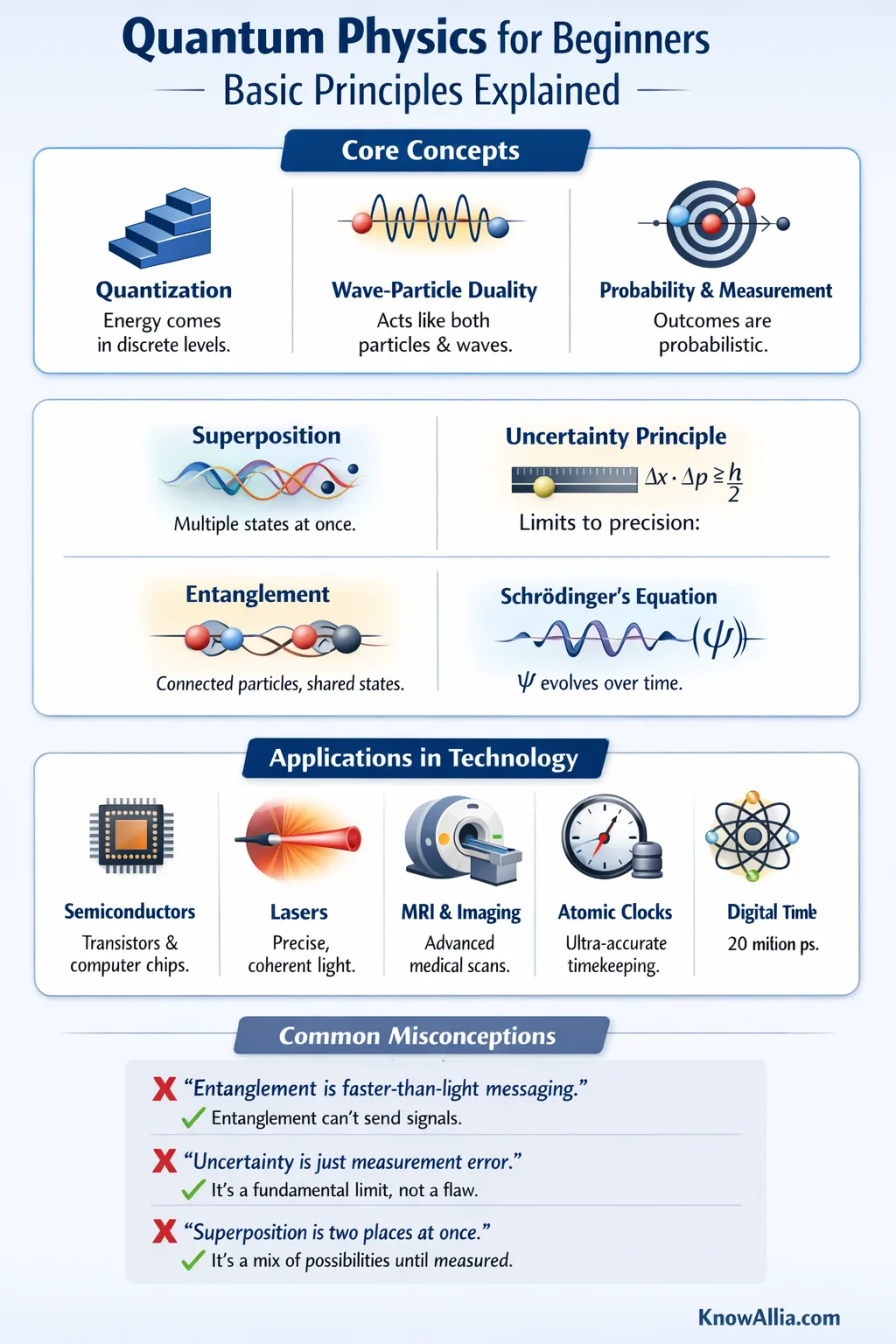
Quantum physics is the science of how nature behaves at the smallest scales—atoms, electrons, light, and the fundamental particles beneath everyday materials. It replaces the classical idea of a world made of tiny billiard balls with a world described by probabilities, waves, and discrete (quantized) chunks.
A Clear Starting Point
Quantum ideas can feel strange because they don’t match how large objects behave. But the core message is simple: at tiny scales, nature runs on rules that are statistical, and some quantities come in fixed steps rather than smooth sliders.
Here are the three pillars you’ll see again and again:
- Quantization: certain energies and properties appear in discrete amounts.
- Wave-like behavior: particles can behave like waves, with interference.
- Measurement outcomes: results are predictable as probabilities, not certainties.
By the time you finish, you’ll be able to explain superposition, uncertainty, entanglement, and the wavefunction in plain language—and you’ll know where quantum physics shows up in real technology without turning it into mysticism.
- Probability
- Quantization
- Wavefunction
- Superposition
- Uncertainty
- Entanglement
- Measurement
What Quantum Physics Is
Quantum physics (often called quantum mechanics) is the theory used to describe how matter and light behave when the details are small enough that classical “common sense” stops being reliable. In that regime, you don’t track an object with a single, exact path the way you would track a thrown ball. Instead, you track what’s possible and how likely each possibility is.
It’s not “magic,” and it’s not “anything can happen.” Quantum physics is strict about what can happen, but it speaks in the language of probabilities. That’s why many quantum predictions are incredibly precise when you repeat experiments many times—even if single events can look random.
Where It Applies
- Atoms and molecules: chemical bonds, spectra, and stability.
- Electrons in solids: why materials can be conductors, semiconductors, or insulators.
- Light as photons: detectors, lasers, and photoelectric effects.
- Very cold or very small systems: where quantum behavior becomes easier to observe directly.
Many modern introductions start from experiments—photoelectric effect, electron diffraction, and atomic structure—because the story of quantum physics is built on measurements that refused to fit classical explanations.[d]↗
Core Principles That Make Quantum Different
Quantization: Nature Has “Steps”
In everyday life, you can usually change things smoothly: turn a dial a tiny bit and the volume changes a tiny bit. In quantum physics, some quantities come in discrete packets. This idea is tied to the Planck constant, which is a defining constant of the modern SI system: its numerical value is fixed as exactly 6.62607015 × 10⁻³⁴ J·s.[a]↗[b]↗
A classic example is the energy of light: the energy of a photon is proportional to its frequency (often written as E = h·f). That “h” is the Planck constant, and it sets the scale of quantum effects in a very practical way.[c]↗
Wave-Particle Duality: One World, Two Descriptions
Quantum objects can behave like particles in one setup and like waves in another. That doesn’t mean they “switch personalities” on a whim. It means the same thing can reveal different properties depending on how you measure it. This is the heart of wave-particle duality.[e]↗
Here’s a useful analogy (just one, and only as far as it goes): think of a song. You can describe it as a waveform (how the sound pressure varies) or as a set of notes and rhythms (discrete musical events). It’s the same music—two viewpoints. In quantum physics, the math supports both viewpoints, but you don’t always get to use both at once in a single measurement.
The Wavefunction: A Map of Possibilities
The wavefunction (usually written as ψ) is the central object in quantum mechanics. It’s not a physical wave like a water wave. It’s a mathematical description that lets you compute the probabilities of different outcomes. A widely taught rule is that probabilities relate to the square of the wavefunction’s amplitude.[g]↗
The wavefunction changes over time according to the Schrödinger equation. In plain terms, that equation is a wave-like rule that tells you how the probability pattern evolves when forces and energies are present.[f]↗
Superposition: Adding Possibilities Together
Superposition means a quantum system can be described as a combination of multiple possible states at once—until a measurement asks a yes/no question and produces one outcome. This is not the same thing as “two classical realities happening simultaneously.” It’s closer to saying the system carries a structured set of possibilities that can interfere with each other, the way waves interfere.
Small but important detail: superposition is about the state description, not about an everyday object “literally being everywhere.” When many particles interact with the environment, superpositions typically become extremely hard to maintain in a visible way.
Measurement: Outcomes Are Real, Predictions Are Statistical
Quantum mechanics is unusually direct about measurement: it doesn’t promise a single, definite outcome for each run of an experiment. It promises a distribution of outcomes, and it tells you how to calculate that distribution.
One clean way to talk about measurement (without loading it with drama) is to separate three layers:
- Preparation: you set up a system in a known way (a source, a filter, a pulse, a trap).
- Evolution: the wavefunction changes predictably via the Schrödinger equation.
- Readout: the apparatus returns a concrete outcome, and repeated trials match the predicted probabilities.
Uncertainty: Built-In Limits to Joint Precision
The uncertainty principle is not about sloppy instruments. It’s a statement about how quantum states work: certain pairs of properties (like position and momentum) can’t both be pinned down with unlimited precision at the same time—even in principle.[h]↗
This matters because it changes how you think about “having” a value. In quantum physics, a system can have a state that makes one quantity sharply defined while making a related quantity more spread out. It’s less like a hidden answer you haven’t looked up yet, and more like the system doesn’t contain both answers in the classical sense.
Entanglement: Correlations That Don’t Split Cleanly
Entanglement means the state of a combined system can’t be fully described as “this part has its own independent state and that part has its own independent state.” Instead, the system is best described as one whole, even if its parts are far apart. These correlations are real and testable, and they play a major role in quantum information science.
A key boundary keeps this from turning into science fiction: entanglement does not let you send messages faster than light. You can see correlations when results are compared, but you can’t use entanglement alone as an instant communication channel.[i]↗
If you want a concrete example of how entanglement shows up in real analysis, Bell-type inequalities are a standard way to discuss and test these correlations in a classroom setting.[j]↗
Quantum Physics, Mapped in One View
A compact picture of the ideas you’ll meet most often: what gets quantized, what behaves like a wave, how probabilities enter, and why some correlations feel “non-classical” without breaking relativity.
How The Ideas Connect
What To Remember
Quantum theory is built to predict outcome distributions. Single trials can look random, repeated trials become reliably patterned.
When alternatives combine like waves, you see cancellations and reinforcements—one of the clearest “quantum fingerprints.”
Entanglement links results, but doesn’t create an instant communication channel. Relativity stays intact.
Quantization In One Line
Some physical quantities come in discrete units, with the Planck constant setting the scale.
Wavefunction In One Line
A compact object that lets you compute probabilities for measurement outcomes.
Measurement In One Line
Experiments return definite outcomes; the theory tells you how likely each outcome is.
Key Experiments That Anchor The Ideas
Quantum physics didn’t appear because scientists wanted a weird theory. It appeared because certain experiments kept giving the same stubborn results, and classical physics couldn’t match them. Courses often start with these foundations before moving to the full theory.[d]↗
Three Core Patterns
- Quantized energy exchange: light and matter trade energy in discrete chunks.
- Interference with single particles: repeated trials build wave-like patterns.
- Stable atomic structure: electrons in atoms behave in ways that demand wave-based descriptions.
Wave-particle duality is often introduced using interference as the “tell.” When you set up experiments that allow alternatives to combine, the results follow wave rules even if detections arrive as single clicks or spots.[e]↗
Then the Schrödinger equation comes in as the simplest general rule that evolves these probability waves over time—and it succeeds spectacularly at describing many atomic and molecular features.[f]↗
Everyday Tech Powered by Quantum Rules
You don’t need a quantum computer on your desk to benefit from quantum physics. If you’re reading this on a modern screen, you’re already surrounded by technology that depends on quantized energy levels and electron behavior in solids.
Semiconductors
Band structures and quantized electron states explain why some materials conduct well, others don’t, and some can be tuned. That’s the backbone of transistors and integrated circuits.
Lasers
Lasers rely on discrete energy levels and controlled emission of light. The “laser-like” part is not just brightness—it’s the tight coordination of photons.
Imaging and Sensing
Many detectors and sensors work because electrons absorb and release energy in quantized ways. That same idea supports a wide range of spectroscopy tools.
Time and Standards
Precise timekeeping is tied to very stable atomic transitions. Modern measurement systems lean on fixed constants and reproducible quantum behavior.
A Practical Map of The Main Ideas
| Concept | Plain Meaning | Typical Example | Why It Matters |
|---|---|---|---|
| Quantization | Some values come in discrete steps. | Photon energy depends on frequency. | Explains atomic stability and spectral lines. |
| Wavefunction | A mathematical object that predicts probabilities. | Probability density relates to |ψ|². | Connects theory to measurements. |
| Superposition | States can combine and interfere. | Interference patterns built from many detections. | Gives “wave-like” signatures in particle experiments. |
| Uncertainty | Limits to jointly sharp values (e.g., position & momentum). | Narrower position spread implies wider momentum spread. | Shapes what can be simultaneously known or prepared. |
| Entanglement | Parts of a system share a joint state. | Correlated outcomes across separated measurements. | Central to quantum information and non-classical correlations. |
Common Misconceptions and Confusions
Quantum physics attracts bold headlines, so it’s worth clearing a few common knots. The goal here isn’t to “police language,” but to keep the ideas accurate and useful.
Misconceptions You’ll Hear a Lot
- Wrong “Entanglement is instant messaging.” Right It creates correlations, but it can’t be used to send faster-than-light messages.[i]↗
- Wrong “Uncertainty is just measurement error.” Right It’s a built-in limit to joint precision, even in theory.[h]↗
- Wrong “Superposition means two classical realities at once.” Right It’s a state description that can produce interference, not a promise of classical duplication.
- Wrong “The wavefunction is a physical wave in space.” Right It’s a tool that outputs probabilities, tied to measurement results.[g]↗
Key Terms Mini-Glossary
If you only memorize a handful of words, make them these. They’re the vocabulary that makes most beginner explanations click.
- Planck Constant (h)
- A fundamental constant that sets the scale of quantization; in the SI system its numerical value is fixed exactly.[a]↗
- Photon
- A quantized “packet” of electromagnetic energy, with energy proportional to frequency.[c]↗
- Wavefunction (ψ)
- A mathematical description used to compute probabilities of measurement outcomes; probability is linked to the squared amplitude.[g]↗
- Superposition
- A combination of possible states that can interfere, producing patterns that classical “either/or” logic can’t reproduce.
- Uncertainty Principle
- A limit to how sharply certain paired properties can be jointly specified or measured.[h]↗
- Entanglement
- A joint quantum state where parts don’t have fully independent descriptions; correlations appear when results are compared.[i]↗
Limits and What We Still Don’t Know
Quantum mechanics is one of the most tested and successful scientific theories ever developed. Still, there are places where our understanding is incomplete—not because the theory is “broken,” but because nature is bigger than any single model.
Interpretations differ. The mathematics reliably predicts outcomes, but people still debate what the wavefunction “is” (a description of knowledge, a physical object, something else). These debates can be interesting, but they usually don’t change the calculations you use for experiments.
- Quantum + gravity: there is no single, universally accepted theory that merges quantum mechanics with gravity in all regimes (this is an active research area).
- Complex many-body systems: even when the rules are known, predicting exact behavior for huge interacting systems can be extremely hard in practice.
- Measurement details: the “how” of measurement—especially in complex environments—is still a deep topic, often discussed using ideas like decoherence.
This kind of honesty matters: it keeps quantum physics grounded and prevents real gaps in knowledge from getting filled with confident-sounding stories.
FAQ
Common Questions Beginners Ask
Is quantum physics only about tiny particles?
It’s most visible at small scales, but the rules are general. Large objects usually look classical because interactions with the environment wash out delicate quantum interference effects.
Does superposition mean something is literally in two places?
Superposition is a state description that can lead to interference. Some experiments look like “two paths at once” in the math, but the safest beginner framing is: it’s a structured set of possibilities until measurement produces an outcome.
Can entanglement send instant messages?
No. Entanglement produces correlations that show up when results are compared, but it doesn’t let you choose a result to encode a message. That’s why it doesn’t enable faster-than-light communication.[i]↗
What is the wavefunction, in plain language?
It’s a mathematical object used to calculate the probability of different measurement outcomes. A common rule relates probabilities to the squared amplitude of the wavefunction.[g]↗
Why does the uncertainty principle matter?
It tells you there are built-in limits to jointly sharp values for certain pairs (like position and momentum). This changes how you think about what it means for a system to “have” a precise value.[h]↗
Do I need advanced math to start learning?
You can learn the concepts and the experimental logic without advanced math. To do real calculations, you’ll eventually want algebra, some calculus, and comfort with complex numbers—but the ideas can come first.
Sources
These sources are chosen for reliability: international standards bodies, government science references, major universities, and established reference works. Each external link is listed once.
- BIPM – SI Defining Constants (Exact defining values, including the Planck constant). [a]
- NIST – CODATA Value: Planck Constant (Reference presentation of the Planck constant value and notation). [b]
- Encyclopaedia Britannica – Planck’s Constant (Accessible explanation and the E = h·f relationship context). [c]
- MIT OpenCourseWare – Quantum Physics I (Course Home) (Typical experimental foundations and course-level framing). [d]
- Encyclopaedia Britannica – Wave-Particle Duality (Definition and context for dual descriptions). [e]
- Encyclopaedia Britannica – Schrödinger Equation (Clear overview of its meaning and significance). [f]
- MIT OpenCourseWare – Lecture: Schrödinger Equation (PDF) (Wavefunction framing and probability via squared amplitude). [g]
- Encyclopaedia Britannica – Uncertainty Principle (Plain-language statement of the principle). [h]
- Caltech Science Exchange – Entanglement (Clear explanation and why it doesn’t enable faster-than-light communication). [i]
- MIT OpenCourseWare – Lecture Notes: Bell’s Inequality and Quantum Entanglement (An educational treatment linking entanglement and Bell-type reasoning). [j]