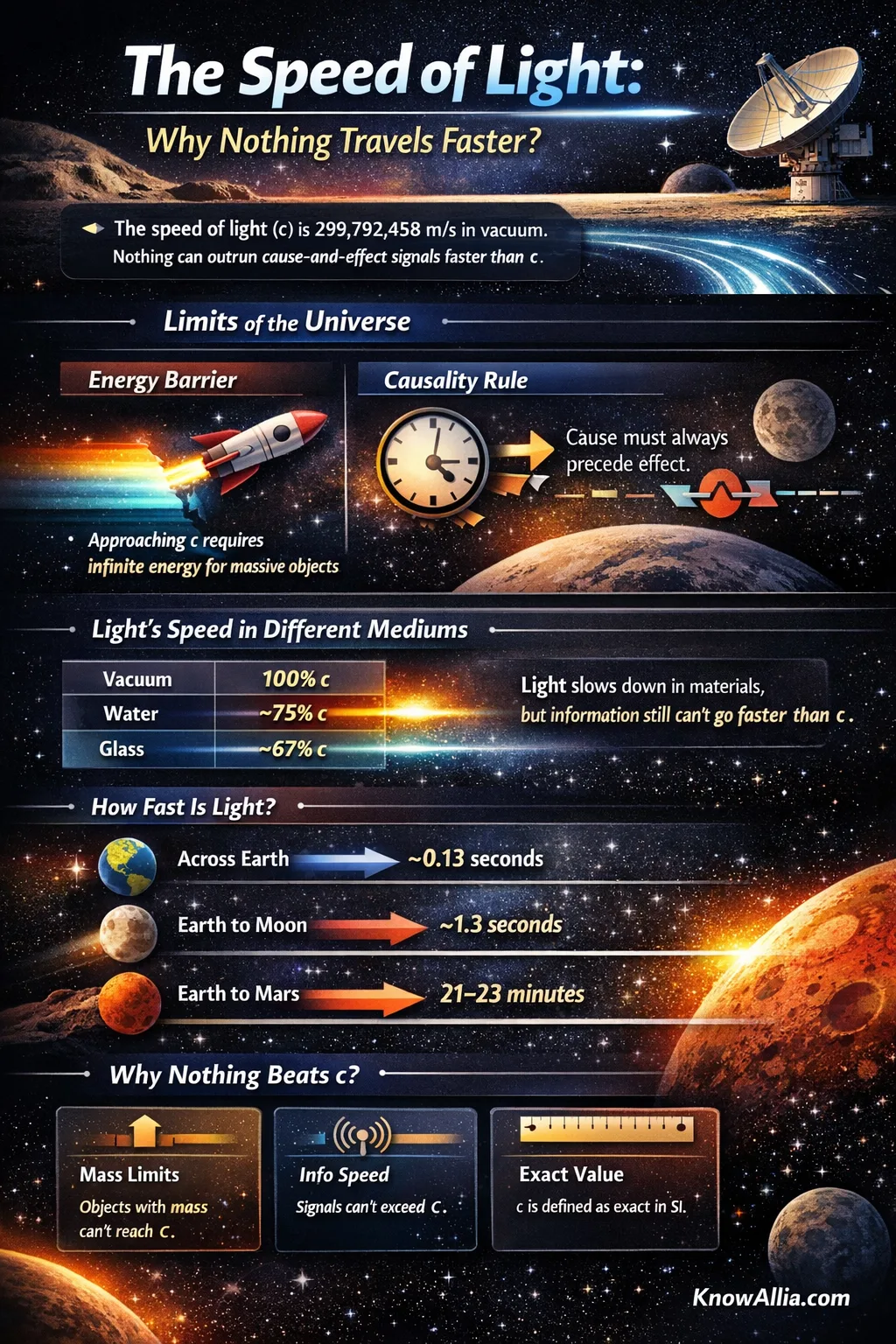
The speed of light (usually written as c) is the maximum speed at which information, energy, and physical influence can travel through empty space. In modern SI units, it is defined to be exactly 299,792,458 meters per second in a vacuum[a]↗[b]↗.
A Clear Starting Point
Light feels “instant” at human distances, but physics treats it as a real speed with real consequences. The important part is that c is not just about light; it’s the universe’s built-in limit for cause-and-effect. When you see “nothing goes faster,” that’s what it means in practice.
This article explains the real meaning of c, why it acts like a hard limit, what people often misunderstand (especially about “superluminal” headlines), and how it appears in everyday technology such as fiber optics and space communication delays.
What “Speed of Light” Really Means
When people say “the speed of light,” they usually mean the speed of electromagnetic radiation in a vacuum. The key detail is that c behaves like a universal conversion rate between space and time in special relativity, and every inertial observer measures the same value in vacuum[d]↗.
Vacuum: The Baseline
In a vacuum, light travels at c. That’s the reference case used in physics and in SI definitions. It’s also why you’ll often see c described as the “cosmic speed limit.”
Materials: Light Can Slow Down
In materials like water or glass, light interacts with matter and the wave’s effective travel speed changes. This is usually described with the refractive index, where the speed in a material is roughly v = c / n[h]↗.
Important nuance: “Nothing travels faster than light” is shorthand. The more precise statement is that nothing can send a cause-and-effect signal faster than c through empty space.
Why Nothing Travels Faster Than c
Physics doesn’t treat the speed limit as a mere engineering problem. It shows up in the structure of special relativity itself: how different observers relate measurements of time, distance, and energy. Two ideas do most of the heavy lifting: the energy wall and causality.
The Energy Wall as You Approach c
As an object with mass accelerates closer to c, adding the same “amount of push” gives you less and less extra speed. The required energy keeps climbing without a finite cap, which is why reaching exactly c isn’t possible for massive objects in special relativity[c]↗.
- You can keep accelerating, but speed gains shrink.
- Energy demands grow extremely fast near c[c]↗.
- For massless particles (like photons), c is the natural travel speed in vacuum.
Causality: Keeping Cause Before Effect
Relativity also protects a basic expectation of the universe: causes come before effects. If “information” could outrun c, different observers could disagree on the order of events in ways that break cause-and-effect reasoning. This is why the limit is often described as a speed of information, not just a speed of photons.
Here’s a helpful analogy: c is like a universal bandwidth cap on reality’s “update rate.” You can move objects around, you can transmit signals, you can build faster electronics—but the rule is that the world won’t let a real influence propagate faster than that cap.
When Light Is Slower Than c (And Why That Doesn’t Break Anything)
Light travels at c only in a vacuum. In materials, the story splits into a few different “speeds,” and mixing them up is one of the biggest sources of confusion online. The main idea: some measured wave speeds can look superluminal, but that does not mean usable information outran c[f]↗.
| Setting | Typical Refractive Index (n) | Approx. Speed as a Fraction of c | Approx. Speed (km/s) |
|---|---|---|---|
| Vacuum | 1.000 | 1.00c | 299,792 |
| Air (near sea level) | ~1.0003 | ~0.9997c | ~299,700 |
| Water | ~1.33 | ~0.75c | ~225,000 |
| Common Glass | ~1.5 | ~0.67c | ~200,000 |
| Optical Fiber (silica, typical) | ~1.44–1.47 | ~0.68–0.69c | ~204,000–208,000 |
Refractive Index, Simply
The refractive index is a practical way to say “how much slower” the wave travels in a medium. In many intro treatments you’ll see n = c / v, meaning the wave speed in the material is v = c / n[h]↗.
Phase vs Group vs Signal Speed
In dispersive materials, a wave’s pattern (phase) and a pulse’s envelope (group) can move differently. Under special conditions, a measured group velocity can exceed c, yet the speed that matters for new information stays limited[f]↗.
The Speed Limit Built Into the Universe
c is defined as 299,792,458 m/s in vacuum. In materials, light can slow down, but the limit still governs how fast new information can propagate.
Signal Travel Time by Distance (One Way)
Short distances feel instant; space distances do not.Across Earth (~40,000 km) ~0.13 sEarth ↔ Low Orbit (typical satellite ranges) millisecondsEarth → Moon ~1.3 sEarth → Mars (worst-case crew comms delay) 21–23 min Vacuum baseline (c) Materials slow light, but do not raise the limitThree Facts That Prevent “Faster Than c”
For objects with mass, getting closer to c becomes harder and harder; the required energy does not stay finite[c]↗.
Even if a wave feature appears superluminal, the arrival of genuinely new information remains limited[f]↗.
In SI, c is exact because the meter is defined by how far light travels in a specified fraction of a second[a]↗.
Exact Value (Vacuum)
299,792,458 m/s (defined in SI; not “approximately” in that unit system)[b]↗.
Why Fiber Has Latency
Light in glass typically travels around two-thirds of c because of refractive index effects[h]↗.
Why Space Feels “Laggy”
At Mars distances, one-way delays can reach 21–23 minutes for certain mission profiles[g]↗.
The Exact Value and Why SI Treats It as Defined
One of the most skipped details on the web is that we don’t “measure c” in SI the way we used to. Since 1983, the meter has been defined using a fixed value of c, which makes the speed of light in vacuum exact by definition[e]↗[a]↗.
So What Do Labs Measure Today?
Modern metrology focuses on realizing the meter: building methods that turn the definition into practical length measurements. In other words, improved techniques don’t change the number for c; they improve how precisely we can create and compare lengths based on that definition[e]↗.
If you’re used to thinking “constants are measured,” this feels backwards at first. But it’s a clever move: by defining a unit using something reproducible and universal, measurements become more stable across labs and decades.
What Changes When You Get Close to Light Speed
At everyday speeds, Newton’s rules work extremely well. Near c, special relativity becomes impossible to ignore. The changes are not “visual tricks”; they’re baked into how time and space are measured when motion is extreme[d]↗.
- Time dilation
- Moving clocks tick slower compared to clocks at rest (from the perspective of a different inertial frame).
- Length contraction
- Distances along the direction of motion appear shorter to an observer for whom the object is moving.
- Energy–speed behavior
- As speed approaches c, extra energy yields diminishing speed gains; reaching c for massive objects is not possible under relativity[c]↗.
There’s a practical takeaway: engineers and physicists often talk about fractions of c because the last tiny slice toward 1.00c is the most expensive part in energy terms.
Where This Speed Limit Shows Up in Real Life
The speed of light is so large that it rarely limits day-to-day motion, but it absolutely limits communication, timing, and long-distance systems. This is why “latency” is a physics issue before it’s a networking issue.
Fiber-Optic Internet and Latency
Even with perfect hardware, data cannot arrive instantly. In optical fiber, signals are limited by both distance and the fact that light propagates slower in glass than in vacuum. The refractive-index relationship (v = c / n) is the core reason latency stacks up over long routes[h]↗.
- Precise timing (navigation, ranging, synchronization) depends on knowing how far signals can travel in a given time.
- Large systems (satellites, undersea cables, distributed computing) are designed around unavoidable signal travel time.
- Measurements in physics labs often use light travel time as a ruler, because it’s stable and well-defined in SI[a]↗.
Common Confusions and Misconceptions
This topic attracts catchy one-liners. The truth is more interesting, and it’s also more precise. Here are common mix-ups that lead people astray without anyone intending it.
Better A cleaner way to say it is: the energy requirement grows without a finite ceiling as speed approaches c, which prevents massive objects from reaching c under relativity[c]↗. (You’ll still see “relativistic mass” in older explanations, but modern treatments often avoid that phrasing.)
Better Certain measured velocities in wave physics can exceed c under specific conditions, but that does not automatically mean a usable message outran c. The information-carrying front remains constrained in standard treatments[f]↗.
Key Terms (Mini Glossary)
- c
- The speed of light in vacuum, used as a universal constant in relativity. In SI, it is defined as exactly 299,792,458 m/s[b]↗.
- Vacuum
- A region treated as empty space (no matter). Vacuum is the reference case where light travels at c.
- Refractive Index (n)
- A number that compares the speed of light in vacuum to its speed in a material; often introduced with n = c / v[h]↗.
- Phase Velocity
- The speed of a wave’s repeating pattern (crests/troughs). It can differ from the speed of a pulse.
- Group Velocity
- The speed of a wave packet’s envelope. Under some setups, it can exceed c without implying faster-than-c messaging in the usual sense[f]↗.
- Signal / Information Speed
- The speed at which genuinely new information can be transmitted; this is the part the “speed limit” is meant to protect.
- SI Meter Definition
- The meter is defined using the distance light travels in vacuum in a specified fraction of a second, tying length standards to c[a]↗.
What We Know for Sure (And What We Still Don’t)
Well-Supported, High-Confidence Points
- In special relativity, inertial observers agree on the vacuum value of c as a constant of nature[d]↗.
- In SI, c is exact because it is part of how the meter is defined[a]↗[e]↗.
- For massive objects, approaching c requires rapidly increasing energy; reaching c is not possible under special relativity[c]↗.
- Apparent “superluminal” wave behaviors can occur in controlled conditions, while information transfer remains constrained in standard treatments[f]↗.
Limitations: What We Don’t Fully Know Yet
Physics can describe how the speed limit works with impressive accuracy, but it’s fair to say we do not have a single, universally accepted “because of X” story for why nature chooses this structure at the deepest level. Today’s best-tested theories take c as a foundational feature, then build consistent, predictive rules around it[d]↗. If future physics changes the foundations, it would have to reproduce the existing results extremely well where we’ve already tested them.
FAQ
Is the speed of light the same as “the speed of information”?
In everyday language people treat them as the same. More carefully: c is the limit for causal influence in vacuum. In materials, light can slow down, and some measured wave features can look faster than c, but that does not automatically mean new information outran c.
Why is c an exact number in SI?
Does light slow down in glass or water?
Yes. The propagation speed in a material is commonly related to refractive index with v = c / n[h]↗. The details can depend on wavelength and the material’s properties.
If nothing can go faster than light, how can “superluminal” group velocity happen?
Wave physics can produce situations where the envelope of a pulse (group velocity) exceeds c, or even appears negative. Standard discussions emphasize that this does not mean a real message carrying new information has been sent faster than c[f]↗.
How long does it take to talk to the Moon or Mars?
Can a massive object ever reach c?
Not within standard special relativity. The required energy grows sharply as speed approaches c, making exactly c unattainable for objects with mass under special relativity[c]↗.
Sources
- BIPM – The Metre (SI Base Unit) (Why c is exact in SI; meter definition) [a]↩
- NIST – Speed of Light in Vacuum (c) (Exact SI value and constant reference) [b]↩
- U.S. Department of Energy – DOE Explains: Speed of Light (Why massive objects can’t reach c; energy behavior) [c]↩
- Einstein-Online – Speed of Light (Constancy of c in special relativity; clear definitions) [d]↩
- BIPM – 17th CGPM (1983) Resolution 1 (Decision that fixed c in SI and redefined the meter) [e]↩
- University of Washington – Notes on Superluminal Velocities (PDF) (Why “superluminal” group velocity doesn’t automatically mean faster-than-c messaging) [f]↩
- NASA – Mars Communications Disruption and Delay (PDF) (Mars one-way delay ranges; operational context) [g]↩
- BCcampus Open Textbook – Snell’s Law and Index of Refraction (n = c / v relationship; basic optics grounding) [h]↩
- NASA TechPort – Project Page Referencing Moon Light-Time (~1.3 s) (Moon one-way light-time and why it matters operationally) [i]↩