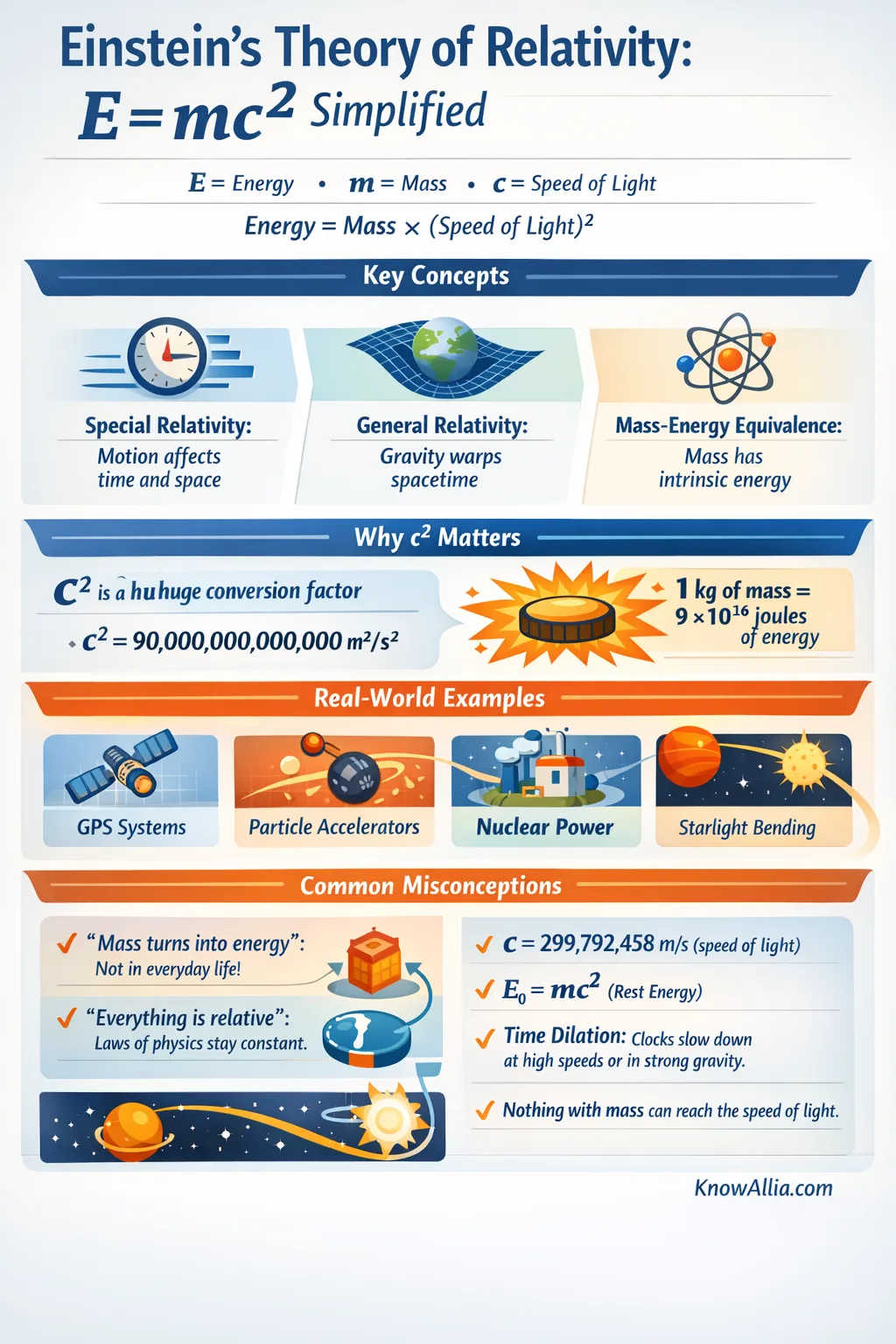
Einstein’s theory of relativity is a set of ideas that ties space, time, mass, and energy into one picture. The famous equation E = mc² says that a body has “rest energy” simply by having mass—no motion required.
A Practical Way to Read Relativity
Relativity doesn’t mean “everything is random.” It means the laws of physics work the same way for everyone who’s not accelerating, and that measurements like time and distance can depend on motion and gravity.
E = mc² is best read as: mass is a form of energy. It’s a deep bookkeeping rule about how nature keeps totals consistent.
- Special relativity: motion changes how time and distance are measured.
- General relativity: gravity is how mass-energy shapes spacetime.
- Mass–energy equivalence: rest mass has a built-in energy “value.”
If you stick with this page, you’ll come away knowing what relativity actually claims, what E = mc² does (and doesn’t) say, where the “c²” comes from, and why these ideas show up in real technology and astronomy—without turning the topic into a math contest.
Relativity Basics: The Core Idea in Plain Words
Relativity is about how measurements work when things move very fast or sit in strong gravity. Two people can both be right even if they report different time intervals or lengths—because those quantities are tied to the observer’s motion and gravitational environment.
Three Statements That Carry Most of the Weight
- Same physics rules for observers moving at constant speed (no acceleration).
- Light’s speed in vacuum is the same for those observers, regardless of how the source moves.
- Space and time aren’t separate ledgers; they behave like a combined system (“spacetime”).
This isn’t just philosophy—these ideas were built to make the world consistent with electromagnetism and with what experiments show. Today, they’re tested in many different ways, from precision clocks to particle beams.
Special Relativity vs General Relativity
It helps to keep the two main “chapters” separate. They’re related, but they answer different kinds of questions.
Special Relativity
- Best for constant-speed motion (inertial frames).
- Explains time dilation and length contraction.
- Gives the cleanest path to E = mc².
A good mental image: different observers are using different “rulers and clocks,” but the underlying rules still match.
General Relativity
- Best for gravity and acceleration.
- Treats gravity as spacetime curvature, not a pull-through-space.
- Predicts effects like gravitational time dilation and the bending of light near massive objects.[d] 🔗
Think of “gravity” as the shape of the stage, not a mysterious string pulling props around.
E = mc² Simplified (Without Turning It Into a Myth)
E = mc² is about rest energy: the energy associated with mass even when the object is not moving. In a modern, clean wording: E₀ = mc², where E₀ is the energy at rest, m is rest mass, and c is the speed of light.
Where it came from: Einstein showed that when a body emits energy, its mass changes in a matching way—linking energy and inertia (resistance to acceleration).[b] 🔗
What the Equation Does (and Doesn’t) Claim
Also, E = mc² is the calm, at-rest version. For a moving object, the full story connects energy to momentum too, and you’ll often see a relationship written in the form E² = (pc)² + (mc²)² in introductory physics materials.[c] 🔗
| Situation | Useful Quantity | What It Means |
|---|---|---|
| Object at rest | Rest energy E₀ | Energy “stored” in the fact that mass exists: E₀ = mc².[c] 🔗 |
| Object moving slowly | Kinetic energy | Close to the familiar classical idea; relativistic corrections are tiny when speed is far below c. |
| Object moving very fast | Total energy E | Energy grows rapidly as speed approaches c; you can add lots of energy without easily reaching c.[c] 🔗 |
| Light (photons) | Energy–momentum link | Light has energy and momentum even though it has zero rest mass in the usual sense.[c] 🔗 |
Why the “c²” Is the Whole Point
The speed of light in vacuum is exactly 299,792,458 meters per second, because modern SI units define it that way (it’s not a measured approximation in this context).[a] 🔗
When you square that number, you get an enormous conversion factor. Here’s a simple analogy: think of c² like a wildly high exchange rate between “kilograms” and “joules.” A tiny “amount” of mass corresponds to a huge “amount” of energy, the same way a small stack of one currency could convert into a massive pile of another if the rate were extreme.
Two Quick Numbers (Just to Build Intuition)
- 1 gram of mass corresponds to about 9 × 10¹³ joules of rest energy (from E = mc² and the exact value of c).[a] 🔗
- 1 kilogram corresponds to about 9 × 10¹⁶ joules of rest energy—same math, just scaled up.[a] 🔗
In everyday life, that rest energy is usually not available to us in a direct, controllable way. The equation is still true—it’s just not a “free energy” button.
Mass and Energy: One Relationship, Many Useful Reads
The same equation can be read as “mass carries rest energy” or “energy contributes to inertia.” The huge factor is c², because c is enormous.
Not a Daily-Life Converter
For ordinary objects, “mass changing into energy” isn’t something you notice. The link is still real—it’s just not usually accessible in a direct way.
A Strong Consistency Check
When energy leaves or enters a system, relativity says inertia must track that change. It keeps conservation laws consistent across observers.
Works With Motion Too
For moving objects, total energy also depends on momentum. That’s why modern texts connect energy, momentum, and mass in one relation.
Where Relativity and E = mc² Show Up in the Real World
You don’t need a spaceship to meet relativity. You just need situations where precision is extreme, speeds are high, or gravity differences matter.
- GPS timing: satellite clocks and ground clocks don’t tick at exactly the same rate. Systems apply relativity corrections to stay accurate; without them, errors would build quickly.[e] 🔗
- Particle accelerators: as particles approach c, adding energy mostly boosts energy and momentum rather than letting them “hit” the speed of light.[c] 🔗
- Starlight and gravity: general relativity predicts how gravity influences light and time in strong fields, which helps interpret astronomical observations.[d] 🔗
- High-precision measurements: modern unit definitions and precision metrology lean on fixed constants like c to keep measurements consistent worldwide.[a] 🔗
A calm takeaway: relativity is often invisible in daily life because v is usually tiny compared to c, and gravity differences around us are modest. But when you scale up speed, precision, or gravity, it stops being optional.
Common Misconceptions (And What’s Actually True)
- Misconception: “Relativity says everything is relative.”
Reality: The laws are consistent; what changes is how different observers measure time and distance. - Misconception: “E = mc² means any mass can easily become usable energy.”
Reality: It’s an equivalence statement. The equation doesn’t promise practical access in everyday settings. - Misconception: “Time dilation is just a weird trick.”
Reality: It’s a real measurement effect tied to motion and gravity; it matters in precision systems.[e] 🔗 - Misconception: “Nothing can go faster than light, so light is the ‘fastest object.’”
Reality: In relativity, c is a limit for objects with mass, and it’s also a key constant that shapes how space and time fit together.[c] 🔗
Key Terms (Mini Glossary)
- Spacetime
- The combined “stage” of space and time. Different observers can slice it into space and time differently, but the underlying structure stays consistent.
- Inertial Frame
- A viewpoint moving at constant speed (no acceleration). Special relativity is built to work cleanly here.
- Time Dilation
- The effect where moving clocks (or clocks in different gravitational conditions) don’t agree on elapsed time in the same way.
- Length Contraction
- The effect where a moving object’s measured length along the direction of motion can be shorter for an observer who sees it moving fast.
- Rest Energy (E₀)
- The energy a body has simply because it has mass: E₀ = mc².[c] 🔗
- Mass–Energy Equivalence
- The idea that mass and energy are different expressions of the same physical quantity; changes in one can imply changes in the other.[b] 🔗
Limitations: What We Don’t Know Yet (Or What Relativity Doesn’t Try to Do)
Relativity is one of the best-tested frameworks in physics, but it’s not marketed as “the final word on everything.” A few honest limits help keep expectations realistic.
- Quantum foundation gap: general relativity is widely expected to be incomplete because it does not include a full quantum description of gravity.[d] 🔗
- Idealized setups: many classic explanations use simplified situations (perfect clocks, clean frames, smooth gravity). That’s fine for learning, but real systems can add extra layers.
- Everyday intuition mismatch: relativity’s “common sense” is built for high speed and high precision, not for walking pace and casual timing.
The good news is that these limits don’t weaken the parts relativity is meant to answer. They just draw a clear border around the map: this is what the theory covers confidently, and this is where new physics may be needed.
Sources
Below are a few high-trust references used to confirm specific claims and definitions. Each link appears only once here; in-text markers like [a] jump to the matching item, and the return arrow brings you back.
- BIPM – The International System of Units (SI), 9th Edition (PDF) (Definition of the speed of light and how SI fixes c exactly.) [a] ↑
- California State University, Northridge – “Does the Inertia of a Body Depend upon its Energy-Content?” (PDF) (Primary-text translation used for the mass–energy link statement.) [b] ↑
- OpenStax (Rice University) – College Physics 2e: “Relativistic Energy” (Rest energy, energy growth near c, and the energy–momentum relationship.) [c] ↑
- NASA Science – “General Relativity and the Nature of Spacetime” (General relativity overview and the note about quantum foundation limits.) [d] ↑
- MIT OpenCourseWare – “Introduction to Special Relativity” (Core topics: time dilation, length contraction, and the structure of special relativity.) [e] ↑
FAQ
FAQ
Is E = mc² the same as “mass turns into energy”?
It’s better to say mass and energy are equivalent measures of the same physical “account.” In many situations, mass stays essentially constant in practice, even though the equivalence is still true.
Does relativity say time is an illusion?
Relativity treats time as a measurable part of spacetime. What changes is that different observers can measure different time intervals between the same events, depending on motion and gravity.
Why can’t objects with mass reach the speed of light?
As an object’s speed approaches c, the energy required to push it closer grows extremely fast. In the standard special-relativity model, that required energy effectively blows up as you approach c.
Is the speed of light a measured number or a defined one?
In modern SI, the speed of light in vacuum is defined to be exact. That definition helps keep measurements consistent worldwide, and it’s why you’ll see “exact” next to the value in official references.
Do you need advanced math to understand the main message?
No. You can understand the core ideas with careful language: what counts as “at rest,” why observers can disagree on time and distance, and how E = mc² is about rest energy and consistency.
What’s the biggest open gap around relativity today?
A major open challenge is building a complete description of gravity that fits naturally with quantum physics. Relativity works extremely well where it’s tested, but it doesn’t try to be a finished theory of everything.