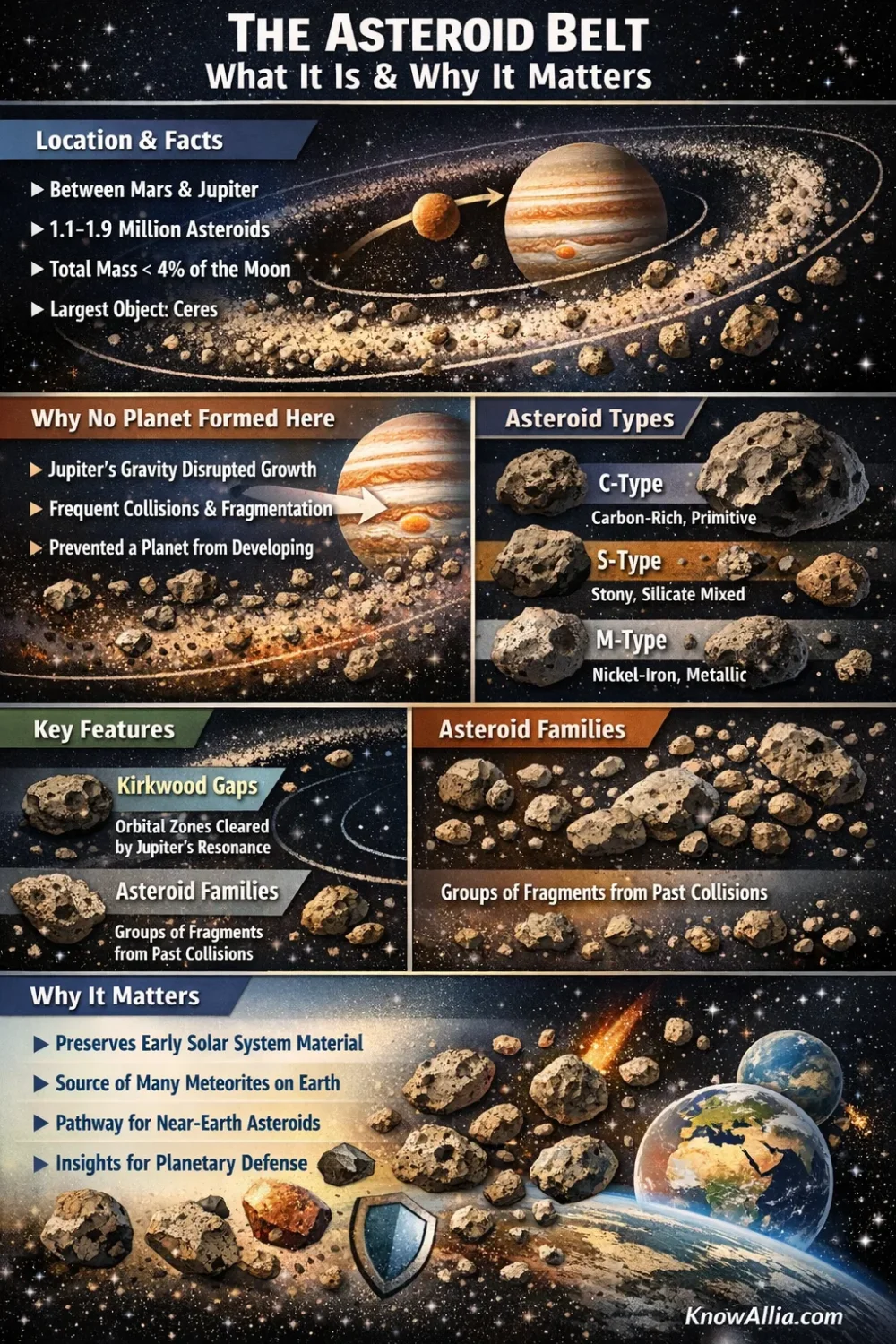
The asteroid belt is the broad band of rocky bodies that orbits the Sun between Mars and Jupiter. It matters because it preserves leftover material from early solar-system formation, feeds some of the meteorites studied on Earth, and helps scientists trace how small bodies move from stable orbits into planet-crossing ones.[a]
A Short Opening View
This region is not a solid ring and not a traffic jam of rocks. It is a wide orbital zone filled with bodies of many sizes, from dust and small fragments to worlds large enough to be studied like planetary survivors. That mix is why the belt keeps showing up in research on origins, impacts, water, and planetary defense.
- It records early solar-system chemistry through different asteroid classes.
- It shows how Jupiter shaped nearby space by interrupting planet formation.
- It links space observations to Earth samples through meteorites and asteroid families.
You will see what the belt is, why no full-sized planet formed there, how scientists sort its members, why Ceres and Vesta get so much attention, and where this region connects to Earth in direct, measurable ways.
What the Asteroid Belt Actually Is
The belt is usually called the main asteroid belt because it is only one asteroid population among several in the solar system. Most known asteroids orbit there, between Mars and Jupiter, and NASA estimates the belt contains about 1.1 to 1.9 million objects larger than 1 kilometer, plus many smaller ones. Even with all that material, the belt’s total mass is still less than the Moon’s mass.[b]
- It is an orbital region, not a physical band you could stand on.
- Its members include dark carbon-rich bodies, stony bodies, metallic bodies, dust, and collisional fragments.
- Some asteroids are nearly round, but most are irregular because they never became large enough for gravity to fully reshape them.
- Many spacecraft have crossed the belt without impact, which tells you how much empty space it contains.[c]
A useful analogy is this: the asteroid belt is less like a wall of rubble and more like a library shelf with long empty gaps between the books. The books matter, but the empty shelf space matters too, because it explains why spacecraft can pass through the belt safely while still finding scientifically rich targets when they aim with precision.
- Between Mars and Jupiter
- Millions of bodies
- Mass below the Moon
- Mostly empty space
- Records early solar-system history
Why It Never Became a Planet
The belt is often described as material that “failed” to become a planet, but that phrasing is too neat. What happened is more physical: Jupiter’s gravity disturbed this zone early, blocking long-term growth and raising collision speeds. Instead of one growing body taking over, many smaller bodies kept colliding, breaking apart, and getting redistributed.[b]
This is why the belt is valuable. It preserves a place where solar-system growth was interrupted. Rather than showing the finished result, it shows a partly preserved construction site whose leftovers still carry chemical and dynamical clues from that early era.[d]
How the Belt Is Organized
Composition, Distance, and Why the Belt Is Not Uniform
The belt is not a random pile. NASA groups asteroids into three broad composition classes: C-type, S-type, and M-type. C-types are the most common and are usually dark, ancient bodies rich in clay and silicate material. S-types are stonier and include silicates mixed with nickel-iron. M-types are more metallic. These differences are tied to where bodies formed and how much heating and melting they experienced.[b]
NASA also notes a broad inner–outer pattern: silicate-rich asteroids are more common in the inner belt, while carbon-rich material becomes more common farther out. That makes the belt useful not only as a population of rocks, but as a map of how temperature and chemistry varied in the young solar system.[c]
| Class | Typical Material | General Appearance | Why Scientists Care |
|---|---|---|---|
| C-type | Clay and silicate-rich material | Dark surfaces | Often preserves very old, less altered material |
| S-type | Silicates mixed with nickel-iron | Brighter, stony surfaces | Helps trace thermal processing and rock-metal mixtures |
| M-type | Nickel-iron rich material | Metal-rich surfaces | Helps test ideas about melting, separation, and metallic interiors |
Kirkwood Gaps and Asteroid Families
The belt also has Kirkwood gaps, which are zones with fewer asteroids because orbital resonances with Jupiter keep clearing them over time. These gaps matter far beyond a simple map label: they show that the belt is under steady gravitational sorting, not frozen in place.[c]
Another layer of structure comes from asteroid families. These are groups of fragments with related orbits, usually produced when a larger parent body was shattered. Families let scientists work backward from present-day orbits to old impact events, which is one reason the belt is treated as a laboratory for collisional evolution, not just a catalog of isolated rocks.[l][k]
The Belt in Measurable Terms
A few numbers and patterns explain why this region is studied as both a chemical archive and a dynamical system.
1.1–1.9 Million
Estimated number of belt asteroids larger than 1 kilometer.
Below the Moon
All belt asteroids together still add up to less mass than Earth’s Moon.
Ceres
The belt’s largest body is also the only dwarf planet in the inner solar system.
What Organizes the Belt
- Jupiter’s gravity interrupts growth and shapes resonances.
- Kirkwood gaps mark orbital zones that get cleared over time.
- Asteroid families preserve the debris patterns of old collisions.
- Inner and outer sections show broad compositional sorting.
Ceres
About 25% of the belt’s total mass.
Vesta
Almost 9% of the belt’s total mass and tied to meteorites found on Earth.
Earth Link
Most meteorites recovered on Earth come from asteroids.
Why Spacecraft Can Cross It
The belt is broad and sparse, so missions pass through it by navigation, not luck.
Why Scientists Keep Returning
Each class, family, and large body preserves a different chapter of solar-system history.
Why It Matters on Earth
Meteorites, near-Earth asteroids, and planetary-defense work all connect back to belt dynamics.
Worlds That Shape the Story
Ceres: A Dwarf Planet Inside the Belt
Ceres changes the way people think about the belt. It is not just another irregular asteroid. NASA classifies it as the only dwarf planet in the inner solar system, and it accounts for about 25% of the belt’s total mass. Ceres also appears to hold abundant water-bearing material, which makes it central to questions about volatile delivery and the early distribution of water-rich matter near the inner planets.[e]
ESA’s Herschel mission detected water vapor around Ceres, and that result pushed the belt into a more interesting category: not merely a rocky leftovers zone, but a region where the line between dry asteroids and more volatile-rich bodies can blur.[g]
Vesta: A Record of Early Melting and Violent Impacts
Vesta is different again. NASA describes it as the second most massive body in the main belt, and Dawn showed that it is much more planet-like than a casual label such as “asteroid” might suggest. It has a differentiated interior, giant impact basins, and a direct link to a known class of meteorites found on Earth.[f]
That is one reason Ceres and Vesta matter so much together. Dawn visited both with the same spacecraft, letting scientists compare a water-rich dwarf planet and a drier protoplanetary remnant within the same orbital region. Studied side by side, they show that the belt is chemically and geologically mixed in ways a one-line textbook definition cannot capture.[d][e][f]
Why the Belt Matters Beyond Astronomy Textbooks
- It preserves early solar-system material. Some asteroid classes still retain very old chemical signatures, so the belt acts as a record of conditions from the era when planets were assembling.[b]
- It connects telescopes to laboratory science. NASA says 99.8% of meteorites found on Earth come from asteroids, which means samples in collections and labs often trace back to belt parent bodies or related fragments.[h]
- It explains how some near-Earth objects begin their journey. Resonances and slow forces such as sunlight-driven drift can move fragments out of stable belt orbits and into planet-crossing paths.[l]
- It keeps the water question open. Ceres and main-belt comets show that the belt includes bodies with volatile-rich behavior, which matters for how scientists think about water in the inner solar system.[g][i]
- It feeds planetary-defense work. NASA’s NEO Surveyor is being built to find asteroids and comets that could pose hazards to Earth, and part of that long story starts with how small bodies are supplied from reservoirs such as the main belt.[j]
An example makes this connection plain. A rock can be blasted off Vesta in an ancient impact, drift over long timescales, enter a resonance, become part of the near-Earth population, survive passage through our atmosphere, and finally land on Earth as a meteorite. That is not a loose narrative chain; it is exactly the kind of multi-step history planetary science now reconstructs from missions, orbital mechanics, and lab analysis.[f][h][l]
Where Readers Often Get Mixed Up
Myth: The Belt Is a Dense Ring of Constant Collisions
Reality: The belt contains many objects, but it also contains a great deal of empty space. Spacecraft can cross it safely, and collisions happen on long timescales rather than as nonstop visible pileups.[c]
Myth: It Is Just One Uniform Group of Rocks
Reality: Composition, orbital structure, resonances, and collisional families all divide the belt into many subpopulations. C-type, S-type, M-type, family members, active asteroids, and large bodies such as Ceres and Vesta all tell different stories.[b]
Terms Worth Knowing
- Main Asteroid Belt
- The broad asteroid population between Mars and Jupiter.
- Orbital Resonance
- A repeating gravitational relationship between orbiting bodies; in the belt, resonances with Jupiter help clear some regions.
- Kirkwood Gaps
- Zones in the main belt where fewer asteroids remain because resonant orbits become unstable over time.
- Asteroid Family
- A group of asteroids with related orbits that usually came from one larger parent body broken apart in an impact.
- C-type, S-type, M-type
- The three broad composition classes used in many asteroid descriptions: carbon-rich, stony, and metallic.
- Main-Belt Comet
- An object that orbits within the asteroid belt but can show comet-like activity such as dust emission.
- HED Meteorites
- Howardite, eucrite, and diogenite meteorites, which NASA links to Vesta.
What Scientists Still Need to Pin Down
Researchers still do not have a complete, settled account of how much mixing happened across the young solar system, how water-rich material moved inward, or how every asteroid family evolved after its original breakup. Active studies of Ceres, main-belt comets, asteroid families, and near-Earth-object supply routes show that the belt is not “solved”; it remains one of the clearest places to test how chemistry, collisions, heat, and gravity worked together early on.[d]
That is why the asteroid belt keeps mattering. It is not merely a strip of rocks between planets. It is one of the best places in the solar system for reading how planetary material was sorted, altered, broken apart, and occasionally sent our way.[d][i]
FAQ
Questions Readers Commonly Ask
Is the asteroid belt a solid ring?
No. It is a wide orbital region with many bodies spread across a very large volume of space, so it contains far more empty space than rock.
Why is the asteroid belt between Mars and Jupiter?
That region is where many small bodies remained after Jupiter’s gravity disrupted long-term planet growth and helped keep the zone dynamically unsettled.
Did the asteroid belt come from an exploded planet?
The modern view does not treat the belt as the debris of one full-sized destroyed planet. It is understood as a remnant population shaped by interrupted growth, collisions, and gravitational resonances.
What is the largest object in the asteroid belt?
Ceres is the largest object in the belt, and NASA classifies it as a dwarf planet rather than a standard asteroid.
Why do scientists care so much about Ceres and Vesta?
They preserve very different conditions inside the same region. Ceres is more water-rich, while Vesta records early melting, crust formation, and giant impacts.
Do meteorites on Earth come from the asteroid belt?
Most meteorites found on Earth come from asteroids, and some can be tied to specific parent bodies or asteroid groups such as Vesta-related material.
Can asteroids leave the belt?
Yes. Resonances with planets and slower forces such as sunlight-driven orbital drift can move fragments into new paths, including near-Earth orbits.
Are there icy or comet-like objects in the belt?
Yes. Ceres shows water-related behavior, and some objects known as main-belt comets orbit in the belt while showing comet-like dust activity.
Sources
- NASA Science – Asteroids Used for the belt’s plain-language definition, location, and origin as leftover material from solar-system formation. ↩
- NASA Science – Asteroid Facts Used for asteroid counts, total mass, broad composition classes, and Jupiter’s role in interrupting planet formation in this region. ↩
- NASA Science – Chapter 1: The Solar System Used for spacecraft crossings, Kirkwood gaps, and the broad inner/outer compositional pattern in the main belt. ↩
- JPL – Dawn Used for why Ceres and Vesta were studied together and how Dawn tied them to solar-system formation and evolution. ↩
- NASA Science – Ceres Facts Used for Ceres as the belt’s largest body, its 25% mass share, and its water-rich character. ↩
- NASA Science – 4 Vesta Used for Vesta’s differentiated nature, giant impacts, and link to HED meteorites. ↩
- ESA – Herschel Discovers Water Vapour Around Dwarf Planet Ceres Used for water-vapor detection around Ceres and the belt’s connection to volatile-rich material. ↩
- NASA Science – Meteors and Meteorites: Facts Used for meteorite origin data and NASA’s Vesta–HED connection. ↩
- NASA Science – NASA’s Webb to Unlock the Mysteries of Comets and the Early Solar System Used for main-belt comets and why comet-like activity inside the belt still matters. ↩
- NASA Science – NEO Surveyor Used for the planetary-defense section and NASA’s current effort to find hazardous small bodies. ↩
- NASA Science – Tracking Evolution in the Asteroid Belt Used for collision-driven erosion and breakup activity within the belt. ↩
- NASA Science – Sunlight May Nudge Asteroids Toward Earth Used for sunlight-driven drift, asteroid-family evolution, and pathways from the main belt into near-Earth space. ↩