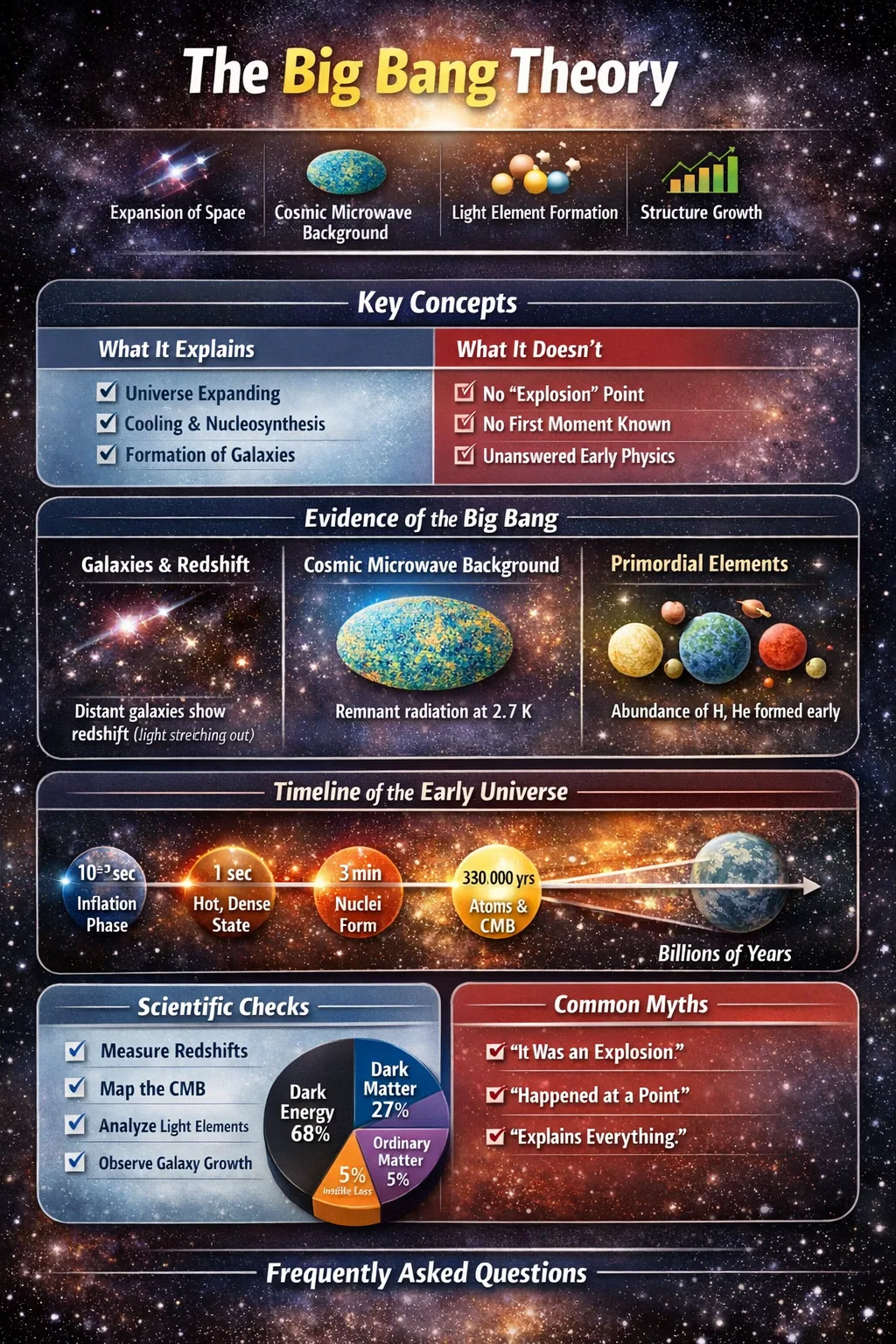
The Big Bang Theory is the leading scientific theory for explaining how the universe evolved from an extremely hot, dense early state into the expanding cosmos we observe today. It is not a story about a single blast “into space.” It is a model about space itself expanding, cooling, and forming structure over time, grounded in observation and tested with multiple independent measurements.
Core Idea
The Big Bang describes cosmic evolution: expansion plus cooling, which naturally leads to a universe filled with galaxies, background radiation, and light elements—without needing to assume a pre-made, static cosmos.
- Expansion
- Cosmic Microwave Background
- Light-Element Formation
- Structure Growth
- Inflation (Hypothesis)
What Is the Big Bang Theory?
The term “Big Bang” refers to a cosmological model that explains the universe’s large-scale evolution by combining physical laws with astronomical observations. It focuses on how the universe changed as it expanded and cooled, rather than describing a fireball traveling through empty space. [Source-1]✓
What the Theory Describes
- Expansion of space over cosmic time.
- Cooling that allows particles, then atomic nuclei, then atoms to form.
- Growth of tiny density differences into galaxies and larger structures.
What the Theory Does Not Claim
- A literal explosion from a central point into pre-existing space.
- A complete description of the very first moment (the earliest times remain an active area of research).
- That every detail is known; the model is refined as measurements improve.
What “Began” in the Model?
In everyday language, “the universe began” can sound like a simple starting gun. In physics, it is more careful: the Big Bang model says the universe was once hotter, denser, and more uniform, and then expanded. When we mathematically run the expansion backward, we reach conditions so extreme that our current theories need help or replacement. That boundary is where confident description starts to thin out.
Helpful mental picture: It is less like shrapnel flying outward and more like a stretching fabric, where distances increase because space expands everywhere at once.
Evidence for a Hot, Expanding Universe
Galaxies and Cosmological Redshift
One of the clearest observational pillars is that many galaxies show redshift: their light is stretched to longer wavelengths as it travels through an expanding universe. The larger the distance, the stronger the effect tends to be, connecting expansion to measurable spectra. [Source-2]✓
The Cosmic Microwave Background
Another central line of evidence is a faint, nearly uniform glow that fills the sky in microwaves: the cosmic microwave background (CMB). Its discovery in the 1960s provided strong support that the universe once passed through a much hotter phase. [Source-3]✓
The CMB’s Temperature Pattern
The CMB is not perfectly identical in every direction. Its tiny temperature differences carry information about early-universe conditions and the seeds of later structure. NASA’s WMAP description gives an example scale: values around 2.7251 K versus 2.7249 K in different sky regions, illustrating how small the variations are. [Source-4]✓
A Timeline from the First Second to the First Atoms
As the universe expanded, it cooled. That cooling sets the order of what can exist: first a very hot particle-and-radiation environment, then stable nuclei, and later neutral atoms. NASA’s Hubble explainer describes a rapid early expansion phase often called cosmic inflation, notes that the trigger is not known, and places key transitions on the scale of about a second and a few minutes after the Big Bang. [Source-5]✓
Later, when stable atoms formed and the universe became transparent, that released light now seen as the CMB. The Center for Astrophysics notes this happened about 380,000 years after the Big Bang, and that the CMB corresponds today to roughly 2.7 K. [Source-6]✓
| When (After the Big Bang) | What Changes | Why It Matters |
|---|---|---|
| Fraction of a second | Inflation is proposed as an extremely rapid expansion phase. | Helps explain large-scale uniformity and the origin of small fluctuations. |
| ~1 second | The universe is a hot, dense mix of particles and radiation. | Sets the stage for later chemistry and structure formation. |
| A few minutes | Atomic nuclei form (mostly hydrogen and helium nuclei). | Predicts light-element abundances that can be compared to observation. |
| ~380,000 years | Electrons bind to nuclei; neutral atoms form; the universe becomes transparent. | Releases the light we detect today as the CMB. |
| Much later | Gravity amplifies small density differences into stars, galaxies, and clusters. | Connects early conditions to the cosmic web we map with telescopes. |
What the Universe Is Made Of
Modern cosmology estimates the universe’s contents by combining measurements of the CMB, galaxy clustering, and related signals. One widely used result set comes from the Planck mission, which reports an age of about 13.8 billion years and an energy budget dominated by components commonly labeled dark matter and dark energy. The key point is not the labels themselves, but that multiple observations require more than just ordinary matter to fit what we see.
| Component | Approximate Share | Plain-Language Meaning |
|---|---|---|
| Ordinary Matter | 4.9% | The atoms that make stars, planets, gas, and life. |
| Dark Matter | 26.8% | Invisible mass that shapes galaxy and cluster gravity. |
| Dark Energy | 68.3% | A component associated with accelerated expansion on large scales. |
How Scientists Check the Model Today
The strength of the Big Bang theory is that it is cross-tested: different measurements, made with different instruments, should agree on the same underlying parameters. When they do, confidence increases. When they do not, scientists refine methods, update assumptions, or propose new physics—carefully and incrementally.
- Measure expansion using distances and redshifts across many galaxies.
- Map background radiation to read early-universe conditions encoded in temperature and polarization patterns.
- Compare light-element abundances with Big Bang nucleosynthesis calculations.
- Track structure growth via galaxy surveys, lensing, and cluster statistics.
- Redshift
- Light stretching as it travels through expanding space, used to infer recession and expansion history.
- Recombination
- The era when electrons and nuclei formed stable atoms, allowing light to travel freely for the first time.
- Nucleosynthesis
- The early formation of atomic nuclei, primarily hydrogen and helium, in the first minutes.
Why agreement matters: If expansion measurements, CMB patterns, and element abundances all point to the same story, the model is not just plausible—it is hard to replace without matching that full web of evidence.
Common Misunderstandings
Many popular explanations are vivid, but they can blur what the science actually says. Clearing up a few points makes the entire model easier to understand.
- “It was an explosion.” The model is about metric expansion: distances grow because space expands.
- “It happened at one location.” On large scales, expansion is described as occurring everywhere, not from a single center in space.
- “The Big Bang explains everything.” It explains a great deal, but some early-time details (like the exact mechanism behind inflation) remain open.
- “We should be able to see the beginning directly.” What we observe is the universe’s earliest accessible signals, interpreted through physics.
Where the Model Is Most Secure
Some parts of early-universe history are treated as especially well-supported because they tie to measurable relics. A key example is Big Bang nucleosynthesis, which Particle Data Group reviews describe as a boundary between well-established early cosmology and more speculative earlier epochs. [Source-8]✓
Frequently Asked Questions
FAQ
Is the Big Bang an explosion in space?
No. In the standard description, the key idea is the expansion of space itself. That expansion changes distances between galaxies on large scales, while local systems (like solar systems) are held together by gravity.
Did the Big Bang create matter and energy?
The model describes how the universe’s contents behaved as conditions changed—how energy, particles, and radiation interacted and cooled. Questions about the deepest origin of the initial state are separate and still studied within physics.
What happened “before” the Big Bang?
In current cosmology, “before” can be a difficult concept, because time itself is part of what the model describes. Some proposals exist, but the safest statement is that the earliest moment is not yet fully explained by a single confirmed theory.
Why is the cosmic microwave background so important?
It is a sky-filling relic signal from an early era, and its tiny variations encode information about the universe’s composition and the seeds of later structure.
Does the Big Bang Theory require inflation?
Inflation is a widely used extension that can explain several observed features in a unified way. It is treated as a strong, testable hypothesis, and research continues to refine what inflation would have looked like and what unique signatures it should leave behind.
How do scientists keep the model honest?
By comparing many independent measurements—expansion, background radiation patterns, element abundances, and structure growth—and checking that they agree within uncertainties. The most trusted conclusions are the ones supported from more than one direction.
When people say the Big Bang explains how the universe began, the careful meaning is this: it explains how the universe evolved from early, extreme conditions into a cosmos that is still expanding and still measurable. The more you connect each claim to an observation—redshift, background radiation, element abundances—the more the story becomes a set of linked facts rather than a metaphor.