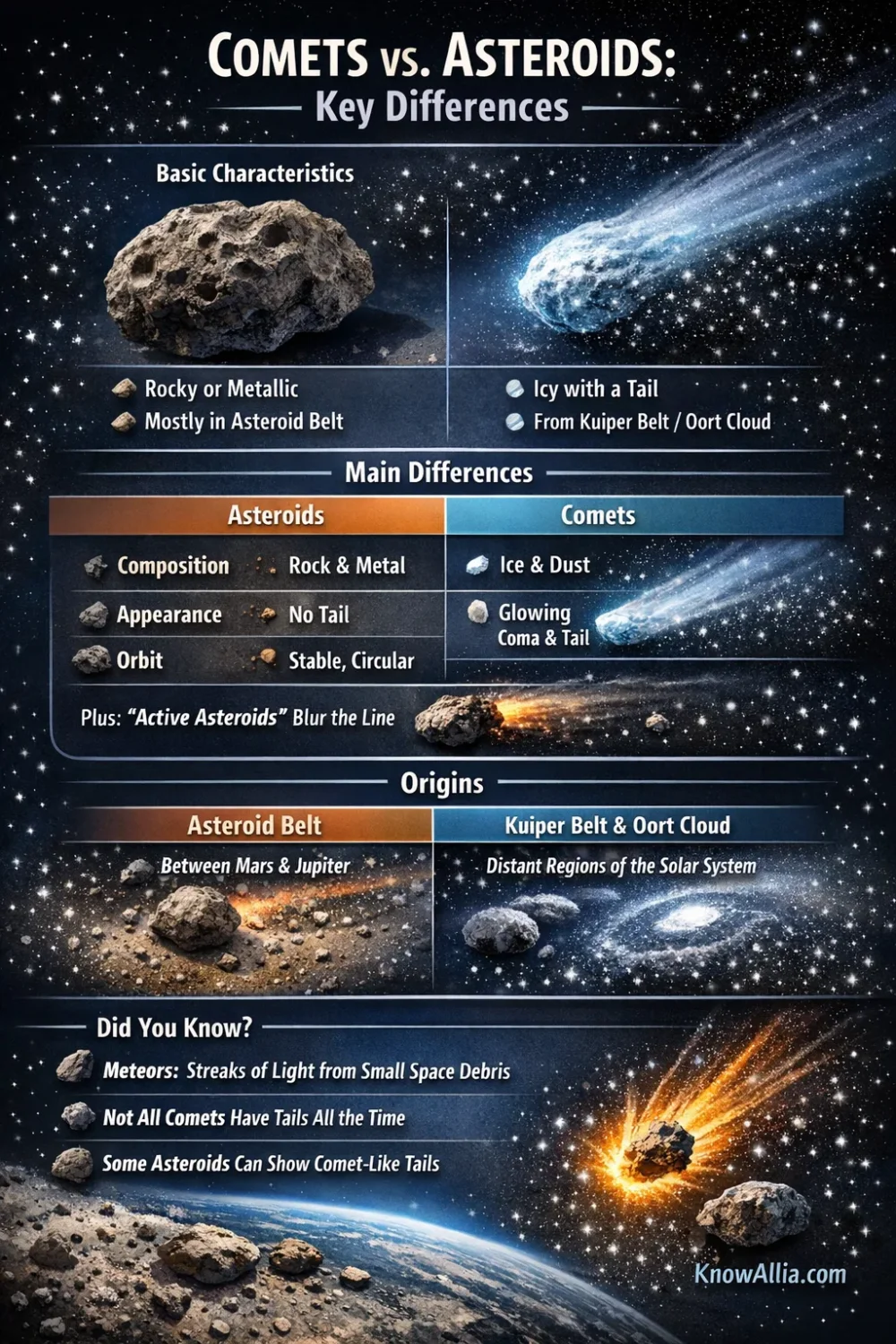
Comets and asteroids are small bodies that orbit the Sun, but they are not the same kind of object. In simple terms, asteroids are usually more rock-heavy, while comets contain more ice and can release gas and dust when sunlight warms them. Both preserve very old material from the early solar system, so they help explain what the solar system was made of before the planets took their present form. [Source-1][Source-2][Source-4]
A Clear Starting Point
This topic often gets reduced to one line: “asteroids are rock, comets are ice.” That is mostly right, but it leaves out the parts readers usually want next: where these objects come from, why some of them blur the usual categories, and how they connect to meteors seen from Earth.
- Asteroids are usually rocky or metallic and often live in the region between Mars and Jupiter.
- Comets are more ice-rich and can grow a coma and tails when they move closer to the Sun.
- A meteor is not the same thing as a comet or an asteroid; it is the streak of light made when a small fragment enters an atmosphere. [Source-5]
This article explains the difference between the objects themselves, the places they usually come from, the terms people often mix up, and what missions such as OSIRIS-REx and Rosetta have added to the picture. [Source-7][Source-8]
What They Are
Asteroids are usually described as rocky remnants from the solar system’s early formation. Comets are often described as frozen mixtures of dust, rock, and volatile materials such as water ice and carbon dioxide ice. Both types orbit the Sun, but they behave differently when heat from the Sun acts on them. [Source-1][Source-2][Source-10]
- Sun-orbiting objects
- Left over from early solar system history
- Different compositions
- Different behavior near the Sun
- Can shed material that later becomes meteoroids
That last point matters. The material tied to comets and asteroids does not stay locked inside one object forever. Collisions can break asteroid material into smaller pieces, and comets can leave debris along their paths. Some of that debris later becomes meteoroids, and if those pieces enter Earth’s atmosphere, they produce meteors. [Source-5]
Main Differences
The easiest way to separate them is to think about composition and behavior near sunlight. A comet near the Sun behaves a bit like ice taken out of a freezer: once enough heat reaches it, the quiet surface starts releasing gas. An asteroid usually stays much more compact and does not build the same kind of glowing envelope. [Source-10][Source-2]
| Feature | Asteroids | Comets |
|---|---|---|
| Typical makeup | Mostly rock, metal, or carbon-rich material | More ice-rich, mixed with dust and rock |
| Usual home region | Mainly the main asteroid belt, plus near-Earth and Trojan populations | Often linked to the Kuiper Belt or the much more distant Oort Cloud |
| Appearance near the Sun | Usually remains a solid point of reflected light | Can form a coma and one or more tails |
| Material loss | Usually from impacts, cracking, spinning, or rare activity | Often from outgassing as ices warm and escape |
| Orbit pattern | Often more stable and less stretched, though not always | Often more stretched, especially for long-period comets |
| What they reveal | Planet formation, impact history, primitive rock chemistry | Cold outer-solar-system material, volatile chemistry, dust and gas release |
Those are the broad rules, not hard walls. Some objects look asteroid-like in orbit but show comet-like activity, and some old comets may lose much of their easy-to-spot ice and look closer to asteroids. That is why the most accurate explanation is not “two perfectly separate boxes,” but two main groups with a few objects in between. [Source-6][Source-3]
Infographic Section
Comets and Asteroids in One View
The main split is simple: asteroids are usually drier and more rock-heavy, while comets are more ice-rich and can become visibly active when sunlight warms them. A smaller middle group shows that nature does not always follow tidy labels.
How the Difference Usually Shows Up
Asteroid Usually rock, metal, or carbon-rich Often stays compact near the SunComet Ice-rich nucleus with dust and rock Can form coma, dust tail, and ion tailActive Asteroid Asteroid-like orbit Comet-like dust activity Sunlight changes what we see Closer heat can wake up comet ice and expose rare activity in some asteroids.Tails point away from the Sun because sunlight pressure and the solar wind push released material outward.Both groups preserve material that dates back to the solar system’s early history, about 4.6 billion years ago.
Most known asteroids are tied to the main belt, while many comets are linked to the Kuiper Belt or Oort Cloud.
Active asteroids and possible extinct comets show that the boundary is useful, but not absolute.
What Readers Often Miss
A comet does not wear a bright tail all the time. Activity rises when solar heat reaches surface ice.
What Matters Near Earth
Near-Earth objects include some asteroids and some comets, so “near Earth” describes orbit, not composition.
Why This Topic Stays Useful
These objects preserve old chemistry that planets have often changed, buried, or recycled.
Where They Come From
Asteroids
Most known asteroids are associated with the main asteroid belt between Mars and Jupiter. Others share an orbit with Jupiter as Trojans, and some move onto paths that bring them closer to Earth. “Near-Earth object” is an orbit label, not a composition label, so it can include both asteroids and comets. [Source-3]
Comets
Many comets are tied to colder outer regions of the solar system. NASA points to the Kuiper Belt and the Oort Cloud as the major reservoirs. In plain terms, short-period comets are more often linked to the Kuiper Belt, while very long-period comets are often linked to the much more distant Oort Cloud. [Source-1][Source-4]
This is one reason the two groups matter so much. They are not just drifting leftovers. They are records of different solar-system neighborhoods. Asteroids often preserve material shaped in warmer inner regions, while comets preserve colder material that stayed farther from the Sun for much of solar-system history. [Source-4][Source-2]
Why Comets Develop Comas and Tails
A comet’s visible activity begins when solar heating reaches near-surface ice. That heating can drive outgassing: gas and dust escape from the nucleus and build a fuzzy atmosphere called a coma. NASA notes that comets can have two tails, a dust tail and an ion tail. [Source-10]
- The dust tail is made of tiny solid particles released from the nucleus.
- The ion tail is made of gas that has been energized by sunlight and the solar wind.
- Both tails point broadly away from the Sun, which is why a comet’s tail does not simply trail behind it like a smoke line behind a car. [Source-10]
That detail is often skipped in short explainers, but it changes how people read comet images. The bright tail is not a fixed “rear end.” It is the visible result of solar energy acting on released material. [Source-1]
Why Scientists Study Them So Closely
Planets are shaped by volcanism, weather, tectonics, impacts, and long internal change. Many comets and asteroids preserve older material in a more direct way. That makes them valuable for studying early solar-system chemistry, the movement of material between inner and outer regions, and the possible delivery of water-rich or organic-rich matter to young worlds. [Source-7][Source-8]
OSIRIS-REx returned asteroid material from Bennu to Earth, while Rosetta became the first mission to rendezvous with a comet, follow it along its orbit, and place a lander on its surface. Together, those missions turned abstract textbook definitions into direct measurements. [Source-7][Source-8]
The asteroid belt also includes Ceres, the largest object in that region. NASA’s Dawn mission found a world about 940 kilometers across with evidence that points to a water-rich history, which shows that “asteroid belt” does not mean “one simple kind of dry rock.” [Source-9]
Where the Line Gets Blurry
This is one of the most useful updates to older textbook-style explanations: not every object fits neatly into one label. NASA tracks active asteroids, bodies with asteroid-like paths that can show tails or comae. Their activity can come from several processes, including impacts, rotational breakup, or the exposure of buried ice. [Source-6]
JPL also notes that a small part of the asteroid population may be burned-out comets whose easy-to-lose surface volatiles are already gone. So the best rule is this: the classic split is still useful, but nature allows mixed cases. [Source-3]
Common Mix-Ups and Misunderstandings
- A meteor is not a comet. A meteor is the streak of light produced when a meteoroid enters an atmosphere. The original material can come from an asteroid, a comet, or other larger bodies. [Source-5]
- Not every comet has a visible tail all the time. A comet can be quiet when it is far from the Sun and more active when warming begins. [Source-10]
- Asteroids are not all shiny metal bodies. Many are rocky, carbon-rich, or loose “rubble-pile” objects rather than solid iron-like masses. [Source-2][Source-7]
- Near-Earth object does not mean one specific composition. It describes an orbit that comes close to Earth’s orbit. [Source-3]
- Ceres sits in the asteroid belt, but it is classed as a dwarf planet. Its location and its classification are related facts, not the same fact. [Source-9]
Terms Worth Knowing
- Nucleus
- The solid central body of a comet, made of ice, dust, and rock.
- Coma
- The fuzzy cloud of gas and dust around an active comet nucleus.
- Dust Tail
- The tail made of small solid particles released from a comet.
- Ion Tail
- The tail made of gas that has been energized and pushed by the solar wind.
- Near-Earth Object
- An asteroid or comet whose orbit brings it into the neighborhood of Earth’s orbit.
- Meteoroid
- A small piece of rocky or metallic material still moving through space.
- Meteor
- The visible streak of light made when a meteoroid enters an atmosphere.
- Meteorite
- A piece of the original object that survives the passage through an atmosphere and reaches the ground.
Those last three terms are where readers most often get tripped up. The object in space is the meteoroid. The bright atmospheric streak is the meteor. The surviving piece on the ground is the meteorite. [Source-5]
Examples That Make the Difference Easier to See
- Halley’s Comet is one of the best-known periodic comets and remains the easiest public example of an ice-rich body that becomes active near the Sun. [Source-1]
- Comet 67P/Churyumov-Gerasimenko became the best-studied comet up close because of the Rosetta mission. [Source-8]
- Bennu is a near-Earth asteroid that provided returned samples for laboratory study on Earth. [Source-7]
- Ceres shows how varied asteroid-belt bodies can be and why simple “dry rock only” descriptions miss part of the story. [Source-9]
What Is Still Being Studied
Scientists can describe the broad difference between comets and asteroids with confidence, but some details remain open. The exact migration history of many small bodies, how much water- or organic-rich material they delivered to early worlds, and how active asteroids should be grouped are still active research areas. [Source-6][Source-7][Source-8]
So the cleanest modern summary is this: asteroids and comets are different on average, not different without exception. Asteroids are usually drier and more rock-heavy. Comets are usually more ice-rich and become visibly active near the Sun. The overlap cases do not weaken the distinction. They make it more accurate.
Frequently Asked Questions
Are comets bigger than asteroids?
Neither group is always bigger. Both comets and asteroids cover a wide size range. The more useful difference is composition and behavior, not simple size.
Do all comets have tails?
No. A comet can look quiet when it is far from the Sun. Visible tails usually appear when solar heating drives outgassing and releases dust and gas.
Can an asteroid have a tail?
Yes. Some active asteroids show tails or comet-like dust activity. That is one reason modern explanations now include mixed or blurred cases.
What is the easiest way to tell a comet from an asteroid?
The simplest rule is this: comets are more ice-rich and can become active near the Sun, while asteroids are usually more rock-heavy and stay compact.
Is a shooting star a comet?
No. A shooting star is a meteor, which is the light made when a small fragment enters an atmosphere. The original fragment may come from a comet or an asteroid.
Why do scientists care so much about comets and asteroids?
Because they preserve old solar-system material that planets have often changed. They help scientists study early chemistry, impacts, and the movement of matter through the solar system.
Sources
- NASA Science – Comets — used for the core definition of comets, their icy makeup, and their link to the Kuiper Belt and Oort Cloud. ↩
- NASA Science – Asteroid Facts — used for asteroid makeup, early-solar-system origin, and the basic contrast with comets. ↩
- NASA JPL CNEOS – Frequently Asked Questions — used for near-Earth objects, the main belt, and the note that some asteroids may be burned-out comets. ↩
- ESA – Comets: an Overview — used for comet origin, age, and why comets are treated as ancient cold-storage material from early solar-system history. ↩
- NASA Science – Meteors and Meteorites: Facts — used for the distinction between meteoroids, meteors, and meteorites. ↩
- NASA Science – Active Asteroids — used for asteroid-like objects that show comet-like activity and for the blurred boundary section. ↩
- NASA Science – OSIRIS-REx — used for the asteroid sample-return mission to Bennu and the study value of asteroid material. ↩
- ESA – Rosetta — used for the first rendezvous-and-landing mission at a comet and for the 67P example. ↩
- NASA Science – Dawn at Ceres — used for Ceres as the largest object in the asteroid belt and for its approximate size and water-rich history. ↩
- NASA Science – Comet Facts — used for the explanation of comet outgassing, dust and ion tails, and tail direction away from the Sun. ↩