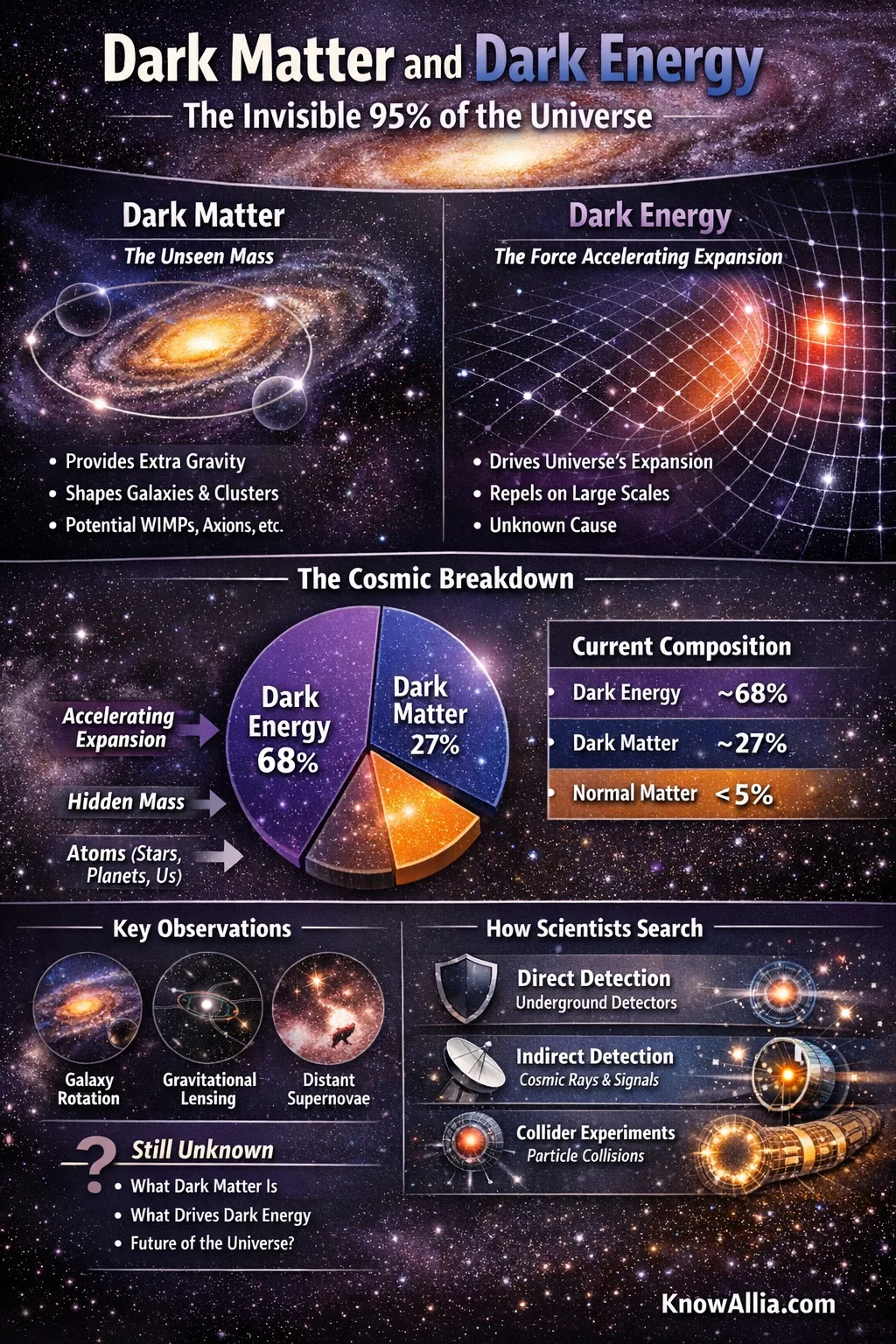
Dark matter and dark energy are umbrella names for two big unknowns in modern cosmology: one that acts like extra gravity (dark matter) and one that is tied to the Universe’s accelerating expansion (dark energy). In today’s standard picture, together they account for roughly 95% of the Universe’s total “energy budget,” while the atoms that make stars, planets, and people are the small remainder.[a]🔗
This topic can feel abstract, but it shows up in very concrete places: how galaxies spin, how galaxy clusters hold together, why light from distant galaxies bends, and why the expansion of space itself is speeding up rather than slowing down.
A Solid Starting Point
Dark matter is “missing mass” you infer from gravity, not from light. Dark energy is the name we give to whatever makes the Universe’s expansion accelerate. The famous “95%” figure is not about what’s inside your room; it’s about the cosmic average over enormous scales.
- What dark matter does: pulls and helps structure form.
- What dark energy does: changes the expansion and affects how structure grows over time.
- What we do not have yet: a confirmed lab detection of dark matter particles, and a settled physical explanation for dark energy.
What you’ll learn here: the clean difference between dark matter and dark energy, the main observations behind each, how scientists estimate their shares, what experiments and missions are trying next, and what is still genuinely unknown.
On This Page
What This “Invisible 95%” Really Means
The “95%” headline is a shorthand for a measured model of the Universe, not a statement about what you can scoop into a jar. Cosmologists describe the Universe using an average density spread over vast volumes. In that accounting, most of the total is not in atoms, but in two components that show up through gravity and expansion.[a]🔗
Here’s the key idea: dark matter behaves like matter (it clumps and adds gravity), while dark energy is smooth on large scales and is tied to the Universe speeding up. NASA summarizes the dark-energy share as roughly about 68–70% of the Universe today.[b]🔗
- Scale matters: cosmic averages can be dominated by something extremely diffuse if it fills space almost everywhere.
- “Dark” means invisible to light: it does not mean “evil,” “empty,” or “mystical.”
- Model context: the usual percentages assume the standard cosmological model, which fits many datasets well but is still tested and refined.
An analogy: imagine walking into a room and only seeing the furniture, but you notice the curtains billowing and doors quietly drifting. You can’t see the air, yet its presence is obvious from the effects. Dark matter and dark energy are similar: you “see” them through what they do, not through what they look like.
Dark Matter in One Sentence
Extra, unseen mass inferred from gravity; it clumps and helps galaxies form and stay bound.
Dark Energy in One Sentence
The name for whatever is behind the Universe’s accelerating expansion; we can measure its effects, but not its true nature.
Dark Matter: The Gravity You Can’t See
Dark matter does not emit, absorb, or reflect light the way normal matter does. What makes it convincing is the repeated, independent pattern: when we measure gravity in space, we often find more mass than the visible stuff can provide. NASA describes how dark matter’s gravity can bend light (gravitational lensing), letting researchers map its distribution even though it is invisible.[d]🔗
Main Observational Clues
- Galaxy rotation: stars far from a galaxy’s center orbit faster than expected from visible matter alone.
- Galaxy clusters: clusters behave as if there is extra mass binding them together.
- Gravitational lensing: background galaxies appear distorted because mass warps spacetime in front of them.
- Cosmic microwave background and structure: the early-Universe “seed patterns” and today’s large-scale structure line up best when a cold, non-baryonic matter component is included.
CERN puts the dark-matter share at about 27% of the Universe, inferred from its gravitational influence, not from direct light-based detection.[c]🔗
What It Might Be
The most common idea is that dark matter is made of new particles that barely interact with normal matter. The Particle Data Group review (hosted by a U.S. national lab) summarizes how dark matter is treated as non-baryonic in modern cosmology and reviews leading candidates and searches.[h]🔗
- WIMPs: heavy, weakly interacting particles (a long-running target, still unconfirmed).
- Axions: very light particles proposed in particle physics, now a major search focus.
- Other possibilities: a “hidden sector” of particles, sterile neutrinos, or compact objects in some scenarios. Evidence is not decisive yet.
How People Try to Detect It
| Strategy | What Is Measured | What a “Hit” Would Look Like | Common Challenge |
|---|---|---|---|
| Direct Detection | Tiny energy deposits from rare collisions inside ultra-quiet detectors | A repeatable signal above backgrounds with a consistent energy pattern | Background rejection and verifying it is not a detector artifact |
| Indirect Detection | Extra gamma rays, neutrinos, or antimatter from space that could come from dark matter interactions | A spatial and spectral pattern difficult to explain with known astrophysics | Separating dark matter signatures from ordinary cosmic sources |
| Collider Searches | Missing energy/momentum in high-energy particle collisions | Events consistent with a new, invisible particle carrying energy away | Many theories can mimic similar “missing energy” signatures |
Dark Energy: The Driver of Cosmic Acceleration
Dark energy is the name for whatever causes the Universe’s expansion to speed up with time. NASA’s overview is blunt in the best way: we can measure the effect and estimate the share, but we don’t yet know what dark energy is in a deep physical sense.[b]🔗
How It Was Discovered
The earliest strong evidence came from observing distant Type Ia supernovae: they appeared dimmer than expected in a Universe that was only slowing down. The discovery is widely recognized, including in the Nobel Prize summary for the 2011 Physics award, which cites the accelerating expansion found through distant supernova observations.[f]🔗
What Dark Energy Does (and Doesn’t) Do
- Does: changes the long-term expansion history of the Universe, and influences how quickly large-scale structure grows.
- Doesn’t: pull galaxies apart internally like a local explosion. Gravity and other forces dominate inside bound systems such as galaxies, solar systems, and atoms.
The U.S. Department of Energy explains dark energy in terms of cosmic acceleration and how experiments test different possibilities, focusing on measured expansion rather than speculation.[e]🔗
The Simplest Explanation: A Cosmological Constant
The simplest fit to many observations is a constant energy density associated with space itself, often written as Λ (lambda). You will also see the “equation-of-state” parameter w, a compact way to describe how this component behaves as the Universe expands. Many measurements are consistent with w near −1, but the job of current and upcoming surveys is to test that carefully, across time and scale.
How Scientists Estimate the Cosmic Recipe
No single observation gives the whole story. Modern cosmology is a cross-check game: different measurements constrain the same parameters in different ways, and the overlaps are where confidence builds. NASA notes that Roman will use multiple techniques that cross-check each other, alongside other major surveys, to test dark energy with less room for hidden systematics.[i]🔗
| Component | Approximate Share Today | How It Behaves | Where It Shows Up Most Clearly |
|---|---|---|---|
| Dark Energy | About 68–70%[b]🔗 | Smooth on large scales; tied to accelerating expansion | Distance–redshift relations, large-scale clustering, combined cosmology fits |
| Dark Matter | About 27%[c]🔗 | Clumps; acts as extra gravity and structure “scaffolding” | Lensing maps, galaxy/cluster dynamics, growth of structure |
| Normal Matter | Less than 5%[a]🔗 | Atoms; forms stars, gas, dust, planets, life | Light from stars/galaxies, gas emissions, chemistry, everything in labs |
Why the Numbers Come with “About”
- Different datasets: CMB, supernovae, lensing, and galaxy surveys have different strengths.
- Different assumptions: the standard model is compact and successful, but it is still a model.
- Systematics: small measurement biases can matter when you are mapping billions of light-years.
How Dark Matter and Dark Energy Work Together
It helps to picture a long story rather than two isolated mysteries. Dark matter provides much of the gravitational structure that lets matter gather into galaxies. Dark energy shapes the expansion history, which in turn influences how fast those structures can grow. Argonne’s overview captures this “push and pull” idea: one component helps clump structure, the other is linked to the stretching of the Universe.[g]🔗
Early Universe
Dark matter helps tiny density differences grow into the first large structures. Without it, the Universe would have a harder time building today’s cosmic web on schedule.
Later Universe
As the Universe expands, dark energy becomes more influential in the overall budget, affecting how quickly structures continue to grow and how distances evolve over time.
Common Confusions and Misconceptions
This topic attracts dramatic phrases, so it’s worth separating what’s supported from what’s just a catchy interpretation. The Harvard–Smithsonian Center for Astrophysics keeps the core distinction simple: dark matter pulls galaxies together, while dark energy pushes the expansion the other way on the largest scales.[j]🔗
Some matter is hard to see, but the dark-matter component discussed in cosmology is mainly treated as non-baryonic (not made of atoms) in the standard model.
It’s better to think in terms of how distances evolve with time. Dark energy shows up in the expansion history, not as a local gust acting on individual objects.
Bound systems (like galaxies and solar systems) are held together by gravity and other forces. Cosmic expansion is most relevant between large structures, over huge distances.
The broad picture is well supported by evidence, but the exact values are refined as measurements improve, and they depend on the chosen cosmology model and dataset combinations.
Key Terms You’ll See a Lot
- Gravitational Lensing
- Light bending because mass warps spacetime; one of the cleanest ways to map dark matter indirectly.
- Cosmic Acceleration
- The observation that the Universe’s expansion is speeding up over time, associated with dark energy.
- ΛCDM
- The standard cosmology model that includes a cosmological constant (Λ) and cold dark matter (CDM).
- Equation of State (w)
- A parameter that summarizes how dark energy behaves as the Universe expands; many measurements are consistent with w near −1.
- Critical Density
- A reference density used to describe the Universe’s total content in a normalized way (fractions add up neatly).
If you want compact, editorial definitions: Britannica’s entries for dark matter and dark energy are useful for terminology, while the science is built from the observational and mission sources listed later.[k]🔗[l]🔗
A Compact Infographic
The Dark Universe, Simplified
A big-picture view of how the Universe’s content is described today, and what we actually measure when we talk about dark matter and dark energy.
Approximate Share Today
Shows up in the expansion history and large-scale distances.
Acts like extra gravity and shapes the cosmic web.
Atoms: stars, gas, dust, planets, and everything in labs.
Light, spectra, and particles from normal matter.
Mass and expansion from gravity, lensing, and cosmic geometry.
What Observations Point to Each
Galaxy rotation, lensing maps, cluster dynamics, and the way structure grows across time.
Distance–redshift measurements, clustering patterns, and combined cosmology fits that favor acceleration.
Different methods have different biases. Agreement between independent probes is the real confidence-builder.
Limitations and What We Still Don’t Know
This is a field with solid measurements and honest unknowns sitting side by side. A reliable way to read new results is to ask: did multiple independent methods move together, or is it one dataset that still needs confirmation?
What We’re Confident About
- There is strong evidence for extra gravitational mass beyond visible matter on many scales.
- The Universe’s expansion history indicates late-time acceleration in the standard interpretation.
- Independent datasets often point to a consistent overall picture, even when details differ.
What Remains Open
- Dark matter’s identity: we have no confirmed particle or object explanation in the lab yet.
- Dark energy’s nature: whether it is a true constant of space or something that changes slowly is still tested.
- Model dependence: “percentages” are precise within a model, but science keeps checking the model itself.
If you want a simple mental rule: treat “dark matter found” or “dark energy solved” headlines as provisional until they survive cross-checks, independent teams, and careful control of measurement bias.
FAQ
Questions People Ask Most
Is dark matter the same thing as dark energy?
No. Dark matter behaves like extra mass: it clumps and adds gravity. Dark energy is tied to the Universe’s accelerating expansion and appears smooth on large scales.
If dark matter is everywhere, why don’t we notice it around Earth?
We expect dark matter to be present locally, but it interacts extremely weakly (if at all) with light and ordinary matter. Its gravitational effect is easiest to detect over large, accumulated masses and long distances.
Does dark energy mean the Universe will definitely expand forever?
Not definitely. A constant dark energy (the simplest model) suggests continued acceleration, but scientists are actively testing whether dark energy is truly constant or changes subtly. The responsible answer is: we are measuring it, not guessing.
Is the “95%” number exact?
It’s a rounded summary of the standard cosmology picture. The broad idea is stable, while the exact values are refined with improved measurements and careful treatment of systematics.
What would count as a breakthrough?
For dark matter, a confirmed detection with a repeatable, independent signature would be a major scientific breakthrough. For dark energy, determining whether it is a true cosmological constant or something that evolves over time would significantly change how we model cosmic history.
Sources
These are high-reliability pages used for specific factual points and definitions. Each external link appears once here; the letter tags jump back to where it was used in the text.
- [a]↩ ESA – Euclid: The Dark Universe (context for the “invisible 95%” framing)
- [b]↩ NASA Science – Dark Energy (dark energy share and acceleration overview)
- [c]↩ CERN – Dark Matter (dark matter share and gravitational inference)
- [d]↩ NASA Science – Dark Matter (lensing and modern evidence framing)
- [e]↩ U.S. Department of Energy – DOE Explains: Cosmic Acceleration and Dark Energy (dark energy concept and how it’s tested)
- [f]↩ NobelPrize.org – Physics 2011 Summary (recognition of the accelerating expansion discovery via supernovae)
- [g]↩ Argonne National Laboratory – Science 101: Dark Matter and Dark Energy (big-picture interplay explanation)
- [h]↩ Particle Data Group – Review: Dark Matter (PDF) (technical but authoritative review of candidates and searches)
- [i]↩ NASA Science – Roman Space Telescope: Dark Energy (multi-probe cross-check approach)
- [j]↩ Harvard–Smithsonian Center for Astrophysics – Dark Energy and Dark Matter (clear distinction: pull vs expansion)
- [k]↩ Encyclopaedia Britannica – Dark Matter (terminology reference for definitions)
- [l]↩ Encyclopaedia Britannica – Dark Energy (terminology reference for definitions)