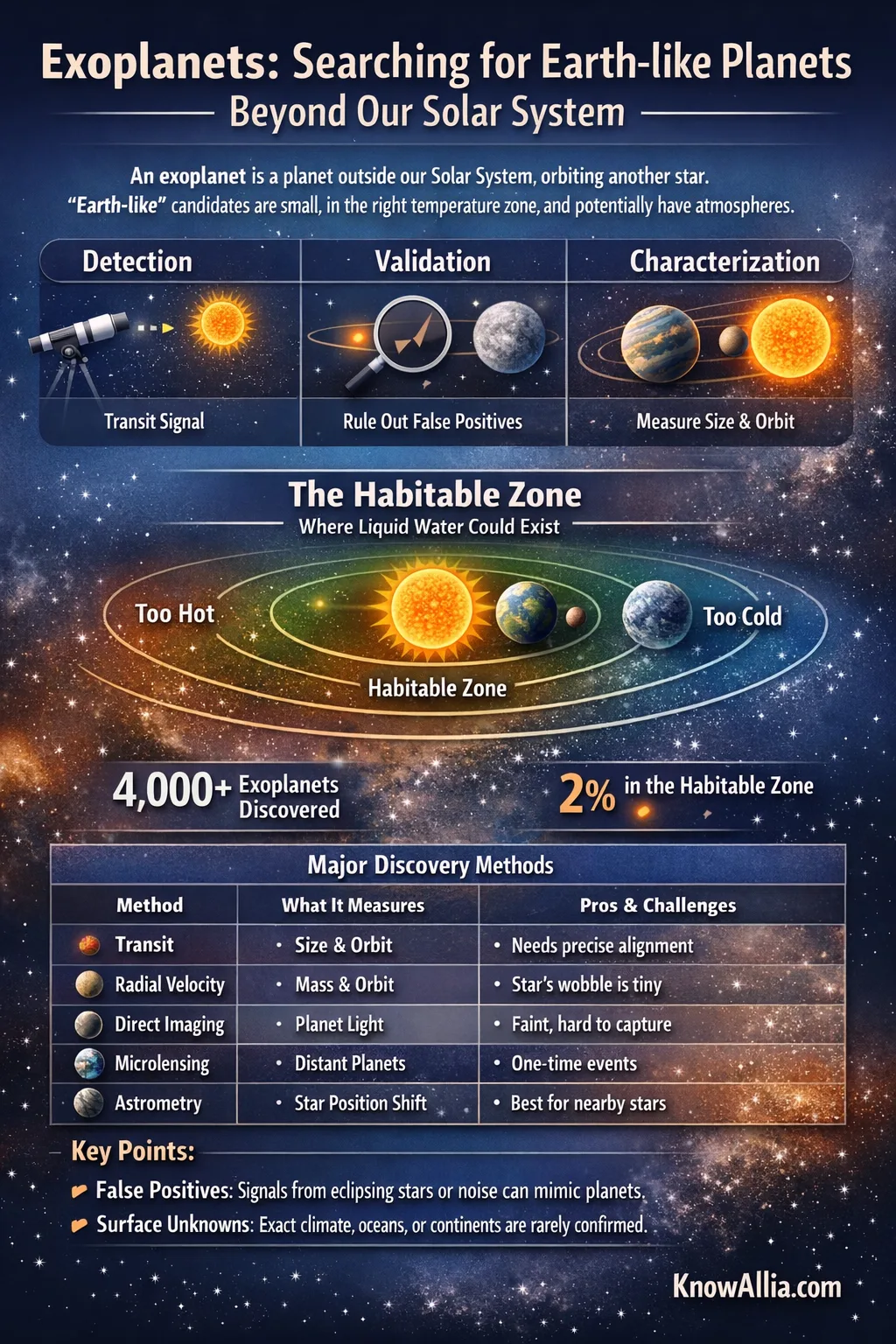
An exoplanet is a planet beyond our Solar System, orbiting another star. The search for Earth-like exoplanets is really a search for measurable “Earth-ish” clues—size, orbit, starlight, and sometimes atmosphere—without pretending we already know what the surface is like. [a] ⓘ
A Clear Starting Point
Most “Earth-like” headlines boil down to three things: small (likely rocky), temperate (not too hot or cold from starlight), and characterizable (we can actually measure something beyond “it exists”). Today we have thousands of worlds to compare, but truly Earth-like conditions are still hard to confirm. [b] ⓘ
- Detection: catching a tiny signal in starlight (often a transit)
- Validation: ruling out look-alikes and false positives
- Characterization: measuring size, mass, orbit, and sometimes atmosphere
This article explains what scientists mean by “Earth-like,” how planets are found and confirmed, what “habitable zone” does (and does not) tell us, and where the most reliable public data lives.
On This Page
What Exoplanets Are
Exoplanets are found around many kinds of stars. Some are huge gas giants hugging their stars, some are icy worlds on wide orbits, and some are smaller rocky planets. The big picture matters: most discoveries so far are shaped by how we look—methods are better at finding certain kinds of planets than others. [b] ⓘ
Useful Mental Model
- Planet size
- Orbit length
- Star type
- Starlight received
- Atmosphere (sometimes)
Those are the “handles” we can grab from far away. Everything else—oceans, continents, weather—usually stays out of reach.
What “Earth-Like” Really Means
“Earth-like” sounds like a single label, but in practice it’s a bundle of approximations. Scientists combine several measurable proxies to decide whether a planet is a strong target for deeper study—especially for atmosphere work.
Clues We Can Measure Early
- Size: “terrestrial” is often framed as roughly 0.5× to 2× Earth’s radius (a size range where rocky composition is plausible). [c] ⓘ
- Orbit: distance from the star and year length
- Starlight: how much energy the planet receives compared to Earth
- Host star: a calm Sun-like star is a different environment than an active red dwarf
Things People Often Assume (But We Rarely Know)
- Surface conditions: temperature, oceans, continents
- Atmosphere details: pressure, clouds, day-night circulation
- Geology: volcanism, plate motion, long-term climate stability
- Magnetic shielding: hard to infer directly
A helpful reality check: calling a planet “Earth-like” based on size and orbit alone is a bit like judging a book from its cover and spine thickness. You can make a smart guess about the category, but you haven’t read the story yet.
Where the Habitable Zone Fits In
The habitable zone is the range of distances from a star where liquid water could exist on a planet’s surface—mainly based on incoming energy. It’s a useful screening tool, not a guarantee. [d] ⓘ
Why this is a content gap online: many pages treat “in the habitable zone” as if it means “habitable.” In reality, it’s just one clue—planets can be too dry, too cloudy, airless, or otherwise unsuitable even in that zone.
How We Detect Distant Planets
Most exoplanets are found indirectly. We usually don’t see the planet itself; we see what it does to the light from its star. A classic example is a transit, when a planet passes in front of its star and dims the starlight slightly. [e] ⓘ
An analogy that matches the scale: spotting a small rocky planet by transit is like noticing a tiny speck cross a bright spotlight from very far away—you’re detecting the brief dip in brightness, not the speck itself.
What Each Method Can Tell You
| Method | Main Signal | What You Can Estimate | Why It’s Tricky for Earth-Like Planets |
|---|---|---|---|
| Transit | Small dip in starlight | Planet radius, orbit period; sometimes rough atmosphere hints | Needs near-perfect alignment; small planets create very small dips [e] ⓘ |
| Radial Velocity | Star’s “wobble” in spectra | Planet minimum mass and orbit | Signals are tiny for small planets; stellar activity can mimic planets |
| Direct Imaging | Faint planet light near a bright star | Orbit, brightness, sometimes atmospheric spectra | Star glare is extreme; Earth-like planets are exceptionally faint |
| Microlensing | Temporary brightening due to gravity | Planet-to-star mass ratio; often planets farther out | Events are one-time; follow-up is limited, so “Earth-like” details are hard |
| Astrometry | Tiny star position shifts | Mass and orbit geometry | Requires exquisite precision; best for nearby stars and longer orbits |
Second content gap you’ll often miss: discovery is not the same as confirmation. A transit-like dip can come from several “planet impostors,” so follow-up observations matter as much as the first detection.
From Signal to Confirmed Planet
Planet hunting has a built-in problem: nature produces look-alikes. A small eclipse from a faint companion star, starspots, or instrumental noise can imitate a planet signal. That’s why researchers use a multi-step confirmation process—often combining several methods. [f] ⓘ
A Typical Confirmation Pipeline
- Detect an initial signal (often a transit series).
- Check the star and the data for obvious false alarms and contamination.
- Model alternative explanations (like eclipsing binaries).
- Follow up with different instruments or techniques (radial velocity, imaging, additional photometry).
- Measure size (radius) and, when possible, mass—so you can estimate density and likely composition.
- Publish with uncertainties and update catalogs as improved measurements come in. [f] ⓘ
This is the “quality control” stage that many surface-level explainers skip. It’s also where uncertainty is handled honestly: a planet can be a strong candidate while still awaiting the last pieces of evidence.
Habitability Clues Scientists Actually Check
After you have a likely rocky planet and a decent orbit estimate, you can start asking: is this a good place to look closer? The habitable zone helps, but it’s only a first filter. [d] ⓘ
Signals That Strengthen (or Weaken) the Case
- Star behavior: frequent flares and strong magnetic activity can change the atmospheric story, especially around red dwarf stars.
- Orbit shape: a highly eccentric orbit can swing a planet between extremes.
- Planet density: mass + radius helps separate rocky worlds from mini-Neptunes.
- System context: nearby planets, resonances, and dust can affect what observations mean.
- Time: long, stable conditions are harder to infer than a single snapshot.
Third content gap that matters for readers: our planet lists are not a perfect census. Short-period planets are easier to detect quickly, so the catalog naturally overrepresents worlds that orbit close to their stars. The “rare” Earth-like planet might be rare in our data partly because it’s harder to catch.
Reading Exoplanet Atmospheres (When We Can)
Atmospheres are where “Earth-like” gets interesting—and where the limits show up fast. One powerful approach is transmission spectroscopy: when a planet transits, a thin ring of starlight passes through the planet’s atmosphere (if it has one), leaving tiny molecular fingerprints in the spectrum. [h] ⓘ
Important nuance: even if you detect a molecule, interpretation needs context. Many gases can have multiple origins. The most reliable statements are usually about composition signals and constraints, not definitive “life found” claims. [h] ⓘ
Earth-Like Exoplanet Search: From Hint to Habitability
A planet becomes a strong “Earth-like” target when multiple measurements line up—size, orbit, star, and (when possible) atmospheric clues—while uncertainties stay visible instead of being brushed aside.
How Evidence Usually Stacks Up
1) Detect Transit dip, stellar wobble, microlensing event2) Validate Rule out impostors, check contamination, follow up3) Characterize Radius + mass → density; orbit → received starlight4) Probe Atmosphere Transmission spectra, thermal emission, direct imaging (rare) Outcome: “Earth-like” becomes a probability, not a stamp Strong targets usually share: • small/rocky signal • temperate orbit • quiet-enough star Common unknowns that remain: • surface pressure • cloud cover • ocean/land balance • long-term climate stabilityWhat Usually Counts as “Earth-Like” Data
Often discussed in a terrestrial range of roughly 0.5–2 Earth radii, but size alone can’t guarantee rock vs gas. [c] ⓘ
Habitable zone is based on starlight and distance. It’s a filter, not a verdict. [d] ⓘ
Transmission spectroscopy can reveal molecules, but interpretation depends on context and uncertainty. [h] ⓘ
Why Confirmation Matters
Before “Earth-like” comes up, scientists work to eliminate false positives and combine data types to strengthen the case. [f] ⓘ
Why Catalogs Change
Planet properties get refined as better observations arrive—mass, radius, and even planet status can be updated over time. [b] ⓘ
Why Not Every Planet Is Equal
Some worlds are simply easier to detect. That bias shapes what “common” looks like in today’s data.
Where Reliable Numbers Come From
If you want to avoid guesswork, use official catalogs. The NASA Exoplanet Archive (hosted at Caltech/IPAC for NASA) provides downloadable tables, tools, and documented programmatic interfaces—useful when you want to filter for “small,” “temperate,” or “around Sun-like stars” without relying on lists that go stale. [g] ⓘ
Real-World Examples of “Earth-Like” Targets
Most well-known examples are famous because they combine detectability (strong signals) with scientific usefulness (they’re good for follow-up). One frequently discussed case is the TRAPPIST-1 system: it offers multiple small planets with repeated transits, which makes it a practical testbed for atmospheric techniques. [h] ⓘ
Why Some Systems Become “Go-To” Examples
- Repeatable events: frequent transits give more chances to measure tiny effects.
- Bright or nearby stars: cleaner data and better follow-up potential.
- Multiple planets: comparative planetology—same star, different planets.
- Temperate orbits: planets that sit in or near the habitable zone draw deeper characterization interest. [k] ⓘ
Common Misconceptions and Common Confusions
These mix-ups are common because the words are simple but the measurements are subtle. Clearing them up makes “Earth-like” articles much easier to read.
Clarifying the Language
None of these points make the search less exciting. They just keep the conversation anchored to what the instruments can truly measure.
Key Terms (Mini Glossary)
- Exoplanet
- A planet outside our Solar System, orbiting another star. [a] ⓘ
- Transit
- A planet passing between a star and the observer, causing a small dip in brightness. [e] ⓘ
- Radial Velocity
- A method that infers planets by measuring how a star’s light shifts as the star moves slightly toward and away from us.
- Habitable Zone
- The range of distances from a star where liquid water could exist on a planet’s surface, based mainly on energy received. [d] ⓘ
- Transmission Spectroscopy
- Comparing a star’s spectrum with and without a transiting planet to infer which wavelengths the planet’s atmosphere absorbs. [h] ⓘ
- False Positive
- A planet-like signal caused by something else (a background eclipsing star, star activity, or instrumental effects). [f] ⓘ
- Catalog
- A curated, updateable database of planets and measurements; it can change as better observations arrive. [b] ⓘ
Limitations and What We Don’t Know Yet
The honest truth is that many “Earth-like” questions are still beyond direct measurement. Even powerful space telescopes often measure indirect fingerprints rather than planet surfaces. Atmospheres of small, temperate planets can be especially challenging, and results may be constrained by clouds, hazes, and limited observing time. [h] ⓘ
- Surface confirmation: we rarely know if there are oceans, continents, or weather systems.
- Atmosphere depth: detecting molecules is possible in some cases, but pressure and climate details are hard.
- Selection bias: the easiest planets to find are not always the most Earth-like. [b] ⓘ
- Context dependence: the same gas or temperature clue can mean different things around different stars.
Still, progress is steady. New surveys expand the planet sample, and follow-up telescopes focus on the best targets—especially those that are small, temperate, and around stars that are bright enough for detailed measurements.
Why Future Surveys Matter
Finding Earth-like planets is partly a technology and time problem: Earth-like orbits around Sun-like stars are longer, so you need longer monitoring to catch repeated transits. Missions designed for bright stars and longer baselines help fill that gap. For example, ESA’s PLATO is built to find and characterize terrestrial planets (including in habitable-zone orbits) by combining transit measurements with stellar information and ground-based follow-up. [i] ⓘ
On the ground, extremely large telescopes are expected to improve our ability to characterize exoplanets, including targets in habitable zones, by pushing resolution and light-gathering power. [j] ⓘ
FAQ
Questions People Ask Most
Does “Earth-like” mean there is life?
No. “Earth-like” usually describes size, orbit/energy, and sometimes atmospheric clues. Life is a separate question that needs much more context than a single label can provide.
Why are transits so popular for finding planets?
Transits let us monitor many stars at once and detect tiny, repeatable dips in brightness. From a clean transit signal, we can estimate a planet’s radius and orbit period. [e] ⓘ
If a planet is in the habitable zone, is it habitable?
Not necessarily. The habitable zone is mainly about whether liquid water could exist based on energy received. Atmosphere, clouds, and many other factors can change outcomes. [d] ⓘ
How do scientists avoid “planet impostors”?
They validate candidates by checking alternative explanations and combining follow-up observations (including different instruments and methods). Confirmation is a structured process, not a single moment. [f] ⓘ
Can we really measure an exoplanet’s atmosphere?
Sometimes. One key method is transmission spectroscopy, which looks for small absorption features in starlight passing through a planet’s atmosphere during a transit. It can reveal molecules, but results depend on noise, clouds, and observing limits. [h] ⓘ
Sources
- NASA Science – Exoplanets Definition of exoplanets and overview of the field. [a] ⓘ
- NASA Science – Exoplanet Catalog Official, updateable catalog context and discovery overview. [b] ⓘ
- NASA Science – Planet Types: Terrestrial Terrestrial size framing and rocky-planet context. [c] ⓘ
- NASA Science – The Habitable Zone Definition and meaning of “habitable zone.” [d] ⓘ
- NASA Science – What’s a Transit? Transit definition and why it works for exoplanet discovery. [e] ⓘ
- NASA Science – 10 Steps to Confirm a Planet Around Another Star Validation/confirmation workflow and false-positive handling. [f] ⓘ
- NASA Exoplanet Archive (Caltech/IPAC) – Using the API Documented ways to retrieve official exoplanet data. [g] ⓘ
- NASA Science – How Will Webb Study Exoplanets? Transmission spectroscopy and atmosphere measurement concepts. [h] ⓘ
- ESA Science Programme – PLATO Mission goals for terrestrial planets, bright stars, and habitability context. [i] ⓘ
- ESO ELT – Exoplanets Ground-based next-generation capability overview for exoplanet characterization. [j] ⓘ
- NASA Science – Goldilocks Zone Resource Habitable-zone concept and why temperate, Earth-size targets draw attention. [k] ⓘ