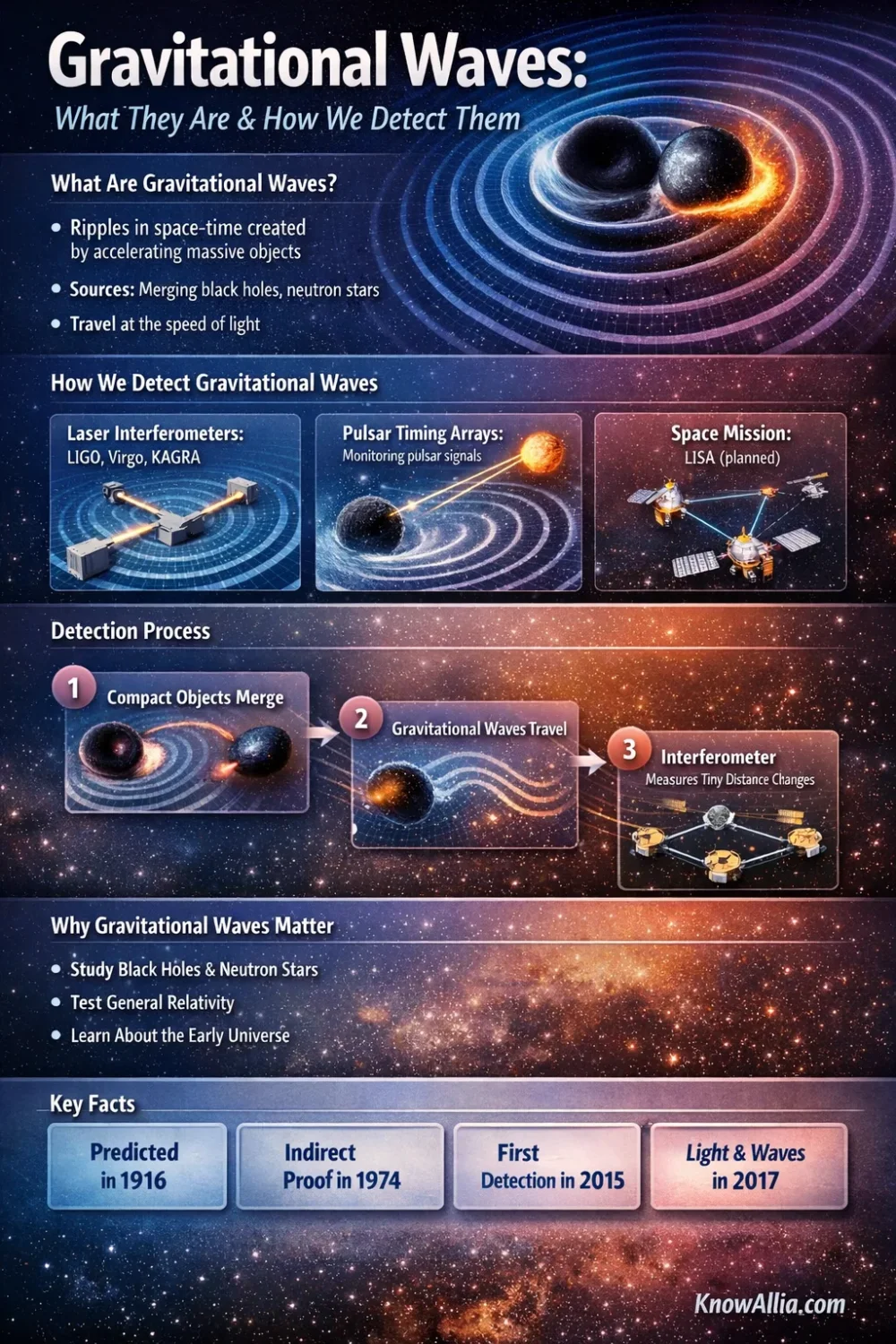
Gravitational waves are tiny stretches and squeezes of space-time produced when massive objects accelerate, especially in tight, fast systems such as merging black holes or neutron stars. They travel at the speed of light and carry direct information about motion, mass, and gravity that ordinary light cannot always provide on its own.[a]
A Clear Starting Point
These waves are not light, sound, or particles. They are changes in the geometry of space-time itself. Detectors do not take pictures of them. They measure relative distance changes so small that the effect can be smaller than an atomic nucleus across kilometer-scale instruments.[d]
- What they are: ripples made by accelerating mass, with the loudest signals coming from compact, heavy systems.[e]
- How we detect them: laser interferometers, pulsar timing arrays, and future space observatories each listen to a different part of the gravitational-wave spectrum.[h][i][j]
- Why they matter: they let astronomers study black holes, neutron stars, and the behavior of gravity in places where light gives only part of the story.[c][g]
You will also see where readers often get mixed up: a gravitational-wave detection is not a dramatic shaking of matter on Earth, and it is not the same thing as a “gravity wave” in air or water. The signal is a measurement of strain — how much distance changes relative to distance already there.
- Predicted in 1916
- Indirect proof in 1974
- Direct detection in 2015
- Light + waves in 2017
- Ground, space, and pulsar methods
What a Gravitational Wave Really Is
A gravitational wave is a traveling distortion in space-time. When massive objects move in an uneven, accelerating way, they can send part of that changing gravitational field outward as a wave. In practice, the clearest signals come from compact objects — black holes and neutron stars — because they pack large mass into small regions and can orbit each other extremely fast.[a][e]
One detail matters more than many short summaries mention: not every moving mass makes a detectable wave. Technically, any accelerating mass emits gravitational radiation, but everyday objects are far too light and too slow to produce a signal our instruments could notice. Detectable waves come from systems with huge mass, rapid motion, and changing geometry.[e]
The wave itself does not look like a visible ripple moving through empty space. A better mental picture is this: if a gravitational wave passes through a ring of freely floating points, one direction is stretched while the perpendicular direction is squeezed, then the pattern flips back and forth. The space between points changes for a moment, and that is the effect detectors try to measure.[a][n]
Useful analogy: the gravitational-wave spectrum is like a piano keyboard. A ground detector does not hear every note. A pulsar timing array listens to very low notes with periods of years. A space mission like LISA is built for notes in between. To hear the full cosmic piece, astronomy needs more than one instrument family.
LIGO groups the most discussed sources into four broad signal families: compact binary inspirals, continuous waves, stochastic backgrounds, and burst signals. That classification is useful because each family leaves a different fingerprint in data, and each asks for a different search strategy.[e]
What Detectors Actually Measure
The central quantity is strain, written as h = ΔL / L. That means detectors care about the fractional change in length, not a simple raw shove. If one arm of an instrument becomes a little longer while the other becomes a little shorter, the wave has left a measurable imprint in the difference between the two paths.[d][n]
What Changes
The distance between freely moving test masses changes by a minute amount, and laser light records that change as a shift in phase or interference pattern.[d]
What Does Not Change
The detector is not measuring a gust, impact, or visible wavefront. It is measuring geometry. That is why the effect can be tiny in matter but still rich in physical meaning.[a]
This point is easy to miss. A detector is not “seeing two black holes collide” in the way a camera sees light. It is inferring the source from the waveform. The shape of that waveform — how frequency and amplitude change with time — lets researchers estimate masses, spins, distance, and sometimes the type of system that produced it.[c][g]
Why the signal is so hard to catch: by the time a wave from a distant merger reaches Earth, the distortion can be far smaller than atomic scales across the detector. That is why gravitational-wave observatories are built around length, isolation, timing precision, and cross-checks, not around ordinary imaging.[a][d]
How Interferometers Turn Stretching Space Into Data
Ground-based observatories such as LIGO, Virgo, and KAGRA use laser interferometers. LIGO has two 4-km arms in each observatory. Virgo uses two 3-km arms in Italy. KAGRA in Japan is also 3 km long and adds two unusual design choices: it sits underground and uses cryogenic sapphire mirrors to reduce noise.[d][k][l]
From Laser Light to Signal
- A laser beam is split into two perpendicular paths.
- The beams travel down long arms, reflect off mirrors, and return.
- Without a passing wave, the paths are tuned so the returning light largely cancels at the output.
- A gravitational wave changes the relative arm lengths, so the two beams no longer cancel in exactly the same way.
- The changing interference pattern becomes a time series that can be searched for physical waveforms.[d][k]
The geometry matters. A wave passing perpendicular to the detector plane tends to lengthen one arm while shortening the other, then reverse that pattern half a cycle later. This differential effect is exactly what makes an L-shaped interferometer useful.[n]
How a Gravitational Wave Becomes a Measured Event
The signal starts as orbital motion, reaches Earth as a tiny strain in space-time, and becomes a detection only after the instrument response, cross-checks, and network agreement all line up.
Why Long Arms Help
A longer baseline turns the same fractional strain into a larger measurable path difference.
Why Noise Control Matters
Seismic motion, thermal motion, and instrument noise can hide the signal unless they are isolated and monitored.
Why One Detector Is Not Enough
A network separates local disturbances from true astrophysical events and narrows the source location on the sky.
Why Noise Control Matters
Real observatories spend just as much effort on noise as on optics. A passing truck, ground motion, thermal motion, or instrumental glitch can all leave traces in the data. That is why detections are not accepted from a single pretty-looking curve. Scientists compare signals across distant detectors, use environmental sensors, and test whether the pattern behaves like a physically allowed waveform rather than a local disturbance.[f][n]
Signal shape also depends on the source. The first black-hole merger that LIGO detected lasted only a fraction of a second in band, while the first neutron-star merger stayed detectable for about 100 seconds. That difference is not cosmetic. It reflects how mass changes the late inspiral and merger timescale.[e][g]
Why Scientists Use Many Detectors
A single detector can show that something happened in the instrument. A network can show that something happened in the sky. This is one of the biggest practical truths in gravitational-wave astronomy, and it is often underexplained in basic articles.[f]
With One Detector
You can measure a candidate signal, but sky localization is weak and local noise is harder to rule out cleanly.
LIGO’s two U.S. sites already help by being far apart. Adding Virgo and KAGRA improves sky localization and broadens observing time. In practice, that means telescopes can be pointed more quickly and over a smaller patch of sky when a wave may also have a light counterpart.[f][g]
The 2017 neutron-star event made this plain: once Virgo joined the network, the source position improved enough for many telescopes to find the light from the same event. That is one reason GW170817 became such a turning point.[g]
Why One Detector Type Is Never Enough
Different gravitational-wave sources live in different frequency bands. Ground interferometers do not miss low-frequency waves because of a software choice. They miss them because Earth-based instruments run into real limits from ground motion, arm length, and noise. To reach lower bands, astronomy needs either a galaxy-sized clock network or an instrument in space.[h][i][j]
| Detector Family | Typical Band | How It Measures | Best-Known Sources | Why It Matters |
|---|---|---|---|---|
| Ground Interferometers LIGO, Virgo, KAGRA | Roughly 10 to 1,000 Hz | Kilometer-scale laser arms on Earth | Stellar-mass black-hole mergers, neutron-star mergers, some black-hole–neutron-star mergers | Direct, high-time-resolution views of the final inspiral, merger, and ringdown |
| Pulsar Timing Arrays NANOGrav and partner arrays | Nanohertz periods of years to decades | Measures tiny timing shifts in ultra-stable millisecond pulsars | Supermassive black-hole binaries and backgrounds built from many slow sources | Opens the lowest-frequency window now probed directly in data |
| Space Interferometers LISA | About 0.1 mHz to 0.1 Hz | Three spacecraft with million-kilometer separations | Massive black holes, compact Galactic binaries, extreme mass-ratio inspirals | Bridges the gap between ground detectors and pulsar timing arrays |
NASA notes that ground detectors like LIGO are sensitive to about 10 to 1,000 Hz, while lower-frequency space systems target about 0.0001 to 0.1 Hz. ESA’s current LISA factsheet gives its operating band as roughly 0.1 mHz to 0.1 Hz, with 2.5 million km between spacecraft. NANOGrav, by contrast, times pulsars over many years and has reported evidence for gravitational waves that oscillate on timescales from years to decades.[h][i][j]
That split across bands is not a minor technical footnote. It changes which universe you can hear. Ground interferometers are best for fast, compact mergers near the end of coalescence. LISA is built for slower, larger systems. Pulsar timing arrays listen for still slower gravitational rhythms that can take years to swing through a full cycle.[i][j]
What Gravitational Waves Have Already Revealed
The story did not begin with the 2015 direct detection. In 1974, Russell Hulse and Joseph Taylor found a binary pulsar whose orbit shrank at the rate expected if the system were losing energy through gravitational radiation. That was the strongest indirect proof then available and helped motivate decades of detector work.[b]
Direct detection arrived on September 14, 2015, when both LIGO detectors measured a wave from a binary black-hole merger. That result did two things at once: it confirmed that gravitational waves can be sensed directly, and it showed that binary black-hole mergers are real astrophysical systems, not just theoretical possibilities.[c]
Then came GW170817, detected on August 17, 2017. This time the source was a neutron-star merger, and it was observed in both gravitational waves and light. That let astronomers connect the waveform to gamma rays, optical follow-up, and heavy-element production, turning gravitational-wave astronomy into true multi-messenger astronomy.[g]
Where the Field Stands Now
On March 5, 2026, the LIGO Laboratory reported that the new LVK catalog update added 128 new candidates from the first part of the fourth observing run, more than doubling the earlier catalog built from the first three runs. The same release noted that the fourth run had already yielded about 300 detections so far, with not all of them yet appearing in the published catalog. That shift matters because the field is no longer limited to a few historic firsts. It is now moving into population-level astronomy.[m]
What can scientists pull from a waveform? Often the masses of the objects, clues about their spins, the distance to the source, and tests of whether the signal follows general relativity. When light is also seen, the science becomes far richer because the same event can be studied from two very different messengers.[c][g][m]
Where Readers Often Get Mixed Up
- “Gravitational waves are the same as gravity waves.”
They are not. Gravity waves in fluids are a different phenomenon. Gravitational waves are distortions of space-time. - “A detector records objects moving through space.”
Not directly. It records tiny changes in relative length and then infers the source from the waveform. - “Any moving mass should be easy to detect.”
No. Everyday sources are far too weak. Detectable signals come from huge masses moving very fast in compact systems.[e] - “LIGO alone covers all gravitational waves.”
No. Ground interferometers hear only part of the spectrum. Pulsar timing arrays and LISA target lower bands.[h][i][j] - “One detector is enough for a firm discovery.”
A network makes the case much stronger by lowering the chance that a local disturbance is mistaken for a cosmic event.[f][n]
Key Terms in Plain Language
- Strain
- The fractional change in length caused by a passing wave. It is the main observable in interferometric detectors.
- Interferometer
- An instrument that compares light paths. In gravitational-wave work, it turns tiny path-length differences into measurable interference changes.
- Inspiral
- The stage in which two compact objects orbit closer and closer because they lose orbital energy through gravitational radiation.
- Ringdown
- The final settling stage after a merger, when the newly formed object relaxes toward a stable state.
- Stochastic Background
- A combined hum from many unresolved sources, or possibly from very early-universe processes, rather than one isolated event.[e]
- Multi-Messenger Astronomy
- Studying the same source with gravitational waves and with light, particles, or both. GW170817 is the famous early example.[g]
- Pulsar Timing Array
- A long-term timing network that treats ultra-stable millisecond pulsars as cosmic clocks and looks for tiny correlated shifts in pulse arrival times.[j]
- Extreme Mass-Ratio Inspiral
- A system in which a small compact object orbits a much more massive black hole. These are among LISA’s major targets.[i]
What We Can Measure, and What Still Stays Fuzzy
Gravitational-wave data are powerful, but they do not answer every question cleanly on first pass. Distance and orbital orientation can partially mimic each other in the waveform. Sky localization improves with more detectors, but it can still be broad. Some weak or borderline events remain harder to classify. And while low-frequency searches have become much more active, the exact makeup of the nanohertz background is still being sorted out from evidence to firmer source interpretation.[f][j][m]
That is normal for a young observing field. Gravitational-wave astronomy has already moved from proof to repeated measurement, but some of its most interesting targets still lie ahead: a clearer nanohertz population picture, lower-frequency space observations with LISA, and sharper tests of gravity and dense matter with richer event catalogs.[i][j][m]
The field’s biggest change is simple to state: the question is no longer whether these waves exist. The question now is how much of the universe can be reconstructed from them.
FAQ
Questions Readers Usually Ask
What is a gravitational wave in one sentence?
A gravitational wave is a traveling distortion of space-time caused by accelerating mass, especially in compact and fast-moving systems such as merging black holes or neutron stars.
Why are detectors built in an L shape?
Because a passing wave tends to stretch one direction while squeezing the perpendicular one. Two perpendicular arms let the instrument compare those changes very precisely.
Can black holes be studied even if they emit little or no light?
Yes. That is one of the strengths of gravitational-wave astronomy. A binary black-hole merger can be measured from its waveform even when there is little or no electromagnetic signal.
Did the first direct detection happen in 2015 or 2016?
The wave was detected on September 14, 2015. The announcement and publication followed in February 2016.
Will LISA replace LIGO?
No. LISA is planned for a lower-frequency band in space, while LIGO, Virgo, and KAGRA observe higher-frequency signals on Earth. They are complementary, not interchangeable.
Why was GW170817 discussed so widely?
Because it was a neutron-star merger seen in gravitational waves and in light. That let astronomers connect the waveform to telescopes across the spectrum and study the same event in more than one messenger.
Sources
- LIGO Lab – What are Gravitational Waves? Used for the core definition, wave behavior, and the 1916 prediction. ↩
- Nobel Prize – The Nobel Prize in Physics 1993: Catching Gravity’s Waves Used for the Hulse–Taylor binary pulsar as strong indirect proof. ↩
- LIGO Lab – Detection Used for the first direct detection on September 14, 2015 and what that event established. ↩
- LIGO Lab – LIGO’s Interferometer Used for arm length, interferometer layout, and path-length measurement. ↩
- LIGO Lab – Sources and Types of Gravitational Waves Used for source classes, inspiral behavior, and why some signals last longer than others in band. ↩
- LIGO Lab – Our Collaborations Used for why multiple detectors improve confidence, sensitivity, and sky localization. ↩
- LIGO Lab – GW170817 Press Release Used for the first neutron-star merger seen in both gravitational waves and light. ↩
- NASA – NSF’s LIGO Has Detected Gravitational Waves Used for the ground-versus-space frequency-band comparison. ↩
- ESA – LISA Factsheet Used for LISA’s band, architecture, and mission role in the lower-frequency regime. ↩
- NANOGrav – 15-Year Data Release Used for pulsar timing arrays and the reported evidence for years-to-decades gravitational-wave oscillations. ↩
- Virgo – Detector Used for Virgo’s 3-km interferometer design and operating principle. ↩
- ICRR, University of Tokyo – KAGRA Observatory Used for KAGRA’s underground location, cryogenic sapphire mirrors, and 3-km scale. ↩
- LIGO Lab – New Catalog More Than Doubles the Number of Gravitational-Wave Detections Made by LIGO, Virgo, and KAGRA Observatories Used for the March 5, 2026 field update and current catalog context. ↩
- LIGO Lab – 2016 Press Kit PDF for the First Detection Used for the differential-arm response, detector validation logic, and how a candidate event is tested against noise. ↩