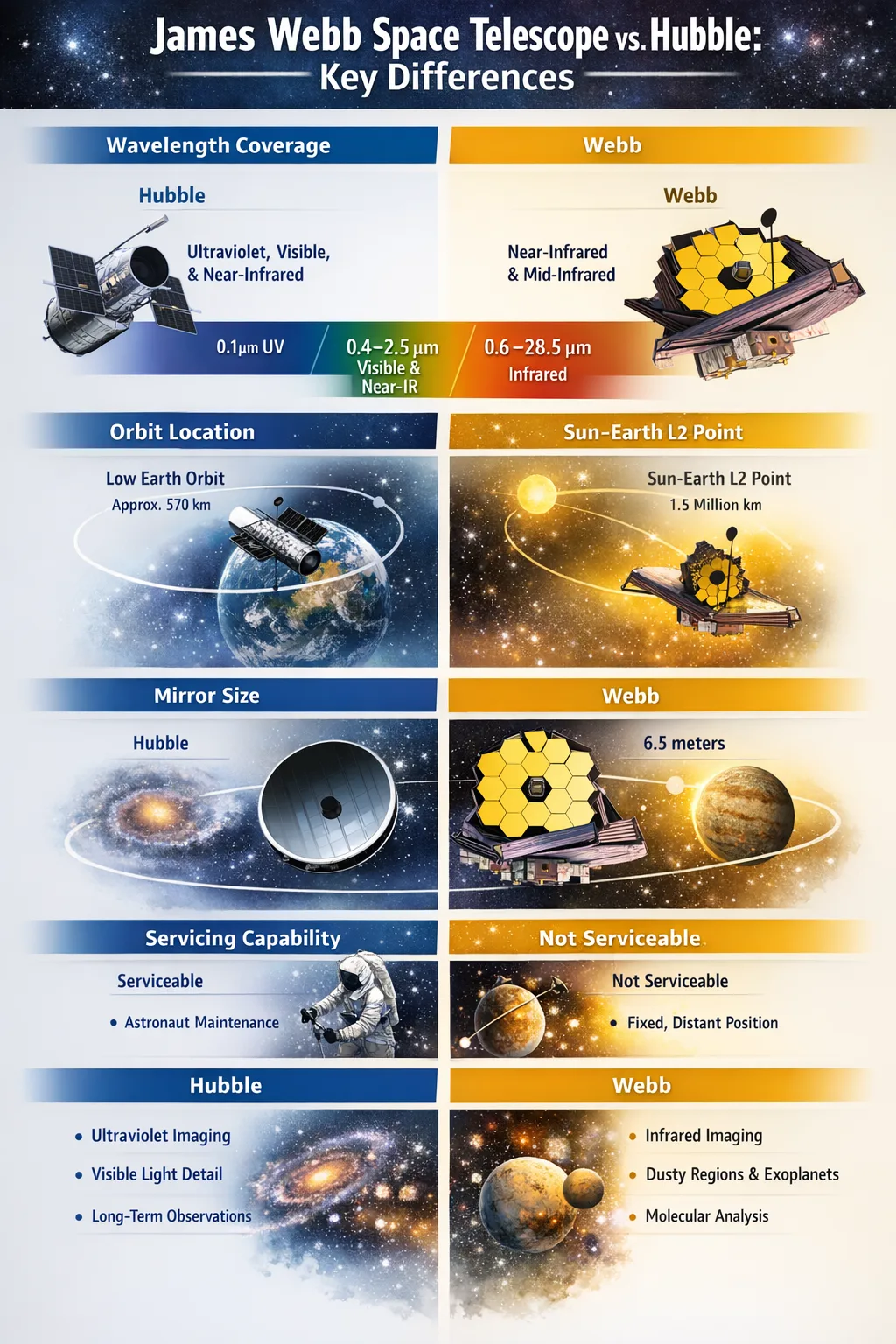
James Webb Space Telescope (JWST) and the Hubble Space Telescope are space-based observatories that collect faint light from distant objects, but they are built for different wavelength ranges, different operating temperatures, and different orbits—so their strengths are not interchangeable.
Think of them as complementary tools: Hubble is a long-running ultraviolet-to-visible specialist with important near-infrared capability, while Webb is engineered for infrared astronomy with deep sensitivity.
A Simple, Accurate Comparison
Hubble
UV, visible, and near-IR views from low-Earth orbit; designed to be serviced
Webb
Near-IR to mid-IR performance from the Sun–Earth L2 region; tuned for cold, stable observing
Many observing programs use both telescopes to build a fuller picture—light at different wavelengths answers different physical questions.
Overview
Hubble was launched aboard Space Shuttle Discovery on April 24, 1990, with the Hubble Space Telescope as the primary payload.[Source-1]
Webb’s mission timeline includes its December 25, 2021 launch and also explains a major operational difference: Webb is far from Earth and cannot be serviced the way Hubble was.[Source-2]
Webb is positioned as a major general-purpose observatory for studying “every phase” of cosmic history, from early galaxies to the formation of planetary systems, with a design shaped around infrared performance.[Source-3]
After commissioning, Webb began routine science operations in 2022 under the Space Telescope Science Institute’s science operations program.[Source-4]
What “Key Differences” Really Means Here
- Wavelength coverage changes what physics you can measure (temperature, dust, molecules, ionized gas).
- Thermal design controls infrared noise; cold hardware matters.
- Orbit and stability shape observing efficiency and sky access.
- Instrument suites define imaging vs spectroscopy capabilities and sensitivity.
Where They Operate
Hubble’s Low-Earth Orbit Context
Hubble circles Earth, completing an orbit about every 95 minutes, which has historically enabled astronaut access for upgrades and repairs.[Source-5]
This orbit also means Hubble observes above the atmosphere, avoiding atmospheric turbulence and absorption that complicate many ground observations.
Webb’s Sun–Earth L2 Orbit
Webb does not orbit Earth. It orbits the Sun near the second Lagrange point (L2), about 1.5 million kilometers from Earth, which helps keep the Sun, Earth, and Moon on the same side of its sunshield for thermal stability.[Source-6]
The payoff is a steady thermal environment that supports infrared sensitivity and long, uninterrupted observing.
Mirrors and Light Collection
Mirror size affects how much light a telescope collects and, at a given wavelength, how fine its diffraction-limited detail can be. Webb’s primary mirror is 6.5 meters across, and its segments are made from beryllium for strength and stability across temperatures.[Source-7]
Hubble’s primary mirror diameter is 2.4 meters, a design that has supported decades of high-resolution science across ultraviolet, visible, and near-infrared wavelengths.[Source-8]
| Category | Hubble Space Telescope | James Webb Space Telescope |
|---|---|---|
| Primary Mirror | 2.4 m diameter | 6.5 m segmented mirror |
| Orbit | Low-Earth orbit (about a 95-minute orbit period) | Sun–Earth L2 region (~1.5 million km from Earth) |
| Best-Known Strength | UV/visible imaging and spectroscopy, plus near-IR | Near-IR and mid-IR imaging and spectroscopy |
| Servicing | Serviceable by design | Not serviceable at its operating distance |
| Thermal Strategy | Operates without a large multi-layer sunshield | Large sunshield keeps optics and instruments extremely cold |
Wavelengths and Sharpness
NASA’s own comparison summarizes the clearest difference: Webb is optimized for about 0.6 to 28.5 microns, while Hubble is optimized for about 0.1 to 2.5 microns—so each telescope sees different physical signals in the same object.[Source-9]
Why wavelength matters: infrared light is strongly linked to cooler material and dust-enshrouded regions, while ultraviolet and visible light can highlight hotter stars, ionized gas, and fine structural detail. The “better” telescope depends on the question being asked.
How Sharp Is Webb Compared With Hubble?
Webb’s larger mirror helps at infrared wavelengths, but resolution is also wavelength-dependent. NASA notes that Hubble at about 0.7 micron (visible) delivers image sharpness comparable to Webb at about 2 microns (near-infrared).[Source-10]
What Hubble Is Naturally Strong At
- Ultraviolet observations that cannot reach the ground effectively
- Fine detail in visible light for galaxies, nebulae, and star clusters
- Long time-baseline studies built over decades of consistent observing
What Webb Is Naturally Strong At
- Dust-penetrating infrared views of star formation regions
- Mid-infrared sensitivity to cooler objects and thermal emission
- Infrared spectroscopy for molecules and atmospheric features
Instruments
In practice, “what a telescope can do” is defined by the instruments attached to it—imagers, spectrographs, and guidance systems. Webb’s instrument suite includes NIRCam, NIRSpec, MIRI, and FGS/NIRISS, supporting both high-quality imaging and multiple spectroscopy modes in the infrared.[Source-11]
Hubble’s current instrument set includes Wide Field Camera 3 (WFC3), Advanced Camera for Surveys (ACS), Cosmic Origins Spectrograph (COS), Space Telescope Imaging Spectrograph (STIS), and the Fine Guidance Sensors that support pointing and other measurements.[Source-12]
Imaging vs. Spectroscopy (Why Both Matter)
- Imaging shows structure: shapes, filaments, clusters, rings, and how light is distributed.
- Spectroscopy reveals composition and conditions: temperatures, chemical signatures, ionization, and motion.
- Many flagship studies combine both—an image to locate features, then spectra to explain them.
Servicing and Upgrades
Hubble was designed with servicing in mind, and NASA explains that five servicing missions extended Hubble’s life and expanded its capabilities through upgrades and repairs over time.[Source-13]
Webb operates much farther away, and NASA’s mission timeline emphasizes that its distance and complexity mean it will not be able to be serviced after deployment.[Source-14]
Why Webb’s Cold Design Is So Central
Infrared telescopes must limit their own heat because warm hardware emits infrared light. NASA describes how Webb’s sunshield enables stable temperatures below 50 Kelvin and notes that Webb’s near-infrared instruments operate around 39 K through passive cooling.[Source-15]
Practical implication: the colder the observatory, the easier it becomes to detect extremely faint infrared signals—especially from very distant or dust-hidden targets.
How the Two Telescopes Complement Each Other
For many science cases, the highest value comes from combining Hubble and Webb rather than ranking them. When you align ultraviolet/visible observations with infrared observations, you can separate what is hot, what is cool, what is hidden by dust, and what is actively forming.
Common Hubble + Webb Pairings
- Galaxies: Hubble highlights fine structure in visible light; Webb reveals dust-embedded components and older stellar populations.
- Star Formation: Hubble maps ionized gas and young stars; Webb looks through dust to protostars and warm dust emission.
- Exoplanets: Webb’s infrared spectroscopy can probe atmospheric molecules, while Hubble’s UV/visible capabilities can add complementary constraints for certain targets.
A Balanced Way to Choose “Which Is Better”
- If your question is UV/visible physics, Hubble is often the natural starting point.
- If your question is infrared physics, Webb is usually the right tool.
- If your question spans dust, temperature, and composition, using both can reduce ambiguity.
Frequently Asked Questions
FAQ
Does Webb “replace” Hubble?
No. They are built for different wavelength ranges and different observing conditions, so they answer different kinds of questions. Many programs gain accuracy by combining ultraviolet/visible data with infrared data.
Why does Webb need to be so cold?
Infrared astronomy is sensitive to heat: warm telescope components can emit infrared light that competes with faint targets. Webb’s design reduces this self-emission so the detectors can measure extremely dim signals.
Is Webb always sharper than Hubble?
Not across all wavelengths. Sharpness depends on both mirror size and wavelength. Webb tends to excel at infrared resolution, while Hubble can provide very fine detail in visible light.
Why can Hubble be serviced but Webb cannot?
Hubble’s low-Earth orbit made astronaut servicing feasible. Webb operates far from Earth in the Sun–Earth L2 region, which makes astronaut servicing impractical with current mission architectures.
What is the most important difference for everyday readers?
Wavelength focus. Hubble is famous for ultraviolet and visible views, while Webb is optimized for infrared. That single design choice shapes everything else: detectors, temperature control, orbit, and the types of discoveries each is best positioned to make.
Can the two telescopes observe the same target?
Yes, and it is often useful. Observing the same target at different wavelengths can separate dust effects from intrinsic structure and reveal different physical processes happening at the same time.