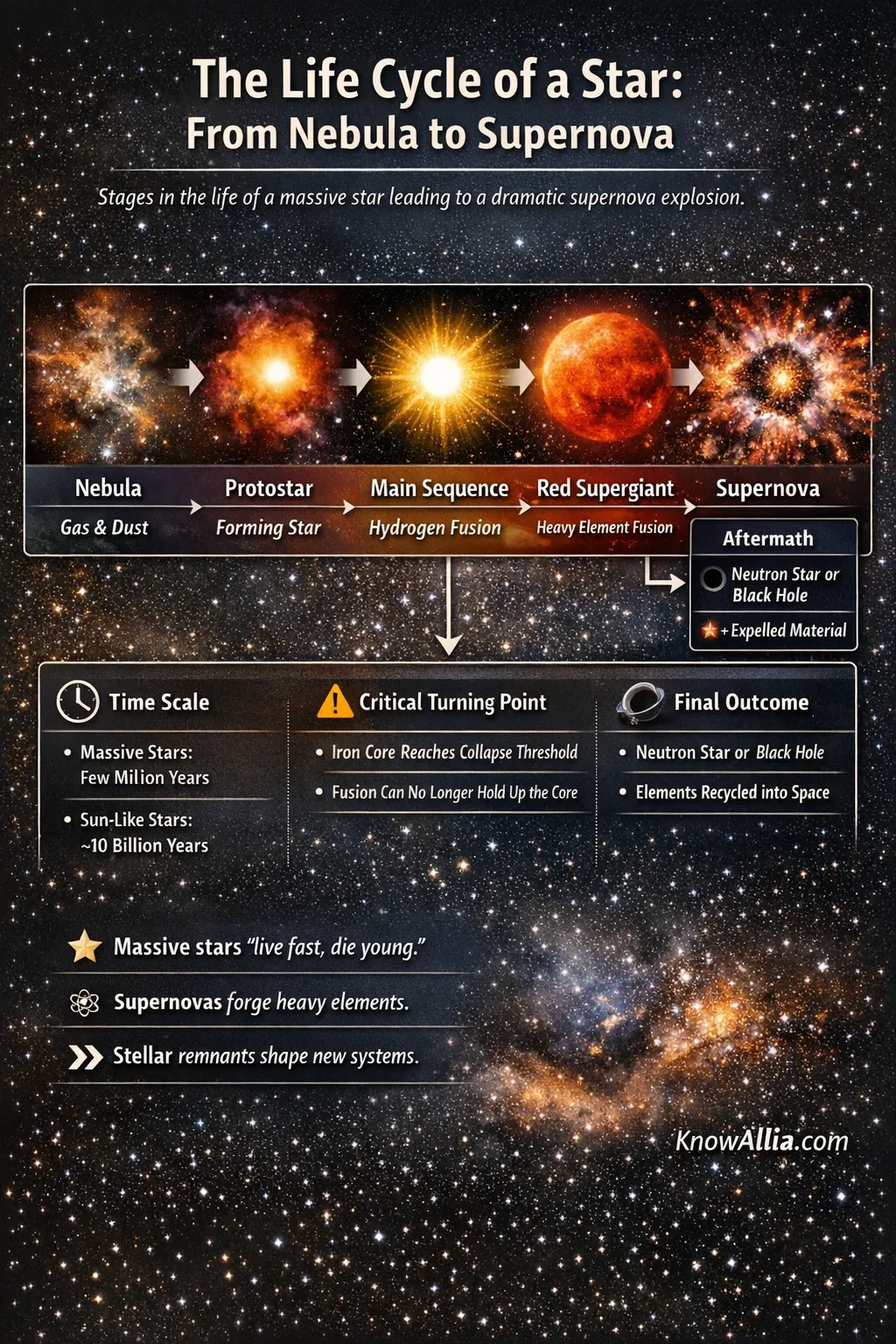
A star is a self-gravitating ball of hot gas (plasma) that shines because its core releases energy through nuclear fusion. The “life cycle of a star” is the story of how that balance begins inside a cold nebula, settles into a long stable phase, and—if the star is massive enough—ends with a supernova that reshapes its neighborhood.[a]↗
A Simple Way to Hold the Whole Story
Stars form when parts of a nebula collapse under gravity, heat up, and finally ignite fusion. From there, the star’s mass quietly decides almost everything: how bright it shines, how long it lives, and whether it can end in a supernova.
- How a nebula becomes a protostar and then a main-sequence star
- What changes inside a star as it runs through different fusion fuels
- Why only some stars explode—and what they leave behind
In this article, you’ll learn what’s physically happening at each stage (not just the names), how astronomers connect the stages to real observations, and where the science is rock-solid versus still being refined. Nebula Protostar Main Sequence Red Supergiant Supernova
What a Star Is (And What Keeps It Stable)
The Core Balance That Defines a Star
- Gravity pulls inward, trying to compress the star.
- Heat and particle pressure push outward; that pressure ultimately comes from energy released by fusion (for most of a star’s lifetime).[b]↗
- When inward and outward forces match, the star is in hydrostatic equilibrium—stable enough to shine steadily for a very long time.
A useful analogy is a seesaw: put gravity on one side and pressure on the other. If one side suddenly gets heavier, the star adjusts—by contracting, expanding, heating, or cooling—until the seesaw levels out again.
Nebulae: The Starting Line for New Stars
In everyday astronomy talk, “nebula” can mean a few different things. Here it means a stellar nursery: a region of gas and dust where parts of a cloud can become dense enough to collapse into new stars.[c]↗
What Triggers the Collapse?
- Gravity becomes locally dominant in a denser pocket of the cloud.
- Nearby activity (like winds from young stars) can compress the cloud further.
- Cooling lets the gas lose heat, making it easier for gravity to keep tightening the clump.
Why Star Birth Is Hard to See
Early star formation happens inside dusty cocoons. Visible light gets blocked, so infrared observations are often needed to see deeper into star-forming regions and disks around young stars.[d]↗
Protostar: A Star Before It Becomes a Star
As a collapsing clump shrinks, it heats up. At this stage, the object is a protostar: it’s bright mainly because gravity is converting potential energy into heat, not because core fusion has fully kicked in.[e]↗
What’s happening inside: material keeps falling inward (accretion), the core gets hotter and denser, and the protostar “practices” being stable by repeatedly adjusting its size and temperature as it grows.
Main Sequence: The Long Hydrogen-Burning Era
A star enters the main sequence when its core becomes hot and dense enough for steady hydrogen fusion into helium. That ignition is a big deal because it creates a reliable energy source that can hold gravity in check for most of the star’s life.[f]↗
Mass Decides the Pace
Heavier stars have more fuel, but they burn it far faster because their cores run hotter and their luminosities climb steeply. The result is a “live fast, die young” pattern.[g]↗
- Sun-like main-sequence lifetime: about 10 billion years (order of magnitude).[g]↗
- Very massive stars: only a few million years on the main sequence.[g]↗
- Smaller K and M stars: projected lifetimes can be tens to hundreds of billions of years.[g]↗
Two common fusion pathways during this era are the proton–proton chain (dominant in lower-mass stars) and the CNO cycle (more important in hotter, higher-mass cores). The names differ, but the headline is the same: hydrogen becomes helium and releases energy.
How Astronomers “Place” a Star in Its Life Cycle
One of the most practical tools is the Hertzsprung–Russell (H–R) diagram, which plots a star’s brightness against its temperature (or color). Main-sequence stars fall on a clear band, and stars shift off that band as their interiors change—so the diagram becomes a map of stellar evolution in action.[h]↗
Giant Phases: When the Core Runs Low on Hydrogen
When the core hydrogen supply drops, the core contracts and heats up while fusion moves into a shell around the core. The outer layers respond by swelling outward. That’s how a star becomes a giant—and the details depend heavily on mass.[i]↗
Lower-Mass Stars (No Supernova Ending)
- Expand into a red giant.
- Begin helium fusion later (after core contraction).
- Lose outer layers over time, enriching space with gas and dust.
These stars usually end as a white dwarf plus an expelled shell (often called a planetary nebula). That “nebula” is not the same thing as a star-forming nebula—same word, different phase of the story.
High-Mass Stars (Supernova Track)
- Expand into a red supergiant (in many cases).
- Fuse heavier elements in stages as the core heats further.
- Build a layered interior—often described as “onion-like” shells of fusion.
As the fuel changes, each new fusion stage typically runs shorter than the last. The star is spending its remaining fuel budget faster and faster.
The Run-Up to Supernova: An Iron Core Changes Everything
Massive stars can fuse elements up to iron-group nuclei. The problem is that iron fusion doesn’t pay energy back the way earlier fusion does. Once an iron-rich core forms, the star is approaching a hard limit: it’s losing the ability to support itself with fusion-driven pressure.[j]↗
A key threshold: in simplified terms, when a dense core nears the Chandrasekhar-scale mass (often quoted around 1.4 solar masses in the white-dwarf context), gravity can win rapidly and trigger collapse.[k]↗
Supernova: The Explosion Phase (What’s Reliable vs. What’s Still Being Refined)
In a core-collapse supernova (the common “massive star” supernova), the core collapses extremely fast. A shock wave forms and the outer layers are blasted outward, leaving a compact object behind. A huge portion of the energy is carried away by neutrinos, and a smaller fraction ends up powering the visible explosion.[l]↗
What Happens in Broad Strokes
- Core collapse: gravity overwhelms pressure support in the iron core.
- Rebound and shock: the inner core compresses to extreme density and rebounds, launching a shock into infalling layers.
- Energy transport: neutrinos flood out; their interaction with matter is central to modern explosion models.
- Ejection: the star’s outer material races outward and becomes a supernova remnant over time.
From Dust Cloud to Supernova: The High-Mass Star Path
A massive star (roughly above the “supernova threshold”) moves through a few big turning points: collapse, steady hydrogen fusion, rapid heavy-element fusion, core collapse, and explosive recycling into space.
Time Scale
Massive stars can reach the supernova stage in a few million years, while Sun-like stars spend ~10 billion years mainly in the main sequence.
Turning Point
Once an iron-rich core dominates, fusion can’t keep the balance. Collapse can follow quickly.
Recycling
Supernova ejecta mix into the interstellar medium and help seed future stars and planets with heavier elements.
What’s Left After the Blast
After a core-collapse supernova, the core remnant is typically a neutron star or a black hole, while the ejected layers expand into a supernova remnant. The exact dividing lines depend on the star’s mass, composition, rotation, and whether it interacted with a companion star.[m]↗
Where “Star Stuff” Comes From
Stars build many elements up to iron-group nuclei during their lives. Some of the heavier elements are strongly linked to explosive environments, and supernovae are a major part of that recycling story.[n]↗
Not Every Star Ends as a Supernova
The phrase “from nebula to supernova” fits massive stars, but most stars won’t explode. Many stars end more quietly as a white dwarf. However, a white dwarf in a close binary can still produce a supernova if it gains enough mass from its partner—this is the classic path to a Type Ia supernova.[o]↗
Why this matters: binary interaction can change a star’s “expected” ending. Even if two stars were born together, mass transfer can make their life cycles diverge in surprising ways.[p]↗
Typical Outcomes by Starting Mass
These ranges are intentionally approximate. Real stars are influenced by composition (metallicity), rotation, and especially binary companions. Still, the table is a practical mental model for “what usually happens.”[q]↗
| Initial Mass (Approx.) | Long Stable Phase | Late Evolution | Common Ending |
|---|---|---|---|
| Low-Mass (below Sun-like) | Long main sequence (hydrogen fusion) | Giant phase; strong mass loss over time | White dwarf + expelled gas shell |
| Sun-Like to Intermediate | Main sequence (billions of years scale) | Red giant / later shell burning | White dwarf; no core-collapse supernova |
| Massive (supernova track) | Bright main sequence (millions of years scale) | Supergiant; heavy-element fusion shells | Core-collapse supernova → neutron star or black hole |
| White Dwarf in Close Binary | White dwarf is already “dead” as a fusion star | Accretes material from companion | Type Ia supernova (thermonuclear runaway) |
Common Misconceptions and Confusions
Common Mix-Up “A nebula is always where stars are born.”
Better “Nebula” is a broad label. It can mean a star-forming cloud, a planetary nebula from a dying star, or a supernova remnant.[r]↗
Common Mix-Up “Stars explode the moment hydrogen runs out.”
Better Many stars don’t explode at all. Massive stars can keep going by fusing heavier elements in stages; collapse happens when the core can no longer be supported the same way.[i]↗
Common Mix-Up “Supernovae make all heavy elements.”
Better Stars manufacture many elements during their lives, and explosions add more—yet some heavy-element pathways involve other extreme events too. It’s a shared cosmic supply chain, not a single factory.[s]↗
Key Terms (Mini Glossary)
- Nebula
- A cloud of gas and dust; context matters because the word covers star-forming regions, planetary nebulae, and supernova remnants.
- Protostar
- A forming star still powered mainly by gravitational contraction rather than steady core fusion.
- Main Sequence
- The long phase where a star fuses hydrogen into helium in its core and stays relatively stable.[f]↗
- Hydrostatic Equilibrium
- The balance between gravity pulling inward and pressure pushing outward inside a star.
- Red Giant / Red Supergiant
- Expanded late-stage stars; “supergiant” is the massive-star version that can proceed toward core collapse.
- Core-Collapse Supernova
- An explosion triggered by the rapid collapse of a massive star’s core, leaving a neutron star or black hole.
- White Dwarf
- A dense stellar remnant; it can still be involved in a Type Ia supernova if it accretes enough mass in a close binary.[o]↗
Limitations and What We Still Don’t Know
Stellar evolution is one of astronomy’s most successful frameworks, but a few parts remain active research territory. That’s normal for a science that deals with extreme conditions we can’t reproduce on Earth.
- Exact “cutoff” masses are fuzzy. The boundary between a star that forms a neutron star versus a black hole depends on details like composition, rotation, and mass loss.[t]↗
- Supernova explosion details are still being refined. The big steps (collapse, neutrinos, shock, ejection) are supported by strong evidence, but how the shock successfully becomes an explosion in 3D is still an area of intense modeling and comparison to data.[u]↗
- Binary interaction can rewrite the script. Mass transfer can speed up, slow down, or redirect late stages and even create supernova paths that don’t fit “single-star” expectations.[p]↗
FAQ
Common Questions About Stellar Life Cycles
Do all stars start in a nebula?
Stars form from gas and dust in the interstellar medium; the “nebula” label is often used for the densest, most structured star-forming regions. In practice, star birth is tied to cloud collapse and fragmentation inside these regions.
What exactly marks the start of the main sequence?
The main sequence begins when hydrogen fusion in the core becomes stable enough to provide the star’s long-term outward pressure support. Before that, a protostar shines mostly from gravitational contraction.
Why can’t a massive star just keep fusing elements forever?
Fusion only releases energy up to a point. Once an iron-rich core dominates, fusing iron doesn’t provide the same energy support, so the core becomes vulnerable to collapse under gravity.
Is a Type Ia supernova part of a normal single-star life cycle?
Not usually. A Type Ia supernova is typically tied to a white dwarf in a close binary system that gains mass from a companion until conditions trigger a runaway thermonuclear event.
What decides whether the remnant is a neutron star or a black hole?
The broad driver is the star’s initial mass, but the final outcome also depends on how much mass the star loses and whether it interacted with a companion. That’s why the boundaries are best treated as approximate.
Do supernovae help create new stars?
Yes. Supernovae inject energy and heavier elements into space. Over time, that material mixes into clouds that can later collapse into new generations of stars and planets.
Sources
- [a] NASA Science – Types of Stars (Mass ranges, main-sequence definition, red giants, compact remnants) [a]↩
- [b] NASA Science – Stars (General star fundamentals and how stars shine) [b]↩
- [c] NASA Science – Stars (Context for star formation and stellar basics; used conceptually for nebula context) [c]↩
- [d] NASA Science (JWST) – Star Lifecycle (Dusty star-forming cocoons, infrared observations, disks around young stars) [d]↩
- [e] ESA (Gaia) – Stellar Evolution (Stellar evolution overview and stage concepts) [e]↩
- [f] NASA Science – Types of Stars (Main sequence as hydrogen fusion; population context) [f]↩
- [g] Open University (OpenLearn) – Stellar Lifetime as a Function of Mass (Main-sequence lifetime table across masses) [g]↩
- [h] Open University (OpenLearn) – H–R Diagram Course Section (H–R diagram context within the same instructional material) [h]↩
- [i] NASA Science – Types of Stars (Giant and supergiant pathways and general end states) [i]↩
- [j] NASA GSFC (Cosmicopia) – Astronomy Q&A (Element formation and recycling context) [j]↩
- [k] NASA Imagine the Universe – White Dwarfs (Chandrasekhar-scale context for compact cores) [k]↩
- [l] Chandra X-ray Observatory (Harvard) – Supernova Remnants Background (Core collapse, neutrinos, shock and explosion overview) [l]↩
- [m] NASA Science – Types of Stars (Neutron stars and black holes as common remnants) [m]↩
- [n] NASA GSFC (Cosmicopia) – Astronomy Q&A (How heavy elements relate to stellar evolution and explosive events) [n]↩
- [o] Chandra X-ray Observatory – Stars and Stellar Evolution (Type Ia vs. core-collapse context in educational materials) [o]↩
- [p] NASA Science – Multiple Star Systems (How companions and mass transfer can affect evolution) [p]↩
- [q] NASA Science – Types of Stars (Mass-dependent outcomes summarized) [q]↩
- [r] NASA Space Place – What Is a Supernova? (Beginner-friendly clarification that “nebula” can appear as an expanding cloud after an explosion) [r]↩
- [s] NASA Advanced Supercomputing – R-Process and Heavy-Element Origins Demo (Modern view that multiple extreme events contribute to the heaviest elements) [s]↩
- [t] NASA Science – Types of Stars (Remnant outcomes depend on mass and stellar evolution details) [t]↩
- [u] Nature – Core-Collapse Supernova Explosion Theory (PDF) (Why explosion modeling remains a complex, active research area) [u]↩