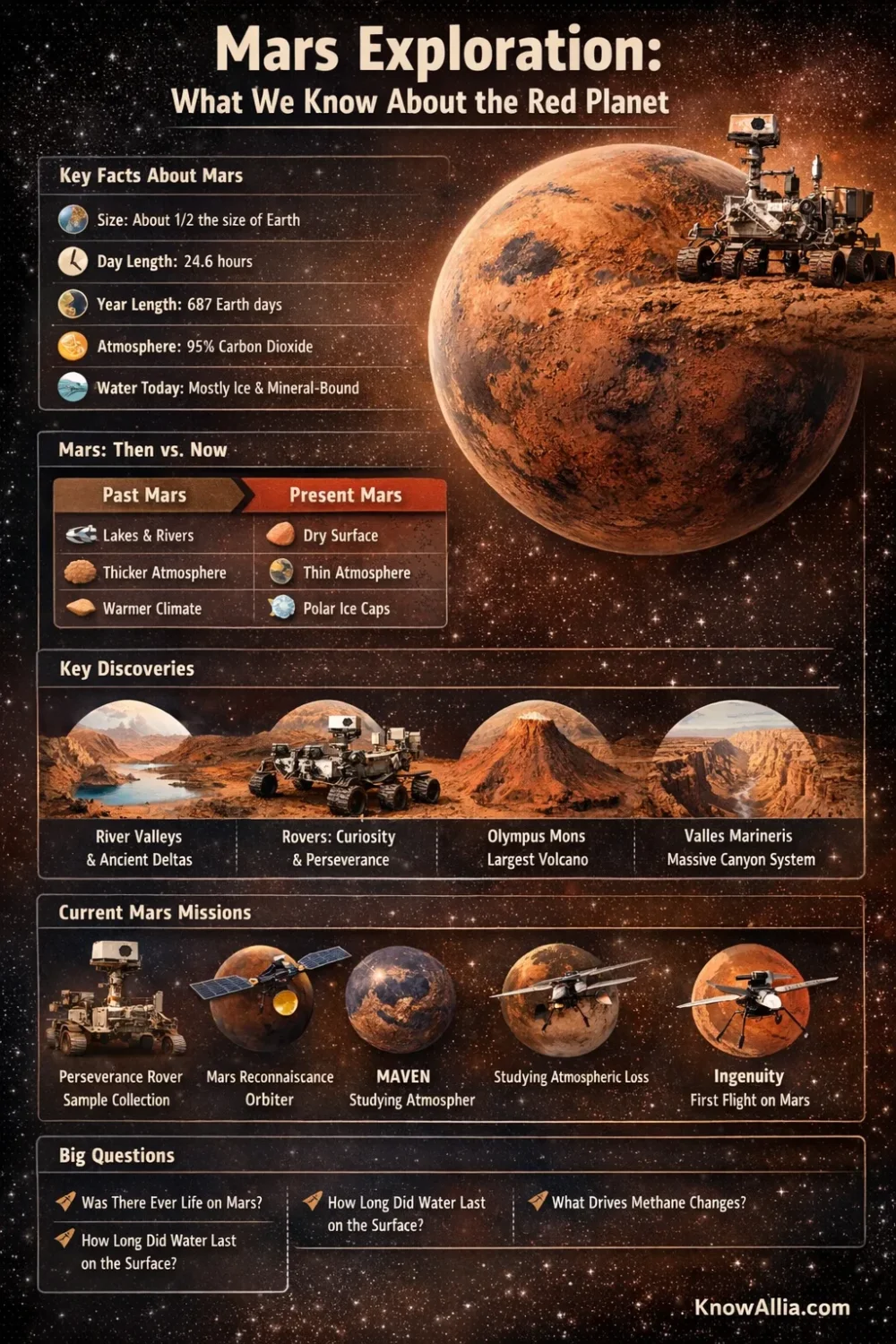
Mars is the fourth planet from the Sun, a cold rocky world with a very thin atmosphere, two small moons, polar ice, giant volcanoes, deep canyons, and strong evidence that liquid water shaped parts of its surface early in its history.[a][b]
What Matters Most
Mars is not just a smaller Earth with less water. It is a planet that changed deeply over time, from a place that once supported lakes, rivers, and mineral-forming water to the dry, dusty surface seen today. The clearest modern picture of Mars comes from combining geology, atmosphere science, orbital mapping, and rover-scale fieldwork.
- No mission has confirmed life on Mars.
- Ancient water is well supported by landforms, minerals, and sedimentary settings.
- Many open questions now focus on timing, duration, and habitability, not on whether Mars changed.
This page follows the evidence from basic planetary data to water history, rover discoveries, orbiters, sample collection, and the places where the science still has real uncertainty. You will also see why some common one-line claims about Mars leave out the most useful part of the story.
Mars in Numbers
Mars is about half Earth’s size, but its land area is close to the area of Earth’s dry land. Its day is 24.6 hours, its year is 687 Earth days, and the planet has two small moons, Phobos and Deimos. Surface temperatures can range from about 20°C down to about −153°C depending on place and season.[a]
| Measure or Feature | Current Best-Known Value | Why It Matters |
|---|---|---|
| Radius | 3,390 km | Lower mass means weaker gravity and less ability to hold a thick atmosphere over geologic time. |
| Average Distance From the Sun | 228 million km | Farther sunlight helps make Mars colder than Earth. |
| Length of Day | 24.6 hours | A Martian day, or sol, is close to an Earth day. |
| Length of Year | 687 Earth days | Seasons last longer than on Earth. |
| Main Atmospheric Gas | 95.9% carbon dioxide | The air is thin, cold, and not breathable for humans.[b] |
| Moons | 2 | Phobos and Deimos are small, irregular bodies that may be captured asteroids. |
| Olympus Mons | More than 25 miles, or more than 40 km, from base to summit | It is the largest volcano in the Solar System. |
| Valles Marineris | More than 4,800 km long | Its scale shows how strongly Mars’s crust and surface evolved over time. |
The term Red Planet is accurate from a distance, but close-up views show many tones, including brown, tan, and gold. Mars looks red mainly because iron-bearing dust and rock have oxidized, which is the same broad chemical idea behind rust on Earth.[c]
Mars in One Scientific View
A smaller rocky planet shaped by ancient water, long-term atmospheric loss, dust, ice, and active robotic field science.
How the Story Fits Together
River valleys, deltas, lake deposits, and water-altered minerals point to a planet that once had active surface water.
Atmospheric escape and long-term climate change left Mars colder and drier than it was early on.
Some water escaped to space, and some appears to be locked into crustal minerals or stored as ice.
Curiosity reads old habitable settings in Gale Crater, while Perseverance studies Jezero Crater and caches samples for later laboratory work.
Measured Anchors
24.6 hours
687 Earth days
Mostly carbon dioxide, with small amounts of nitrogen and argon
Ice and mineral-bound water dominate; stable open surface water is not part of the current environment
Olympus Mons
Valles Marineris
What Is Well Supported
Mars had a wetter past, has a thin modern atmosphere, and preserves a readable rock record of climate change.
What Rovers Add
They move from broad orbital hints to direct ground truth: texture, chemistry, layers, drilling, and sample handling.
What Still Needs Work
The exact duration of habitable settings, the role of methane and oxygen anomalies, and the details of Mars’s deep water budget.
Water Then and Now
The broad answer is simple: Mars was wetter before, and Mars is drier now. The more useful answer is that Mars still holds water today, but mostly as ice or water locked into minerals, not as stable lakes or rivers on the surface. NASA notes that a large share of ancient Martian water may still be trapped in the crust, with one study estimating roughly 30% to 99% stored in minerals rather than lost entirely to space.[d]
That distinction matters because it changes the old picture of Mars from “a planet that lost all its water” to “a planet that redistributed much of its water into new places and forms.” It is one reason Mars remains so scientifically useful: the planet preserves traces of climate change in rock, ice, salts, and atmosphere at the same time.
Atmospheric escape is still part of the story. NASA’s MAVEN mission has helped scientists measure how Mars loses gas from its upper atmosphere to space, which helps explain how a planet that once supported surface water became colder and less hospitable over long spans of time.[e]
A Useful Way to Think About It: studying Mars is a bit like solving a case with three layers of evidence. Orbiters map the scene, rovers inspect the ground, and returned samples would act like laboratory retesting. That is why Mars science rarely depends on one dramatic clue alone.
How Scientists Read Mars
Mars science works best when each mission does a different job. Orbiters show regional patterns. Landers and rovers test local rocks directly. Instruments compare mineral chemistry, textures, layers, atmosphere, and season-to-season change. That mix is what turns a red disk in the sky into a readable planetary record.
Orbital Mapping
NASA’s Mars Reconnaissance Orbiter continues to map terrain, search for long-duration water clues, and relay data from surface missions. It gives the regional context that rovers alone cannot provide.[f]
Long Baseline Monitoring
Mars Odyssey continues to study clouds, fog, frost, and the chemistry of the Martian surface. Long-running missions matter because seasonal change is part of the signal, not background noise.[g]
Places That Changed the Story
The strongest Mars articles usually mention water, life, and rovers, but they often underplay place. On Mars, location is everything. A crater floor, an ancient delta, and a layered mountain do not tell the same climate story.
Jezero Crater
NASA chose Jezero because it once held a lake and an ancient river delta. That makes it one of the best-known places on Mars for preserving sediments that could retain traces of old environments and possible biosignatures. USGS mapping also ties the delta deposits to the surrounding ancient crust, which helps scientists link rover-scale findings to broader Martian geology.[h][i]
Gale Crater
Curiosity’s work in Gale Crater showed that Mars once had environments that could support microbial life. The value of Gale is not that it “proved life,” but that it demonstrated past habitability through chemistry, minerals, and layered sediments read directly on the ground.[j]
Missions Still Shaping the Picture
Current Mars knowledge is built by overlap, not by a single flagship result. The missions below fill different roles, and together they create a far more reliable picture than any one instrument could on its own.
- Perseverance is collecting and caching samples in Jezero Crater, including rock, regolith, and atmosphere samples for future Earth-based study.[k]
- Curiosity remains active and continues to read the sedimentary record in Gale Crater.[l]
- Ingenuity completed 72 flights and ended its mission in January 2024 after proving powered flight on another planet.[m]
- Mars Express, ESA’s long-running orbiter, remains in operation and continues to study the atmosphere, surface, subsurface, and the moons Phobos and Deimos.[n]
- MOXIE, the oxygen demonstration carried by Perseverance, showed that oxygen can be produced from Mars’s carbon-dioxide-rich atmosphere. NASA reported a total of 122 grams of oxygen produced during the experiment.[o]
- Mars Sample Return is still under development. NASA announced in January 2025 that it would study two landing approaches before choosing a single path forward, with formal design confirmation expected later in 2026.[p]
Where People Often Get Mars Wrong
Water Once Existed, So Mars Must Still Be Wet
No. The evidence for ancient water is strong, but modern Mars is dominated by ice, minerals, frost, dust, and a thin atmosphere. Wet past does not equal wet present.
Habitability Means Life Was Found
No. Habitability means an environment could support life as we understand it. It does not mean life has been detected.
Thin Atmosphere Means Nothing Happens
No. Mars still has weather, dust movement, seasonal gas changes, frost, clouds, and strong local environmental variation.
Every Life Hint Is a Discovery
No. Possible biosignatures, methane spikes, and promising samples are signals to test, not finished answers. Good Mars science moves carefully because false certainty is easy on a planet with incomplete evidence.
Key Terms Used on This Page
- Sol
- A Martian solar day. One sol is slightly longer than an Earth day.
- Regolith
- Loose rock fragments, dust, and broken material covering solid bedrock.
- Delta
- A fan-shaped deposit built where flowing water slows down and drops sediment.
- Habitability
- The ability of an environment to support life, not proof that life exists there.
- Biosignature
- A chemical, mineral, structural, or textural clue that may point to past or present biology, but must be tested carefully.
- Atmospheric Escape
- The process by which gases leave a planet’s atmosphere and are lost to space.
Examples That Show Why Mars Is So Useful
- Layered sediments in Gale Crater help scientists read environmental change through time.
- Delta deposits in Jezero Crater offer a setting where fine sediments may have trapped organic or environmental clues.
- Atmospheric measurements show that even a thin atmosphere can still behave in seasonally complex ways.
- Oxygen production by MOXIE shows that Mars science is not only about the past; it also tests future exploration tools.
Where Evidence Still Stops
Mars science is strong, but it is not finished. We still do not know exactly how long the most favorable surface environments lasted, how much water remains deep below the surface, or what fully explains the methane and oxygen behavior measured at Gale Crater. NASA has described those atmospheric patterns as unresolved, and that is a good reminder that uncertainty is part of the real answer, not a flaw in it.[q]
No confirmed life detection has been announced for Mars. Even the most promising samples and biosignature discussions still require more testing, more context, and in some cases laboratory work on Earth before stronger claims would be justified.
Mars is easiest to understand when its story is split into three parts: a wetter early planet, a long transition shaped by atmosphere loss and geology, and a modern cold desert that still preserves an unusually readable record of change. That is what makes Mars more than a popular target. It is one of the best places in the Solar System for asking how habitable worlds begin, change, and sometimes narrow their own options.
FAQ
Why Is Mars Called the Red Planet?
Mars appears red mainly because iron-bearing dust and rock on the surface have oxidized. From orbit the planet looks reddish, although close-up views also show brown, tan, and gold tones.
Does Mars Have Water Today?
Yes, but mostly as ice or water locked into minerals. Stable open liquid water is not part of the modern surface environment.
Has Life Been Found on Mars?
No confirmed life detection has been made. Missions search for signs of ancient habitability and for clues that may deserve deeper testing.
Why Did NASA Choose Jezero Crater?
Jezero Crater once held a lake and river delta. That makes it a strong location for preserving sediments and chemical traces from ancient environments.
What Did Ingenuity Prove on Mars?
Ingenuity proved that powered, controlled flight is possible in the thin Martian atmosphere. It far exceeded its original technology-demonstration goals.
What Is the Biggest Open Question About Mars?
There is no single biggest question, but several stand out: how long wet habitable environments lasted, how much water remains deep below ground, and whether any biosignature-like clues will survive closer testing.
Sources
- [a] NASA – Mars: Facts Basic planetary values, seasons, temperature range, surface features, and moon data. ↩
- [b] NASA – The Five Most Abundant Gases in the Martian Atmosphere Surface atmosphere composition data used for the carbon dioxide figure. ↩
- [c] NASA – Mars: Facts Used for the explanation of why Mars appears red from a distance. ↩
- [d] NASA – New Study Challenges Long-Held Theory of Fate of Mars’ Water Used in the section on crustal water storage and the long-term water budget. ↩
- [e] NASA – MAVEN Atmospheric escape and upper-atmosphere science. ↩
- [f] NASA – Mars Reconnaissance Orbiter Orbital mapping, water-history objectives, and ongoing mission role. ↩
- [g] NASA – Mars Odyssey Long-running orbital observations of clouds, fog, frost, and surface chemistry. ↩
- [h] NASA – Mars 2020 Perseverance Jezero Crater lake-and-delta setting and mission objectives. ↩
- [i] U.S. Geological Survey – Geologic Map of the Mars 2020 Perseverance Rover Landing Site Regional geologic context for Jezero Crater and its delta deposits. ↩
- [j] NASA – Mars Science Laboratory: Curiosity Rover Gale Crater habitability findings and current rover context. ↩
- [k] NASA – Mars Rock Samples Sample collection and caching work by Perseverance. ↩
- [l] NASA – Curiosity Rover Updates Recent Curiosity activity and continuing surface operations. ↩
- [m] NASA – Ingenuity Mars Helicopter Mission completion date and total flight count. ↩
- [n] ESA – Mars Express Status, mission scope, and continuing operation of Europe’s long-running Mars orbiter. ↩
- [o] NASA – NASA’s Oxygen-Generating Experiment MOXIE Completes Mars Mission Oxygen production totals and the technology result. ↩
- [p] NASA – NASA to Explore Two Landing Options for Returning Samples from Mars Current development status of Mars Sample Return. ↩
- [q] NASA – With Mars Methane Mystery Unsolved, Curiosity Serves Scientists a New One: Oxygen Used for the unresolved methane and oxygen discussion in the uncertainty section. ↩