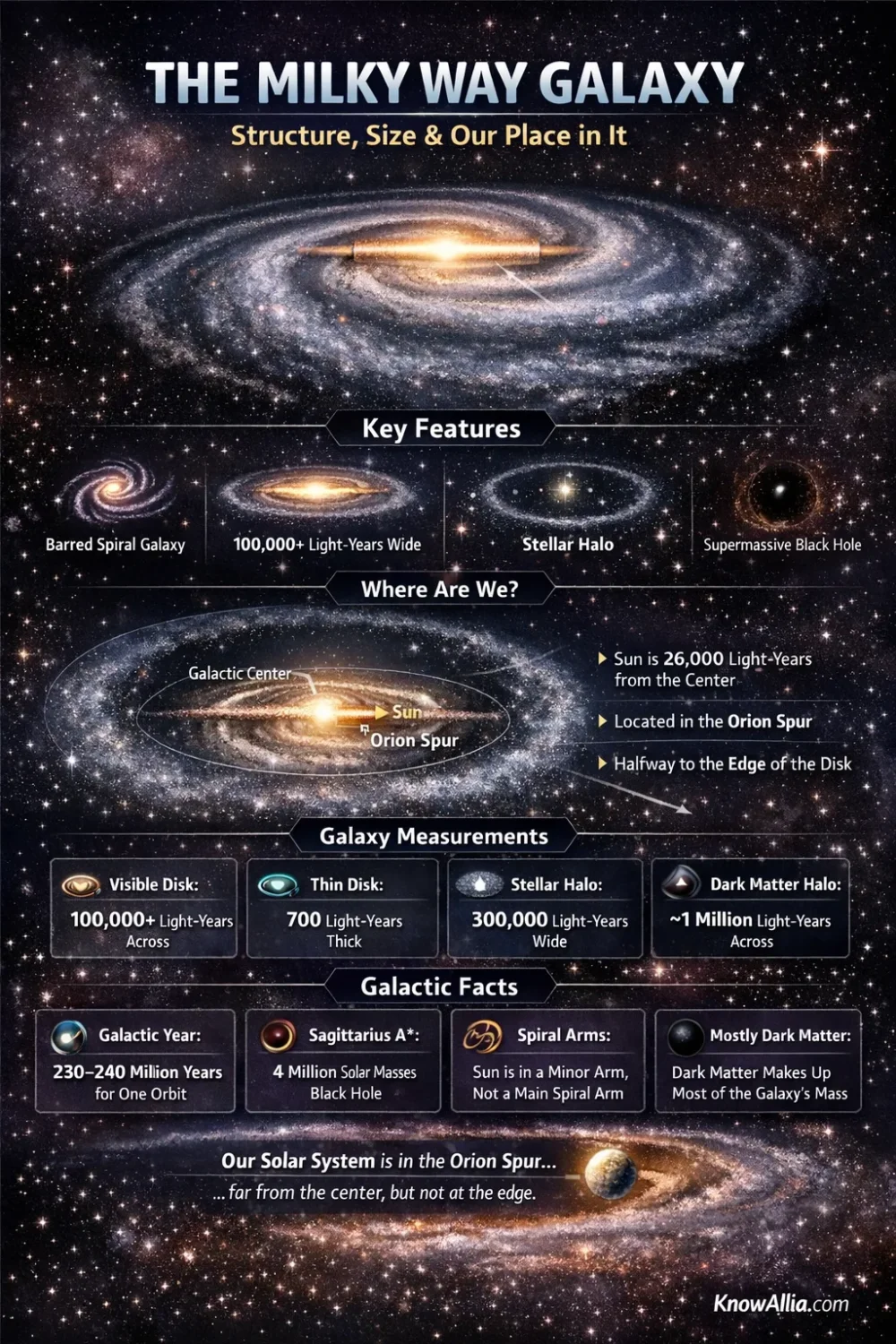
The Milky Way is a barred spiral galaxy that contains the Solar System. Its bright disk stretches a little over 100,000 light-years, holds a few hundred billion stars, and places the Sun in the Orion Spur rather than near the center.[a][c]
The Picture That Matters First
The Milky Way is not just the pale band seen in the night sky. That band is the inside view of a flattened galaxy made of a central bar, spiral structure, a bulge of older stars, a wide stellar halo, and an even larger dark-matter halo.
Some numbers for the Milky Way look inconsistent because astronomers are often measuring different parts of the same galaxy. A disk width, a halo width, and a total mass are all real, but they describe different things.
- The Sun sits about 26,000 light-years from the galactic center and about halfway from the center to the visible edge.
- One trip around the galaxy takes about 230 to 240 million years.
- The black hole in the center is real, but it is only one part of a far larger galactic system.
This article explains the Milky Way’s shape, the reason its size is quoted in more than one way, how astronomers map it from the inside, and where Earth fits within that larger structure. It also clears up a few easy mix-ups that keep showing up in public explanations.
What the Milky Way Actually Is
From Earth, the Milky Way looks like a faint, milky band crossing the sky because we are viewing the galaxy’s disk from the inside. Seen from outside, it would not look like a band at all. It would look like a spiral system with a central bar and broad arms wrapped around it.[b]
The shortest useful definition is this: the Milky Way is a barred spiral galaxy made of stars, gas, dust, dark matter, and a compact central black hole. Most of the stars we notice with ordinary skywatching belong to the disk. Much of the dust also lives there, which is one reason the center is hard to study in visible light.
- Barred Spiral Galaxy
- Visible Disk
- Bulge and Central Bar
- Stellar Halo
- Dark-Matter Halo
- Solar System in Orion Spur
A useful way to think about it is this: the sky band is the inside view, the galaxy diagram is the outside view. Mixing those two views is one of the main reasons the Milky Way often feels harder to picture than other galaxies.
Main Parts of the Galaxy
The Disk
The disk is the Milky Way’s flat, star-filled body. It holds most of the galaxy’s stars along with gas and dust, and it is the part that creates the bright band seen from Earth. ESA materials describe a thin disk about 700 light-years high embedded in a thick disk about 3,000 light-years high.[c]
The Bar and Bulge
In the middle sits an elongated bar and the surrounding bulge. ESA describes the bar as peanut-shaped in overall appearance, with a half-length of about 10,000 light-years. The bulge is packed mostly with older, redder stars and contains about 10 billion stars.[c]
The Halos
Outside the disk is a stellar halo with isolated stars and many globular clusters. Far beyond that lies the much larger dark-matter halo, which does not shine but adds most of the galaxy’s mass. NASA visualization pages place the stellar halo at roughly 300,000 light-years across and the dark-matter halo much farther out.[h]
The center also contains Sagittarius A*, the Milky Way’s supermassive black hole. It is about 4 million solar masses, and its first direct image was released in 2022 through the Event Horizon Telescope collaboration.[g]
Why the Milky Way’s Size Depends on What You Measure
Many articles give one Milky Way size and move on. That is where the topic usually goes flat. The Milky Way has more than one meaningful size, because the bright disk, the stellar halo, and the dark-matter halo do not end at the same distance. Two different numbers can both be correct when they refer to different layers of the galaxy.
| What Is Measured | Approximate Scale | What That Number Means |
|---|---|---|
| Visible Disk Width | Just over 100,000 light-years | The bright, flattened main body where most stars, gas, and dust are found.[a][b] |
| Thin Disk Height | About 700 light-years | The flatter inner layer of the disk, rich in younger stars and interstellar matter.[c] |
| Thick Disk Height | About 3,000 light-years | A puffier, older stellar layer embedded around the thin disk.[c] |
| Stellar Halo | Roughly 300,000 light-years across | The sparse outer region of stars and globular clusters around the disk and bulge.[h] |
| Dark-Matter Halo | Far larger; NASA visual materials summarize it as roughly 1 million light-years across | The invisible mass component that extends far beyond the visible galaxy.[h] |
One more number matters: the Milky Way’s total mass is about 1.5 trillion solar masses in one widely used Hubble-and-Gaia estimate. That figure includes stars, gas, dust, the central black hole, and a much larger dark-matter share.[d]
This is where many public summaries leave a gap: they quote one size as if it ends the discussion. It does not. A visible disk width tells you how broad the bright main body is. It does not tell you how far the dark halo extends, and it does not tell you the galaxy’s full mass.
Numbers That Make the Milky Way Easier to Picture
Rounded values from NASA, ESA, and NSF materials. They describe different parts of the same galaxy, which is why no single number explains everything.
Scaled Layout
Galactic Center Sun in Orion Spur ~26,000 light-years from center Central Bar and Bulge Visible Disk: a little over 100,000 light-years across The wider halo extends well beyond the bright diskBarred spiral galaxy with a flattened disk, central bar, bulge, and outer halo.
In the Orion Spur, about halfway from the center to the visible edge of the disk.
The Solar System needs about 230–240 million years to orbit the Milky Way once.
Sagittarius A* has a mass of about 4 million Suns and was directly imaged in 2022.
Disk
The bright stellar-and-gas body most people mean when they say the Milky Way is about 100,000 light-years wide.
Halo
The stellar halo is far broader than the bright disk, and the dark-matter halo reaches much farther still.
Mass
The galaxy’s total mass is far larger than the mass of its visible stars alone because dark matter dominates the total.
Values in the panel are rounded so the structure is easy to compare without losing the physical scale behind it.[c][d][g][h]
Where the Solar System Sits
The Sun is not near the Milky Way’s center. It lies about 8 kiloparsecs, or roughly 26,000 light-years, from the center in a small structure called the Orion Arm or Orion Spur. NASA and ESA materials also place the Sun about halfway from the center to the visible edge of the disk.[a][c]
- Local address: the Solar System sits in the Orion Spur, between larger spiral structures such as Sagittarius-Carina and Perseus.
- Distance from the center: about 26,000 light-years.
- Distance from the visible edge: roughly comparable in scale, which is why “about halfway out” is a fair summary.
- Orbital motion: one lap around the Milky Way takes about 230 to 240 million years.[b]
Here is the point many readers miss: when people say “we live in the Milky Way,” they do not mean the Solar System is in some special central position. We live in an ordinary part of the disk, inside a smaller spur, far from the center but not near the galaxy’s farthest outskirts either.
Mapping the Milky Way from inside is a bit like trying to sketch a forest while standing among the trees. Nearby stars can be placed well, but the full spiral pattern is harder to read because dust, distance, and our inside-the-disk viewpoint hide the outline.[e][h]
Example: when you look toward Sagittarius in the night sky, you are looking toward the crowded inner Milky Way. When astronomers observe that direction in radio and infrared wavelengths, they can recover structure that visible light alone cannot show clearly because dust blocks so much of the view.
How the Milky Way Grew Over Time
The Milky Way is roughly 13 billion years old in broad terms, but its parts did not all settle into place at the same time. ESA reporting based on Gaia data shows that the thick disk began forming about 13 billion years ago, and that the galaxy’s growth can be described in two broad phases rather than one smooth process.[f]
- Early phase: the thick disk started forming stars very early in cosmic history.
- Merger era: a dwarf galaxy often called Gaia-Sausage-Enceladus merged with the Milky Way and helped shape the halo and thick-disk star formation record.
- Later phase: the thin disk, the one that contains the Sun, formed afterward and became the main long-lived home of many younger stars.
This matters because it changes the usual simple story. The Milky Way is not just an old spiral that slowly stayed the same. It is a system built by early disk formation, mergers, star formation bursts, and long-term settling of gas and stars.
Where Readers Often Get Mixed Up
Those mix-ups are common because many short explainers compress structure, size, and sky appearance into one paragraph. Separating them makes the Milky Way much easier to understand.
Terms That Make the Topic Easier
- Barred Spiral Galaxy
- A spiral galaxy whose center includes an elongated bar of stars rather than a purely round central region.
- Bulge
- The dense central concentration of stars around the galaxy’s middle, populated mostly by older stars.
- Orion Spur
- The local spur where the Sun and Solar System are located, between larger spiral structures.
- Thin Disk
- The flatter stellar-and-gas layer that contains most of the bright band seen in the sky.
- Thick Disk
- A broader, older stellar layer surrounding the thin disk.
- Stellar Halo
- A sparse, roughly spherical outer region of stars and globular clusters around the disk and bulge.
- Dark-Matter Halo
- The much larger invisible mass component that surrounds the visible galaxy and strongly affects its gravity.
- Sagittarius A*
- The supermassive black hole at the galactic center, with a mass of about 4 million Suns.
What Astronomers Still Debate
Some pieces of the Milky Way are well established. Others are still being refined. The exact spiral layout, where the outer disk fades into the halo, and the galaxy’s total mass all depend on method and dataset. Even the “size of the Milky Way” changes with the boundary an author chooses to describe.[d][e][h]
That uncertainty is not a flaw in astronomy. It is the normal result of studying a galaxy while living inside it. Modern surveys such as Gaia and infrared mapping from space keep improving the picture, but the Milky Way still has blurred edges in more ways than one.
FAQ
Answers to the Questions People Ask Most
Is the Milky Way a spiral galaxy or a barred spiral galaxy?
It is a barred spiral galaxy. The Milky Way has spiral structure, but its center includes an elongated stellar bar rather than a simple round core.
How big is the Milky Way?
The visible disk is a little over 100,000 light-years across. The stellar halo reaches much farther, and the dark-matter halo extends farther still, which is why size numbers vary by context.
Where is the Sun inside the Milky Way?
The Sun lies in the Orion Spur, about 26,000 light-years from the galactic center and roughly halfway from the center to the visible outer edge of the disk.
How long does the Solar System take to orbit the galaxy?
One orbit around the Milky Way takes about 230 to 240 million years. That span is often called a galactic year.
What is at the center of the Milky Way?
The center contains a dense stellar region, gas, dust, and the supermassive black hole Sagittarius A*, which has a mass of about 4 million Suns.
Once the disk, halo, bar, and our local position are separated clearly, the Milky Way stops being a vague streak and becomes something more concrete: a layered galaxy with a measurable structure, a workable scale, and a very ordinary place for the Solar System inside it.
Sources
- [a] NASA – Imagine the Universe! Milky Way Info — Disk width, Sun’s distance from the center, and the distance scale used in the article.
- [b] NASA Science – Galaxies — The Milky Way as a sky band, the Solar System’s orbital period, and the Local Group context.
- [c] ESA – Anatomy of the Milky Way — Barred-spiral structure, disk dimensions, bulge, and stellar halo description.
- [d] NASA Science – What Does the Milky Way Weigh? Hubble and Gaia Investigate — Total mass estimate, star count context, and the role of dark matter.
- [e] NASA Science – Tracing the Arms of Our Milky Way Galaxy — Spiral-arm mapping uncertainty and the Sun’s placement in a minor spur.
- [f] ESA – Gaia Finds Parts of the Milky Way Much Older Than Expected — Thick-disk age, two-phase formation, and the Gaia-Sausage-Enceladus merger context.
- [g] NSF – Astronomers Reveal First Image of the Black Hole at the Heart of Our Galaxy — Sagittarius A*, its mass scale, and the 2022 first direct image.
- [h] NASA SVS – Milky Way Anatomy — Stellar-halo scale, dark-matter-halo scale, and why the inside view limits fine structural detail.