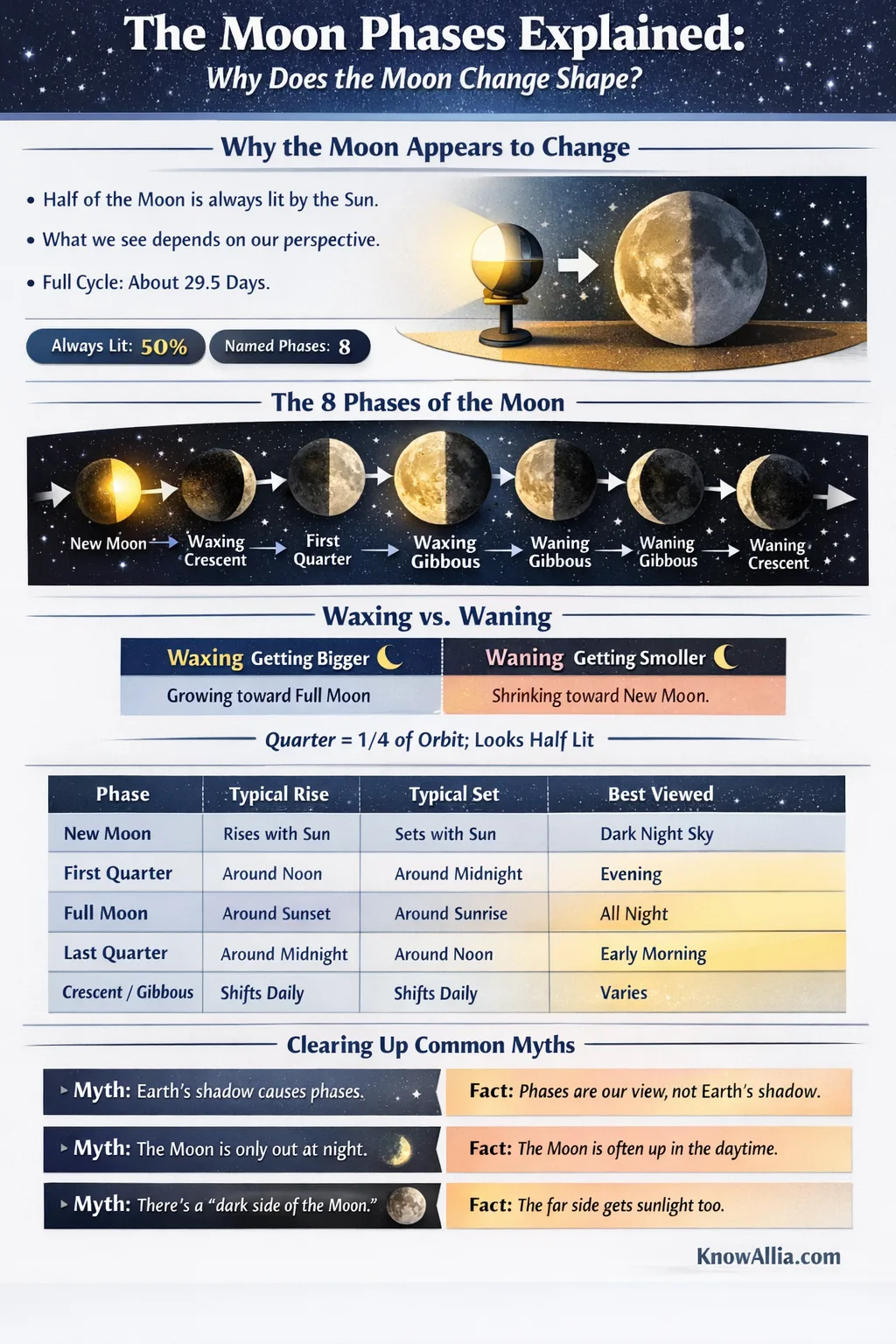
Moon phases are the changing slice of the Moon’s sunlit half that we can see from Earth as the Moon orbits us. The Moon itself does not “change shape”; only our viewing angle changes. [g]
The Core Idea, Without the Fluff
The Sun always lights half of the Moon, all the time. As the Moon moves around Earth, we see different portions of that lit half, creating the familiar sequence from new Moon to full Moon and back again. [a]
- Phases are perspective: it’s about what we can see, not what the Moon “becomes.”
- Waxing means the lit portion we see is growing; waning means it’s shrinking.
- The full cycle repeats about every 29.5 days on average. [b]
What you’ll learn here: how the Sun–Earth–Moon geometry creates phases, what each phase name really means, why “quarter” looks like half, why the Moon is sometimes up in daylight, and how the phase you see connects to typical moonrise and moonset times.
Jump to a Section
Why the Moon Seems to Change Shape
At any moment, the Moon is a sphere with one side in sunlight and the other side in darkness. From Earth, we’re watching that half-lit globe from a moving viewpoint, so the dividing line between lunar “day” and “night” slides across what we can see. That shifting view is the entire story of moon phases. [a]
One Analogy That Usually Clicks
Picture a bright lamp shining on a soccer ball. The ball is always half lit, but if you walk around it, the visible lit portion changes from a thin slice to a full circle. The Moon works the same way: the “lamp” is the Sun, and we’re the person walking around. The ball doesn’t change; the angle does.
- Always lit: 50%
- What changes: our view
- Cycle: ~29.5 days
- Named phases: 8
The Eight Moon Phases, in Order
The phase names describe how much of the Moon’s face appears illuminated and whether that visible lit portion is growing (waxing) or shrinking (waning). The sequence below repeats in the same order worldwide. [b]
- New Moon: the lit side faces away from us, so the Moon is usually not visible.
- Waxing Crescent: a thin bright curve appears and grows.
- First Quarter: about half of the Moon’s face looks lit (the Moon is one-quarter of the way through its orbit from new Moon). [h]
- Waxing Gibbous: more than half looks lit, growing toward full.
- Full Moon: the Moon’s Earth-facing side is near fully lit.
- Waning Gibbous: still more than half looks lit, but shrinking.
- Last (Third) Quarter: again about half looks lit, now decreasing.
- Waning Crescent: a thin bright curve remains and fades toward new Moon.
A small detail many people miss: even though “full Moon” is a specific instant, it can look full for more than one night because the percent illuminated changes slowly near full. [b]
Waxing vs. Waning (And Why “Quarter” Looks Like Half)
Waxing means the visible bright part is increasing night by night; waning means it’s decreasing. The word “quarter” can feel odd because the Moon looks half lit—but “first quarter” and “last quarter” refer to how far along the Moon is in its orbit from new Moon, not the visual fraction. [d]
Also, the phase is the same everywhere on Earth at a given moment, but it may look rotated or flipped depending on your hemisphere. Travel across the equator and the crescent can appear on the opposite side than you’re used to. [c]
A Practical Example
If you spot a crescent Moon low in the western sky shortly after sunset, it’s typically a waxing crescent—the Moon is setting not long after the Sun, so it’s early in the cycle. If you see a crescent before sunrise, it’s typically a waning crescent, late in the cycle.
Why the Moon Rises Later Each Day
As the Moon advances along its orbit, Earth has to rotate a bit more before the Moon comes into view. That’s why moonrise is roughly 50 minutes later from one day to the next (the exact amount varies). [f]
When Each Phase Is Up in the Sky
Phases are not just “how it looks”—they also line up with typical moonrise and moonset patterns. This is why a full Moon often shows up in the evening, while quarter Moons can be great in late afternoon or early morning. [a]
| Phase | Typical Rise (Approx.) | Typical Set (Approx.) | What It’s Usually Best For |
|---|---|---|---|
| New Moon | Rises with the Sun | Sets with the Sun | Usually not visible; the Moon is up in daytime. Sky stays darker at night. |
| First Quarter | Around noon | Around midnight | Excellent evening viewing; shadows on craters can look crisp. |
| Full Moon | Around sunset | Around sunrise | Bright all night; good for seeing the Moon easily, not ideal for faint stars. |
| Last (Third) Quarter | Around midnight | Around noon | Great in the early morning; often visible in daylight later on. |
| Crescent & Gibbous Phases | Shifts day by day | Shifts day by day | Waxing phases favor evening; waning phases favor morning. |
If you’ve ever wondered “Why is the Moon out at 3 p.m.?”—that’s normal. The Moon is in the sky during the day just as often as at night; it’s simply harder to notice in a bright sky. [c]
Premium Infographic: The Phase Cycle Overview
Moon Phases, From New to New
The Sun lights half the Moon. The phase is the part of that lit half we can see, depending on where the Moon is in its orbit.
Phase Wheel (Not to Scale)
Sun Earth New First Quarter Full Last QuarterWaxing (growing) Waning (shrinking)What Changes vs. What Stays the Same
Half the Moon is sunlit; half is in shadow. The phase is our view of that half-lit globe.
The Moon’s position relative to the Sun, which shifts moonrise and moonset times through the month.
Evening Moons are often waxing; morning Moons are often waning.
New Moon
Moon is near the Sun in the sky, rising and setting with it.
Full Moon
Moon is opposite the Sun, rising near sunset and setting near sunrise.
Quarter Moons
Sun and Moon are roughly 90° apart, often giving strong crater shadows.
Why the Cycle Takes About 29.5 Days
The Moon takes about 27.3 days to orbit Earth relative to the background stars, but the phase cycle (new Moon to new Moon) takes about 29.5 days. The reason is simple: while the Moon is orbiting Earth, Earth is also moving along its path around the Sun, so the Moon has to travel a bit farther to line up with the Sun the same way again. [d]
- Sidereal month
- How long the Moon takes to return to the same position against the stars (about 27.3 days).
- Synodic month (lunation)
- How long it takes to go from one new Moon to the next (about 29.5 days on average). [b]
Extra Effects You Might Notice (Still Part of the Same Story)
Once you understand the main geometry, a few real-sky details start to make more sense—without changing the basic explanation.
- Earthshine: during some crescent phases, the “dark” part of the Moon can faintly glow because sunlight reflects off Earth and softly lights the Moon’s night side. [a]
- Daytime Moons: quarter phases can be especially easy to spot in daylight because the Moon is high and well separated from the Sun in the sky. [a]
- Libration: the Moon can seem to “nod” or “twist” slightly over time, letting us peek a bit around the edge—subtle, but real. [b]
Common Confusions (Cleared Up Calmly)
Why Eclipses Don’t Happen Every Month
If phases were caused by Earth’s shadow, we’d expect an eclipse at every full Moon. In reality, eclipses are occasional because the Moon’s orbit is tilted relative to Earth’s orbit around the Sun, so the line-up isn’t perfect most months. [e]
Key Terms in Plain English
These words show up everywhere in moon-phase discussions. Here they are without the heavy tone.
- Waxing
- The visible bright part is getting larger from night to night.
- Waning
- The visible bright part is getting smaller from night to night.
- Crescent
- Less than half of the Moon’s face looks lit.
- Gibbous
- More than half looks lit, but it’s not full.
- Lunation
- One full phase cycle from new Moon to new Moon. [b]
Limitations and What We Don’t Know
Moon phase is a global geometry and can be defined to a specific moment, but real-life viewing varies. Local moonrise and moonset depend on where you are (latitude/longitude), your horizon, and atmospheric effects. Even the “same” phase can look rotated depending on hemisphere and viewing angle. [c]
Also, phrases like “rises at noon” are useful patterns, not guarantees—think of them as typical timing that helps you predict when to look, not a promise for every location and date. When you need exact times for a specific place, you’ll want a dedicated astronomical almanac or ephemeris service.
FAQ
Questions People Ask Most About Moon Phases
Is the Moon really changing shape?
No. The Moon stays a sphere. What changes is how much of its sunlit half we can see as the Moon moves around Earth.
Why does “first quarter” look like half a Moon?
Can two countries see different phases on the same day?
The phase is the same worldwide at a given moment. People in different places may see it at different angles, and local rise/set times differ, but the underlying phase is the same.
Why is a full Moon usually visible all night?
At full Moon, the Moon is roughly opposite the Sun in the sky. That geometry naturally lines moonrise up near sunset and moonset up near sunrise.
Why don’t we get a lunar eclipse every full Moon?
Because the Moon’s orbit is tilted, the Sun–Earth–Moon alignment is usually slightly off. Eclipses require a much tighter alignment than regular phases do.
Is the “dark side of the Moon” always dark?
No. The far side of the Moon receives sunlight too. “Dark side” is a common phrase, but it’s misleading—there’s no permanent darkness across an entire lunar hemisphere.
Sources
References below are limited to high-trust institutional and editorial sources. Each external link appears only once here; in-text markers point back to the relevant source.
- NASA Science – Moon Phases (phase definitions, rise/set patterns, earthshine, libration) [a]
- U.S. Naval Observatory – Phases of the Moon and Percent of the Moon Illuminated (official definitions, lunation, percent illumination, “quarter” meaning) [b]
- NASA Science – Top Moon Questions (daytime Moon, “dark side” clarification, hemisphere viewpoint notes) [c]
- NASA/GSFC – Eclipses and the Moon’s Orbit (why synodic month differs from sidereal month; orbital geometry) [d]
- NASA Science – Eclipses and the Moon (why eclipses are occasional; orbit tilt overview) [e]
- Institute of Physics – Phases and Orbits of the Moon (moonrise shifting later day by day; hemisphere appearance notes) [f]
- NASA Space Place – What Are the Moon’s Phases? (plain-language overview; eight phases list) [g]
- Encyclopaedia Britannica – What Are the Phases of the Moon? (editorial reference overview of the eight-phase cycle) [h]