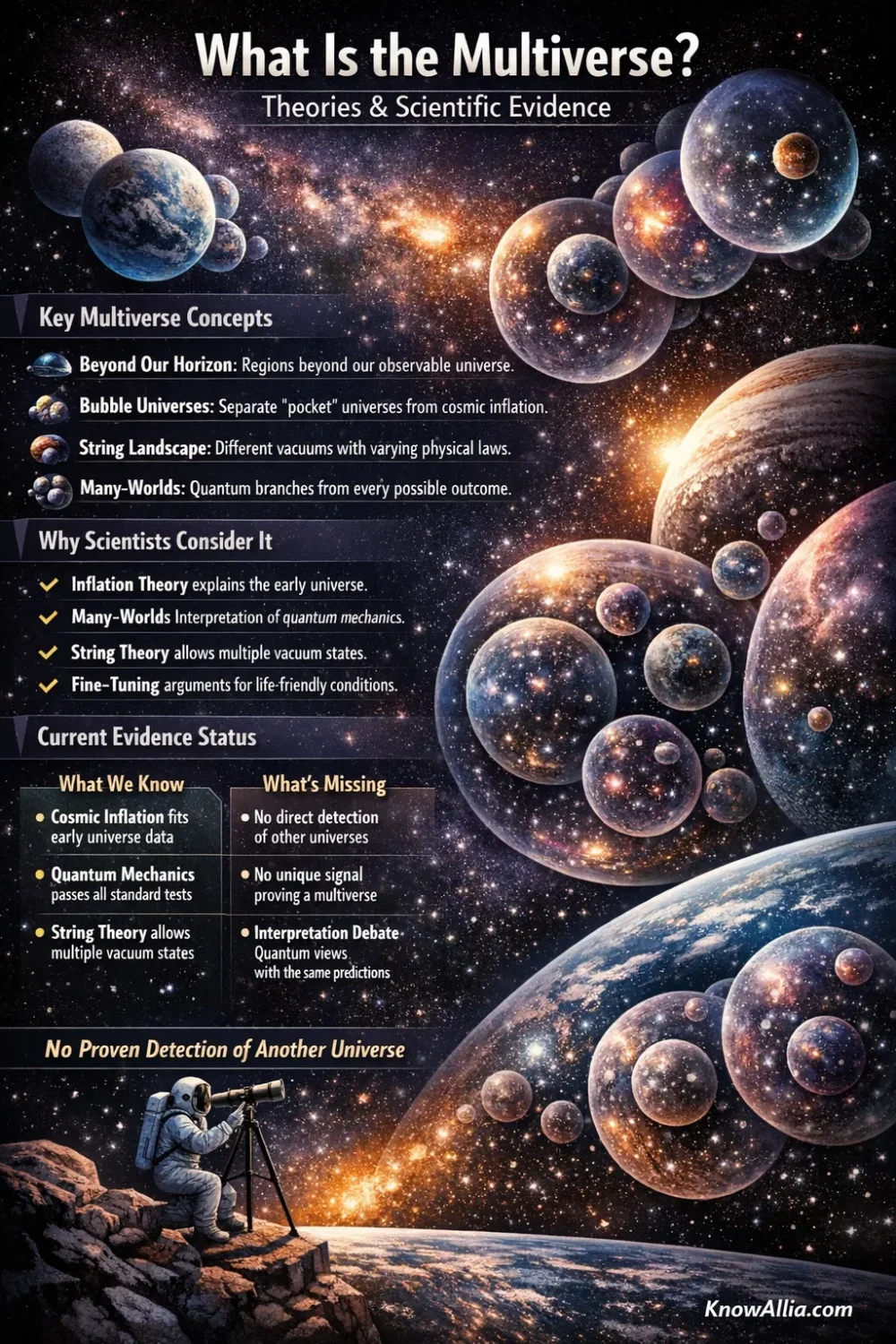
The multiverse is a broad label for ideas suggesting that our observable universe may be only one part of a larger reality. In some models, other universes lie far beyond our cosmic horizon; in others, they appear as separate bubble regions born from inflation; in the many-worlds reading of quantum mechanics, they are branching outcomes of one quantum state. The most important point is simple: no other universe has been directly observed.[a][d]
That makes the subject unusual. It sits between tested physics and open extrapolation. Cosmic inflation has observational support because it fits features of the early universe, including large-scale flatness and the pattern of primordial fluctuations. But support for inflation is not the same as proof of an inflationary multiverse, because only some inflation models continue forever and generate separate pocket universes.[b][e][i]
Start Here
The multiverse is not one settled theory. It is a family of proposals that show up in cosmology, quantum mechanics, and high-energy theory. Some are closer to tested science than others.
The cleanest way to read the evidence is to separate motivation from confirmation. Modern physics gives reasons to discuss a multiverse. It has not yet delivered a confirmed detection.
- Best current status: interesting scientific possibility, not an established fact.
- Most common confusion: evidence for inflation or quantum mechanics is often mistaken for evidence for other universes.
- What would change the picture: a unique observational signal or a model that makes successful, distinctive predictions.
You will see where the leading models come from, how they differ from one another, what scientists mean by evidence in this debate, and why the leap from a successful equation to “many universes exist” is larger than it first sounds.
What the Word Actually Covers
The first mistake is to treat the multiverse as if it were one clean, single idea. It is not. The term bundles together several proposals that differ in origin, mathematical structure, and distance from observation.
The observable universe is only the region from which light has had time to reach us. That limit is not a proven outer wall. A multiverse claim starts when a model says reality extends beyond our visible patch in a way that produces other regions, histories, or law-sets. A simple analogy helps: seeing only one lit patch of ocean through fog does not show that the sea ends at the edge of the light.
- Beyond-horizon space: more cosmic regions may exist beyond what we can observe, while still obeying the same basic laws.
- Bubble universes: inflation may end in some places and continue in others, leaving separate “pocket” universes.
- String landscape scenarios: different low-energy states of a deeper theory may allow different constants or particle content in different regions.
- Many-worlds: quantum mechanics may evolve without collapse, so measurement-like events correspond to branching histories rather than one selected outcome.
Those proposals are related by family resemblance, not by identity. That distinction matters because a good objection or a good piece of evidence for one version may say very little about the others.
Why Scientists Take the Idea Seriously
Physicists do not usually bring up a multiverse because it sounds dramatic. They bring it up when it appears as a by-product of other work.
- Inflationary cosmology explains why the universe looks so flat and smooth on large scales, while also allowing tiny primordial fluctuations to grow into galaxies and clusters. Some versions of inflation do not stop everywhere at once, which opens the door to an inflationary multiverse.[c][b]
- Quantum mechanics works with astonishing accuracy, but its interpretation is still debated. The many-worlds view keeps the wave function evolving smoothly and drops collapse, at the cost of a branching picture of reality.[d]
- String-based ideas can permit a huge number of possible vacuum states. If different regions realize different states, a landscape-style multiverse becomes thinkable.[h]
- Fine-tuning discussions sometimes use a multiverse plus anthropic reasoning to explain why our universe allows complex structures and observers. That is a live argument, not a settled result.[e]
This is one of the biggest content gaps in popular writing on the subject: the phrase scientific evidence for the multiverse is often used too loosely. A better question is, “Which larger theory is doing the work here, and does that theory actually require multiple universes?” Sometimes the answer is yes, sometimes only maybe, and sometimes no.
Main Models and What They Claim
| Model | Basic Idea | What Stays the Same | What Could Change | What Would Count as Stronger Support |
|---|---|---|---|---|
| Beyond-Horizon Space | Reality extends far past our observable patch. | Usually the same local laws and constants. | Initial conditions and large-scale arrangement of matter. | Independent reason to think space is vastly larger than what we can see, with testable consequences for topology or correlations. |
| Eternal Inflation | Inflation ends in some regions but continues elsewhere, producing pocket universes. | A shared inflationary origin. | Local constants, particle content, or reheating history in different bubbles. | A unique bubble-collision signal in the CMB or another early-universe relic that cannot be explained more simply. |
| String Landscape | Different vacuum states of string theory may be realized in different regions. | A deeper underlying theory. | Low-energy laws, constants, symmetry breaking, and particle masses. | A tested link between string vacuum statistics and observed constants, plus evidence that the mechanism really operates in cosmology. |
| Many-Worlds | The universal wave function evolves without collapse, so branches correspond to different outcomes. | The same quantum laws everywhere. | Which branch an observer experiences. | An empirical result that separates Everett-style branching from rival interpretations, not merely ordinary quantum success. |
Two distinctions are worth underlining. First, cosmological multiverses are usually about other space-time regions. Many-worlds is about the interpretation of quantum evolution. Second, a model can be mathematically elegant and still fall short of observational confirmation. That is why the debate often turns on testability rather than on imagination.[d][h]
Why Many-Worlds and Bubble Universes Are Not the Same Thing
Popular media often folds everything into the phrase parallel universes. That blurs an important line. In bubble-universe models, other universes are other regions of space-time with their own cosmic histories. In many-worlds, the branching comes from how the quantum state is understood. One is a cosmology question. The other is an interpretation question.
What Counts as Evidence
Reasons the Idea Stays on the Table
- Inflation fits major early-universe observations.
- Quantum mechanics keeps passing every ordinary test thrown at it.
- Some high-energy models naturally produce many possible states or regions.
- Fine-tuning puzzles push some researchers toward anthropic explanations.
What Would Raise the Bar
- A distinctive bubble-collision scar in the cosmic microwave background, ideally with a matching polarization pattern.
- A model that predicts observed constants as typical, not just possible.
- An experiment that distinguishes many-worlds from rival interpretations rather than confirming quantum theory in general.
- Multiple independent observables pointing to the same multiverse mechanism.
The short reading of the current record is this: physicists have reasons to discuss multiverse models, but no observation has yet forced the conclusion that another universe exists.
Data Often Mentioned in the Debate
Planck 2018 measured the scalar spectral index at ns = 0.9649 ± 0.0042, found space consistent with flatness to about 0.4% when combined with BAO data, and set a 95% upper limit of r0.002 < 0.056 when combined with BK15. Those are powerful results for inflationary cosmology. They do not by themselves establish eternal inflation or a multiverse.[i]
Searches for bubble-collision imprints have already been attempted. Early work with WMAP put upper limits on such signatures rather than finding a detection, and later Planck-based discussion of unusual patches remained explicitly tentative, with a call for follow-up observations rather than a claim of proof.[f][g]
How Multiverse Ideas Move From Data to Speculation
Observed physics can motivate a multiverse, but each step away from direct data adds another layer that still has to be tested.
From Observation to Extrapolation
Observed Today CMB patterns, flatness, quantum behavior Good Early-Universe Fit Inflation explains several large-scale features Extra Step Some models keep inflation going forever Result Bubble or landscape ideas What Would Help A unique collision signal, a matching polarization pattern, or a model that predicts constants Main Obstacle Other universes may be causally disconnected or leave signals that ordinary physics can mimic Current Verdict Motivated by live physics, still missing decisive observational confirmationInflationary-style early-universe features and ordinary quantum behavior are grounded in data.
Only some versions of inflation, string-based cosmology, or quantum interpretation produce a multiverse.
No confirmed direct signal from another universe has been accepted by the field.
Best-Supported Base Layer
Observed early-universe data make inflation a serious topic of study, though not every inflation model leads to eternal inflation.
Most Debated Leap
Going from a good local model to an unseen ensemble of universes raises hard questions about probability, typicality, and testability.
Cleanest Standard
A multiverse proposal gets stronger when it produces a distinctive signal that competing single-universe models do not naturally reproduce.
Why Testing Is So Difficult
- Causal isolation: if another universe cannot exchange signals with ours, observation becomes hard by definition.
- Signal erasure: even in bubble-collision models, a collision may occur too early and be washed out by later inflation.[e]
- The measure problem: if the multiverse is effectively infinite, assigning probabilities to different regions becomes mathematically slippery.[e]
- Interpretation overlap: many-worlds is hard to test because rival interpretations of quantum mechanics often reproduce the same laboratory predictions.[d]
- Look-alike patterns: unusual features in the CMB can have ordinary explanations, so one odd patch is rarely enough.[f][g]
One way to picture the problem is to imagine trying to infer distant islands from ripples on one beach. A ripple might carry a real clue, but many local causes can make a very similar pattern. That is why multiverse searches live or die on whether a proposed signal is unique, not merely interesting.
Where People Get Mixed Up
Better reading: it is an umbrella term covering very different proposals.
Better reading: inflation has observational support, but only some inflation models imply eternal inflation and pocket universes.
Better reading: experiments confirm quantum mechanics itself; the interpretation question remains open.
Better reading: fine-tuning can motivate multiverse arguments, but motivation is weaker than confirmation.
Better reading: some versions still matter because they arise from active physics and may produce search targets, even though decisive evidence is still absent.
This is another place where popular explanations often fall short: they jump straight from possible to real. Physics usually demands a longer chain than that.
Terms That Matter
- Observable Universe
- The region from which light or other signals have had time to reach us since the early universe.
- Cosmic Inflation
- A brief era of extremely rapid expansion in the very early universe used to explain flatness, smoothness, and the seeds of later structure.
- Eternal Inflation
- A class of inflation models in which inflation ends locally but continues elsewhere, producing many pocket universes.
- Pocket Universe
- A bubble-like region in which inflation has ended and ordinary cosmic evolution begins.
- Wave Function
- The mathematical object in quantum mechanics that encodes the possible states of a system.
- Decoherence
- The process by which quantum superpositions lose the ability to interfere in practice, helping explain why the macroscopic world looks classical.
- Anthropic Reasoning
- The idea that any observed universe must be compatible with the existence of observers, which affects how probabilities are discussed.
- Measure Problem
- The difficulty of assigning sensible probabilities in a very large or infinite multiverse.
What Scientists Still Cannot Show
What Remains Unsettled
- No one has directly observed another universe.
- No agreed probability rule solves the measure problem for eternal inflation.
- Not every successful inflation model leads to a multiverse.
- No experiment has uniquely selected many-worlds over all serious rivals.
- No claimed bubble-collision signal has won broad acceptance.
For now, the multiverse sits in an unusual scientific position. It is more than pure fiction because it grows out of active work in cosmology and quantum theory. It is less than an established feature of nature because the decisive evidence is still missing.[e][d]
Frequently Asked Questions
Is the multiverse a theory or a hypothesis?
It depends on the version being discussed. Some multiverse ideas are side effects of larger physical models, while others are broader hypotheses or interpretations. The word itself does not name one universally accepted theory.
Has any experiment proved that another universe exists?
No. There is no confirmed direct observation of another universe. Proposed hints, such as bubble-collision patterns in the cosmic microwave background, remain unconfirmed.
Does cosmic inflation prove a multiverse?
No. Inflation has observational support, but only some inflation models lead to eternal inflation and pocket universes. The step from inflation to multiverse is model-dependent.
Is many-worlds the same as parallel universes in cosmology?
No. Many-worlds is an interpretation of quantum mechanics. Bubble or landscape multiverses belong to cosmology and the early universe. They are often discussed together, but they are not the same claim.
Could the multiverse ever become testable?
Possibly. A unique early-universe signal, a successful prediction of observed constants, or an experiment that distinguishes quantum interpretations would all strengthen the case. The difficulty is that many candidate signals can be mimicked by simpler explanations.
Why do scientists connect the multiverse to fine-tuning?
Because if many universes exist with different constants, it becomes less surprising that at least one universe allows stars, chemistry, and observers. That line of reasoning is influential, but it is still debated.
Sources
- [a] Britannica – Multiverse — definition of the term and the distinction between an observable universe and a wider multiverse.
- [b] NASA Science – Overview — inflation, the early-universe timeline, and why cosmologists use inflation to explain large-scale features.
- [c] NASA Science – WMAP Overview — how CMB observations connect the “baby picture” of the universe to inflation and later structure formation.
- [d] Stanford Encyclopedia of Philosophy – Many-Worlds Interpretation of Quantum Mechanics — what many-worlds claims and why it belongs to quantum interpretation rather than ordinary cosmological observation.
- [e] Stanford Encyclopedia of Philosophy – Philosophy of Cosmology — eternal inflation, anthropic reasoning, the measure problem, and the testing limits of multiverse proposals.
- [f] UCL News – First Observational Test of the ‘Multiverse’ — early bubble-collision searches in CMB data and why the first observational work was not conclusive.
- [g] U.S. Planck Data Center – Looking Within Our Universe For Something Beyond — careful discussion of Planck-era anomalies and why they were presented as tentative rather than as proof.
- [h] arXiv – Lectures on Naturalness, String Landscape and Multiverse — academic overview of how landscape-style multiverse ideas arise from string-based theory.
- [i] arXiv – Planck 2018 Results. X. Constraints on Inflation — inflation constraints frequently cited in multiverse discussions, including ns, flatness, and tensor bounds.