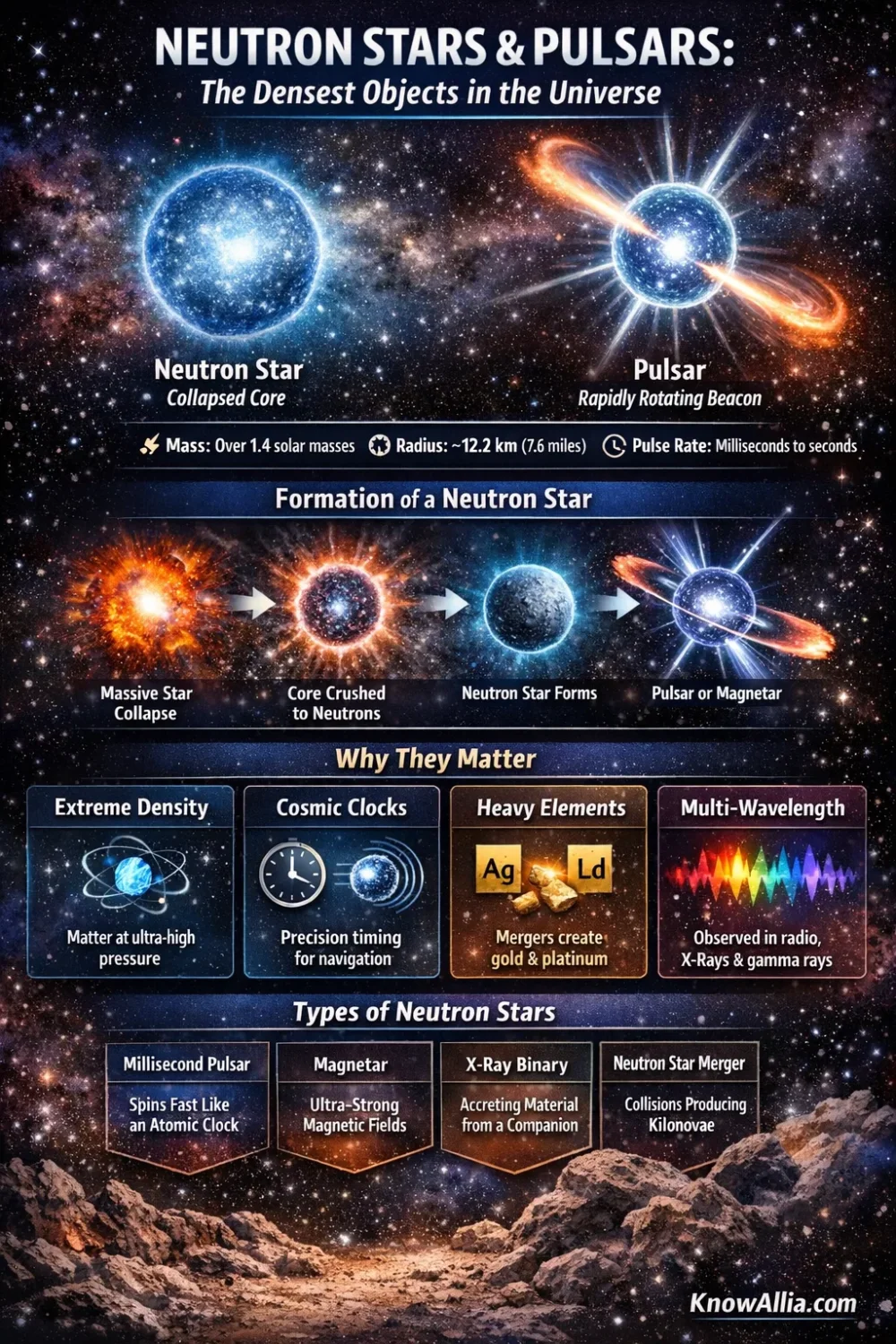
Neutron stars are collapsed stellar remnants left behind after certain massive stars explode, and they pack more than the Sun’s mass into a body only about 20–25 kilometers across. That makes them the densest stable objects astronomers can study directly. A pulsar is not a different material or a separate cosmic species; it is a neutron star whose radiation beam sweeps across Earth with such regular timing that it looks like a natural clock.[a][b][e]
A Clear Starting Point
These objects sit at the meeting point of stellar death, nuclear physics, gravity, and high-energy astronomy. Most short explainers stop at the lighthouse analogy. That leaves out the parts that now matter most: measured radii, what pulsar timing can test, and why neutron-star mergers changed how astronomers talk about the origin of many heavy elements.
- A standard neutron star with about 1.4 solar masses is now constrained to a radius near 12.2 kilometers in current NICER-based work.[g]
- Some millisecond pulsars keep time so well that NASA describes them as accurate as atomic clocks, which is why they matter for timing experiments and deep-space navigation ideas.[m]
- When two neutron stars merge, the event can produce a kilonova and help make heavy elements beyond iron.[l]
The sections below move from the basic definition to formation, pulse physics, measured structure, common labels, why pulsars are such useful tools, and the parts astronomers are still testing.
Jump to a Section
- Collapsed Stellar Core
- City-Size Object
- Rapid Rotation
- Extreme Magnetic Field
- Clock-Like Pulses
- Dense Matter Physics
What They Are
A neutron star is the compact remnant of a massive star’s core after collapse. A pulsar is a neutron star seen through a very specific observational geometry and energy pattern: the star rotates, its magnetic axis is offset from its spin axis, and a beam sweeps across our line of sight. That is why the two words are related but not interchangeable.[b][n]
Not every neutron star appears as a pulsar. Some are quiet, some shine mainly in X-rays, some accrete matter from a companion, and some sit at the ultra-magnetic end of the family as magnetars. Astronomers also detect neutron stars across more than one band of light: radio, visible, X-rays, and gamma rays all matter here, so the old idea that pulsars are “just radio sources” is too narrow.[c][i]
A simple rule helps: every pulsar is a neutron star, but not every neutron star is seen as a pulsar. The broader class is the neutron star; the pulsar label describes what the object does from our viewpoint.
How They Form
For many neutron stars, the story starts with a star roughly 8–25 times the Sun’s mass. Fusion in the core runs through heavier and heavier elements until iron builds up. At that point, the core can no longer keep supporting itself the same way. It collapses fast, the outer layers blow off in a core-collapse supernova, and the leftover core becomes a neutron star if the remnant mass stays below the limit for black-hole formation.[d][a][g]
- The parent star exhausts its usable core fuel.
- The iron-rich core collapses under gravity.
- Protons and electrons are driven together, producing neutron-rich matter and a flood of neutrinos.
- The outer star is expelled, while the surviving inner remnant becomes a neutron star.
The observational era for pulsars began with a real turning point in astronomy. The first pulsar was found on 28 November 1967, and the discovery paper appeared in Nature on 24 February 1968. That finding quickly changed neutron stars from theory into observed objects.[k]
Why Pulsars Pulse
The classic analogy works because it is accurate: a pulsar behaves like a lighthouse. The beam is not turning on and off each time. The star keeps emitting, but the beam only looks like a flash when it sweeps across Earth. NASA and ESA both describe this pulse pattern as the result of a misalignment between the spin axis and the magnetic axis.[b][c]
Observed pulse periods usually range from milliseconds to seconds. Some pulsars rotate only a few times per second, while others spin hundreds of times per second. Those faster objects are often old neutron stars that were spun up again in binary systems after pulling in matter from a companion star. That is why astronomers call many of them recycled or millisecond pulsars.[b][h][m]
Density and Structure
Calling neutron stars “dense” is true but still far too mild. A neutron star squeezes more than about 1.4 solar masses into a city-scale volume, and ESA notes that a single teaspoon of material from a neutron-star core would weigh over three billion tons. NICER-based work has sharpened the size question even further: a standard neutron star around 1.4 solar masses is now constrained to a radius near 12.2 ± 0.5 kilometers in one recent synthesis, with the maximum supported mass in that analysis near 2.3 solar masses before collapse to a black hole.[e][d][g]
That is why neutron stars matter far beyond stellar astronomy. Their interiors reach pressures and densities that Earth-based labs cannot copy at full scale. Radius measurements, mass measurements, and pulse-shape modeling are now central to figuring out the equation of state of ultra-dense matter: in plain language, how matter behaves when it is packed to an extreme that normal atoms cannot survive.[f][g]
Neutron Stars and Pulsars by Scale
Massive-star collapse can leave behind a city-size object. Add rapid rotation and a tilted magnetic axis, and that object may appear as a pulsar. Current NICER work is now putting tighter numbers on size and mass than older summaries could offer.[g]
A standard 1.4-solar-mass neutron star is now pinned down much better than before.[g]
Some millisecond pulsars are accurate enough to be treated as natural clocks.[m]
The parent star uses fuel until its inner structure can no longer hold itself up.
The core falls inward fast, and the outer layers are expelled in a supernova.
A Sun-like amount of mass survives in a body roughly the size of a city.
Rotation, magnetic geometry, and field strength shape what astronomers detect.
Interior Physics
Mass and radius together help narrow how ultra-dense matter behaves under enormous pressure.[f][g]
Precision Timing
Pulsar timing can reveal companion masses, orbital effects, and timing shifts too small for ordinary stars.[h]
Mergers
When neutron stars collide, the event can launch a kilonova and help make heavy elements beyond iron.[l]
Common Labels
Much of the confusion around this topic comes from mixing what the object is with how it is observed. The table below separates the labels that are often blended together in simpler articles.
| Label | What It Means | Main Power Source | Typical Observational Clue |
|---|---|---|---|
| Neutron star | The collapsed core left after some massive stars explode. | Stored heat, rotation, magnetic energy, or accretion, depending on subtype. | Compact object with more than solar mass in a city-size body.[a][e] |
| Pulsar | A neutron star whose beam crosses Earth and appears as pulses. | Usually rotational energy. | Pulse periods from milliseconds to seconds; multiwavelength pulses are possible.[b][c] |
| Millisecond pulsar | An old neutron star spun up again, often in a binary system. | Rotation after accretion-driven spin-up. | Very stable timing; useful as a natural clock and for navigation studies.[m][h] |
| Magnetar | A neutron star with an especially intense magnetic field. | Magnetic-field decay can dominate the emission. | Powerful X-ray and gamma-ray activity; at least some magnetars can produce FRB-like bursts.[j][a] |
| Binary neutron-star merger | The collision of two neutron stars after orbital decay. | Orbital energy released through gravitational waves and explosive ejecta. | Gravitational-wave signal, kilonova light, and heavy-element production.[l] |
Why They Matter
They Test Matter at Extreme Pressure
Neutron stars let astronomers measure matter where gravity compresses ordinary atomic structure out of existence. NICER was built to tackle this directly by tightening neutron-star mass and radius estimates. NASA describes these objects as environments where all four fundamental forces matter at once, and newer NICER results have narrowed the likely size of a standard neutron star far better than older textbook-style summaries could do.[e][f][g]
They Behave Like Cosmic Clocks
Pulsars are useful because their timing is so regular. NRAO describes their pulses as a superfast clock, and that clock can be used to measure orbital motion, companion masses, and subtle propagation effects. NASA’s newer station research materials add that some pulsars are accurate enough to act like atomic clocks and that the SEXTANT work showed pulsar-based navigation is feasible as a GPS-like idea for the wider solar system.[h][m]
They Help Explain Heavy Elements
Neutron stars also matter to chemistry and cosmic history. The first joint detection of gravitational waves and electromagnetic light from a binary neutron-star merger, GW170817, tied these mergers to kilonova emission and to the making of heavy elements beyond iron. That matters because it gives astronomers a real observed path for the origin of elements such as gold and platinum, rather than a purely theoretical one.[l]
They Are Not Only Radio Objects
Older public descriptions often center almost entirely on radio pulses. That is no longer enough. ESA notes that pulsars can be seen in radio, visible light, X-rays, and gamma rays, and NASA’s Fermi catalog work reports 294 confirmed gamma-ray pulsars with 34 more suspects awaiting confirmation. That wider multiwavelength view changes how pulsar populations are studied and how emission models are tested.[c][i]
A Useful Example
If two stars in a binary system both leave neutron-star remnants, the pair can spiral toward each other over time. One line of research then opens into gravitational waves, another into kilonova light, and another into the chemical story of heavy elements. A single class of object therefore links stellar death, relativity, and the cosmic origin of matter found in planets and meteorites.[l]
Common Confusion
- “Every neutron star is a pulsar.” No. Many neutron stars are quiet, old, weakly beamed toward us, or detected in other ways.[n]
- “A pulsar flashes because it turns on and off.” No. The beam keeps sweeping; the pulse is a line-of-sight effect.[b]
- “Pulsars are radio-only objects.” No. Astronomers observe pulsars in visible light, X-rays, and gamma rays too.[c][i]
- “Magnetars are outside the neutron-star family.” No. A magnetar is a neutron star with an especially intense magnetic field.[a]
- “The interior question is basically solved.” No. Radius measurements are better now, but the exact state of matter at the deepest densities is still being narrowed down.[f][g]
Key Terms
- Equation of State
- The relationship between pressure and density inside matter. For neutron stars, this tells astronomers how stiff or compressible the interior is.
- Magnetosphere
- The region around a neutron star where its magnetic field shapes particle motion and emission.
- Millisecond Pulsar
- A pulsar with a spin period measured in thousandths of a second, usually spun up again through binary interaction.
- Kilonova
- The bright transient glow from neutron-rich matter thrown out during a neutron-star merger.
- Radius Constraint
- An observational limit on a neutron star’s size, often inferred from X-ray pulse modeling and timing.
- Pulse Timing
- The measurement of pulse arrival times so precisely that astronomers can track orbital motion, spin changes, and propagation effects.
These terms matter because modern neutron-star research is no longer only about spotting unusual objects. It is about turning those objects into measurements of size, timing, magnetic behavior, and merger physics.[g][h]
What Scientists Are Still Testing
Several parts of the picture are much sharper than they were a decade ago, but the field is not finished. Astronomers are still tightening the exact interior composition of neutron stars, the true maximum mass a neutron star can support before collapsing, and the details of how charged particles are accelerated strongly enough to make pulsar emission. ESA has been very plain about this last point: even with thousands of known pulsars, the full mechanism behind their emission is still not pinned down.[g][o]
There is also honest uncertainty around some fast radio bursts. NASA has shown that magnetars can produce FRB-like bursts, which is a major clue, but that does not prove that all FRBs come from magnetars. Likewise, NICER has narrowed the allowed size range of standard neutron stars, but it has not turned the interior problem into a closed case.[j][f][g]
The honest bottom line: astronomers know what neutron stars are and how pulsars appear, but they are still refining what the deepest interior is made of and exactly how some of the emission physics works.
FAQ
Frequently Asked Questions
Are All Neutron Stars Pulsars?
No. A pulsar is a neutron star whose emission beam and rotation make pulses visible from Earth. Many neutron stars are not observed that way.
How Small Is a Neutron Star?
A typical neutron star is only about 20–25 kilometers across. Current NICER-based work places a standard 1.4-solar-mass neutron star near a radius of 12.2 kilometers.
What Is the Difference Between a Pulsar and a Magnetar?
Both are neutron stars. A pulsar is identified by its sweeping pulses, while a magnetar is identified by an exceptionally strong magnetic field and energetic outbursts.
Why Do Astronomers Care So Much About Pulsar Timing?
Because pulse arrival times can be measured with extraordinary precision. That lets astronomers study orbital motion, gravity, matter around the star, and even navigation concepts for deep space.
Do Neutron-Star Mergers Really Make Heavy Elements?
Yes, current merger observations strongly support that idea. The GW170817 event linked a binary neutron-star merger with kilonova light and heavy-element synthesis beyond iron.
Sources
- [a] NASA Science – Types — Used for the size scale of neutron stars, subtype framing, and basic formation range.
- [b] NASA Imagine the Universe – Neutron Stars — Used for the pulsar beam mechanism, pulse periods, and the lighthouse explanation.
- [c] ESA – Neutron Stars: Pulsars and Magnetars — Used for fast spin, multiwavelength emission, and the pulse-beam description.
- [d] ESA – Webb Finds Clues of Neutron Star at Heart of Supernova Remnant — Used for progenitor-mass context and the teaspoon-density comparison.
- [e] HEASARC / NASA – The Neutron Star Interior Composition Explorer Mission — Used for the highest stable density wording, mission purpose, and why mass-radius measurements matter.
- [f] NASA – NICER Probes the Squeezability of Neutron Stars — Used for the newer mass-radius context and the tighter radius estimate for standard neutron stars.
- [g] HEASARC / NASA – NICER Nuggets: 5 June 2025 — Used for the 12.2 ± 0.5 km radius estimate, the mass limit near 2.3 solar masses, and the dense-matter interpretation.
- NRAO – Pulsars Astronomy — Used for pulsars as precise clocks and for timing binary motion and companion masses.
- [i] NASA Science – NASA’s Fermi Mission Nets 300 Gamma-Ray Pulsars … and Counting — Used for the current gamma-ray pulsar count and the multiwavelength view of pulsar astronomy.
- NASA – Missions Help Pinpoint the Source of a Unique X-Ray, Radio Burst — Used for the magnetar-FRB connection.
- [k] ESA – 24 February — Used for the first pulsar discovery date and the publication date of the announcement in Nature.
- LIGO – Enabling the Discovery of Kilonovae Associated with Neutron Star Mergers with Electromagnetic Follow-up — Used for GW170817, kilonovae, and heavy-element synthesis beyond iron.
- [m] NASA – Navigation Technology — Used for atomic-clock-level timing language and the SEXTANT navigation demonstration.
- [n] NASA Imagine the Universe – Ask an Astrophysicist: Neutron Stars — Used for the distinction between neutron stars and pulsars and for why many neutron stars are not seen as pulsars.
- [o] ESA Science & Technology – Baffling Pulsar Leaves Astronomers in the Dark — Used for the point that pulsar emission physics is still not fully settled.