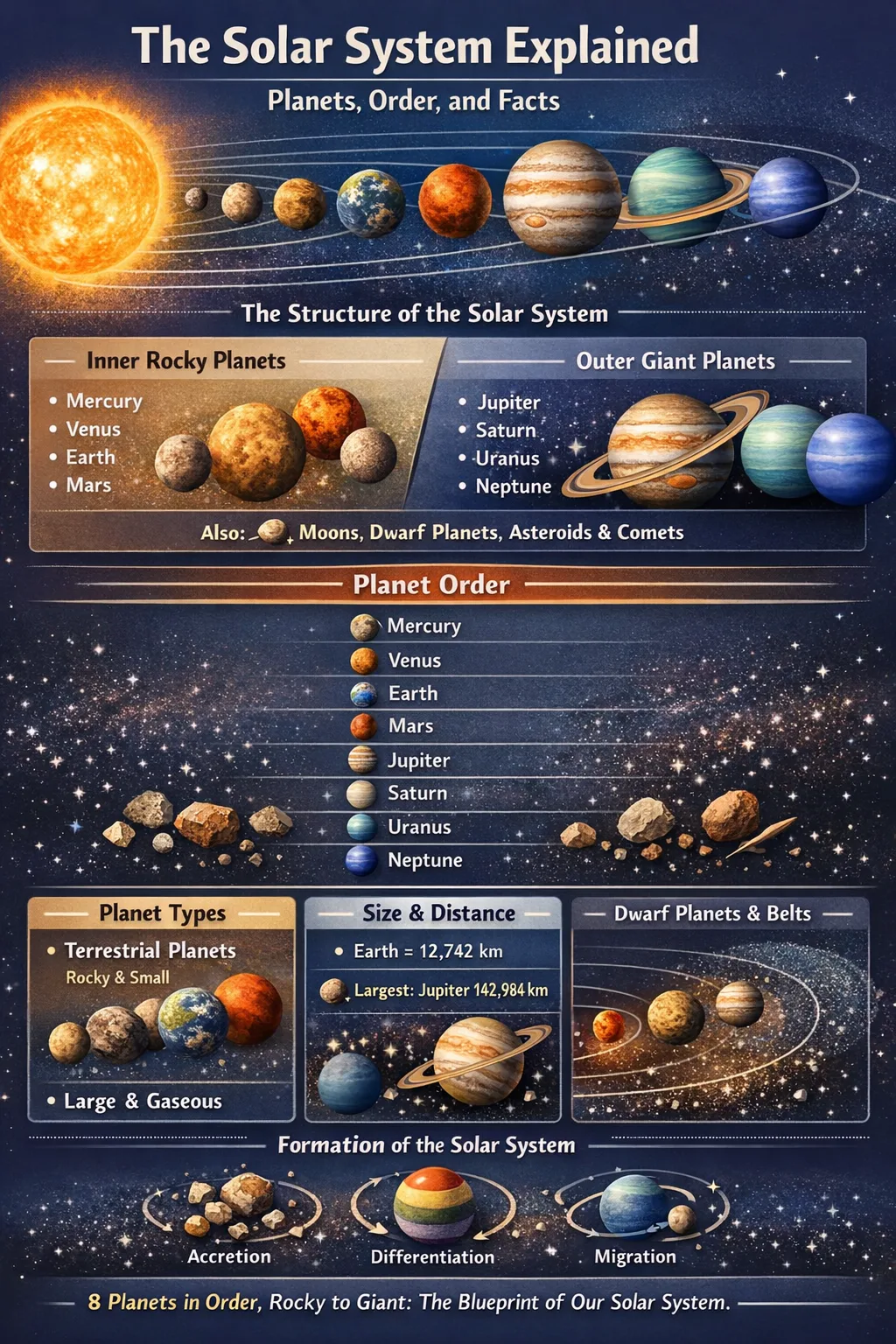
The Solar System is the Sun and everything that stays bound to it by gravity: planets, dwarf planets, moons, rings, asteroids, comets, and fine dust. It is a single system, but it is not one uniform place. Temperatures, materials, and orbital speeds shift dramatically as you move outward, and those differences explain why rocky worlds formed close in while giant planets dominate farther out [Source-1]✓
A Clear Starting Point
If you only remember one line, make it this: the Sun sits at the center, and the eight planets move outward in a consistent order. Everything else fits around that structure.
Planet Order
Mercury, Venus, Earth, Mars, Jupiter, Saturn, Uranus, Neptune
Main Split
Rocky inner planets and giant outer planets
Also Included
Dwarf planets, moons, rings, asteroids, comets, and dust
What the Solar System Is
The Solar System is not just “planets around the Sun.” It is a gravitational family with many kinds of objects. Planets are the most visible members, but most of the Solar System’s variety lives in smaller bodies that preserve clues about early materials and long-term orbital behavior.
Core Members
- The Sun (a star) providing most of the system’s gravity and energy
- Eight planets in stable, long-lived orbits
- Moons, rings, and tenuous atmospheres bound to many planets
Smaller Populations
- Dwarf planets and other large remnants that never became full planets
- Asteroids and comets, plus smaller debris from collisions
- Dust and gas shaped by solar radiation and solar wind
The Sun as the Anchor
The Sun is a medium-sized star made of hot, electrically charged gas (plasma). Gravity holds it together, and the same gravity sets the pace for every orbit in the Solar System. Even “simple” details reflect that complexity: the Sun does not rotate like a rigid ball, so different latitudes complete a rotation at different rates [Source-2]✓
- Why the Sun Matters
- Its gravity shapes orbits; its light and heat shape surface conditions; its magnetic activity influences space environments throughout the system.
- What “Solar” Really Means
- Anything described as solar is tied to the Sun as the central star of this system, not just to sunlight.
- Energy Source
- The Sun shines because nuclear fusion in its core converts mass into energy, released as light and other radiation.
Planet Order and Definition
In everyday language, a planet is “a big world in space.” In science, the definition is tighter. The International Astronomical Union (IAU) set a Solar System definition in 2006: a planet must orbit the Sun, be massive enough to become nearly round, and clear its orbital neighborhood of comparable bodies [Source-3]✓
“Clearing the neighborhood” does not mean a planet removes every object near its orbit. It means the planet is gravitationally dominant there: it has swept up, ejected, or controls most similar-sized bodies over time.
Planet Order from the Sun
- Mercury
- Venus
- Earth
- Mars
- Jupiter
- Saturn
- Uranus
- Neptune
This order is not random. It reflects how the Solar System’s original disk arranged materials: heavier rock and metal favored the inner region, while abundant hydrogen compounds and ices were more stable farther out. Over time, gravity and collisions refined the layout into the architecture we see today.
Planet Types
The eight planets are often grouped by composition and structure. The split is simple, but it helps explain surface conditions, atmospheres, and the presence of rings and many moons.
Terrestrial Planets
RockyDenseSolid Surface
- Mercury: cratered, very thin atmosphere
- Venus: thick atmosphere, very high surface temperatures
- Earth: oceans, active geology, substantial atmosphere
- Mars: dusty surface, thin atmosphere, large volcanoes and canyons
Giant Planets
LargeMany MoonsRing Systems
- Jupiter and Saturn: gas giants with thick hydrogen-helium envelopes
- Uranus and Neptune: ice giants with larger fractions of water-ammonia-methane ices and deep atmospheres
Names can be misleading. “Ice giant” does not mean a frozen surface like an iceberg. It points to interior chemistry: compounds that would be ices at very low temperatures become hot, high-pressure fluids deep inside these planets.
Planet Sizes and Distances
“Size” can mean diameter, mass, or volume. For clear comparison, diameter is a practical start. Distance is usually expressed as an average distance from the Sun, because planets travel in slightly elliptical orbits. The values below summarize equatorial diameters and average distances in common units [Source-4]✓
| Order | Planet | Type | Diameter (km) | Average Distance (million km) |
|---|---|---|---|---|
| 1 | Mercury | Terrestrial | 4,880 | 58 |
| 2 | Venus | Terrestrial | 12,104 | 108 |
| 3 | Earth | Terrestrial | 12,756 | 149.7 |
| 4 | Mars | Terrestrial | 6,792 | 227.9 |
| 5 | Jupiter | Gas Giant | 142,984 | 778 |
| 6 | Saturn | Gas Giant | 120,536 | 1,400 |
| 7 | Uranus | Ice Giant | 51,118 | 2,900 |
| 8 | Neptune | Ice Giant | 49,528 | 4,500 |
A useful way to read the table:
- The inner four planets are small and close together (tens to a few hundred million km).
- The giant planets are much larger, and the gaps between orbits grow quickly beyond Mars.
Orbits, Distances, and Time
Planet orbits are close to a common plane because they formed from a flattened disk around the young Sun. Orbits are also slightly elliptical, so “distance from the Sun” is usually an average. To keep distance comparisons consistent, astronomy uses the astronomical unit with the symbol au. In 2012, the IAU defined 1 au as exactly 149,597,870,700 meters [Source-5]✓
What Changes as You Move Outward
- Orbital speed decreases: outer planets move more slowly along larger paths.
- Sunlight intensity drops: energy spreads out with distance.
- Typical materials shift: volatile compounds are more stable far from the Sun, while rock and metal dominate close in.
Dwarf Planets and Small Bodies
Dwarf planets are round, orbit the Sun, and are not moons, but they do not dominate their orbital zones the way planets do. They share space with other objects in similar orbits, which is why they are classified separately in the Solar System’s naming system.
Major Regions You Will Hear About
- Asteroid Belt: a broad region of rocky bodies between Mars and Jupiter
- Kuiper Belt: an outer zone of icy objects beyond Neptune, associated with Pluto, many dwarf planets, and some comets [Source-6]✓
- Oort Cloud: a very distant, theoretical reservoir often used to explain the origin of many long-period comets
Small bodies are not “leftovers” in a casual sense. They are records of early Solar System chemistry and collisions. When scientists talk about the Solar System’s history, these objects often carry the clearest long-term signatures.
How the System Took Shape
The Solar System formed as gravity pulled a rotating cloud of gas and dust into a denser center. Conservation of angular momentum naturally flattened much of the remaining material into a disk. Inside that disk, tiny grains collided and stuck. Over time, those small aggregates grew into larger bodies. The inner region favored rock and metal; farther out, colder conditions allowed ices to join the mix, supporting the growth of much larger planets.
Three Processes That Shaped the Layout
- Accretion: small solids merged into bigger bodies through repeated collisions.
- Differentiation: heavier materials sank in larger bodies, forming cores, mantles, and crusts.
- Migration and Resonance: gravitational interactions shifted some orbits and locked others into stable patterns.
Why the Outer Planets Are Different
Beyond the inner Solar System, more raw material was available for growth, and ices added mass efficiently. Once large cores formed, they could collect thick atmospheres. That is why the outer planets are much larger and often have extensive moon systems and rings.
Putting It All Together
Think of the Solar System as a layered structure: a luminous center, a compact set of rocky worlds, a transition zone rich in small bodies, and then a wide outer region of giants and icy populations. Once you learn the order and the reasons the categories exist, most Solar System “facts” become easier to remember because they connect to a single physical story.
FAQ
Frequently Asked Questions
How Many Planets Are in the Solar System?
There are eight planets: Mercury, Venus, Earth, Mars, Jupiter, Saturn, Uranus, and Neptune.
What Separates a Planet from a Dwarf Planet?
In the Solar System, a planet is nearly round, orbits the Sun, and has cleared its orbital neighborhood. A dwarf planet is nearly round and orbits the Sun, but it has not cleared its neighborhood.
Is Pluto Part of the Solar System?
Yes. Pluto is a Solar System object that orbits the Sun. It is classified as a dwarf planet.
Do All Planets Orbit in a Perfect Circle?
No. Planetary orbits are ellipses (slightly stretched circles). That is why distance from the Sun is often given as an average.
What Does “au” Mean in Astronomy?
au is the symbol for the astronomical unit, a standard distance used for Solar System scales.
Where Is the Kuiper Belt?
The Kuiper Belt is a region of icy objects beyond Neptune. It is associated with Pluto and many other distant bodies.