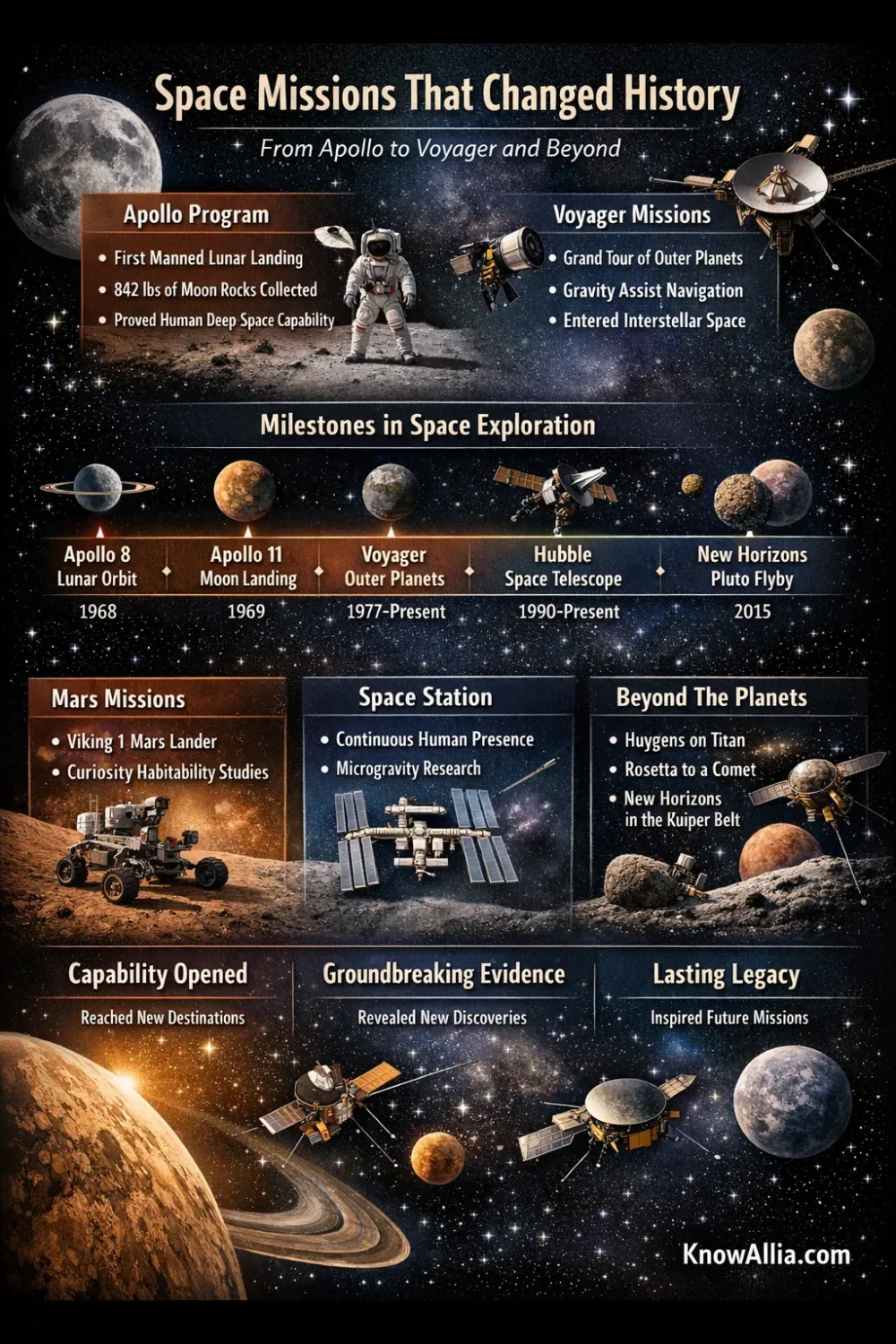
A history-changing space mission is one that opens a new capability, returns evidence nobody had before, or changes how later missions are designed. By that standard, Apollo and Voyager sit at the center of space history, but they are part of a longer chain that also includes Mars landers, space telescopes, orbital laboratories, and frontier probes that pushed the map outward.
Why These Missions Still Matter
Some missions are remembered because they were first. Others matter because they changed how spaceflight works long after launch day. The missions below did both: they proved new methods, opened new destinations, and left data or operating models that later missions still rely on.
- Apollo showed that humans could travel to another world, work there, and bring back samples for long-term science.
- Voyager turned gravity assists and long-range robotic exploration into a practical way to study the outer Solar System.
- Later missions expanded that playbook through Mars habitability studies, orbital observatories, space-station research, Titan landings, comet rendezvous, Pluto flybys, and far-infrared astronomy.
The sections below connect first achievements, scientific return, and lasting influence. That makes it easier to see why one mission becomes a milestone while another remains a narrower success.
- Lunar Exploration
- Outer Planet Flybys
- Mars Habitability
- Space Telescopes
- Long-Duration Orbit
- Titan, Comets, Pluto
What Actually Makes a Mission Change History
Not every famous mission changes the field in the same way. Some missions matter because they prove that a destination is reachable. Some matter because they rewrite textbooks. Others matter because they establish a method that later missions keep using. The most durable milestones usually do all three.
- Capability opened: a new kind of flight, landing, orbit, sample return, or observing platform becomes possible.
- Evidence returned: the mission answers a real scientific question or forces scientists to ask better ones.
- Legacy carried forward: later missions reuse the same operating model, navigation logic, scientific strategy, or engineering approach.
This is where many popular space lists stop too early. They often rank missions by fame alone. A better measure is whether the mission changed capability, knowledge, and future mission design at the same time.
How a Mission Becomes a Turning Point
The pattern is simple: open a capability, prove it with data, and leave a model later missions can reuse.
History-Changing Pattern
New Route Apollo 8 Crewed lunar orbit New Surface Work Apollo 11 Landing and sample return New Reach Voyager Gravity-assist outer tours New Platforms Hubble / ISS Long-duration science New Frontier New Horizons / Webb Pluto and deep cosmosIt changed spaceflight from orbiting Earth to traveling, landing, sampling, and returning from another world.
Its route design and long service life made multi-planet exploration practical, not theoretical.
History-changing work now includes telescopes, stations, Mars laboratories, Titan landers, comet missions, and Kuiper Belt probes.
Capability
A mission matters first because it lets humans or instruments do something that was not previously demonstrated.
Evidence
The mission has to return data that changes accepted models, not just confirm what telescopes already suggested.
Legacy
The clearest milestones leave behind a method that future missions keep using in new settings.
A Clear Look at the Missions That Shifted the Field
| Mission | Era | What It Proved | Why It Stayed Important |
|---|---|---|---|
| Apollo 8 | 1968 | Crewed travel to lunar orbit and back | Made deep-space human navigation and lunar mission architecture real |
| Apollo 11 | 1969 | Human landing and work on the Moon | Turned another world into a field site for science and sample return |
| Voyager 1 and 2 | 1977–present | Multi-planet flybys using gravity assists | Set the standard for outer planet exploration and interstellar extension |
| Viking 1 | 1976 | First fully successful Mars surface mission | Moved Mars science from distant observation to on-site testing |
| Hubble | 1990–present | Long-life precision astronomy above Earth’s atmosphere | Changed cosmology, galaxy studies, and exoplanet atmosphere work |
| ISS | 2000–present | Continuous human presence in orbit | Made long-duration microgravity research routine |
| Curiosity | 2012–present | Geology-led search for past habitability on Mars | Refocused Mars exploration on environments where life could once have existed |
| Huygens | 2005 | Landing in the outer Solar System | Delivered direct data from Titan’s atmosphere and surface |
| Rosetta | 2004–2016 | Comet rendezvous and lander deployment | Brought small-body exploration into long-duration close study |
| New Horizons | 2015–present | First close reconnaissance of Pluto and later Arrokoth | Brought the Kuiper Belt into direct exploration |
| Webb | 2021–present | High-power infrared astronomy at Sun-Earth L2 | Extended observational reach toward the early Universe and planet-forming systems |
Apollo Changed What Human Spaceflight Could Do
The Apollo program mattered for more than one reason. It was not just about a single landing. Apollo changed mission design, navigation, life-support planning, surface operations, and the scientific value of human fieldwork beyond Earth orbit.
Apollo 8 Turned the Moon Into a Reachable Destination
Apollo 8 was the first crewed mission to leave low Earth orbit, the first crewed launch of the Saturn V rocket, and the first time humans orbited the Moon and saw Earthrise above its surface.[a] That changed the problem of lunar travel from theory to operation. After Apollo 8, a lunar mission was no longer an abstract target. It was a route that had been flown.
That is a larger step than it can seem in retrospect. The mission proved that a crew could navigate to another world, enter orbit, function safely there, and return home. In practical terms, Apollo 8 was the mission that made the rest of Apollo believable.
Apollo 11 Made Another World a Place for Field Science
Apollo 11 is remembered because it landed the first humans on the Moon.[b] Its deeper legacy is that it made extraterrestrial fieldwork real. Once astronauts could land, deploy instruments, collect samples, document geology, and return material to Earth, the Moon stopped being only a distant object of observation.
Across six Apollo landing missions, astronauts collected 2,196 samples with a total mass of 842 pounds, or 382 kilograms.[c] That sample return mattered because it created a long scientific afterlife. Lunar materials are still studied today, which means Apollo did not end when the last crew departed. It became an archive that keeps producing new results.
A useful way to understand Apollo is to think of it as the difference between looking at a coastline from an airplane and walking its beaches with a notebook and sample bag. Telescopes and orbiters can see a great deal. Boots, tools, and returned material change the level of evidence.
Voyager Turned the Outer Solar System Into a Real Place
If Apollo changed what humans could do in deep space, Voyager changed what robotic probes could do over very long distances. The twin spacecraft were designed to exploit a rare alignment of Jupiter, Saturn, Uranus, and Neptune that occurs about every 175 years, making a four-planet tour possible with limited propellant.[d]
A gravity assist works a bit like stepping onto a moving walkway at an airport. You still move along your route, but the platform changes your speed and direction far more efficiently than your own effort alone. Voyager used planets in exactly that way, bending its path and gaining speed without carrying huge fuel reserves.
Voyager 1 and Voyager 2 first transformed Jupiter and Saturn from blurry telescopic disks into complex systems of storms, rings, magnetic fields, and active moons. Voyager then extended that model to Uranus and Neptune, and the mission’s image archive still contains the only up-close views of those two planets.[e] In effect, Voyager did not just visit four planets. It taught scientists to think in terms of planetary systems.
The mission’s historical reach widened again when Voyager 1 crossed into interstellar space in August 2012 and Voyager 2 did the same in November 2018.[f] That shifted Voyager from a planetary tour into a boundary mission, measuring the region beyond the heliosphere rather than simply heading toward it.
Many popular summaries treat Voyager as a glorious photo mission. That misses the bigger point. Voyager changed trajectory design, mission longevity, and scientific expectations. It showed that a probe launched for one destination could keep enlarging its job for decades.
Mars Missions Changed the Search for Habitability
Mars missions changed history in a different way. They moved the question from “What does Mars look like?” to “What kind of environment did Mars have, and could it once have supported life?”
Viking 1 Put Mars Science on the Ground
Viking 1 was the first spacecraft to successfully land on Mars and operate there as part of a surface science mission.[g] That shifted Mars exploration from flyby and orbital reconnaissance to in-place measurement. Even where its biology experiments did not produce a simple answer, Viking made one thing clear: Mars science would have to be done on Mars, not only from afar.
Curiosity Reframed the Goal From Life Detection to Habitability
Curiosity mattered because it asked a sharper question. Rather than trying to settle the life question in one step, it focused on whether Mars once had environments capable of supporting microbial life. Early in the mission, Curiosity found chemical and mineral evidence of past habitable environments in Gale Crater.[h] That made Mars geology central to Mars astrobiology.
This change in method has been lasting. Instead of hunting only for dramatic signs, later Mars work increasingly follows rock layers, sediments, water history, and environmental context. That is a more disciplined route, and Curiosity helped normalize it.
Space Observatories Changed What We Could See
History-changing space missions are not limited to travel and landings. Some of the most durable milestones are observatories. They do not touch another world, but they change the scale and precision of what humans can know.
Hubble Turned Orbit Into a Long-Term Astronomy Platform
Since its 1990 launch, Hubble has changed astronomy across subjects that range from nearby planets to the expansion history of the Universe.[i] NASA’s own mission overview points to two examples that show its reach clearly: Hubble helped determine the atmospheric composition of planets around other stars and contributed to the discovery of dark energy.[j]
That matters historically because Hubble made space-based observing feel permanent rather than experimental. A telescope above Earth’s atmosphere could be more than a one-off technical success. It could become a continuously useful scientific institution.
Webb Extended the Reach of Space Astronomy
Webb carries that idea into a new range. NASA describes it as an observatory that studies every phase in the history of the Universe, from the first luminous glows after the Big Bang to the formation of solar systems capable of supporting life.[k] Its position around Sun-Earth L2, about 1.5 million kilometers from Earth, gives it a stable environment for deep infrared observing.[l]
Webb belongs in the same historical conversation because it shows that a mission can change history by expanding visibility, not only by expanding travel. The destination, in this case, is the deep record of cosmic time.
The Space Station Made Long-Duration Human Presence Routine
The International Space Station changed history more quietly than Apollo, but its effect is broad. In November 2025, it reached 25 years of continuous human presence in orbit, and NASA notes that more than 290 people from 26 countries have visited the station.[m]
That matters because the station turned space from a brief expedition site into a place where humans can live, work, repair hardware, run experiments, and study the effects of long-duration exposure to microgravity. Apollo proved humans could go far. The station proved they could stay.
It also changed engineering culture. Space hardware no longer had to be thought of only in terms of launch and return. Some systems could be maintained, adapted, and studied as part of a long orbital life.
Beyond the Big Planets, Missions Kept Redrawing the Map
After Apollo and Voyager, the history of space exploration did not become a repetition of the same story. It diversified. New missions changed history by targeting places that had once been too distant, too uncertain, or too technically demanding.
Huygens Brought the Outer Solar System to the Surface
On 14 January 2005, ESA’s Huygens probe landed on Titan, becoming the first probe to land on an object in the outer Solar System.[n] That moved outer planet science beyond flybys and orbiters. Titan became a place with weather, a surface, and a landing history, not just a moon seen through haze.
Rosetta Made a Comet a Long-Term Target
Rosetta was the first mission to rendezvous with a comet, escort it as it orbited the Sun, and deploy a lander to its surface.[o] That changed small-body science from pass-by photography to close, sustained tracking. For studies of Solar System origins, that was a major shift in method.
New Horizons Turned Pluto From a Dot Into a World
New Horizons was the first spacecraft to explore Pluto up close, and later the first to explore a second Kuiper Belt object, Arrokoth, at close range.[p] That changed the outer edge of the Solar System from a distant category into a directly explored region.
Pluto’s close-up geology was one of the clearest lessons. A place that many people expected to be simple turned out to be varied and active-looking in ways that demanded new explanations. That is one of the classic signs of a history-changing mission: it replaces a neat assumption with a richer, testable picture.
Where Readers Often Get Mixed Up
Apollo Was Not Just One Landing
Apollo 11 is the best-known moment, but Apollo changed history through a sequence of achievements: deep-space navigation, lunar orbit, landing operations, surface science, and sample return.
Voyager Was Not Only a Photo Mission
Its images are iconic, but the deeper legacy is route design, long-duration spacecraft management, outer planet system science, and interstellar measurement.
“First” and “Most Influential” Are Not Always the Same
Some missions are first to arrive. Others matter more because they leave a method that many later missions repeat.
Hubble and Webb Are Not Doing the Same Job
Both are observatories, but they operate with different strengths, wavelength coverage, and scientific emphasis. Webb extends rather than duplicates Hubble.
This distinction matters because popular rankings often confuse public memory with historical effect. The missions most worth studying are usually the ones that altered the rules of the next era.
Useful Terms That Make This Topic Easier
- Gravity Assist
- A maneuver that uses a planet’s motion and gravity to change a spacecraft’s speed and direction.
- Interstellar Space
- The region beyond the heliosphere, where the Sun’s outward flow no longer dominates the local environment.
- Sample Return
- A mission result in which physical material from another world is brought back to Earth for laboratory study.
- Habitability
- The set of environmental conditions that could allow microbial life to exist, even if no life is directly detected.
- Flyby
- A mission profile in which a spacecraft passes a target once rather than entering orbit around it.
- L2
- The second Sun-Earth Lagrange point, a position well suited to stable deep-space observing.
Where the Record Is Still Incomplete
Even the most famous missions left unanswered questions. That is part of why their legacy lasts.
- Apollo returned lunar material, but the Moon is large and geologically varied. Six landing sites cannot answer every question about its full history.
- Voyager gave unmatched flyby data, but flybys are snapshots. Uranus and Neptune still need dedicated orbiters for a fuller record.
- Viking established Mars surface science, yet its biology results did not close the life question in a simple way.
- Huygens reached Titan’s surface, but one landing is still only one local view of a very complex moon.
- New Horizons revealed Pluto in detail during a brief pass, not a long orbital campaign.
This honesty matters. A mission does not have to answer everything to change history. Often the real turning point is that it asks better questions than the field had before.
Why Apollo and Voyager Still Anchor the Story
Many later missions are more specialized, and some are more refined. Yet Apollo and Voyager still anchor the story because they shifted the possible in two opposite directions at once. Apollo proved that humans could leave Earth orbit, land elsewhere, work with intent, and bring material home. Voyager proved that robotic spacecraft could keep extending their mission far beyond the original plan, using physics, patience, and careful operations to turn the outer Solar System into mapped territory.
The missions that followed did not replace them. They extended their logic. Mars landers deepened surface science. Hubble and Webb expanded observational reach. The space station normalized long-duration habitation. Huygens, Rosetta, and New Horizons showed that distant or difficult targets could become direct scientific workplaces. That is why the phrase “space missions that changed history” still naturally begins with Apollo and Voyager, but it does not end there.
FAQ
Which space mission changed history the most?
There is no single universal answer, but Apollo and Voyager are usually the strongest pair. Apollo changed human deep-space capability, while Voyager changed robotic exploration of the outer Solar System and later interstellar space.
Why are Apollo and Voyager often discussed together?
They represent two different but equally lasting models of exploration. Apollo showed what crewed missions can achieve on another world. Voyager showed how robotic probes can extend reach, duration, and scientific return across vast distances.
Was Apollo only important because of Apollo 11?
No. Apollo 8, Apollo 11, and the later sample-return missions each changed a different part of lunar exploration. The program’s influence came from a sequence of tested capabilities, not one moment alone.
Why does Voyager still matter if it launched in 1977?
Voyager still matters because its data reshaped outer planet science, its route design remains a classic model for gravity-assist exploration, and both spacecraft later reached interstellar space, extending the mission far beyond its original goals.
Why are Hubble and Webb included in a list of history-changing missions?
Because missions do not need to land anywhere to change history. Space observatories can transform knowledge by revealing things that were previously invisible or too blurred to measure well from Earth.
What mission changed Mars research the most?
Viking 1 changed Mars science by making the surface a direct research site. Curiosity later changed the method again by centering the search on past habitability and the geological record.
Sources
- [a] NASA – Apollo 8 — First crewed lunar orbit, first crewed Saturn V launch, and Earthrise context. ↩
- [b] NASA – Apollo 11 — First human landing on the Moon and mission background. ↩
- [c] NASA Science – NASA’s Apollo Samples Yield New Information about the Moon — Sample count and total returned lunar mass; relevant to Apollo’s long scientific afterlife. ↩
- [d] NASA Science – Voyager Fact Sheet — Rare outer-planet alignment, gravity-assist logic, and the original planetary tour. ↩
- [e] NASA Science – Images Voyager Took — Still the only up-close images of Uranus and Neptune; visual legacy of the mission. ↩
- [f] NASA Science – Interstellar Mission — Voyager 1 and Voyager 2 crossing dates into interstellar space and ongoing mission goals. ↩
- [g] NASA Science – Viking Project — Viking 1 as the first fully successful Mars landing mission and the start of in-place Mars science. ↩
- [h] NASA Science – Mars Science Laboratory: Curiosity Rover — Evidence for past habitable environments and the shift toward geology-led Mars habitability research. ↩
- [i] NASA Science – Hubble Space Telescope — Hubble’s long mission and broad effect on astronomy. ↩
- [j] NASA Science – Hubble Space Telescope — Atmospheric composition of exoplanets and dark energy as examples of Hubble’s historical impact. ↩
- [k] NASA Science – James Webb Space Telescope — Webb’s science scope from the early Universe to planetary system formation. ↩
- [l] NASA Science – James Webb Space Telescope — Webb’s L2 location and operating context. ↩
- [m] NASA – International Space Station: 25 Years — Continuous human presence in orbit, visitor count, and long-duration research context. ↩
- [n] ESA Science & Technology – Titan Surface Landing — Huygens as the first probe to land on an object in the outer Solar System. ↩
- [o] ESA – Rosetta | rendezvous with a comet — First comet rendezvous, escort mission, and surface lander deployment. ↩
- [p] NASA Science – New Horizons — First close exploration of Pluto and later Arrokoth in the Kuiper Belt. ↩