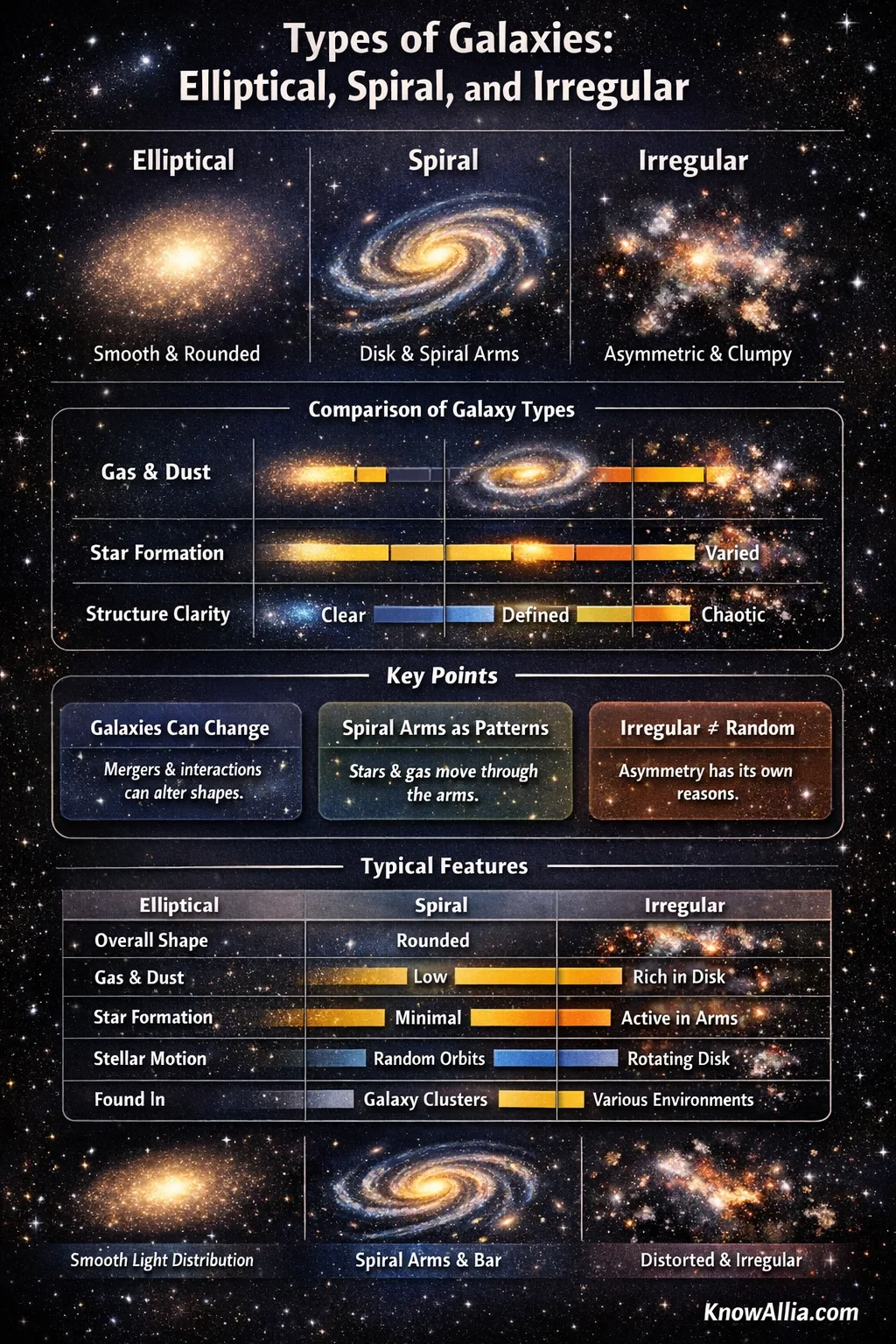
A galaxy type is a way to sort galaxies by how they appear in images—mainly their overall shape and visible structure. In everyday terms, most well-known galaxies fall into three broad families: elliptical, spiral, and irregular[a]↗.
A Clean Mental Model to Start With
Galaxy “types” are about shape and visible layout, not about which galaxies are “better” or “older.” A spiral can be calm or busy; an elliptical can be huge or small. Think of the labels as a filing system that helps astronomers compare objects that would otherwise be hard to describe quickly.
- Elliptical: smooth light, no obvious arms; often looks like a glowing oval.
- Spiral: a flat disk with arms; usually has gas and dust in the disk.
- Irregular: doesn’t neatly fit the others; shape can be lopsided or messy.
In this article, you’ll learn what each type really means, what astronomers look at when they classify galaxies, and which common assumptions are worth unlearning. You’ll also see how these categories connect to things like gas and dust, star formation, and galaxy interactions.
On This Page
What Galaxy Type Really Means
It’s About Appearance First
When astronomers talk about elliptical, spiral, and irregular, they’re describing morphology—how a galaxy looks in a particular set of observations. That matters because images are often the first clue we get, especially for distant galaxies. But the label is not the whole story.
- Viewing angle can hide features. A spiral seen edge-on may look more like a thin streak than a pinwheel.
- Wavelength changes what stands out. Dust lanes can dominate in visible light, while infrared can reveal stars behind dust.
- Not a personality test: a “calm” or “active” galaxy can exist inside any shape category.
How Astronomers Classify Galaxies in Practice
A classic starting point is the Hubble tuning fork: ellipticals on one side, spirals (including barred spirals) on the other, and in-between disk galaxies called lenticular (S0) sitting near the “fork”[b]↗. Irregular galaxies are the ones that don’t sit neatly on that diagram.
Important nuance The tuning fork is still useful, but it’s too simple to capture every real galaxy. Modern classification often combines visual structure with measurements such as color, gas content, and how stars move inside the galaxy.
What They Look For (Even Before the Math)
- Disk vs. no disk: A flat rotating disk is a big hint you’re looking at a spiral or lenticular.
- Arms and dust lanes: Visible spiral arms and dust lanes usually live in disk galaxies.
- Bulge and bar: A central bulge can be small or dominant; a bar can redirect gas and reshape the inner disk over time.
- Clumpiness: Patchy, asymmetric light and scattered star-forming regions can point toward “irregular.”
Elliptical Galaxies
An elliptical galaxy is usually described as a smooth, rounded-to-oval glow, without the obvious arms you’d see in a spiral. The “elliptical” name is about outline, not about being a perfect mathematical ellipse[d]↗.
What They Tend to Look Like
- Smooth light distribution: brightness usually fades gradually from the center outward.
- Wide range of shapes: from almost round to noticeably stretched. Astronomers often label them from E0 (rounder) to E7 (more elongated)[b]↗.
- Less obvious internal structure: no clean arm pattern, no strong dust lanes.
Stars, Gas, and Motion
Ellipticals often contain little gas and dust compared with spirals, which means there’s typically less raw material for making new stars. Their stars can move in many different directions instead of marching around in a neat disk-like rotation[a]↗.
Where They’re Common
Elliptical galaxies show up often in galaxy clusters—busy neighborhoods where galaxies live close enough that gravity encourages encounters and mergers over cosmic time[d]↗.
How They Can Form (What’s Strongly Supported)
A leading idea is that collisions and mergers between galaxies can scramble ordered disks into a more rounded, featureless system. That’s one reason ellipticals are often discussed alongside the long-term effects of galaxy interactions[a]↗.
Example that fits the pattern The Hubble Space Telescope has imaged ellipticals that look extremely smooth and centrally concentrated, with very little obvious dust structure. NASA notes that ellipticals can also be very large systems in today’s universe[f]↗.
Spiral Galaxies
A spiral galaxy is best recognized by a flat disk with arms that curve outward from the center. Many spirals also have a central bulge, and quite a few have a bar cutting through that bulge, with arms starting near the bar’s ends[c]↗.
The Usual Parts People Point To
- Disk: the broad, flat region where many stars orbit and where dust lanes are often visible.
- Arms: curved features in the disk; they often highlight regions with gas, dust, and younger stars.
- Bulge: a rounder central concentration of stars; size varies widely across spirals[b]↗.
- Bar (in barred spirals): an extended structure of stars crossing the center, tied to how some spirals channel material inward[b]↗.
Why Do Spiral Arms Exist at All?
One famous puzzle is the “winding problem”: if spiral arms were a single fixed structure, the galaxy’s rotation should wrap them tighter and tighter over time. A widely used explanation is that arms can behave more like a pattern—regions of higher and lower density—rather than a permanent set of the same stars and gas. As material orbits, it moves through the arm region, bunching up and then flowing onward[e]↗.
Here’s a simple analogy: a spiral arm can act like a stadium wave. The wave shape travels around the arena, but the people making it are constantly changing—standing up, sitting down, and moving on. In a galaxy disk, stars and gas do something similar as they pass in and out of the spiral pattern.
A Sneaky Detail: Orientation Can Fool You
Spirals can look dramatically different depending on how they’re tilted relative to us. Face-on spirals show arms clearly; edge-on spirals can look like a bright central bulge with a thin line across it. That’s one reason a single image sometimes isn’t enough for a confident label—astronomers may compare multiple wavelengths or use additional measurements before calling it[c]↗.
A useful context point In the nearby universe, spirals are often described as the most common large-galaxy category in broad surveys (you’ll see figures around “about 60%” in some references), but any single number depends on what sample you pick and how you define boundaries[c]↗.
Irregular Galaxies
An irregular galaxy is, essentially, “none of the above”: it doesn’t show the clean symmetry of an elliptical or the organized disk-and-arms structure of a spiral. Some irregulars are small and clumpy; others look distorted, as if gravity has been pulling them off-balance.
Why “Irregular” Happens
- Natural diversity: many smaller galaxies simply don’t develop a stable spiral pattern.
- Interactions: close passes and mergers can stretch galaxies into tidal shapes or disturb their internal structure.
- Time and environment: in the early universe, galaxies were often less settled, and many looked irregular compared with today’s familiar spirals and ellipticals[f]↗.
Can Irregulars Become “Regular”?
Some researchers argue that, as irregular galaxies collide and merge over time, they can build up more recognizable structure. NASA describes irregulars as especially common earlier in cosmic history and discusses the idea that interactions can help create the spirals and ellipticals we see today—while also emphasizing that real galaxy evolution is complex and not a single straight line[f]↗.
A concrete example NASA highlights images of a dwarf irregular (such as NGC 4214) where bright star-forming regions sit in an uneven, clumpy layout rather than in a clean spiral pattern[f]↗.
Elliptical vs. Spiral vs. Irregular: A Practical Comparison
These are typical trends, not strict rules. Real galaxies can be hybrids, transitional forms, or simply hard to classify from one viewpoint.
| Feature | Elliptical | Spiral | Irregular |
|---|---|---|---|
| Overall look | Smooth, rounded-to-oval light | Flat disk with arms; often a bulge | Asymmetric, clumpy, or distorted |
| Gas & dust | Often low compared with spirals[a]↗ | Common in the disk; dust lanes can be visible[c]↗ | Varies; can be gas-rich, especially in dwarfs |
| Star formation | Often lower in many examples | Frequently active in arms (bright regions) | Can be patchy; bursts can happen in clumps |
| Stellar motion | More random directions in many cases[a]↗ | Strong overall rotation in the disk | Mixed; depends on mass and history |
| Common settings | Often found in clusters[d]↗ | Common in a wide range of environments | Common among smaller galaxies; also in disturbed systems |
| Related subtypes | Giant ellipticals, dwarf ellipticals[b]↗ | Barred spirals; tightly vs loosely wound arms[b]↗ | Some show hints of structure; others are highly disorganized[g]↗ |
Galaxy Shapes, Explained Visually
Three familiar morphology families share one big idea: shape is a clue, not a full biography. The same galaxy can look different by angle and wavelength, but these patterns stay useful for quick comparison.
What Stands Out at First Glance
Elliptical Spiral IrregularGas & Dust (typical) Star Formation (typical) Structure ClarityLower Higher VariableThree Quick Takeaways
Mergers can reshape disks; calm periods can preserve structure. Real histories can be long and non-linear.
Spiral arms can behave like density regions that stars and gas pass through, instead of “fixed” arms made of the same material.
“Irregular” is still a category: it often describes asymmetry, clumps, or disturbance that doesn’t match clean spiral/elliptical shapes.
Elliptical: The Smooth Profile
Often looks uniform and rounded, with less obvious dust structure. Many are discussed in the context of dense environments and mergers.
Spiral: The Disk and Arms
A rotating disk can host arms, dust lanes, and bright star-forming regions. Bars are common and can reshape the inner galaxy.
Irregular: The Asymmetry Story
Clumpy or lopsided light is common. Some are small dwarfs; others show disturbance from nearby gravitational encounters.
Common Misconceptions and Confusion
Misconception 1: “Early-Type” Means “Older”
Not quite The words early-type and late-type came from an old idea that galaxies evolve left-to-right across the tuning fork. That interpretation is now considered false, even though the terms still show up in astronomy conversations[g]↗.
Misconception 2: “Spiral Arms Are Made of the Same Stars Forever”
Usually misleading A lot of evidence supports the idea that arms can be a density pattern that stars and gas move through. That’s how the “winding problem” is often addressed in modern explanations[e]↗.
Misconception 3: “Irregular Means Random, With No Useful Pattern”
Too harsh “Irregular” can still be informative. It often points to asymmetry, clumps, or disturbance, and it’s especially common when looking back to earlier cosmic times, before many galaxies settled into familiar shapes[f]↗.
Misconception 4: “You Can Always Tell the Type from One Photo”
Not always A single image can be deceptive. Tilt, dust, and resolution matter. That’s why astronomers use multiple wavelengths and multiple clues—especially for distant galaxies where detail is limited.
Key Terms (Mini Glossary)
- Morphology
- The visible shape and structure of a galaxy (how it looks in images).
- Disk
- A flattened component where many stars orbit; common in spirals and lenticulars.
- Bulge
- A rounder central concentration of stars; can be small or dominant depending on the galaxy.
- Bar
- An elongated structure of stars through the center of some spirals; arms often connect near its ends.
- Interstellar Medium (ISM)
- The gas and dust between stars inside a galaxy—the raw material for future star formation.
- Star Formation
- The process of making new stars from dense gas; often highlighted by bright regions in galaxy disks.
- Merger
- A collision and combination of galaxies; can dramatically reshape morphology over time.
- Tidal Interaction
- Gravitational pulling between nearby galaxies that can distort shapes, trigger star formation, or strip material.
Limitations: What We Don’t Know (Or Can’t Say for Sure Yet)
Galaxy typing is powerful, but it has honest limits.
- Arm longevity: exactly how spiral patterns start, persist, and fade can depend on multiple mechanisms; even NASA notes the question is “surprisingly difficult” in real galaxies[e]↗.
- Blurry boundaries: some galaxies sit between categories (like lenticulars between ellipticals and spirals), and distant galaxies can be hard to classify because details are missing[b]↗.
- Evolution is not a single track: while mergers and interactions can drive change, real histories vary with mass, environment, and internal processes. A type label is a snapshot, not a full timeline[f]↗.
If you want one calm rule to remember: classification describes what you see. Explaining why you see it is the next step, and it usually needs more than a single image.
FAQ
Answers to Common Questions
Are all galaxies strictly elliptical, spiral, or irregular?
No. Those are broad families. Some galaxies sit between categories (like lenticular/S0 galaxies), and some are simply hard to classify from one viewpoint or one wavelength.
Can a galaxy change its type over time?
It can. Interactions and mergers can reshape galaxies, and internal changes can also alter visible structure. That said, there isn’t one universal path that every galaxy follows.
Is the Milky Way a spiral galaxy?
Yes—commonly described as a barred spiral, meaning it has a bar-like structure across its center with spiral arms connected to that region.
Do elliptical galaxies have no gas or dust at all?
Not “none,” but many ellipticals are described as having much less gas and dust than spirals. That’s one reason their star formation is often lower in many examples.
Why don’t spiral arms wind up into a tight coil?
A common explanation is that the arms behave like a density pattern in the disk. Stars and gas move through the arm region rather than the arm being made of the same fixed material.
Are irregular galaxies always created by collisions?
Not always. Some irregulars are naturally small and clumpy. Others do look disturbed by gravitational encounters. “Irregular” describes the appearance, not a single cause.
Sources
Each source is linked once below. The small bracket links in the article jump to the relevant item here.
- [Source-1] NASA Science – Galaxy Types (Core definitions and typical traits of elliptical, spiral, and irregular galaxies.) [a]↩
- [Source-2] NASA Science – The Hubble Tuning Fork: Classification of Galaxies (How the tuning fork diagram organizes ellipticals, spirals, barred spirals, lenticulars, and notes classification limits.) [b]↩
- [Source-3] ESA/Hubble – Word Bank: Spiral Galaxy (Spiral structure, bars, orientation effects, and broad distribution notes.) [c]↩
- [Source-4] ESA/Hubble – Word Bank: Elliptical Galaxy (Elliptical appearance, typical environments like clusters, and merger context.) [d]↩
- [Source-5] NASA Science – Hubble Comes Face-to-Face with Spiral’s Arms (Clear explanation of the winding problem and arms as density patterns; includes an everyday analogy.) [e]↩
- [Source-6] NASA Science – Hubble’s Galaxies (Notes on irregular galaxies in the early universe and how interactions relate to structural change over time.) [f]↩
- [Source-7] Swinburne University (COSMOS) – Hubble Classification (Explains the tuning fork and clarifies that “early/late” is not a true evolutionary timeline.) [g]↩
- [Source-8] Encyclopaedia Britannica – Galaxy: Types of Galaxies (Concise reference summary of the three main types; helpful for historical context and terminology.) [h]↩