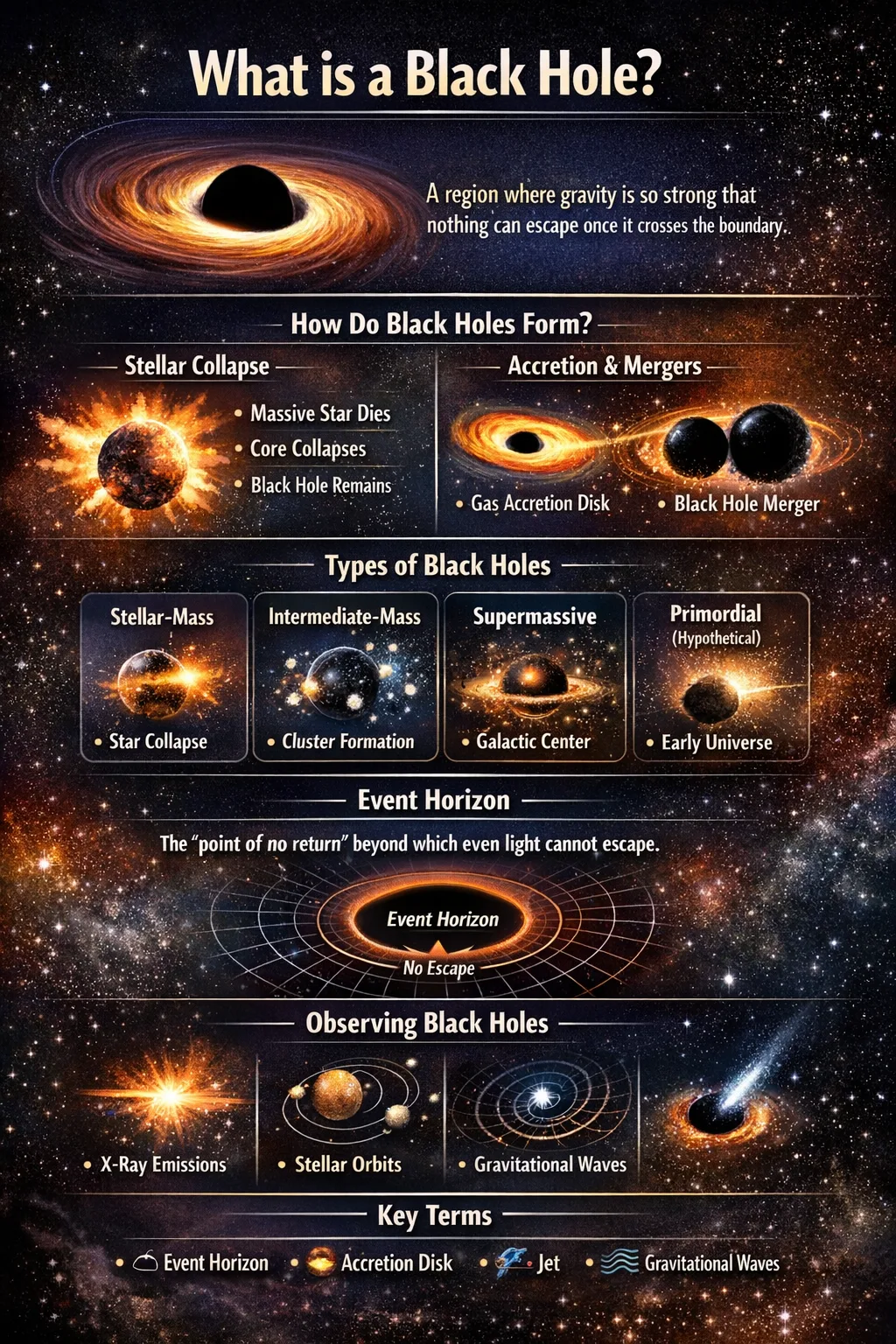
Black holes are astronomical objects where gravity is so intense that, once something crosses a certain boundary, it cannot return. They are not empty “holes” in space. They are regions where mass is packed so tightly that spacetime bends in extreme ways, shaping how matter and light move nearby.
This guide explains what a black hole is, how it can form, the main types astronomers discuss, and why the event horizon matters for both physics and observation.
A Practical Way to Think About Black Holes
A black hole is defined by a boundary called the event horizon. Outside it, matter and light can still travel outward. Inside it, every possible path forward leads deeper inward. A black hole can influence its surroundings through gravity, heating gas into bright disks, and sometimes launching fast outflows.
- Not an empty cavity: it is a compact concentration of mass-energy.
- Often “seen” indirectly: by how nearby matter moves and glows.
- Defined by a boundary: the event horizon is a limit for escape.
What a Black Hole Is
A black hole is an object with a gravitational pull so strong that not even light can escape once it passes the event horizon. In everyday terms, the event horizon marks where the “escape speed” would need to be faster than light, whichline. This is the key boundary used in modern descriptions of black holes.[Source-1]✓
What Makes a Black Hole Different From a Dense Star
- Escape becomes impossible beyond the event horizon.
- Spacetime curvature becomes so strong that “straight-line” paths bend sharply inward.
- Black holes can be described with a small set of properties in astrophysics: mass and spin are especially central.
Importantly, gravity at a distance depends mainly on mass. Far from the black hole, its pull can resemble that of any other object with the same mass. The most distinctive effects appear close in, where extreme gravity shapes matter, light, and time in ways that are measurable.
How Black Holes Form
Black holes form when matter is compressed enough that gravity overwhelms the forces that normally support an object. The best-established pathway in today’s Universe is gravitational collapse tied to the life cycle of massive stars, while other pathways are studied for the earliest epochs of cosmic history.
Stellar Collapse After a Massive Star’s Life Cycle
- Nuclear fuel runs low in the stellar core, reducing outward pressure.
- The core contracts, becoming hotter and denser, while outer layers may expand.
- When the core can no longer support itself, it collapses rapidly.
- A supernova may eject the star’s outer layers, while the remaining core can become a black hole if it is compact and massive enough.
Growth Through Accretion and Mergers
Accretion
Gas can spiral inward and form an accretion disk. Friction and compression heat the disk, often making it bright in X-rays and other wavelengths. Some systems also produce jets that carry energy outward.
Black Hole Mergers
Two black holes in a close orbit can merge, producing a single larger black hole. The final moments can release energy as gravitational waves, which are measured by ground-based observatories.[Source-2]✓
Pathways Considered for the Early Universe
Astrophysicists also study how very large black holes could appear early in cosmic history. Observations with the James Webb Space Telescope have identified very distant galaxies hosting actively growing black holes in the young Universe, helping refine models for how supermassive black holes can build up over time.[Source-3]✓
Types of Black Holes
In astronomy, “type” usually refers to mass scale and formation context. Boundaries can vary by research area, but these categories are widely used because they connect to different formation scenarios and observational signatures.
| Category | Typical Context | How It Is Often Identified |
|---|---|---|
| Stellar-Mass | Forms from the end stages of massive stars in galaxies today. | Motion of companion stars, hot accretion disks, X-ray emission, and mergers producing gravitational waves. |
| Intermediate-Mass | Sits between stellar-mass and supermassive; formation is studied in dense star environments and via mergers. | Indirect evidence from star cluster dynamics, luminous accretion episodes, and gravitational-wave events in suitable mass ranges. |
| Supermassive | Resides in the centers of many galaxies; can power active galactic nuclei when feeding. | Fast orbital speeds near galaxy centers, energetic emission from accretion, and time-variable brightness patterns. |
| Primordial (Hypothesized) | Proposed to form from high-density regions in the early Universe; not confirmed. | Searches focus on gravitational effects on matter and light; no conclusive detection so far. |
Why “type” matters: different mass scales imply different formation histories, growth limits, and likely environments. That changes which instruments and measurements are most informative.
Event Horizon
The event horizon is not a hard surface. It is a boundary in spacetime: once crossed, all future paths that light or matter can take point inward. That is why light cannot escape back out to distant observers, even though the region just outside the horizon can be filled with bright, hot material.[Source-5]✓
A Useful Radius in the Simplest Case
For a non-rotating black hole, the event horizon radius is commonly written in terms of mass. This is a clean reference point in many explanations, even though real astrophysical black holes can rotate.
r_s = 2GM / c^2
Here, M is the black hole’s mass, G is the gravitational constant, and c is the speed of light. Rotation changes the detailed structure, but the central idea stays the same: the horizon marks a one-way boundary for escape.
What the Event Horizon Means for Observation
- Light from inside does not reach distant observers, so “seeing” the interior directly is not possible with light-based telescopes.
- Nearby matter can still be observed: hot gas outside the horizon can glow strongly and trace the gravitational field.
- Gravity affects orbits, timing, and lensing, allowing measurements of mass and environment without needing light from inside the horizon.
How Black Holes Are Studied
Because black holes do not emit light on their own, astronomers study what happens around them. The strongest evidence typically comes from motion, radiation produced by infalling matter, and spacetime signals from mergers.
Tracking Motion
- Stellar orbits: stars moving fast around an unseen mass can indicate a compact object.
- Gas dynamics: rotating gas disks can reveal mass distribution near galaxy centers.
- Timing patterns in some systems can show matter circling close to the horizon.
Reading Light From Nearby Matter
- X-rays: hot inner disks can reach extremely high temperatures.
- Radio emission: jets and energetic particles can shine at long wavelengths.
- Variability: flickering can reflect changing inflow and energetic regions close to the center.
Using Time Variability as a Clue
Some supermassive black holes show changes in brightness as their feeding rate varies. Comparing observations across different years can reveal evidence for active, flickering behavior in galaxy centers, helping identify growing black holes in large surveys.[Source-6]✓
A calm misconception check: a black hole does not “pull” more strongly from far away than any other object of the same mass. What makes it special is how extremely compact it is, which allows matter to orbit and heat up very close to the center, producing distinctive signals.
Key Terms
These terms appear often in black hole discussions. Knowing them makes research summaries and telescope results much easier to follow.
- Event Horizon
- The boundary beyond which escape to the outside is not possible.
- Accretion Disk
- A rotating disk of gas and dust heated by friction and compression as it spirals inward.
- Spin
- How fast the black hole rotates; it can affect nearby spacetime and the shape of stable orbits.
- Jet
- A narrow outflow of particles and energy that can be launched from regions near the center in some systems.
- Gravitational Waves
- Ripples in spacetime produced by accelerating massive objects, especially compact mergers.
- Singularity
- A mathematical feature in some solutions of gravity where densities become extreme; the detailed physical picture is an active research area.
- “Shadow” and “ring” refer to how light is bent and captured around the black hole when observed at very high resolution.
- “Active” typically means the black hole is currently accreting material and producing strong emission.
- “Quiescent” means low activity, where the environment is relatively faint.
FAQ
Frequently Asked Questions
Can a black hole be seen directly?
Not in the same way as a glowing star. Astronomers observe black holes through effects on nearby matter and light, such as hot accretion disks, fast orbital motion, and merger signals measured as gravitational waves.
Is the event horizon a physical surface?
No. The event horizon is a boundary in spacetime. Matter crossing it does not hit a solid wall at that location; instead, the horizon marks the point beyond which escape outward is not possible.
Do black holes pull in everything around them?
A black hole’s gravity depends mainly on its mass. From far away, it can behave like any object with the same mass. The strongest distinctive effects occur close in, where matter can orbit very tightly, heat up, and produce bright signals.
What happens to light near a black hole?
Light paths bend in strong gravity. Some light can orbit briefly or be redirected, while light that crosses the event horizon cannot return to distant observers. This is why black holes can appear as dark regions against bright surroundings.
How do supermassive black holes get so large?
They can grow by accreting gas and by merging with other black holes. Observations of actively growing black holes in very distant galaxies help refine models of how fast this growth can happen in different cosmic eras.
What is inside the event horizon?
Physics predicts that conditions become extremely intense inside. However, because signals cannot escape from beyond the horizon, the detailed internal picture is constrained by theory and remains an active research area, especially where gravity and quantum physics meet.