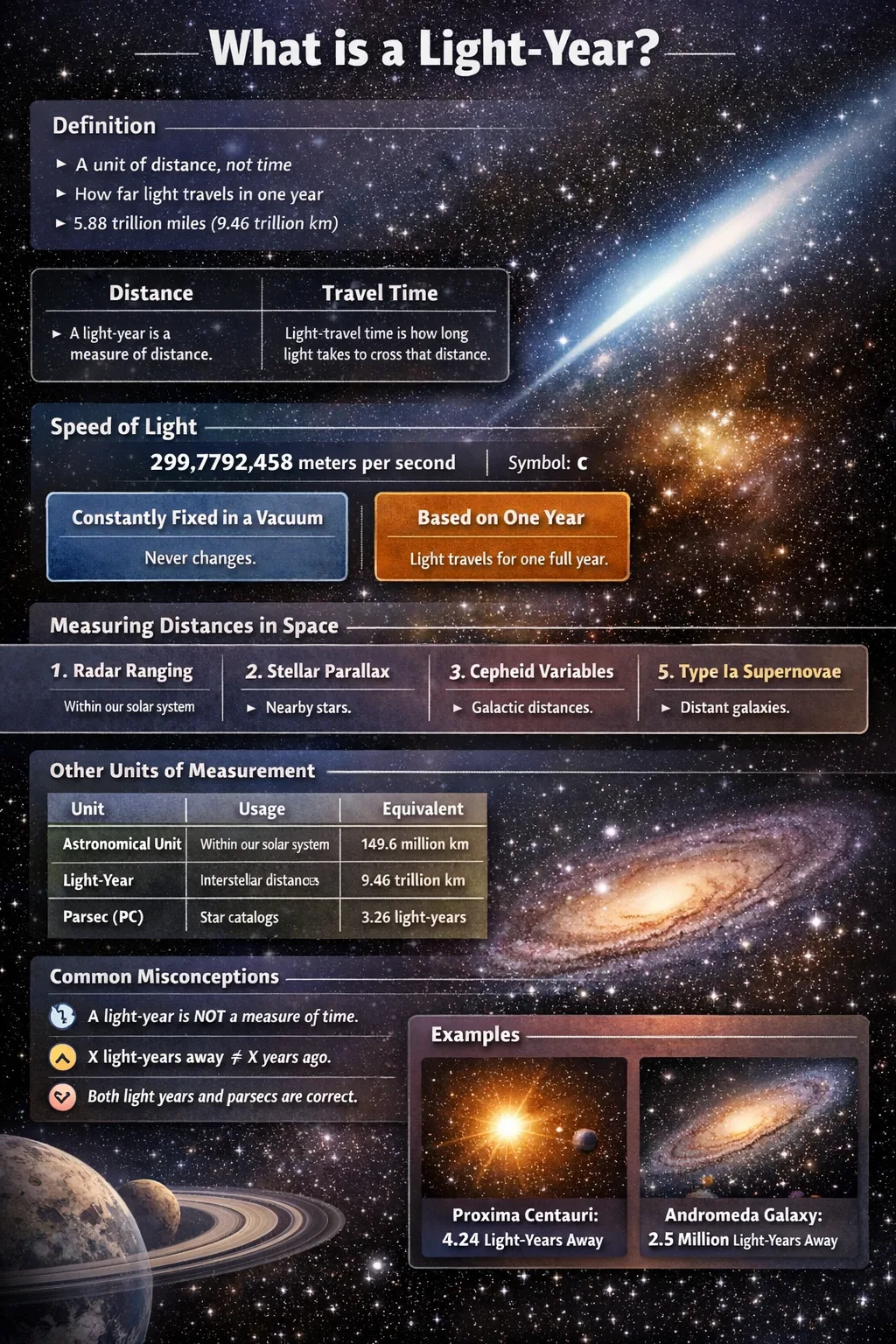
A light-year is a unit of distance, not time: it describes how far light travels in a vacuum in one year. In familiar units, that’s about 5.88 trillion miles (9.46 trillion kilometers).[Source-1]
In Plain Terms
When you read “10 light-years away,” you’re reading a distance. If you could travel at the speed of light (a thought experiment), it would take about 10 years to cover that span. The unit is mainly used for interstellar and larger scales where miles or kilometers become unwieldy.
What a Light-Year Really Means
- Type: Distance Unit
- Scale: Interstellar and Beyond
- Symbol: ly
- Often Used In: Astronomy Writing
Think of a light-year as a yardstick for space. It’s built from something universal (light’s motion in vacuum) and a familiar calendar interval (a year). That combination makes it easy to talk about distances between stars, star clusters, and galaxies without drowning in zeros.
- Distance vs. Light-Travel Time
- “Light-year” is the distance. “Light-travel time” is how long that distance takes at a given speed. The two match only if the speed is exactly the speed of light.
- Where You’ll See It
- Popular science, star distances, and galaxy-scale descriptions. In technical work, parsecs often appear alongside light-years.
The Constant That Makes It Work
The light-year starts with the speed of light in vacuum, written as c. In the International System of Units, its value is fixed as 299,792,458 meters per second, which is why it’s treated as exact in SI terms.[Source-2]
Why “Exact” Matters
Fixing c means that many distance conversions stay stable over time. The remaining choice is how a “year” is defined for the unit, which is standardized in astronomy to keep the light-year consistent.
What the Name Gets Right
The name is literal: a year’s worth of light’s travel. The confusion happens when people treat it as a time label instead of a length.
How Distance in Space Is Measured
Astronomers don’t use one single technique for all distances. They combine methods into a connected set of measurements often described as a cosmic distance ladder, choosing the approach that matches the scale of the target.[Source-3]
Each method has a “sweet spot.” Nearby objects can be measured with geometry. Farther objects often require comparing observed signals (like brightness or spectra) to well-understood reference behaviors.
- Radar Ranging for parts of our solar system, using signal travel time.
- Parallax for nearby stars, using apparent shifts as Earth moves.
- Cepheid Variables to extend distances to regions within and near our galaxy.
- Type Ia Supernovae for much larger galaxy distances, using their standardized brightness patterns.
- Redshift-Based relations for extremely distant objects, where the spectrum’s shift becomes informative.
Light-Years, Parsecs, and Astronomical Units
Light-years are intuitive, but astronomy also relies on other units that connect neatly to how distances are defined and measured. The astronomical unit (au) anchors solar-system scale, and the parsec (pc) connects directly to parallax geometry.
| Unit | What It’s Best For | Useful Relationship |
|---|---|---|
| Astronomical Unit (au) | Solar-system distances | Exactly 149,597,870,700 m |
| Light-Year (ly) | Star-to-star and galaxy talk | About 9.46 trillion km; about 63,241 au |
| Parsec (pc) | Milky Way structure, star catalogs | Defined by 1 arcsecond parallax; about 206,000 au |
Why Two Units Exist Side by Side
Light-years read naturally in plain language. Parsecs fit the geometry of parallax and scale smoothly into kiloparsecs and megaparsecs for mapping galaxies. The au stays practical when talking about planetary and spacecraft distances.
Nearest Star Example: Proxima Centauri
Proxima Centauri is our closest stellar neighbor, sitting just over four light-years from Earth. That means its light takes a little over four years to reach us, so observations are always a snapshot of the recent past.[Source-5]
What “Four Light-Years” Implies
- It is a distance, not a countdown.
- Light travel time matches the number only at light speed.
- It sets a real scale for “nearby” in stellar terms.
Why It Feels Far Anyway
Even the nearest stars are separated by vast emptiness. That’s why units like light-years exist: they keep the conversation readable without losing the reality of the scale.
Nearby Galaxy Example: Andromeda
The Andromeda Galaxy is described as being about 2.5 million light-years away. At that distance, light-years become more than a convenient unit: they also hint at how far back in time the light began its journey to us.[Source-6]
For very large distances, the unit helps your brain keep numbers meaningful. “Millions of light-years” signals a different scale than “a few light-years,” even before you do any math.
Our Galaxy’s Scale: The Milky Way
On the scale of our own galaxy, light-years remain a natural fit. The disk region that contains the Sun is described as being about 100,000 light-years across, which places star-by-star distances in a larger structural context.[Source-7]
Reading Big Numbers Without Losing Meaning
A light-year is huge on a human scale, but it’s a comfortable unit for galaxy-wide structure. It sits between the au (great for solar-system talk) and larger parsec-based units used for mapping and statistics.
Common Mix-Ups and Clear Meanings
- “Light-year” sounds like time, but it is always a distance.
- “X light-years away” is not “X years ago” in a general sense; it’s a distance that light covers in that time at light speed.
- Numbers are often rounded because astronomy works with large, measured ranges and uncertainties.
- Light-years and parsecs can both be correct; they serve different habits and measurement traditions.
- Inside the solar system, you’ll more often see au or “light-minutes” and “light-hours” because the distances are comparatively smaller.
Once you treat the light-year as a distance label, the unit becomes straightforward. It’s one of several ways scientists keep astronomical scales readable while staying precise about what is being measured.
Frequently Asked Questions
Is a Light-Year a Measure of Time?
No. A light-year is a distance. The “year” in the name describes how long light travels to make that distance, not how long an event lasts.
Why Do People Say “We See It X Years in the Past”?
Because light takes time to travel. If something is 100 light-years away, the light arriving today left about 100 years ago. The light-year is still the distance; the time statement is a separate interpretation.
Are Light-Years Used in Professional Astronomy?
Yes, especially in public communication. In many research contexts, parsecs (and larger multiples like kiloparsecs) are common, while au is common for solar-system distances.
Does a Light-Year Assume Light Always Moves the Same Way?
The unit is defined using light’s travel in a vacuum. In real space, the light we receive can pass through gas and dust, but the light-year itself remains a standardized unit for distance.
What Is the Best Way to Interpret “Millions of Light-Years”?
Treat it as a scale marker: it signals intergalactic distances. It also implies that the light has been traveling for millions of years, which helps explain why astronomy often involves “looking back” in time.