Skip to content

Science

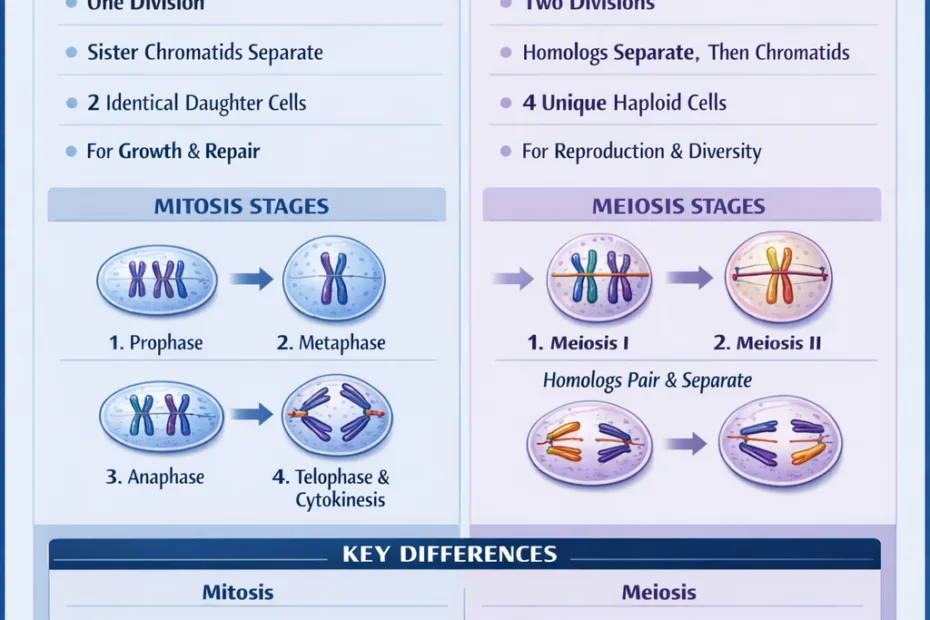
Cells divide through mitosis or meiosis, illustrated with diagrams of cell stages and chromosome structures.

Mitosis vs. Meiosis: How Cells Divide and Reproduce

Mitosis and meiosis are two ways eukaryotic cells divide their DNA. Mitosis makes two matching cells for growth and routine renewal, while meiosis makes reproductive cells (and, in many organisms, spores) by halving the chromosome set and mixing genetic material so new individuals start with a fresh combination.[c]↗ A Clear Way to Think About It Mitosis is about keeping things consistent: same chromosome set in,… Mitosis vs. Meiosis: How Cells Divide and Reproduce
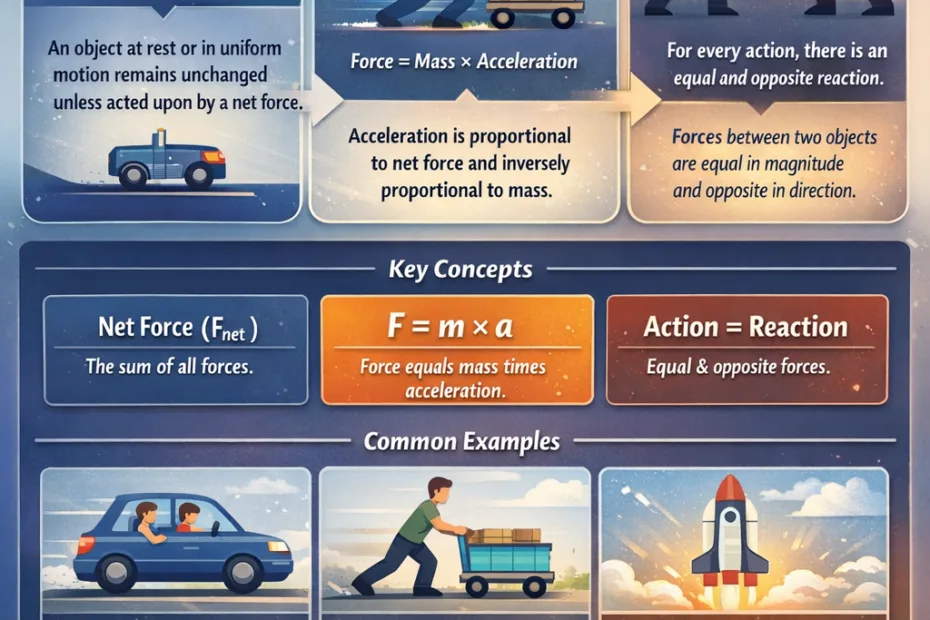
Newton's three laws of motion explained with examples, including a person pushing a cart and a car in motion.

Newton’s Three Laws of Motion: Explained with Examples

Newton’s three laws of motion are three simple rules that connect forces to how objects move: (1) motion doesn’t change unless there is a net force, (2) net force sets the object’s acceleration, and (3) forces always come in equal-and-opposite pairs between interacting objects.[a]↗ A Clear Mental Picture These laws don’t replace common sense; they sharpen it. They explain why a smooth-gliding object keeps going,… Newton’s Three Laws of Motion: Explained with Examples

A colorful infographic illustrating the four laws of thermodynamics, featuring a temperature gauge.

The 4 Laws of Thermodynamics: Definition and Examples

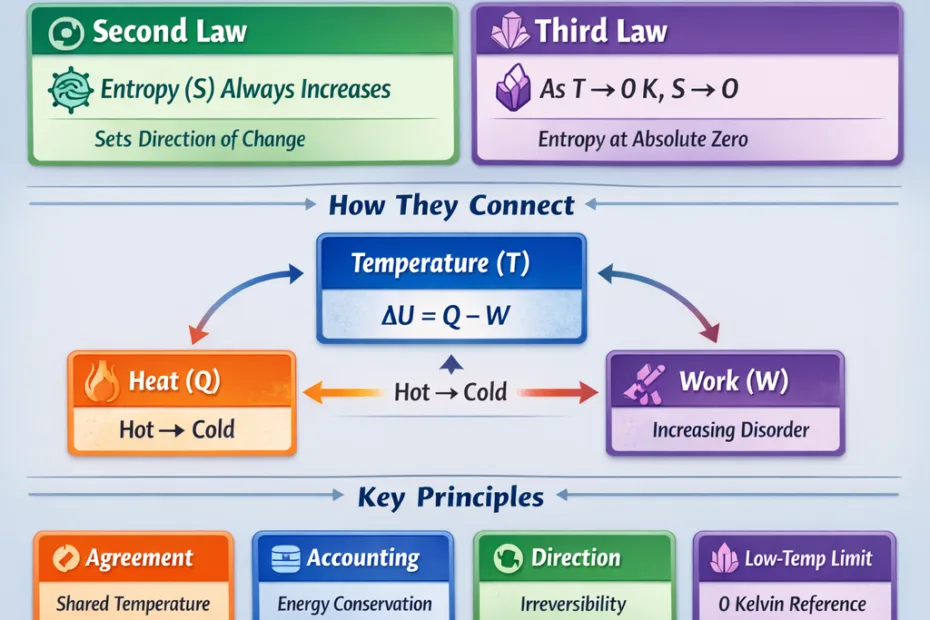
The four laws of thermodynamics are the basic rules that connect temperature, heat, work, and entropy. They explain why thermometers can agree, why energy accounting always balances, why some changes have a clear “direction,” and why absolute zero is a limit you can approach but not reach in practice.[g]↗ A Clear Starting Point Thermodynamics is about energy moving and energy changing form in systems you… The 4 Laws of Thermodynamics: Definition and Examples

The periodic table of elements with colored groups and a close-up of colorful element spheres.

The Periodic Table of Elements: Groups and Properties

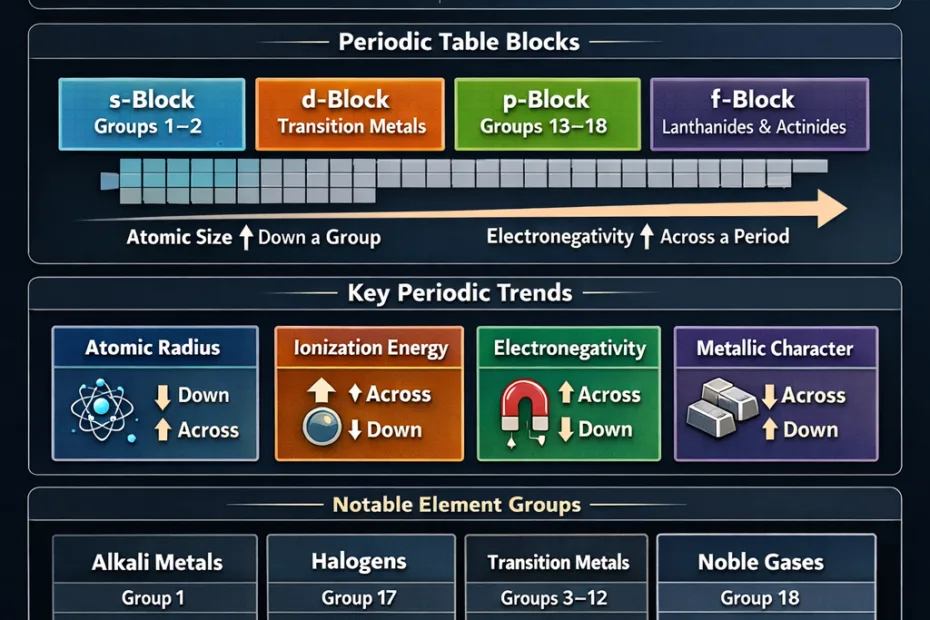
The periodic table is a map of all known chemical elements arranged by atomic number (the number of protons). Its layout is designed so elements with similar behavior line up in vertical columns called groups, while horizontal rows called periods reflect repeating patterns in electron structure.[e] 🔗 A Clean Overview Before We Go Deeper When people say “groups and properties,” they usually mean one idea:… The Periodic Table of Elements: Groups and Properties

Einstein's theory of relativity simplified with a colorful illustration of a spaceship and energy symbols.

Einstein’s Theory of Relativity: E=mc² Simplified

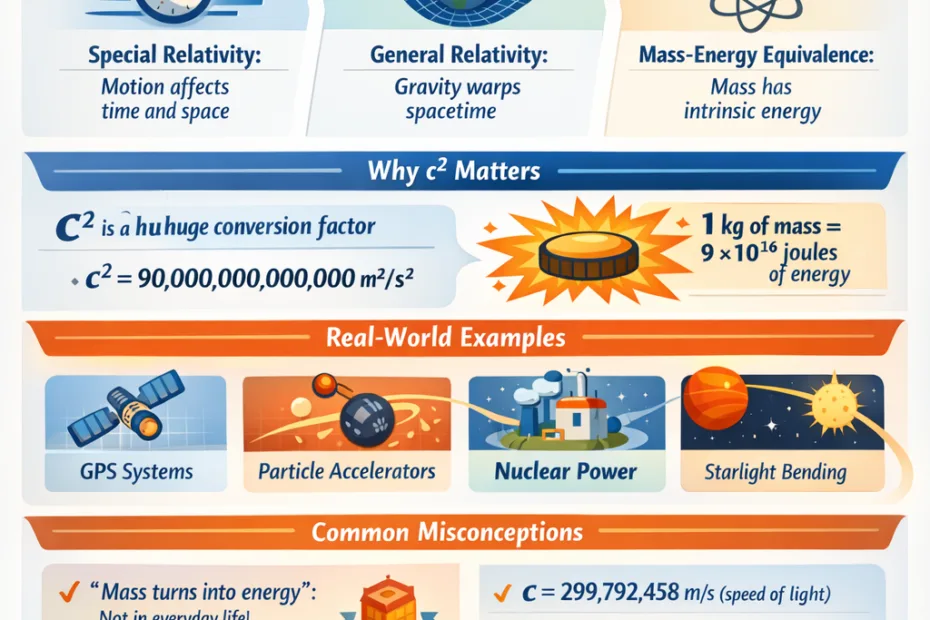
Einstein’s theory of relativity is a set of ideas that ties space, time, mass, and energy into one picture. The famous equation E = mc² says that a body has “rest energy” simply by having mass—no motion required. A Practical Way to Read Relativity Relativity doesn’t mean “everything is random.” It means the laws of physics work the same way for everyone who’s not accelerating,… Einstein’s Theory of Relativity: E=mc² Simplified

A colorful infographic illustrating quantum physics basics with atoms and wave patterns, linked to a beginners…

Quantum Physics for Beginners: Basic Principles Explained

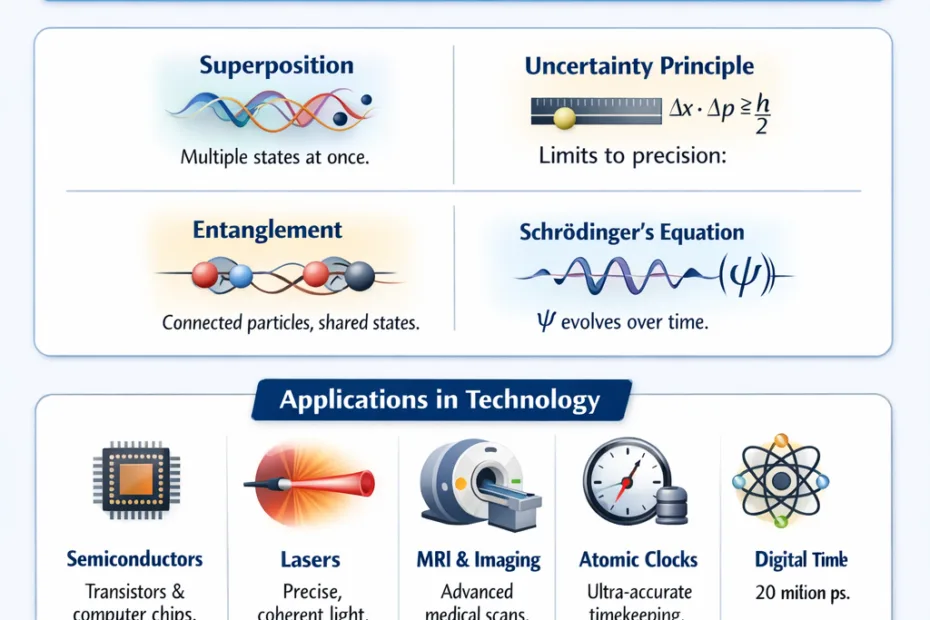
Quantum physics is the science of how nature behaves at the smallest scales—atoms, electrons, light, and the fundamental particles beneath everyday materials. It replaces the classical idea of a world made of tiny billiard balls with a world described by probabilities, waves, and discrete (quantized) chunks. A Clear Starting Point Quantum ideas can feel strange because they don’t match how large objects behave. But the… Quantum Physics for Beginners: Basic Principles Explained

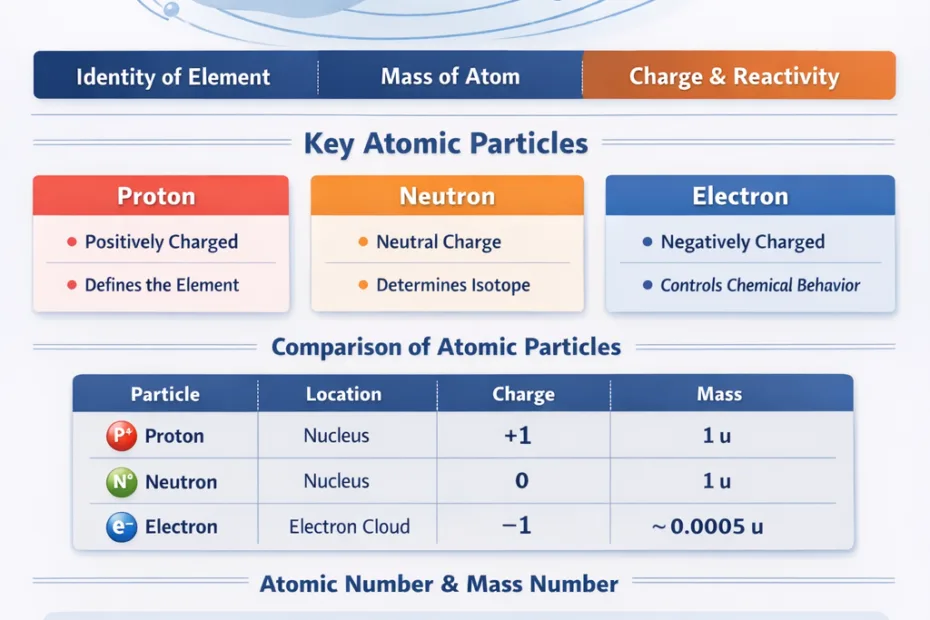
A diagram showing the structure of an atom with protons, neutrons, and electrons labeled.

The Structure of an Atom: Protons, Neutrons, and Electrons

An atom is the smallest particle that still represents a chemical element: a tiny, positively charged nucleus (made of protons and usually neutrons) with electrons around it shaping the atom’s size and behavior.[b]🔗 A Clear Picture Before the Details Atoms look simple on paper, yet they explain why matter has identity (which element it is), charge (neutral or ion), and patterns (how substances react and… The Structure of an Atom: Protons, Neutrons, and Electrons

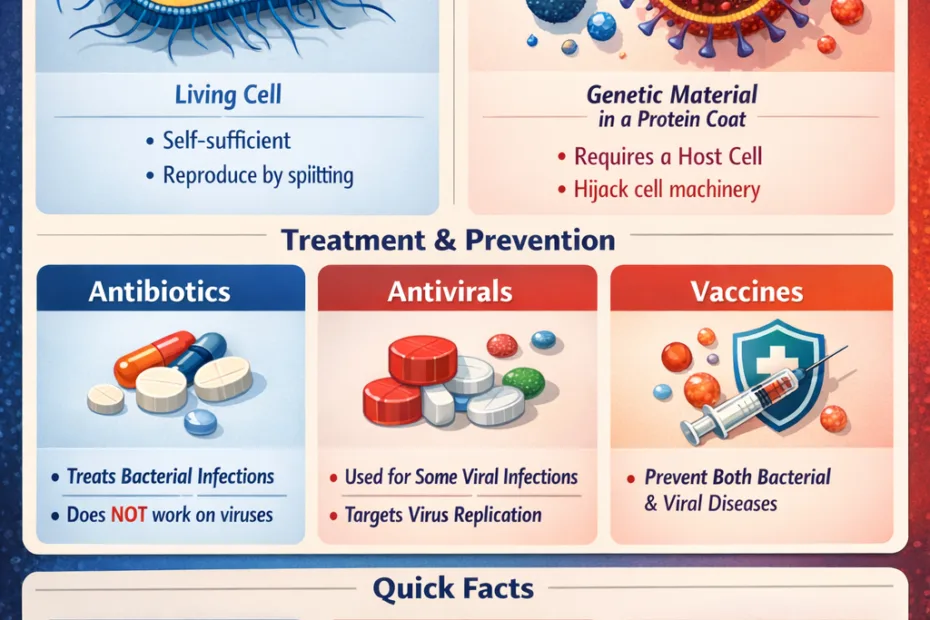
Bacteria and viruses are shown with labeled illustrations, highlighting their difference in structure.

Bacteria vs. Virus: What Is the Difference?

Bacteria are living, single-celled organisms, while viruses are infectious particles made of genetic material wrapped in a protein coat that must use a host cell to make copies of themselves.[a]🔗[b]🔗 A Clear Way to Think About It Bacteria are complete cells with their own machinery. Viruses are genetic instructions in a protective shell. That single difference explains how they multiply, what medicines work, and why… Bacteria vs. Virus: What Is the Difference?

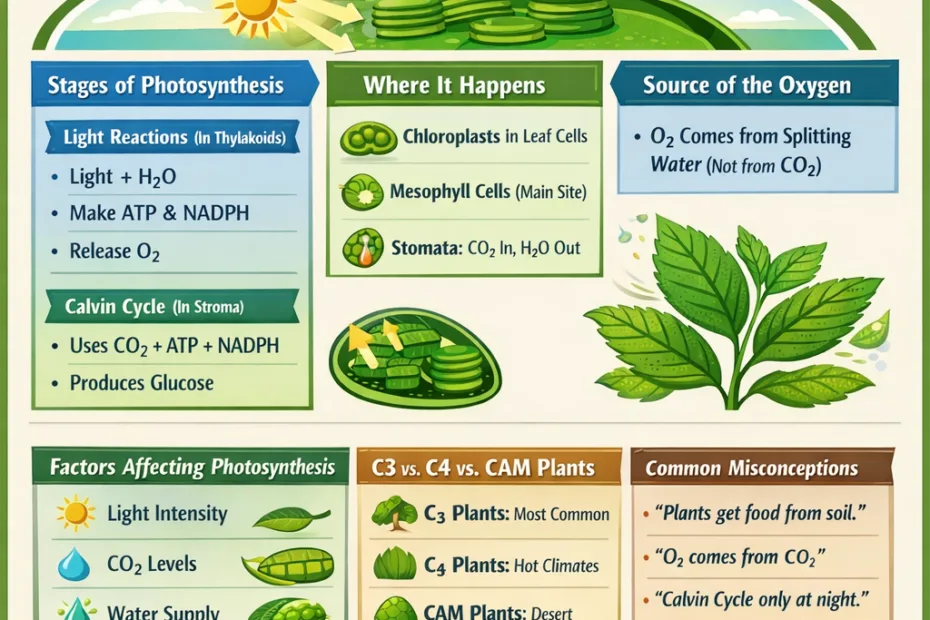
A plant leaf showing the photosynthesis equation process with sunlight, water, and CO2 entering.

Photosynthesis Equation: How Plants Make Food

Photosynthesis is the way plants, algae, and some bacteria make sugars from light—using carbon dioxide and water, and releasing oxygen along the way [a]. A Practical Way to Think About It The famous photosynthesis equation is a net summary: it’s the “receipt” for a long chain of reactions inside chloroplasts. In a real leaf, those reactions happen in two linked stages, and they’re tightly shaped… Photosynthesis Equation: How Plants Make Food

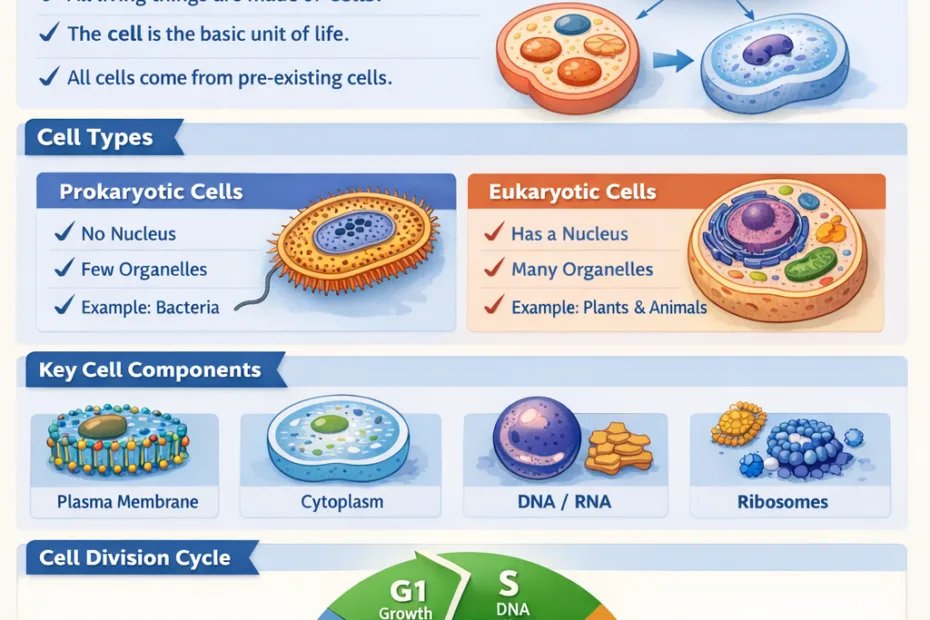
A diagram showing a cell with labeled parts like the nucleus, mitochondria, and cell membrane.

What is a Cell? Structure, Parts, and Organelles

A cell is the smallest unit of life that can carry out the basic functions needed to sustain an organism, and it forms the basic structural and functional unit of all living organisms.[Source-1]✓ A Practical Way to Think About Cells A working cell is a self-maintaining system: it keeps its inside stable, uses energy, reads genetic instructions, and builds the molecules it needs. In complex… What is a Cell? Structure, Parts, and Organelles