Skip to content

Physics

The infographic shows a cyclist and a falling apple to illustrate kinetic and potential energy differences.

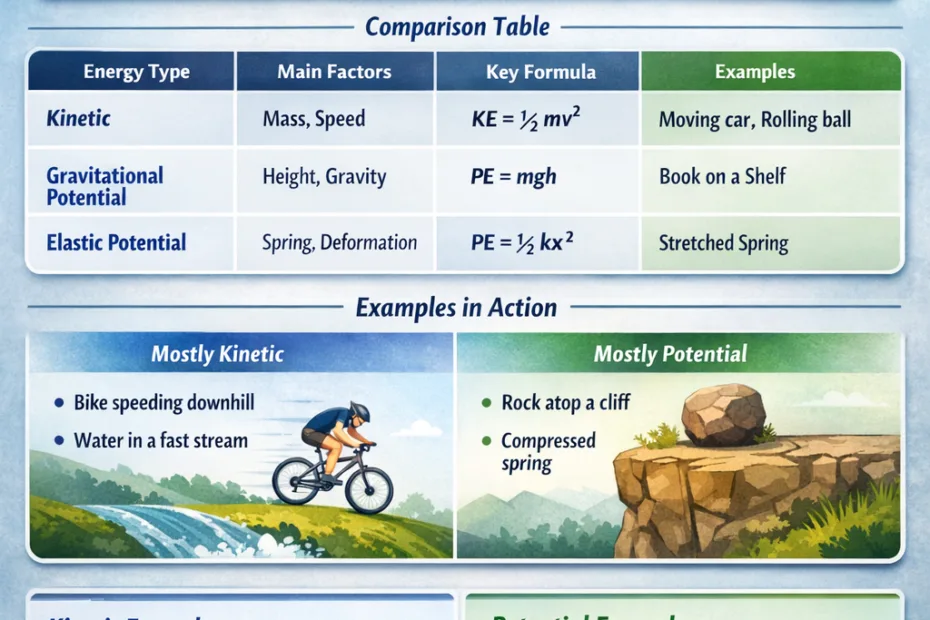
Kinetic vs. Potential Energy: Definitions and Examples
Kinetic energy is the energy an object has because it is moving, while potential energy is energy tied to position or configuration within a system (like height in a gravitational field or a compressed spring). Both are measured in joules (J), and in many everyday situations they trade places as things speed up, slow down, rise, or fall [a]đź”—. A Practical Way to Think About… Kinetic vs. Potential Energy: Definitions and Examples
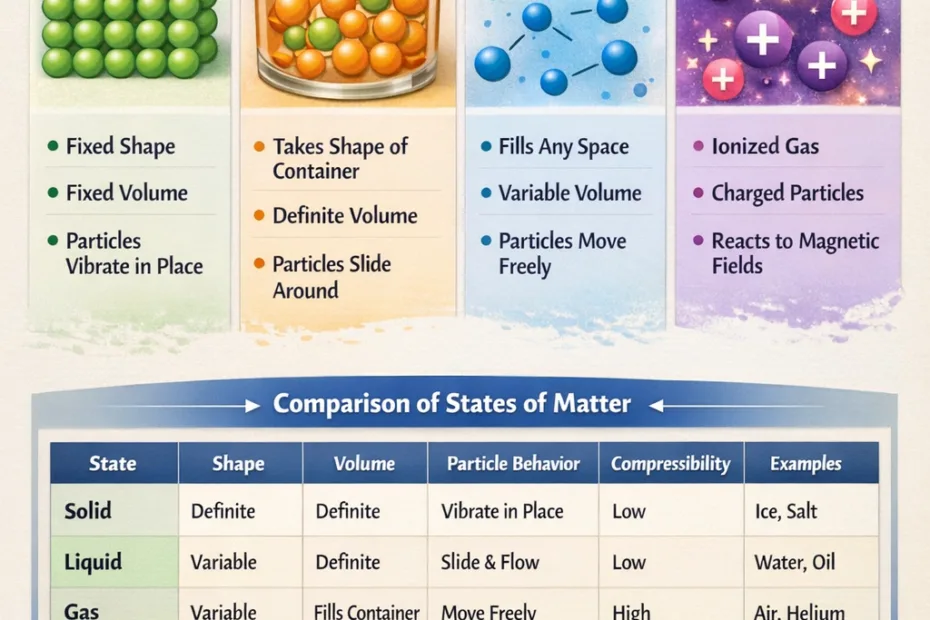
An infographic illustrating the states of matter with colorful representations of solid, liquid, gas, and plas…

The States of Matter: Solid, Liquid, Gas, and Plasma

The states of matter are the main physical forms a substance can take—solid, liquid, gas, and plasma—based on how tightly its particles are held together and how freely they move.[a]đź”— A Clear Way to Think About It Solids keep their shape, liquids keep their volume, gases expand to fill space, and plasma behaves like a gas with charged particles that react strongly to electric and… The States of Matter: Solid, Liquid, Gas, and Plasma

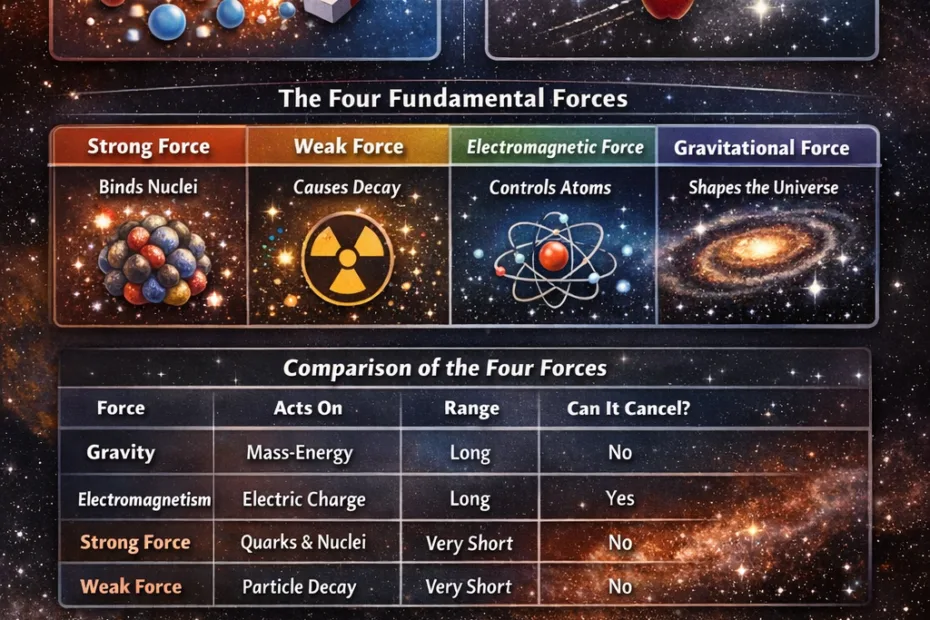
A diagram comparing electromagnetism and gravity, showing a magnetic field and planet with gravity pull.

Electromagnetism vs. Gravity: The Four Fundamental Forces

Electromagnetism is the force behind electric charge and magnetism; gravity is the attraction linked to mass and energy and, in modern physics, to the shape of spacetime. Both can reach across huge distances, yet they behave so differently that one builds atoms while the other builds galaxies. A Clear Starting Point Electromagnetism usually dominates at human scales because it can be extremely strong between charged… Electromagnetism vs. Gravity: The Four Fundamental Forces

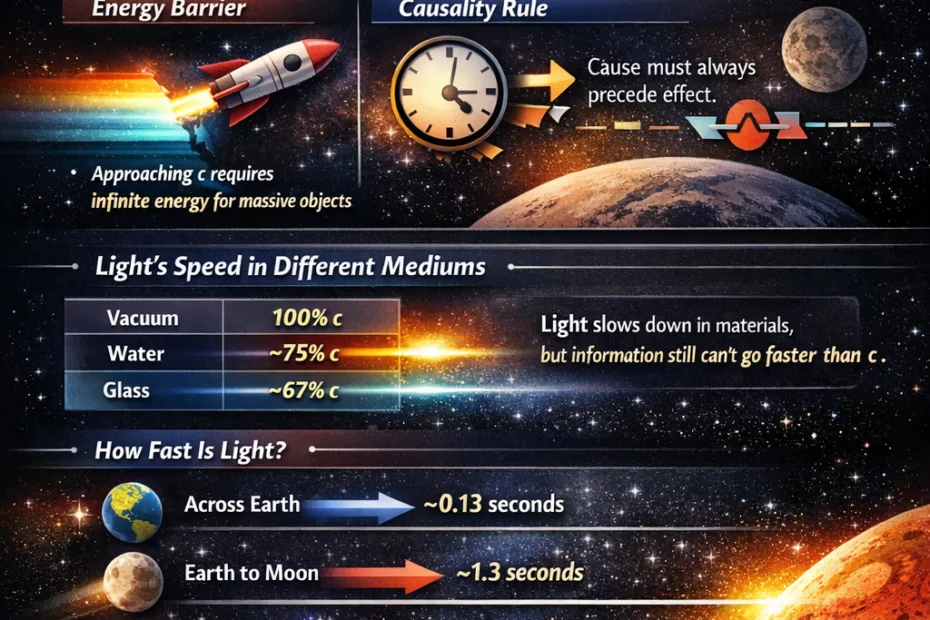
A visual explaining the speed of light with diagrams of planets and colorful light beams in space.

The Speed of Light: Why Nothing Travels Faster?

The speed of light (usually written as c) is the maximum speed at which information, energy, and physical influence can travel through empty space. In modern SI units, it is defined to be exactly 299,792,458 meters per second in a vacuum[a]↗[b]↗. A Clear Starting Point Light feels “instant” at human distances, but physics treats it as a real speed with real consequences. The important part… The Speed of Light: Why Nothing Travels Faster?

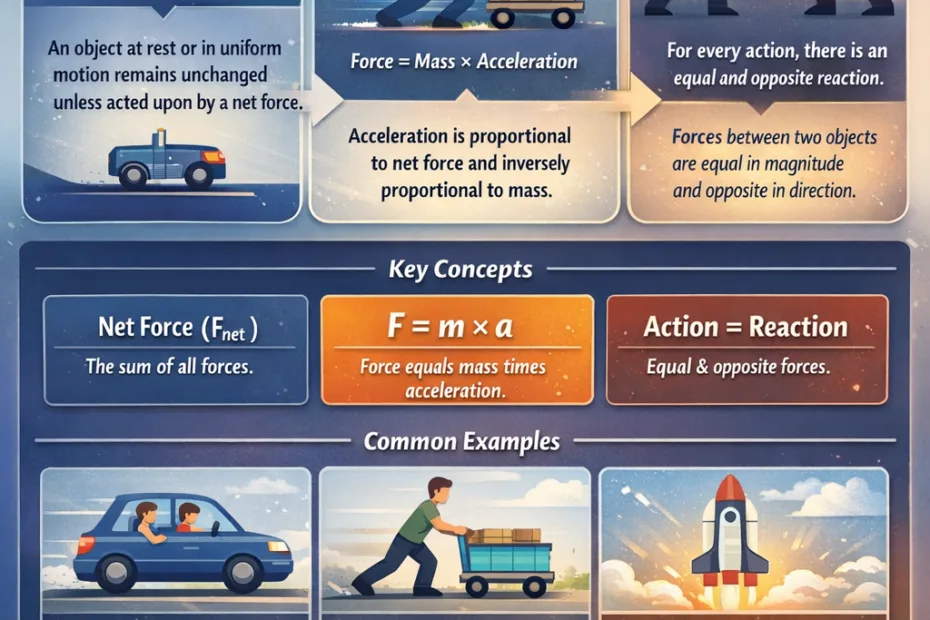
Newton's three laws of motion explained with examples, including a person pushing a cart and a car in motion.

Newton’s Three Laws of Motion: Explained with Examples

Newton’s three laws of motion are three simple rules that connect forces to how objects move: (1) motion doesn’t change unless there is a net force, (2) net force sets the object’s acceleration, and (3) forces always come in equal-and-opposite pairs between interacting objects.[a]↗ A Clear Mental Picture These laws don’t replace common sense; they sharpen it. They explain why a smooth-gliding object keeps going,… Newton’s Three Laws of Motion: Explained with Examples

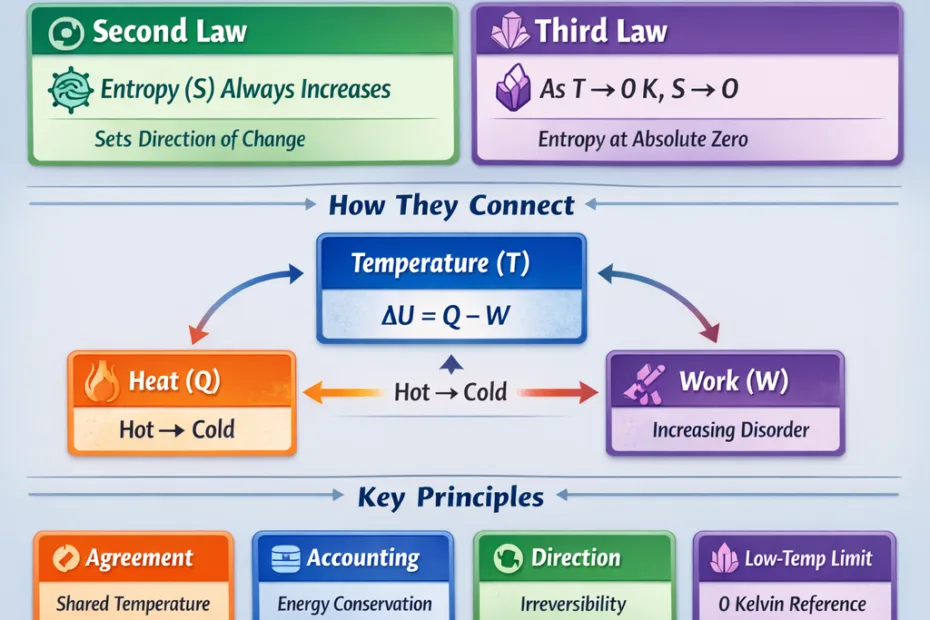
A colorful infographic illustrating the four laws of thermodynamics, featuring a temperature gauge.

The 4 Laws of Thermodynamics: Definition and Examples

The four laws of thermodynamics are the basic rules that connect temperature, heat, work, and entropy. They explain why thermometers can agree, why energy accounting always balances, why some changes have a clear “direction,” and why absolute zero is a limit you can approach but not reach in practice.[g]↗ A Clear Starting Point Thermodynamics is about energy moving and energy changing form in systems you… The 4 Laws of Thermodynamics: Definition and Examples

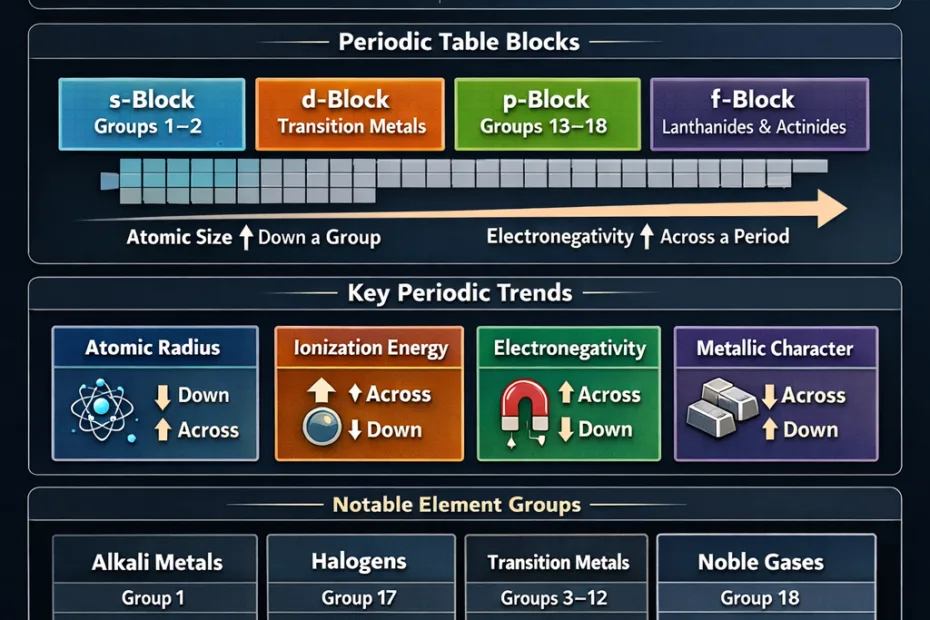
The periodic table of elements with colored groups and a close-up of colorful element spheres.

The Periodic Table of Elements: Groups and Properties

The periodic table is a map of all known chemical elements arranged by atomic number (the number of protons). Its layout is designed so elements with similar behavior line up in vertical columns called groups, while horizontal rows called periods reflect repeating patterns in electron structure.[e] đź”— A Clean Overview Before We Go Deeper When people say “groups and properties,” they usually mean one idea:… The Periodic Table of Elements: Groups and Properties

Einstein's theory of relativity simplified with a colorful illustration of a spaceship and energy symbols.

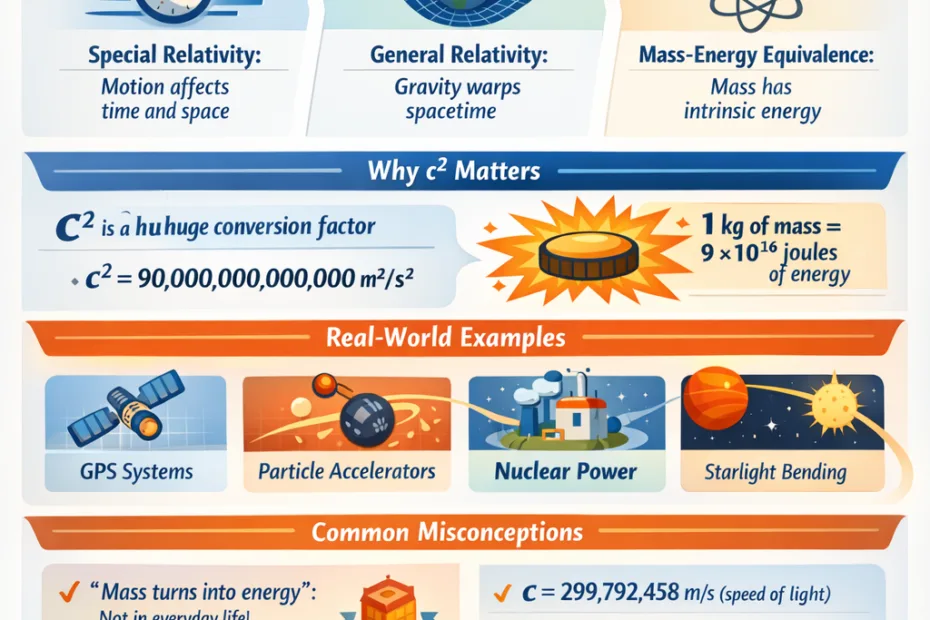
Einstein’s Theory of Relativity: E=mc² Simplified

Einstein’s theory of relativity is a set of ideas that ties space, time, mass, and energy into one picture. The famous equation E = mc² says that a body has “rest energy” simply by having mass—no motion required. A Practical Way to Read Relativity Relativity doesn’t mean “everything is random.” It means the laws of physics work the same way for everyone who’s not accelerating,… Einstein’s Theory of Relativity: E=mc² Simplified

A colorful infographic illustrating quantum physics basics with atoms and wave patterns, linked to a beginners…

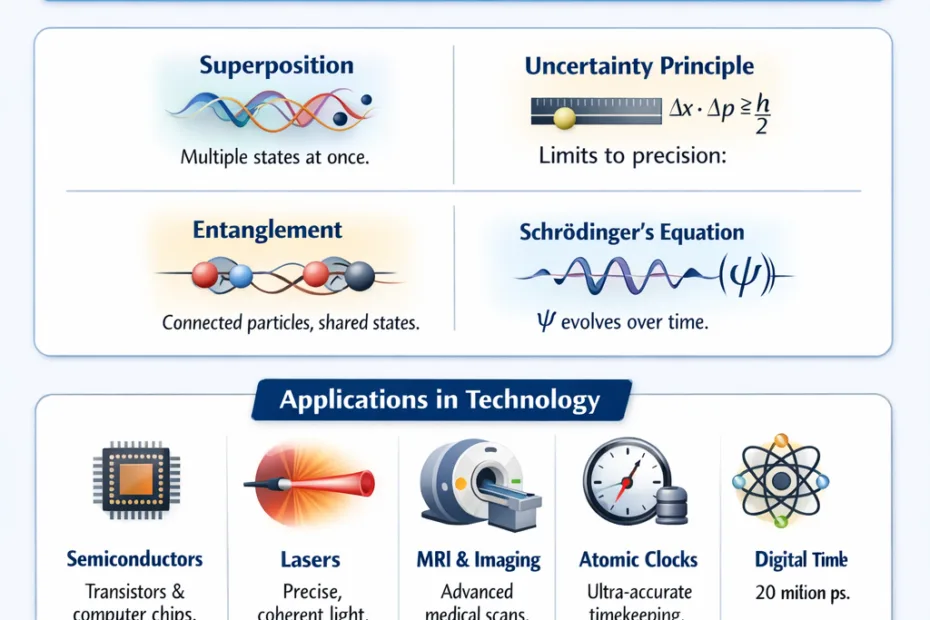
Quantum Physics for Beginners: Basic Principles Explained

Quantum physics is the science of how nature behaves at the smallest scales—atoms, electrons, light, and the fundamental particles beneath everyday materials. It replaces the classical idea of a world made of tiny billiard balls with a world described by probabilities, waves, and discrete (quantized) chunks. A Clear Starting Point Quantum ideas can feel strange because they don’t match how large objects behave. But the… Quantum Physics for Beginners: Basic Principles Explained

A diagram showing the structure of an atom with protons, neutrons, and electrons labeled.

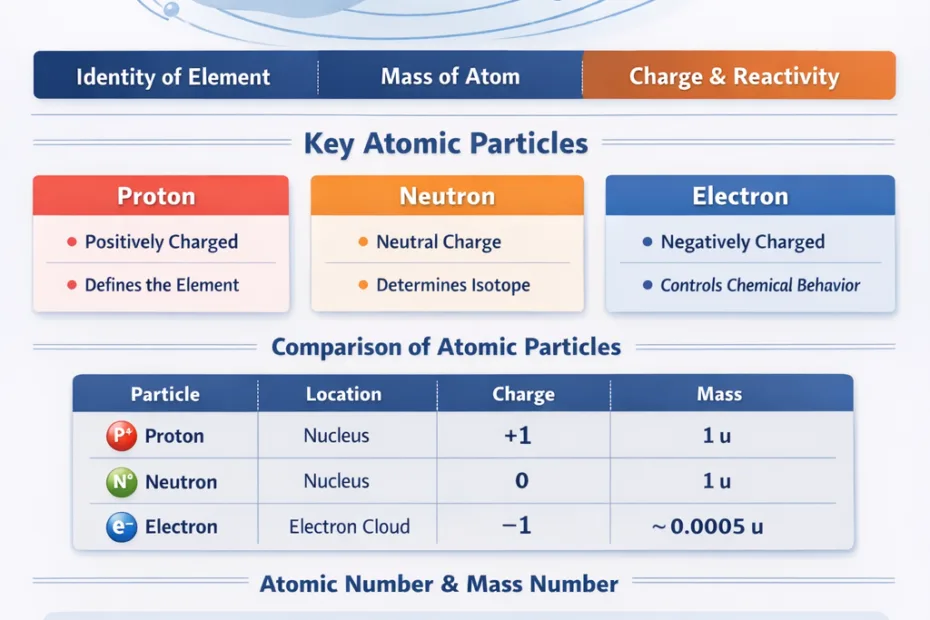
The Structure of an Atom: Protons, Neutrons, and Electrons

An atom is the smallest particle that still represents a chemical element: a tiny, positively charged nucleus (made of protons and usually neutrons) with electrons around it shaping the atom’s size and behavior.[b]đź”— A Clear Picture Before the Details Atoms look simple on paper, yet they explain why matter has identity (which element it is), charge (neutral or ion), and patterns (how substances react and… The Structure of an Atom: Protons, Neutrons, and Electrons