Skip to content

Space

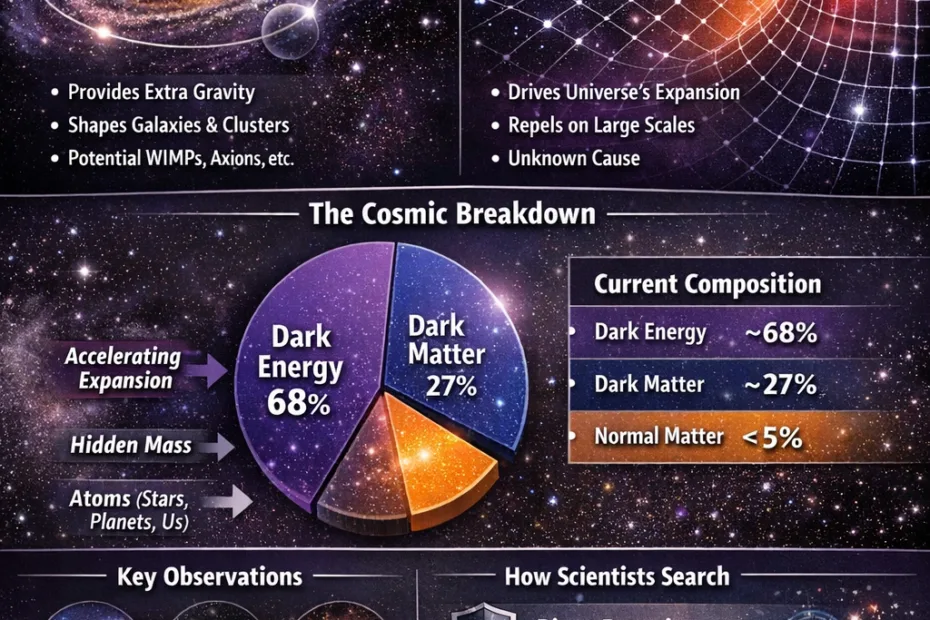
A pie chart shows dark matter at 27% and dark energy at 68% of the universe in an infographic about dark matte…

Dark Matter and Dark Energy: The Invisible 95% of the Universe

Dark matter and dark energy are umbrella names for two big unknowns in modern cosmology: one that acts like extra gravity (dark matter) and one that is tied to the Universe’s accelerating expansion (dark energy). In today’s standard picture, together they account for roughly 95% of the Universe’s total “energy budget,” while the atoms that make stars, planets, and people are the small remainder.[a]🔗 This… Dark Matter and Dark Energy: The Invisible 95% of the Universe
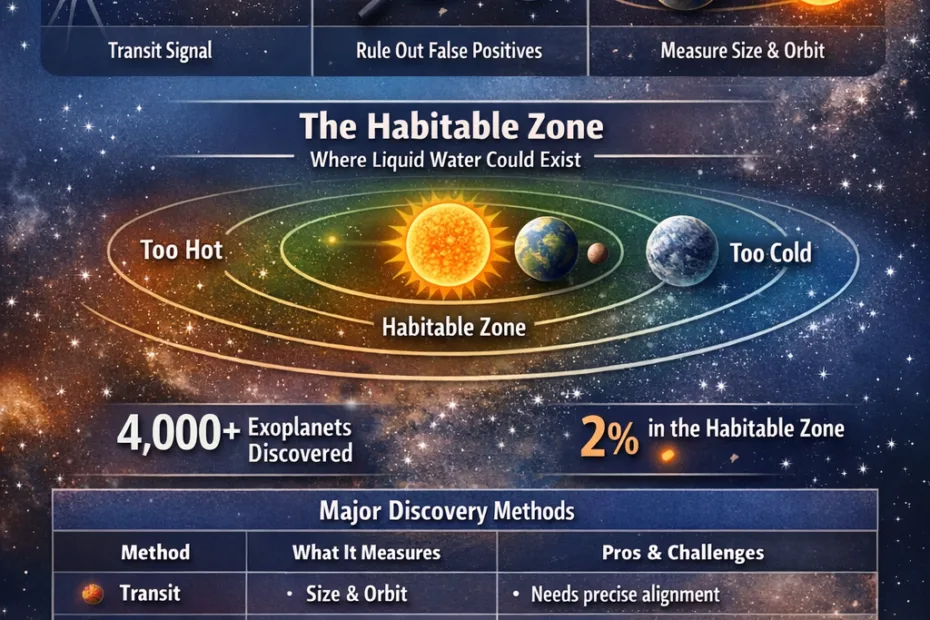
A diagram shows a planet in the habitable zone orbiting a star with Earth-like planets nearby.

Exoplanets: Searching for Earth-like Planets Beyond Our Solar System

An exoplanet is a planet beyond our Solar System, orbiting another star. The search for Earth-like exoplanets is really a search for measurable “Earth-ish” clues—size, orbit, starlight, and sometimes atmosphere—without pretending we already know what the surface is like. [a] ⓘ A Clear Starting Point Most “Earth-like” headlines boil down to three things: small (likely rocky), temperate (not too hot or cold from starlight), and… Exoplanets: Searching for Earth-like Planets Beyond Our Solar System

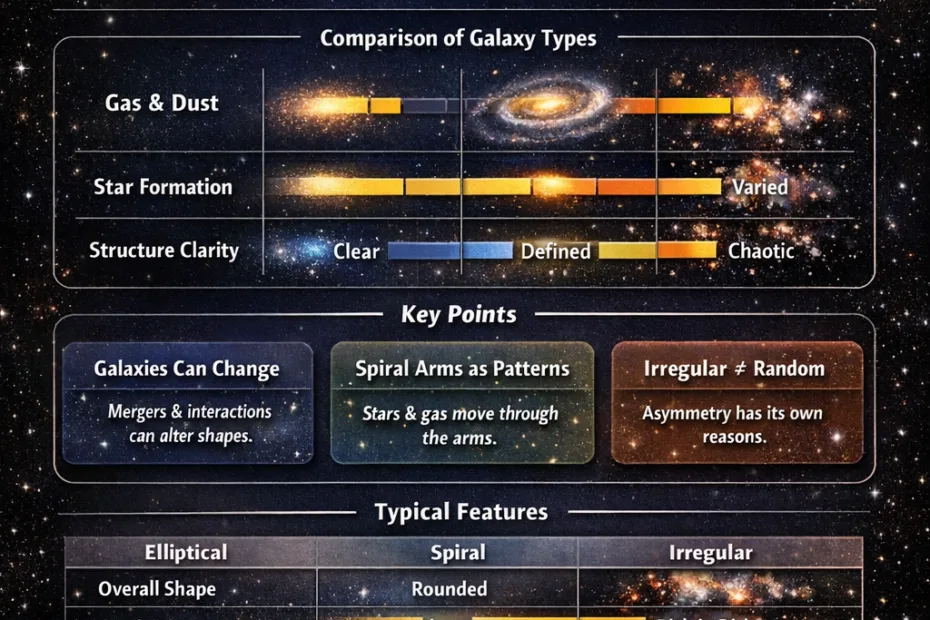
Messier galaxy images show elliptical, spiral, and irregular types in this infographic.

Types of Galaxies: Elliptical, Spiral, and Irregular

A galaxy type is a way to sort galaxies by how they appear in images—mainly their overall shape and visible structure. In everyday terms, most well-known galaxies fall into three broad families: elliptical, spiral, and irregular[a]↗. A Clean Mental Model to Start With Galaxy “types” are about shape and visible layout, not about which galaxies are “better” or “older.” A spiral can be calm or… Types of Galaxies: Elliptical, Spiral, and Irregular

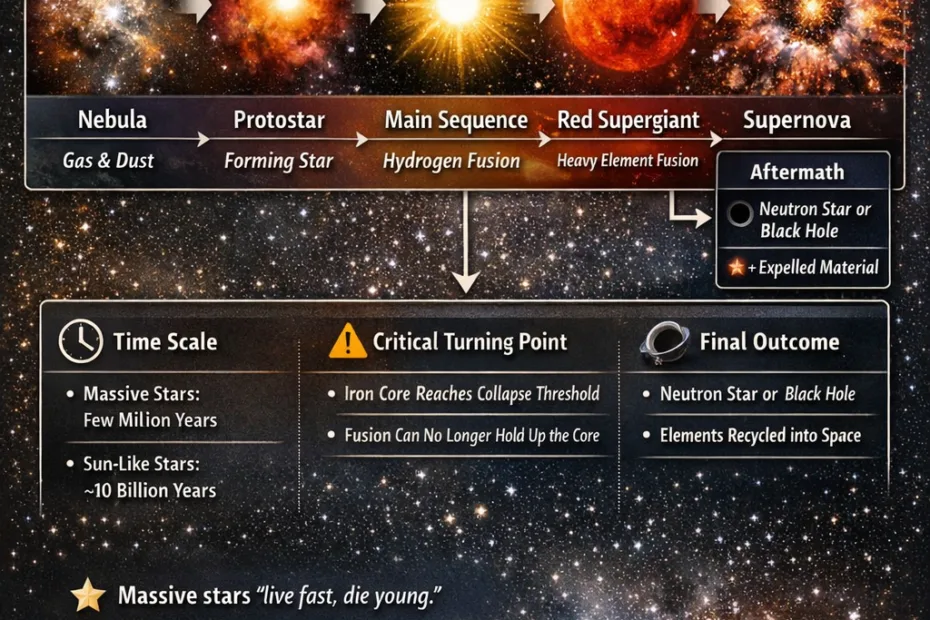
A star's life cycle begins with a glowing nebula and ends with a supernova explosion.

The Life Cycle of a Star: From Nebula to Supernova

A star is a self-gravitating ball of hot gas (plasma) that shines because its core releases energy through nuclear fusion. The “life cycle of a star” is the story of how that balance begins inside a cold nebula, settles into a long stable phase, and—if the star is massive enough—ends with a supernova that reshapes its neighborhood.[a]↗ A Simple Way to Hold the Whole Story… The Life Cycle of a Star: From Nebula to Supernova

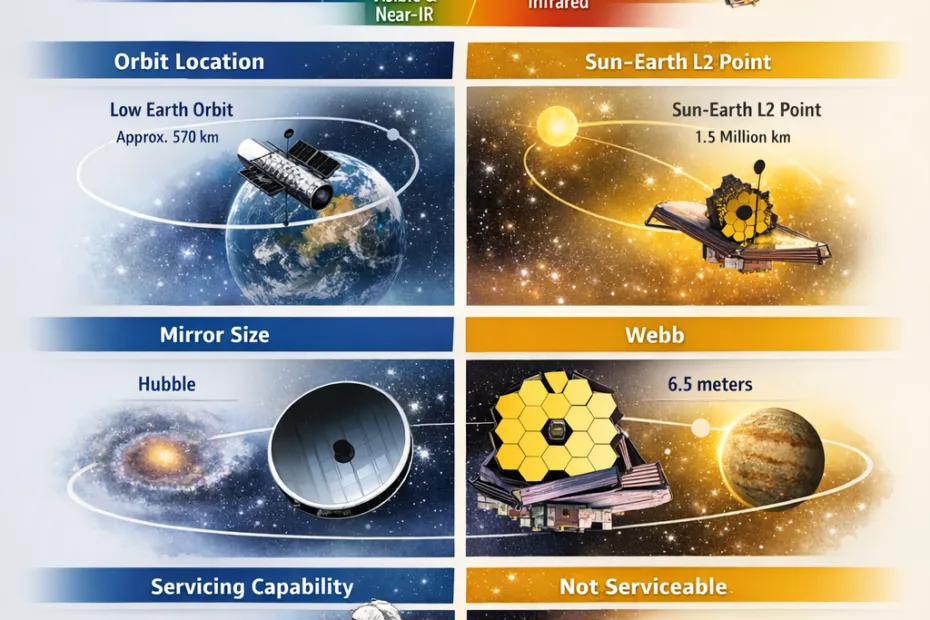
James Webb Space Telescope and Hubble images of distant planets and galaxies with comparison icons.

James Webb Space Telescope vs. Hubble: Key Differences

James Webb Space Telescope (JWST) and the Hubble Space Telescope are space-based observatories that collect faint light from distant objects, but they are built for different wavelength ranges, different operating temperatures, and different orbits—so their strengths are not interchangeable. Think of them as complementary tools: Hubble is a long-running ultraviolet-to-visible specialist with important near-infrared capability, while Webb is engineered for infrared astronomy with deep sensitivity.… James Webb Space Telescope vs. Hubble: Key Differences

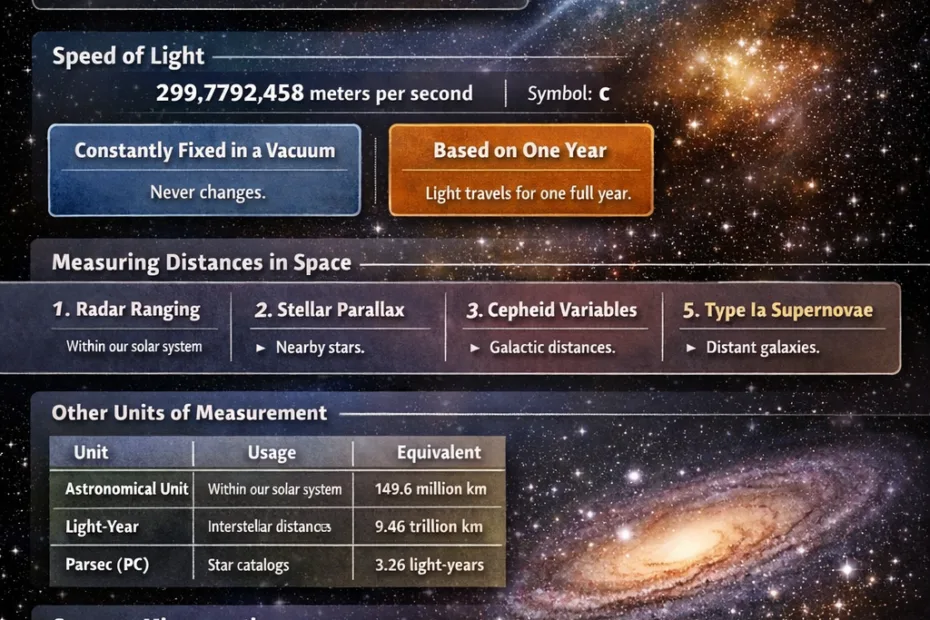
A colorful infographic shows the vast distance of a light-year with stars and galaxy images to explain 'what i…

What is a Light-Year? Measuring Distance in Space

A light-year is a unit of distance, not time: it describes how far light travels in a vacuum in one year. In familiar units, that’s about 5.88 trillion miles (9.46 trillion kilometers).[Source-1] In Plain Terms When you read “10 light-years away,” you’re reading a distance. If you could travel at the speed of light (a thought experiment), it would take about 10 years to cover… What is a Light-Year? Measuring Distance in Space

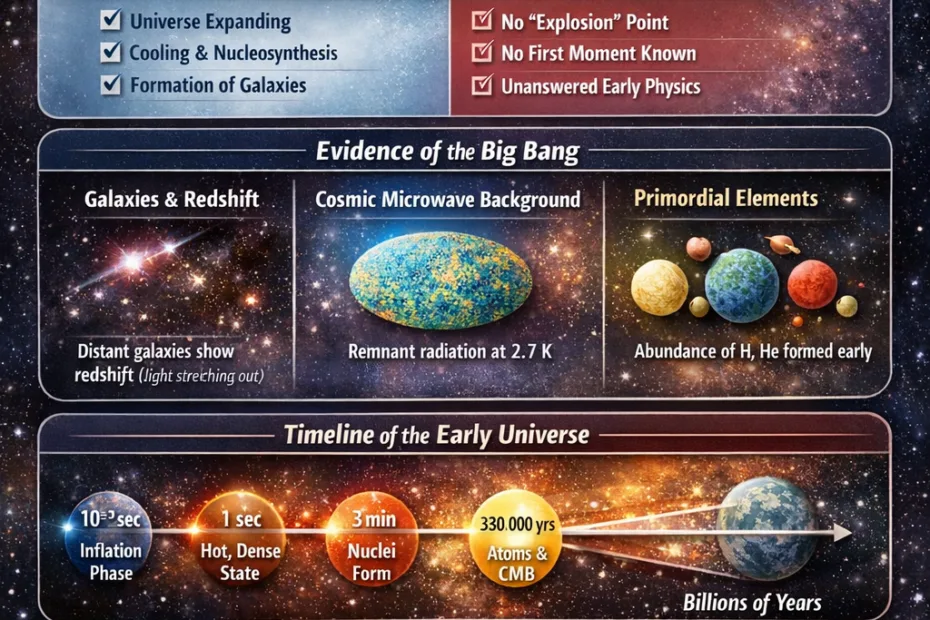
A timeline graphic with an explosion illustration illustrating the universe's origin from the Big Bang.

The Big Bang Theory: How the Universe Began

The Big Bang Theory is the leading scientific theory for explaining how the universe evolved from an extremely hot, dense early state into the expanding cosmos we observe today. It is not a story about a single blast “into space.” It is a model about space itself expanding, cooling, and forming structure over time, grounded in observation and tested with multiple independent measurements. Core Idea… The Big Bang Theory: How the Universe Began

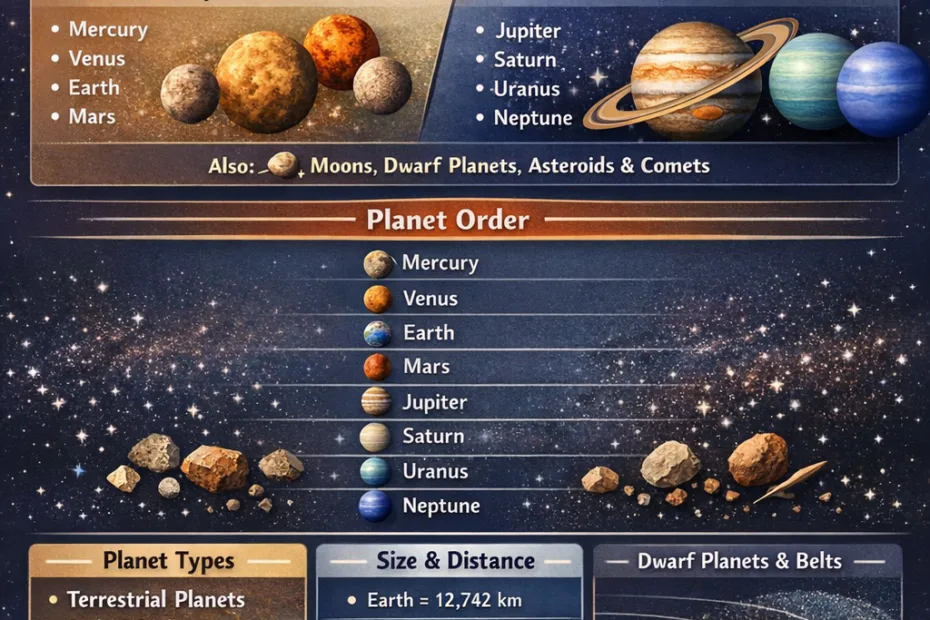
The solar system explained with images of planets arranged in order, including planets and moons.

The Solar System Explained: Planets, Order, and Facts

The Solar System is the Sun and everything that stays bound to it by gravity: planets, dwarf planets, moons, rings, asteroids, comets, and fine dust. It is a single system, but it is not one uniform place. Temperatures, materials, and orbital speeds shift dramatically as you move outward, and those differences explain why rocky worlds formed close in while giant planets dominate farther out [Source-1]✓… The Solar System Explained: Planets, Order, and Facts

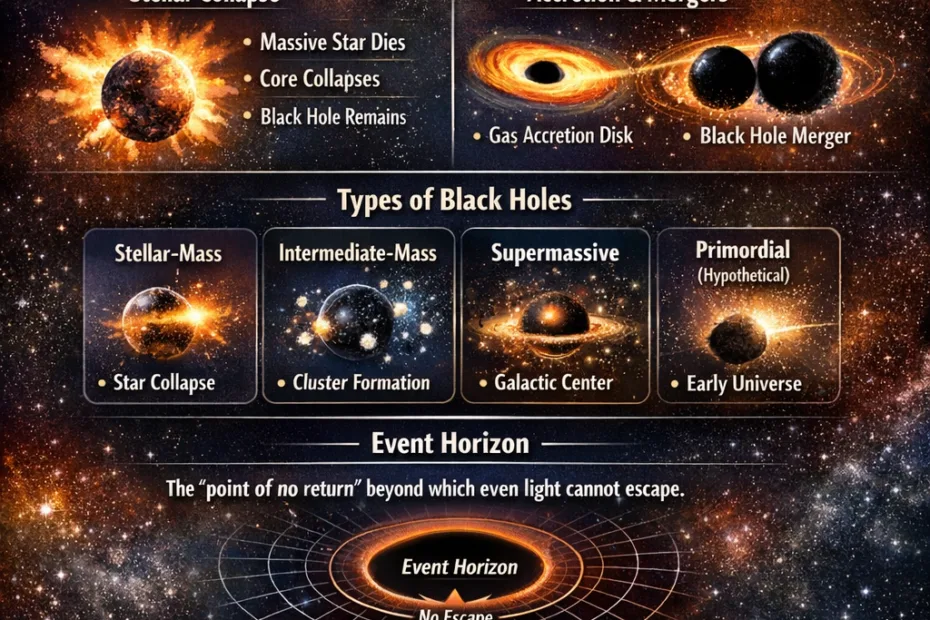
An infographic showing the formation process of a black hole with a star collapsing into a dark central point.

What is a Black Hole? Formation, Types, and Event Horizon

Black holes are astronomical objects where gravity is so intense that, once something crosses a certain boundary, it cannot return. They are not empty “holes” in space. They are regions where mass is packed so tightly that spacetime bends in extreme ways, shaping how matter and light move nearby. This guide explains what a black hole is, how it can form, the main types astronomers… What is a Black Hole? Formation, Types, and Event Horizon