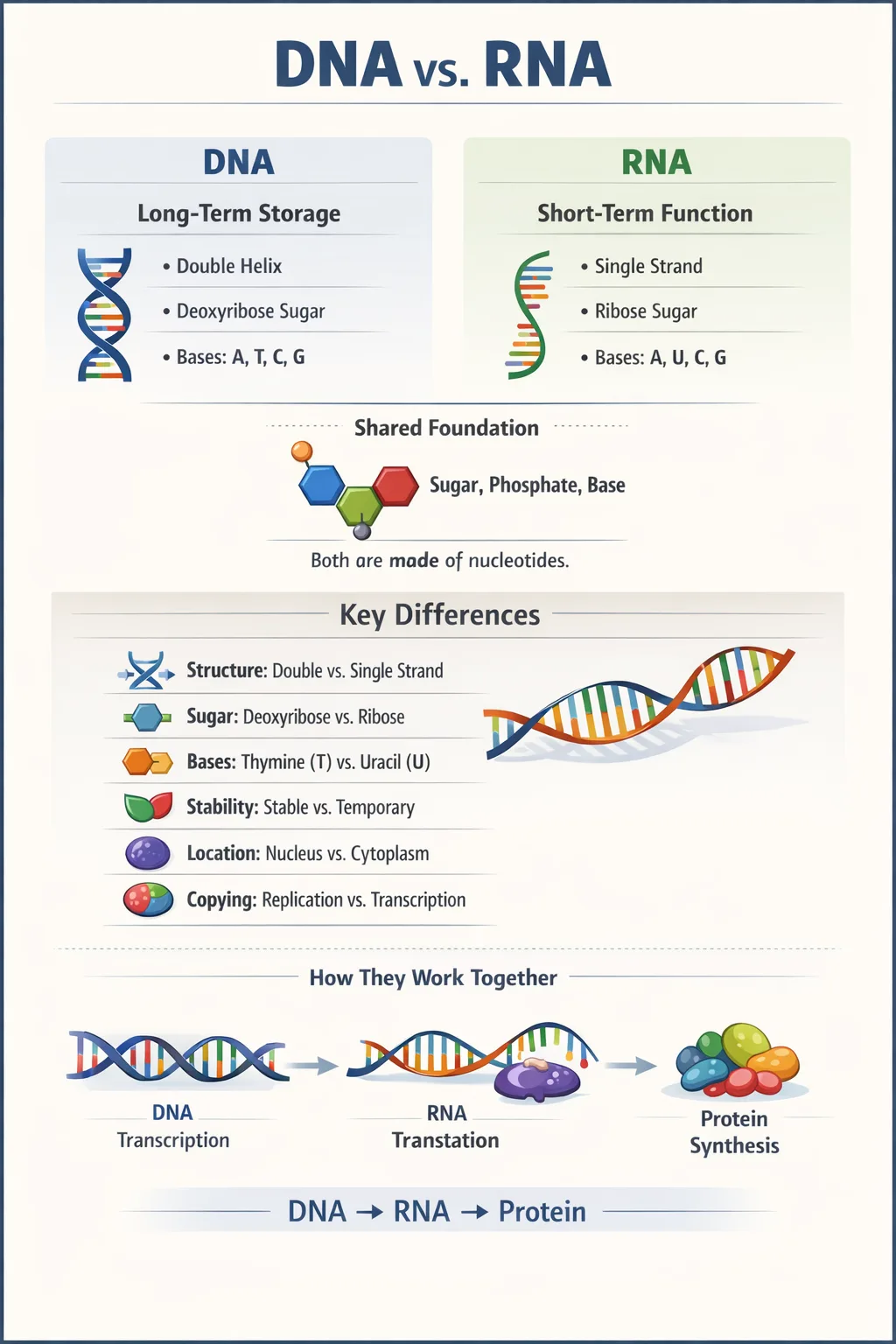
DNA and RNA are nucleic acids—chains of nucleotides that cells use to store genetic instructions and to put those instructions to work.
They are closely related, but they are not interchangeable. DNA is built for long-term stability and inheritance; RNA is built for flexibility, short-lived messaging, and hands-on roles in making molecules the cell needs.
DNA and RNA in Plain Terms
DNA (deoxyribonucleic acid) is the cell’s long-term information store. In most living organisms, it is made of two strands that form a double helix and carry the instructions used to build and maintain the organism.[Source-1]✓
RNA (ribonucleic acid) is the working layer that helps the cell use genetic information. It is most often single-stranded, uses the sugar ribose, and uses uracil (U) where DNA typically uses thymine (T). Different RNAs handle messaging, structure, transport, and regulation.[Source-2]✓
DNA: What It’s Built For
- Stable storage of genetic information
- High-fidelity copying during cell division
- Efficient packaging into chromosomes (in many organisms)
RNA: What It’s Built For
- Flexible shapes and short-lived messages
- Direct roles in protein production machinery
- Regulation of when, where, and how genes are used
- Shared Foundation
- Both DNA and RNA are polymers made from nucleotides—each nucleotide contains a sugar, a phosphate group, and a nitrogen-containing base. In RNA the sugar is ribose; in DNA it is deoxyribose. RNA typically uses uracil (U) in place of thymine (T).[Source-3]✓
Seven Key Differences Between DNA and RNA
- Name and role: DNA is the long-term information archive; RNA is the working layer that helps express, interpret, or regulate that information.
- Sugar: DNA contains deoxyribose; RNA contains ribose. That single oxygen difference influences stability and chemistry.
- Bases: DNA uses A, C, G, and T; RNA uses A, C, G, and U. The T→U swap changes how the molecule is built and recognized in cells.
- Strands and typical structure: DNA is typically double-stranded and forms a helix; RNA is often single-stranded and can fold into many shapes.
- Stability: DNA is generally more chemically stable for long-term storage, while RNA is more reactive and often shorter-lived—useful for temporary messages and flexible functions.
- Where you find them (in many organisms): DNA is largely kept in dedicated storage regions (such as the nucleus in many cells), while RNA commonly operates both where it is made and where proteins are built.
- How they are copied and used: DNA is copied as DNA (replication). RNA is usually made from DNA (transcription) and then used directly—often as the template or machinery for protein production.
Why the sugar difference matters: ribose has a 2′ hydroxyl (–OH) group where deoxyribose has a hydrogen. That small change helps explain why RNA is typically less stable over long periods, while DNA is well-suited for durable storage.[Source-4]✓
DNA vs. RNA Comparison Table
| Feature | DNA | RNA | Why It Matters |
|---|---|---|---|
| Primary job | Long-term information storage | Information use, messaging, structure, regulation | DNA preserves instructions; RNA helps the cell execute them. |
| Sugar | Deoxyribose | Ribose | Ribose chemistry supports flexible roles; deoxyribose supports durability. |
| Bases | A, C, G, T | A, C, G, U | The T/U distinction helps cells distinguish DNA from RNA and supports different processing. |
| Typical strands | Double-stranded | Often single-stranded | Two strands enable accurate copying and repair; single strands fold into diverse shapes for function. |
| Shape | Double helix | Many fold patterns (loops, hairpins, complex structures) | RNA folding allows it to act as both information carrier and working component. |
| Typical lifetime | Long-lived in cells | Often short-lived (varies by RNA type) | Short lifetimes support fast adjustment of cellular activity. |
| Main “direction” of use | Copied to DNA (replication) | Made from DNA (transcription) and used directly | RNA is the operational layer between stored instructions and real-time cellular work. |
What DNA Does in Cells
DNA is the hereditary material in humans and almost all other organisms. In many cells, most DNA is stored in the nucleus, and a small amount can be present in mitochondria; DNA uses four bases (A, G, C, T) and organizes those bases into sequences that carry biological instructions.[Source-5]✓
- Genome
- Genes
- Replication
- Base Pairing
- Chromosomes
- Stores instructions in the order of its bases (the sequence).
- Serves as a template for accurate copying when cells divide.
- Acts as the reference for making RNA molecules that the cell uses for many tasks.
DNA’s “Two-Strand” Advantage
Two complementary strands make it easier to preserve information. If one strand is damaged, the other can often serve as a reference for repair and accurate copying.
What RNA Does in Cells
RNA is essential for turning genetic information into functional molecules. Messenger RNA (mRNA) carries instructions for protein production; ribosomes read those instructions, and RNA molecules inside the ribosome help drive the chemistry that builds proteins. This is why RNA is often described as both a carrier of information and an active participant in cellular machinery.[Source-6]✓
mRNA: Instruction Carrier
- Copied from DNA during transcription
- Delivers a readable sequence for protein building
- Often temporary by design
rRNA: Ribosome Core
- Forms key structural parts of ribosomes
- Helps carry out the reactions that link amino acids
- Pairs with proteins to make an efficient machine
tRNA: Molecular Adaptor
- Matches amino acids to mRNA “words”
- Supports accurate protein assembly
- Operates repeatedly during translation
Regulatory RNA is a broad idea: some RNAs do not code for proteins at all. Instead, they help control which genes are active, when they are active, and how strongly they are used.
How DNA and RNA Work Together
A practical way to think about the relationship is storage → working copy → build. DNA holds the instructions, RNA is produced from those instructions, and the cell uses RNA to assemble proteins. A classic illustration summarizes the flow as DNA encodes RNA, and RNA encodes protein; it also describes how tRNA reads mRNA in sets of three nucleotides during protein building.[Source-7]✓
- Transcription: a gene’s DNA sequence is copied into an RNA sequence (often mRNA).
- RNA processing and delivery: the RNA is prepared and moved to the right cellular location.
- Translation: ribosomes read mRNA, and tRNA helps deliver the correct amino acids to build a protein.
A Simple Mental Model
DNA is like an archive that stays protected; RNA is like working documents that can be created, edited, moved around, and discarded once the job is done. The biology is more nuanced, but the model is reliable for understanding function.
Common Points of Confusion
- “RNA is always single-stranded.” Often true, but many RNAs fold into stable structures.
- “DNA only exists in one place.” Many cells store DNA mainly in the nucleus, but some also keep DNA in mitochondria.
- “RNA only carries messages.” Some RNAs are structural parts of machines; others help catalyze reactions or regulate gene activity.
- “DNA vs. RNA is just T versus U.” The base swap is real, but strand structure, stability, location, and roles matter just as much.
Once those points are clear, the “DNA vs. RNA” comparison stops feeling like a memorization task and starts feeling like a system: durable storage paired with a flexible set of molecules that can act quickly.
FAQ
Is RNA always single-stranded?
RNA is most often single-stranded, but it can fold back on itself and create stable structures (like hairpins and loops). Those shapes are part of why RNA can take on functional roles beyond carrying information.
Why does RNA use uracil instead of thymine?
RNA typically uses uracil (U) where DNA uses thymine (T). This is one of the standard chemical distinctions cells use to differentiate RNA from DNA and to manage each molecule with the right enzymes and pathways.
Are DNA and RNA made from the same types of molecules?
They are built from the same general unit: nucleotides. Both have a sugar-phosphate backbone and nitrogen-containing bases, but they differ in the sugar (deoxyribose vs ribose) and one base (thymine vs uracil).
How does a cell go from a gene to a protein?
In many cases, the gene’s DNA sequence is transcribed into messenger RNA (mRNA). Ribosomes then translate the mRNA sequence, and transfer RNA (tRNA) helps match the message to the correct amino acids to build the protein.
Does RNA only exist to make proteins?
No. Some RNA molecules are central parts of cellular machines, and some RNAs help regulate when genes are active. Protein coding is important, but it is only one part of RNA biology.
What does “double helix” mean for DNA?
It refers to two strands that wind around each other. The strands are connected by base pairing (A pairs with T, and C pairs with G), creating a stable structure that is well suited for storing information and copying it accurately.