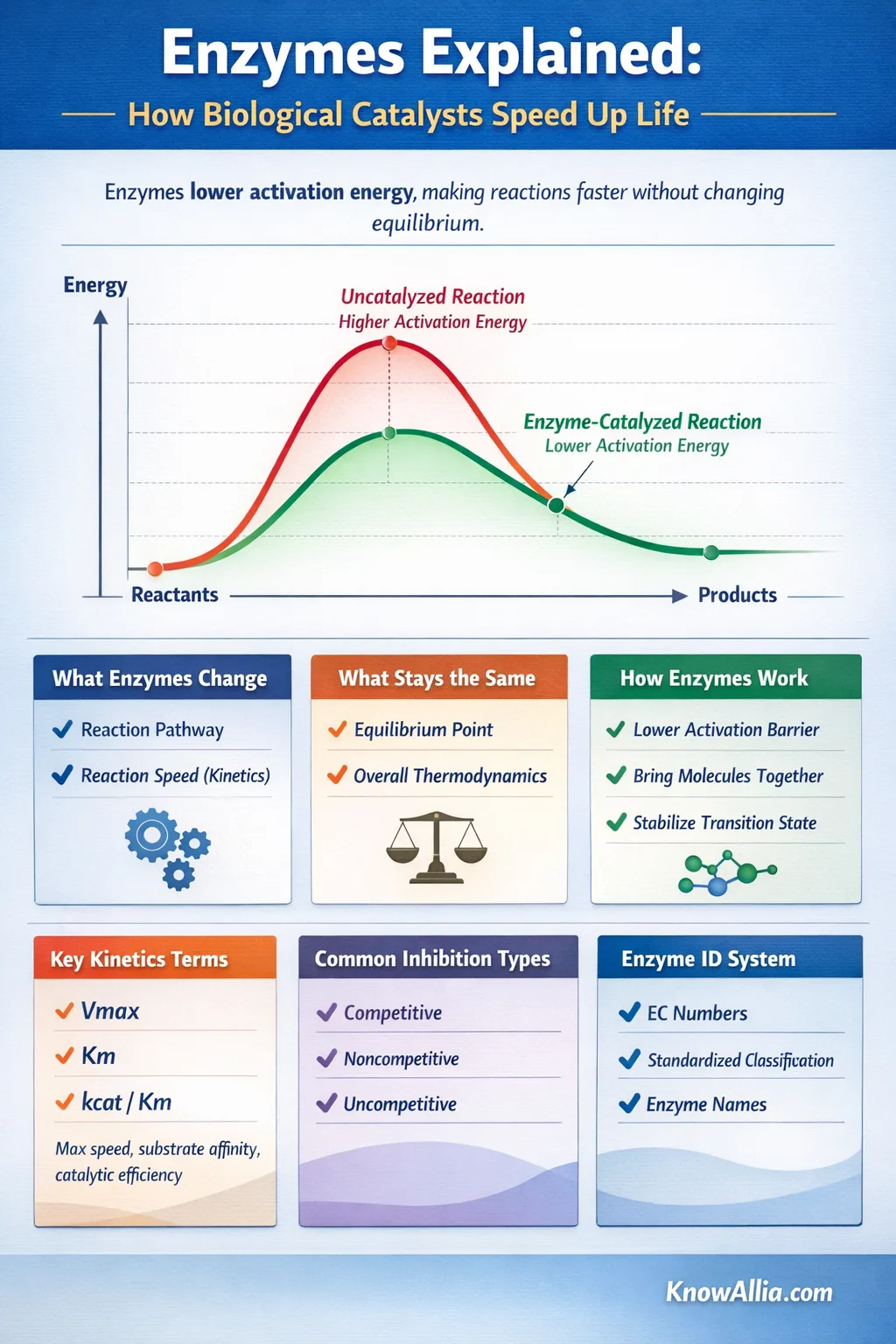
An enzyme is a biological catalyst that speeds up a chemical reaction in living systems without being permanently used up, usually by making it easier for molecules to reach the reaction’s “go” moment (the activation energy step). [a]↗[b]↗[c]↗
A Clear Snapshot Before We Dive In
Enzymes are the reason biology can run at real-world speed: digestion, muscle movement, DNA copying, and cell signaling all rely on them. Most are proteins, and a small but important set are RNA-based catalysts. [d]↗[e]↗
- What enzymes do: change the reaction pathway so the reaction happens faster.
- What enzymes don’t: change the reaction’s overall thermodynamics or where equilibrium ends up.
- How scientists compare them: with Km, kcat, kcat/Km, and standardized names like EC numbers.
By the end, you’ll know what enzymes are made of, how they accelerate reactions, what the most common kinetics terms really mean, and how to look up an enzyme with the same identifiers researchers use.
Jump to What You Care About
What Enzymes Are
Most enzymes are proteins folded into precise shapes, and that shape is what makes them useful. A smaller group are ribozymes (RNA molecules that catalyze reactions). [a]↗[d]↗
In a cell, enzymes sit at the center of metabolism: they help build molecules, break them apart, move chemical groups around, and reshape compounds so the next step can happen. [e]↗
The Main “Jobs” Enzymes Do in Biology
- Join two molecules by forming a new bond.
- Split a bond to break a molecule into smaller pieces.
- Transfer functional groups (like phosphates) from one molecule to another.
- Rearrange a molecule into a new shape without adding or removing atoms.
You’ll see these themes repeated across digestion, energy production, DNA/RNA work, and cell signaling.
How Enzymes Speed Up Reactions
The core idea is simple: enzymes increase reaction rate by lowering the activation energy barrier. In chemistry terms, they’re catalysts—substances that increase rate without changing the reaction’s overall standard Gibbs energy change. [f]↗[g]↗
An analogy that actually fits: imagine reactants have to cross a steep mountain pass to become products. An enzyme doesn’t move the destination. It builds a tunnel through the mountain, so the same trip happens faster and with less struggle.
What Changes (and What Doesn’t)
That “doesn’t change equilibrium” line is easy to misunderstand. Enzymes speed up both the forward and reverse directions, so equilibrium is reached sooner, but the final balance is still set by thermodynamics. [h]↗
How Enzymes Pull This Off
- Bring molecules together in the right orientation, so “lucky collisions” aren’t required.
- Stabilize the transition state, the fleeting high-energy arrangement that sits between reactants and products.
- Create a tuned micro-environment (local charge, acidity, water access) inside the active site.
- Use chemistry tricks like acid–base catalysis, temporary covalent bonds, or metal-ion help when needed.
Active Site, Specificity, and “Induced Fit”
The active site is the working pocket where substrate binds and the reaction happens. It’s usually a small part of the overall enzyme, but it’s packed with the residues (and sometimes cofactors) that make catalysis possible.
You’ll often hear lock-and-key. It’s a helpful mental picture, but real enzymes are more flexible. Many use induced fit: the enzyme shifts shape as the substrate binds, improving the match at the moment catalysis matters most. [i]↗
Why Specificity Can Be So High
- Shape complement: the active site fits the substrate’s geometry.
- Charge and polarity: attractions and repulsions guide binding.
- Water control: some reactions need water excluded; others need it positioned.
- 3D timing: enzymes can favor a specific direction or stereochemistry.
What Shapes Enzyme Activity
- Temperature (too high can denature proteins).
- pH (changes charge states in the active site).
- Salt and ions (screen charges; can stabilize or disrupt binding).
- Substrate availability (many enzymes saturate).
- Regulators (activators, inhibitors, feedback signals).
Kinetics You’ll Actually Use
A lot of enzyme content online stops at “enzymes speed things up.” Useful, but incomplete. In real biology (and in labs), the big questions are: how fast, under what conditions, and compared to what. That’s where enzyme kinetics comes in. [j]↗[k]↗
| Term | What It Means | How to Read It |
|---|---|---|
| Vmax | The maximum rate when the enzyme is saturated with substrate. | Think “ceiling speed” for that enzyme amount and setup. |
| Km | The substrate concentration where the rate is half of Vmax (in classic Michaelis–Menten behavior). | Often used as a rough indicator of how much substrate is needed for strong activity, but context matters. |
| kcat | Turnover number: how many substrate molecules one active site converts per second at saturation. | Higher can mean faster chemistry, but only for the tested conditions. |
| kcat/Km | Catalytic efficiency (combines binding and turnover). | Best single number for “how effective” an enzyme is at low substrate levels. |
One detail that gets skipped a lot: kinetic values are not universal fingerprints. They depend on temperature, pH, buffer composition, which substrate form was used, and even how the enzyme concentration was measured. Reporting standards like STRENDA exist because missing experimental details make comparisons unreliable. [l]↗
How Enzyme Activity Is Measured (Plain Language)
- Measure the initial rate (early time points) so product buildup and side effects don’t confuse the signal.
- Repeat at multiple substrate concentrations to see whether the enzyme saturates and to estimate Km and Vmax (when the model applies).
- Convert rates into standardized units (and clearly state conditions), so results can be compared. [j]↗[l]↗
Regulation: How Cells Control Enzyme Power
If enzymes ran at full speed all the time, cells would waste energy and build the wrong things at the wrong time. So biology regulates enzymes using several layers: rapid switching, slower “volume knobs,” and long-term changes in enzyme production. [m]↗
Common Control Mechanisms
- Allosteric regulation: a molecule binds away from the active site and changes activity.
- Feedback inhibition: a pathway’s end product slows an earlier enzyme, preventing overproduction.
- Covalent modification: small chemical tags (often phosphates) switch activity up or down.
- Zymogens: enzymes made as inactive precursors that become active at the right place/time.
How Inhibitors Typically Change the “Shape” of Kinetics
| Inhibition Type | Where It Binds (Simplified) | Typical Effect on Km | Typical Effect on Vmax |
|---|---|---|---|
| Competitive | Active site (competes with substrate) | Often increases | Usually unchanged |
| Noncompetitive (special case) | Allosteric site; binds E and ES similarly | Often unchanged | Often decreases |
| Uncompetitive | Binds only after substrate is bound (ES complex) | Often decreases | Often decreases |
| Irreversible | Forms a stable inactivating interaction | Depends on mechanism | Decreases as active enzyme is removed |
Real enzymes can show “mixed” behavior and more complex kinetics, especially in multi-substrate reactions. That’s normal in biology. [j]↗
Cofactors, Coenzymes, and Helper Chemistry
Some enzymes are “ready to go” as proteins alone. Many are not. They rely on helpers called cofactors—metal ions like Mg²⁺ or Zn²⁺, or organic molecules (often vitamin-derived) called coenzymes. The enzyme plus its required helper is sometimes called a holoenzyme.
Why bother with helpers? Because biology needs chemical abilities that amino acids can’t always deliver on their own—like stable electron transfer, carrying acyl groups, or managing challenging redox chemistry.
A Few Real-World Examples
- Kinases commonly rely on Mg²⁺ to help position ATP for phosphate transfer.
- Dehydrogenases often use NAD⁺/NADH as a coenzyme for electron transfer.
- Metalloenzymes may use Zn²⁺ to activate water or stabilize charge during catalysis.
How Scientists Name and Look Up Enzymes
Names like “lactase” or “DNA polymerase” are useful, but they can be ambiguous across species, labs, and databases. That’s why enzymes also have standardized identifiers: EC numbers (Enzyme Commission numbers). Each EC number is a four-level classification that narrows from a broad reaction class down to a specific reaction. [n]↗[o]↗
Why this matters: EC numbers describe the reaction, not a single protein sequence. Different proteins (even from different organisms) can share an EC number if they catalyze the same reaction.
Reliable Places to Check an Enzyme
- ExplorEnz is an approved access point to the official IUBMB enzyme list and EC classifications. [p]↗
- ExPASy ENZYME summarizes enzyme nomenclature entries tied to EC numbers. [q]↗
- BRENDA compiles enzyme functional data (including kinetics) and connects entries to EC numbers. [r]↗
- RCSB PDB lets you browse structures by enzyme classification, useful when you want 3D context. [s]↗
Why Enzymes Make Life Run on Time
Enzymes speed reactions by lowering the activation barrier (the hard part of the journey). They change the pathway, not the destination: equilibrium and overall thermodynamics stay the same, but the system gets there much faster.
Common Misconceptions and Confusions
Reality They speed up reaching equilibrium; they don’t shift where equilibrium ends up. [h]↗
Reality A catalyst participates but is regenerated; enzymes can be reused until they’re damaged or regulated down. [f]↗
Reality Most are proteins, but some RNA molecules catalyze reactions too. [a]↗[e]↗
Reality Km is context-dependent; it’s best read alongside kcat, substrate range, and the exact conditions used. [j]↗[l]↗
Key Terms Glossary
- Substrate
- The molecule an enzyme acts on before it becomes product.
- Active Site
- The region of the enzyme where binding and catalysis happen.
- Activation Energy
- The energy barrier that must be overcome to reach the transition state. [g]↗
- Transition State
- The short-lived, high-energy arrangement between reactants and products (often the main thing enzymes stabilize).
- EC Number
- A standardized four-part identifier that classifies enzymes by the reaction they catalyze. [n]↗
- kcat
- Turnover number: how many substrate molecules per second one active site converts at saturation. [l]↗
- Km
- In classic Michaelis–Menten behavior, the substrate concentration where the rate is half-maximal. [j]↗
Limitations and What We Still Don’t Know
Enzyme science is mature, but it’s not “finished.” A few honest limits are worth keeping in mind when you read enzyme claims or compare numbers across sources.
- In vitro vs. in-cell reality: measurements in purified buffers don’t perfectly replicate the crowded, regulated environment inside a living cell.
- Conditions drive the numbers: Km and kcat can shift with pH, temperature, substrate form, and measurement method. [l]↗
- Models have boundaries: Michaelis–Menten fits many enzymes, but not all (multi-substrate systems, cooperative enzymes, and complex regulation can bend the “simple curve”). [j]↗
- Naming evolves: EC classifications are actively curated; new activities are added and some entries are refined over time. [p]↗
If you ever feel lost, one steady approach helps: follow the identifiers (EC numbers), confirm the experimental conditions, and treat single-number comparisons as useful hints, not final verdicts.
FAQ
Do enzymes work by “adding energy” to reactions?
No. Enzymes don’t add energy to make a reaction happen. They lower the activation barrier by offering a different pathway, which makes reactions proceed faster under the same conditions. [g]↗
Do enzymes change the equilibrium of a reaction?
Are all enzymes proteins?
What does an EC number actually tell me?
What’s the difference between Km and kcat?
Km relates to how reaction rate responds to substrate concentration in Michaelis–Menten behavior. kcat is a turnover rate at saturation (per active site). Together with kcat/Km, they help compare enzyme performance—if (and only if) conditions are clearly reported. [l]↗
Sources
Each source link appears once here. The letter tags jump between where it’s cited and where it’s listed.
- NHGRI (NIH) – Enzyme (Genetics Glossary) (definition; proteins vs RNA enzymes) [a]↩
- Encyclopaedia Britannica – Enzyme (overview; mechanisms and regulation context) [b]↩
- University of Wisconsin–Madison – Enzymes and Equilibrium (why equilibrium doesn’t shift) [c]↩
- NIGMS (NIH) – Science Snippet: Examining Enzymes (what enzymes do; RNA enzymes noted) [d]↩
- NIGMS (NIH) – Science Snippet: Examining Enzymes (task categories and examples) [e]↩
- IUPAC Gold Book – Catalyst (catalyst definition; thermodynamics note) [f]↩
- IUPAC Gold Book – Activation Energy (PDF) (activation energy definition) [g]↩
- University of Wisconsin–Madison – Enzymes and Equilibrium (equilibrium clarification) [h]↩
- Encyclopaedia Britannica – Enzyme (induced fit and specificity context) [i]↩
- IUBMB – Current Recommendations on Enzyme Nomenclature and Kinetics (PDF) (terminology and kinetics concepts) [j]↩
- IUBMB – Current Recommendations on Enzyme Nomenclature and Kinetics (PDF) (inhibition and reporting vocabulary) [k]↩
- STRENDA – Guidelines for Reporting Enzyme Data (units and reporting guidance for Km, kcat, kcat/Km) [l]↩
- Encyclopaedia Britannica – Enzyme (regulation and allosteric control context) [m]↩
- IUBMB – Current Recommendations on Enzyme Nomenclature and Kinetics (PDF) (EC classification overview) [n]↩
- IUBMB Nomenclature (QMUL Mirror) – Enzyme Nomenclature Home (official classification entry point) [o]↩
- ExplorEnz – Official IUBMB Enzyme List (EC numbers and curated enzyme list access) [p]↩
- ExPASy – ENZYME Database (nomenclature summaries tied to EC numbers) [q]↩
- BRENDA – Enzyme Database (Data Fields) (what functional and kinetics fields are collected) [r]↩
- RCSB PDB – Browse by Enzyme Classification (structure browsing via EC classes) [s]↩