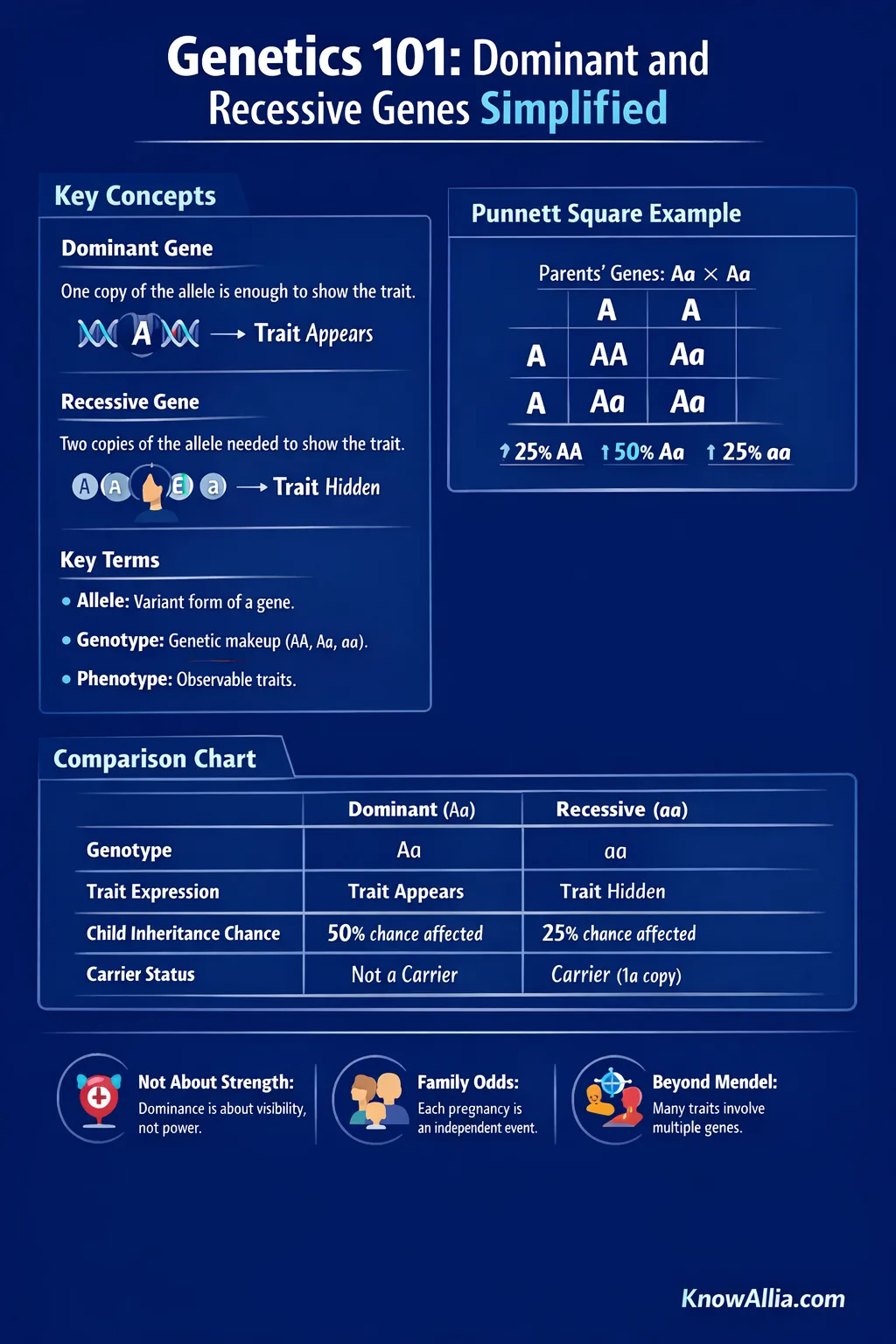
Dominant and recessive genes describe how two versions of the same gene (alleles) show up in traits when a person inherits one version from each parent—not whether a gene is “strong,” “better,” or more common.[a]↗
A Clean Mental Model
Dominant means one allele can be enough to influence the observable trait in a typical two-allele setup; recessive means the trait usually needs two copies of the allele to show.[b]↗ Real traits can be more complicated than that, so this article also explains where the simple story bends—without hand-waving.
- What “dominant” and “recessive” do (and do not) mean
- How family inheritance odds work in common scenarios
- Why the same trait can look different across people, even with the same variant
What you’ll learn here: You’ll understand the key genetics words people use (allele, genotype, phenotype), how dominant/recessive patterns are calculated, and why real-life traits don’t always behave like tidy textbook examples.
What Dominant and Recessive Really Describe
Most of the time, when people say “a dominant gene” or “a recessive gene,” they’re talking about two alleles of one gene and how they relate to the trait you can observe (the phenotype). In a classic dominant pattern, one copy of an allele can be enough to show the trait in a person who has two different alleles for that gene (a heterozygote).[b]↗
In a classic recessive pattern, the trait usually shows when someone inherits two copies of the recessive allele. A person with just one recessive copy often does not show the trait but can still pass the allele on (commonly described as a carrier).[c]↗
One Important Detail People Skip
Dominance is not about an allele being “stronger,” “healthier,” or more common. It is about what you observe when two alleles sit together in one person. In some traits, a single altered copy changes the trait because half the usual gene output isn’t enough or because the altered copy has a new effect. In others, you need two altered copies before you see a clear change.[c]↗
Key Terms You’ll See
- Gene
- A stretch of DNA that provides instructions for making a product (often a protein) and influencing traits. People typically inherit one copy from each parent.[f]↗
- Allele
- A version of a gene. Different alleles can lead to different trait outcomes (including subtle ones).[f]↗
- Genotype
- Your genetic “set” for a given gene or region—often discussed as which alleles you have (like AA, Aa, or aa).[d]↗
- Phenotype
- What you can observe or measure—features, traits, or test results that come from genetics plus other influences.[e]↗
Small but useful distinction: Genotype is what you have. Phenotype is what shows. Dominant and recessive describe the relationship between alleles and phenotype—not a label stamped on a gene forever.
Why Two Copies Matter
In the most common human setup, you carry two alleles for many genes—one from each parent. That’s why dominant/recessive language keeps coming up: you’re often asking, “What happens when these two versions are paired?”[b]↗
How Family Inheritance Patterns Work
When genetics is discussed in families, the word “chance” shows up a lot. The important thing is that these are per-pregnancy probabilities under specific assumptions (for example: one parent has a single altered copy, or both parents are carriers). Each pregnancy is an independent event; previous outcomes don’t change the math for the next child.[h]↗
| Scenario | Typical Parent Setup | Typical Child Chances (Per Pregnancy) | What This Does (and Doesn’t) Tell You |
|---|---|---|---|
| Autosomal Dominant | One affected parent has one altered copy; the other parent does not | 50% chance to inherit the altered copy | Often predicts inheritance well, but expression can vary; some cases come from new variants |
| Autosomal Recessive | Both parents are unaffected carriers (one altered copy each) | 25% affected, 50% carrier, 25% neither carrier nor affected | Commonly used in carrier screening; still doesn’t predict symptom severity |
| X-Linked Patterns | Chance depends on whether the variant is on the X chromosome and the sex chromosomes involved | Often differs for sons vs daughters (for example, a carrier mother has specific probabilities per pregnancy) | Labels like “dominant” and “recessive” can be less clean for X-linked traits |
About “new” (de novo) variants: Sometimes a variant appears for the first time in a child—arising in an egg or sperm cell, or early after fertilization—so a child can have a dominant condition even when parents don’t show it.[g]↗
If you want one sentence to keep you grounded: inheritance patterns are about who tends to inherit what, while real-life outcomes depend on how that variant affects the body and how consistently it shows up across people.[h]↗
Punnett Squares Without the Headache
A Punnett square is just a compact way to list possible allele pairings from two parents. The easiest analogy is a two-coin flip: one coin represents which allele a parent passes down. Flip both coins and you see the combined outcome. A Punnett square simply writes those outcomes down, neatly, instead of relying on memory.
A Simple Method That Stays Honest
- Step 1: Write each parent’s two alleles (for example, Aa).
- Step 2: List the possible alleles each parent can pass on (A or a).
- Step 3: Combine them in a grid to see the possible child genotypes.
- Step 4: Translate genotype to phenotype only if you know the pattern (dominant, recessive, codominant, etc.).
| A (Parent 2) | a (Parent 2) | |
|---|---|---|
| A (Parent 1) | AA | Aa |
| a (Parent 1) | Aa | aa |
What the Square Can’t Do
A Punnett square can show possible combinations and their probabilities, but it cannot guarantee how strongly a trait will show, whether symptoms will be mild or noticeable, or how environment will influence outcomes. That’s where penetrance, expressivity, and polygenic effects enter the picture.[k]↗
Where “Dominant vs Recessive” Stops Being the Whole Story
Search results often teach dominance as if it explains most traits. In real biology, dominant/recessive is a useful starter, but plenty of traits don’t follow simple Mendelian patterns. One major reason: many traits involve multiple genes and environmental influences, so they won’t behave like single-gene textbook examples.[i]↗
Polygenic and multifactorial traits: When multiple genes contribute, inheritance doesn’t line up with “3:1” style ratios. Many of these traits are also influenced by environment and are called multifactorial.[i]↗
Another common gap is assuming “dominant” means “always shows.” Some variants have reduced penetrance (not everyone with the variant shows the trait) and variable expressivity (people show it differently).[k]↗
And sometimes, the relationship between alleles is simply not “masking.” In codominance, both alleles can show their effects side by side rather than one hiding the other.[j]↗
Common Misconceptions and Confusions
Common idea Dominant means “stronger,” “better,” or “more evolved.”
More accurate Dominant describes what happens in a heterozygote: which allele’s effect shows up in the phenotype in that context.[b]↗
Common idea Recessive traits are always rare.
More accurate “Recessive” doesn’t tell you frequency. An allele can be common and still recessive; population frequency is a separate topic.
Common idea If something is dominant, everyone with the variant will show the trait the same way.
More accurate Penetrance and expressivity can change what you see across people, even in the same family.[k]↗
Common idea Punnett squares predict exactly what your child will be like.
More accurate They show probabilities and possible genotypes under assumptions; they don’t guarantee phenotype, severity, or timing.
How Genetic Testing Uses These Labels
Genetic testing looks for changes (variants) in DNA that might be related to a trait or health condition. It can be used for different goals: confirming a suspected diagnosis, estimating the chance of passing on a condition, guiding treatment decisions in some situations, or identifying carrier status—depending on the test and context.[l]↗
A practical translation: When a report says a variant is linked to an autosomal dominant or autosomal recessive condition, it’s describing the typical inheritance pattern observed in families—not promising a certain outcome for every individual.
Testing also intersects with family “chance” calculations. Even when probabilities are clear on paper, real families may see exceptions because a variant is new (de novo), because not everyone with the variant shows symptoms (reduced penetrance), or because symptoms vary widely (variable expressivity).[h]↗
Limitations and What We Still Can’t Predict Perfectly
Genetics can be wonderfully precise in explaining inheritance patterns, but it’s not a crystal ball for every trait. Some traits are influenced by many genes, and many polygenic traits also include environmental effects—so prediction becomes a range rather than a single answer.[i]↗
Even in single-gene patterns, it’s possible for people with the same variant to show different features, or none at all. That’s the heart of reduced penetrance and variable expressivity—and it’s a big reason why “dominant” should not be read as “guaranteed.”[k]↗
What We Don’t Know in Advance
- Whether a person with a known variant will show no signs, mild signs, or more noticeable signs
- How strongly lifestyle, environment, or other genes will shift a trait
- Which “simple” explanations on the internet are actually standing in for a multi-gene reality
If one idea should stick, let it be this: dominant and recessive are useful labels for a specific kind of question—how two alleles behave together—but biology has more than one way to build a trait.
Dominant vs Recessive in One Visual
Two Alleles, One Outcome: What “Dominant” Really Signals
Dominant and recessive describe how paired alleles influence the trait you can observe. This is about the allele relationship in one person—not about frequency, value, or “strength.”
How Pairings Commonly Play Out
AA Two copies of the “A” allele Typical: A-type phenotype Aa One “A” + one “a” allele Typical: A-type phenotype aa Two copies of the “a” allele Typical: a-type phenotype Core idea Dominant describes the heterozygote (Aa) outcome; recessive typically shows when both alleles are recessive (aa).Why Real Outcomes Vary
Reduced penetrance means some people with a variant show no signs; expressivity means people can show it differently.
Many traits involve multiple genes and environment, so simple dominant/recessive rules won’t cover the full picture.
Some traits show codominance or other patterns where one allele doesn’t simply “mask” the other.
Dominant ≠ Common
Dominance is about allele interaction in one person, not how frequent an allele is in a population.
Probabilities Are Per Pregnancy
Family chances apply equally to each pregnancy; past outcomes do not change the next one’s probability.
Traits Can Be Layered
A single gene can matter, but the final trait can still be shaped by other genes and environment.
FAQ
Answers to the Questions People Actually Ask
Does dominant mean “stronger” or “more important”?
No. Dominant describes which allele’s effect tends to show in the phenotype when two different alleles are paired in one person. It is not a ranking of value or strength.
Can a dominant condition appear when neither parent seems affected?
Yes. A variant can sometimes arise for the first time in an egg or sperm cell or early in development (a new, or de novo, variant). Also, reduced penetrance can make a variant harder to spot in a family.
If two parents are carriers, is it always 25% affected and 75% not affected?
Under the standard autosomal recessive carrier-carrier scenario, the typical per-pregnancy chances are 25% affected, 50% carrier, and 25% neither carrier nor affected. Those probabilities apply equally to each pregnancy.
Why do some people with the same variant have different symptoms?
Two common reasons are variable expressivity (differences in how the trait shows) and reduced penetrance (some people with the variant show no signs). Other genes and environment can also influence outcomes.
Are most human traits purely dominant or recessive?
Many traits are polygenic (influenced by multiple genes) and often multifactorial (also influenced by environment). In those cases, dominant/recessive labels capture only a small part of what’s going on.
What does genetic testing actually tell you?
It can identify specific genetic variants and help clarify inheritance patterns or risks, but it usually doesn’t predict exact trait severity or guarantee outcomes. Interpretation depends on the test, the variant, and personal/family context.
Sources
- [a]↩ MedlinePlus Genetics – What Are the Different Ways a Genetic Condition Can Be Inherited? (Core definitions and overview of inheritance patterns)
- [b]↩ National Human Genome Research Institute – Dominant Traits and Alleles (Definition of dominant in the allele–trait relationship)
- [c]↩ National Human Genome Research Institute – Recessive Traits and Alleles (Recessive traits, carriers, and why dominance is not “strength”)
- [d]↩ National Human Genome Research Institute – Genotype (Definition of genotype)
- [e]↩ National Human Genome Research Institute – Phenotype (Definition of phenotype)
- [f]↩ MedlinePlus Genetics – What Is a Gene? (Plain-language gene and allele basics)
- [g]↩ MedlinePlus Genetics – Gene Mutation (Gene Variant) and How Variants Occur (How variants arise, including de novo variants)
- [h]↩ MedlinePlus Genetics – Family Risk and Inheritance Chances (Per-pregnancy probabilities, independent events, and common inheritance examples)
- [i]↩ National Human Genome Research Institute – Polygenic Trait (Why many traits don’t follow simple Mendelian patterns)
- [j]↩ National Human Genome Research Institute – Codominance (Definition of codominance as an alternate allele relationship)
- [k]↩ MedlinePlus Genetics – Reduced Penetrance and Variable Expressivity (Why traits may not show consistently, even in “dominant” patterns)
- [l]↩ MedlinePlus Genetics – What Is Genetic Testing? (What genetic tests do and how results are used)