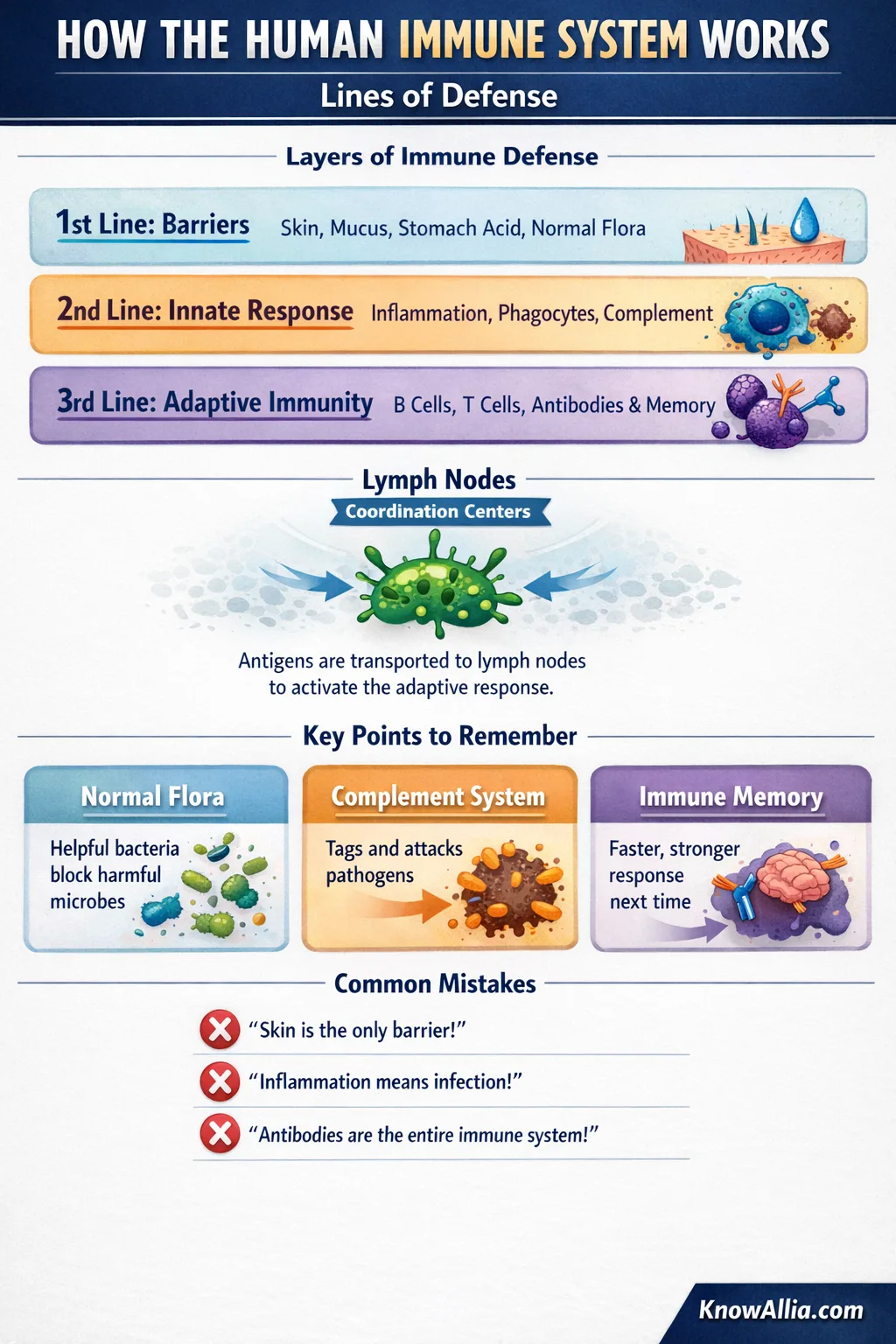
The human immune system is your body’s built-in defense network that recognizes and responds to germs (like bacteria and viruses) and other things that don’t belong. It works through layered “lines of defense”: barriers that block entry, fast internal responses that slow invaders down, and a targeted system that learns and remembers for the next time.[a]↗
“Lines of defense” is a simple way to describe a complex, coordinated system. In real life, these layers overlap and support each other—more like a team than separate departments.[g]↗
A Clear Starting Point
Your defenses start with barriers (skin, mucus, stomach acid), then move to a rapid internal response (inflammation, immune cells, protective proteins), and finally to adaptive immunity (antibodies, specialized T cells, and long-term memory).[a]↗
What you’ll walk away knowing: how the immune system organizes its defenses, what each layer actually does, and how they connect—especially in places many articles skip, like normal flora, complement proteins, and the role of lymph nodes as a “meeting point” for immune decisions.[c]↗
- Barrier Defenses
- Innate Immunity
- Adaptive Immunity
- Inflammation
- Antibodies
- Complement
- Lymph Nodes
- Immune Memory
On This Page
How Immune Defense Is Organized
Most “lines of defense” explanations point to three big layers. That’s useful—just remember the real system is more like overlapping circles than a straight ladder.[g]↗
- Barriers stop many threats before they enter (skin, mucus, stomach acid, protective enzymes).[a]↗
- Innate immunity reacts quickly if something gets past barriers (inflammation, phagocytes, interferons, complement proteins).[c]↗
- Adaptive immunity targets specific antigens and forms memory (B cells, T cells, antibodies).[a]↗
| Defense Layer | Main Job | Typical Speed | Common Tools |
|---|---|---|---|
| First Line (Barriers) | Block entry and reduce survival of germs | Always on | Skin, mucus, cilia movement, stomach acid, enzymes like lysozyme, normal flora[c]↗ |
| Second Line (Innate) | Detect danger fast and limit spread | Minutes to hours | Inflammation, macrophages, neutrophils, complement cascade, interferons, NK cells[c]↗ |
| Third Line (Adaptive) | Precise attack + long-term memory | Days (first time), faster later | B cells, antibodies, helper T cells, cytotoxic T cells, memory cells[d]↗ |
First Line: Barriers That Keep Germs Out
Barriers aren’t just “a wall.” They’re a whole set of physical and chemical features that make it hard for germs to enter—and even harder to stay long enough to cause trouble.[c]↗
What Counts as a Barrier?
- Skin: a tough, dry outer layer that sheds cells, carrying microbes away with it.[c]↗
- Mucus + cilia: sticky mucus traps particles; tiny “sweepers” move it upward so it can be swallowed and neutralized in stomach acid.[c]↗
- Stomach acid: a low-pH environment that many pathogens can’t tolerate.[a]↗
- Protective enzymes: for example, enzymes in tears and skin oils that help limit microbes.[a]↗
- Normal flora (helpful microbes): they take up space and resources so harmful microbes have a harder time gaining a foothold, especially on mucosal surfaces.[c]↗
Everyday Examples
- You breathe dust and microbes daily, but mucus + cilia help move that load out before it settles.[c]↗
- Minor germs on your hands often never get past intact skin.[c]↗
- Food can carry microbes, but stomach acid is a harsh filter.[a]↗
A key detail many quick explainers miss: your barriers aren’t sterile. In many places, “friendly” microbes are part of the protection strategy.[c]↗
Mucosal Surfaces: Where a Lot of Defense Happens
Much of the body’s contact with the outside world happens across mucosal surfaces (like the gut and airways). Many teaching references describe MALT (mucosa-associated lymphoid tissue) as the largest lymphoid organ system, with a large share of the body’s lymphocytes concentrated around these entry points.[f]↗
A standout player here is secretory IgA, an antibody type commonly emphasized in mucosal immunity for helping block microbes from attaching and crossing these surfaces.[f]↗
Second Line: Fast Innate Responses Inside the Body
If something slips past barriers, the immune system doesn’t “wait around.” The innate response is designed to detect danger patterns and react quickly—often before the body has figured out exactly what the intruder is.[c]↗
Inflammation: The Classic Fast Response
Inflammation is a well-known part of innate immunity. One clear description includes four classic signs: heat, redness, pain, and swelling.[c]↗
A practical way to picture inflammation: it increases blood flow and makes it easier for immune cells and helpful proteins to reach the area, while also supporting cleanup and early repair.[c]↗
A Real-World Walkthrough: A Small Cut
- Barrier break: skin is no longer a sealed surface.
- Local signals: damaged cells and immune sentries release chemical signals that open local blood vessels and increase permeability.[a]↗
- Rapid recruitment: phagocytes (like neutrophils and macrophages) arrive and begin clearing microbes and debris.[a]↗
- Tagging + amplification: proteins such as the complement system can label microbes (opsonization), attract immune cells, and even form damaging pores in some pathogens’ membranes.[c]↗
- Antigen transport: dendritic cells can move antigen information to lymph nodes to help launch a targeted adaptive response.[c]↗
Key Players in Innate Defense
- Phagocytes: cells that engulf and digest invaders and debris (phagocytosis).[a]↗
- Pattern recognition receptors (PRRs): receptors that detect common “danger patterns” found in many microbes.[c]↗
- Interferons: proteins released by virus-infected cells that help nearby cells switch on antiviral defenses.[c]↗
- Natural killer (NK) cells: lymphocytes that can trigger programmed cell death in infected cells; some details of how they recognize targets are still being actively studied.[c]↗
- Cytokines and chemokines: short-range signals that help immune cells coordinate and move to where they’re needed.[c]↗
A small but important detail: some innate signals can contribute to fever—for example, MedlinePlus notes interleukin-1 as a factor associated with fever in immune responses.[a]↗
Third Line: Adaptive Immunity and Memory
Adaptive immunity is the “specialist” layer. It focuses on specific targets (antigens) and creates a memory that can make the next encounter faster and stronger.[a]↗
B Cells, T Cells, and Antibodies
B Cells (Antibody Side)
B cells can differentiate into plasma cells that produce antibodies. Antibodies bind to specific antigens, which can neutralize threats or make it easier for other immune cells to clear them.[a]↗
In a first-time response, antibody levels typically rise after a delay of several days; later exposures can trigger a much faster and higher response thanks to memory B cells.[d]↗
T Cells (Control and Direct Attack)
MedlinePlus describes T lymphocytes as cells that can attack antigens directly and also help control the immune response through signaling molecules (cytokines).[a]↗
In practice, helper T cells support other immune functions, while cytotoxic T cells can destroy infected cells. This “cell-side” response matters especially for infections where microbes hide inside our cells.[g]↗
How Vaccines Fit Into the “Lines of Defense” Story
Vaccines are designed to build active immunity and memory without requiring the full risks of the disease itself. The CDC’s Pink Book notes that active immunity usually lasts for many years, often for a lifetime, and that memory B cells can persist for many years.[b]↗
The WHO explains the idea in plain terms: vaccines teach the immune system to recognize a threat so it can respond faster in the future.[e]↗
How the Lines Work Together
The most useful way to understand immunity is to see connection points—places where one line of defense sets up the next. For example, barrier defenses reduce exposure, innate responses slow spread, and antigen transport to lymph nodes helps trigger targeted adaptive responses.[c]↗
An analogy that usually holds up: think of immunity like a well-run building security system. The locks and doors are your barriers. The security team that responds to alarms is innate immunity. The special investigators who learn a specific suspect’s face—and share that information so the next alert is faster—are adaptive immunity and memory.
Complement: A “Bridge” Many Articles Skip
The complement system is often presented as “innate,” but it also links to adaptive immunity through different activation routes. One clear description explains that complement proteins can label pathogens for phagocytosis, attract immune cells, and form membrane-damaging pores; and that it can be activated via an antibody-related pathway as well.[c]↗
Defense Also Means Knowing What to Ignore
Protection isn’t only about attack. MedlinePlus notes that the immune system learns to treat many of your own antigens as “normal” and usually doesn’t react against them.[a]↗
Common Confusions That Trip People Up
Key Terms You’ll See Often
- Antigen
- A substance the immune system can recognize and respond to (often a protein on a microbe or particle).[a]↗
- Innate Immunity
- The defense system you’re born with; includes barriers, fast-acting cells, and proteins like interferons and complement.[a]↗
- Adaptive Immunity
- Targeted defenses that develop with exposure; includes B cells, T cells, antibodies, and memory.[a]↗
- Phagocytosis
- When immune cells engulf and digest microbes or debris.[a]↗
- Complement System
- A protein cascade in blood plasma that can label pathogens, attract immune cells, and form membrane-damaging pores; it can connect innate and adaptive responses.[c]↗
- Cytokines
- Short-range signaling molecules that help immune cells coordinate actions; chemokines are a related group that help guide movement.[c]↗
- Normal Flora
- Non-harmful microbes that live on and in you; they can help prevent pathogens from growing on mucosal surfaces.[c]↗
- Lymph Node
- A meeting and filtering site where immune cells can coordinate; antigen transport to lymph nodes supports adaptive responses.[c]↗
- Secretory IgA
- An antibody type highlighted in mucosal immunity that helps block microbes from attaching and crossing mucosal surfaces.[f]↗
- Immunological Memory
- The reason second encounters can be faster and stronger; memory B cells can persist for years, supporting long-term protection.[b]↗
Immune Defense, Clearly Mapped
Layers Working at the Same Time
Barriers reduce entry, innate responses buy time, and adaptive immunity adds precision and memory. The handoffs—like antigen travel to lymph nodes—are where the system gets its real strength.[c]↗
Defense Flow
Three Details Worth Remembering
Some nonpathogenic bacteria help prevent pathogens from growing on mucosal surfaces.[c]↗
It can tag pathogens, attract phagocytes, and form pores that damage membranes.[c]↗
Later exposures can trigger faster, higher antibody responses than the first encounter.[d]↗
Barrier Reality Check
Barrier defenses are continuous protection, not a reaction that “turns on” only after infection.[c]↗
Inflammation Has a Job
It helps bring fluid and cells to the area and supports cleanup and repair—often before the specific threat is fully identified.[c]↗
Vaccines Use Memory
They aim to build active immunity and immunological memory without requiring full disease exposure.[b]↗
What We Still Don’t Know (and Why That’s Normal)
Even with decades of research, immune responses can vary a lot from person to person. Here are a few areas where medicine is careful about making “one-size-fits-all” claims:
- How long memory lasts can differ by pathogen and vaccine type; protection is often strong for years, but it isn’t identical for every situation.[b]↗
- What “protection” means isn’t always captured by a single measurement—antibodies matter, but immune protection can also involve cell-based responses and other factors.[h]↗
- Mucosal immunity is central to host defense and highly active, but research continues to refine how different mucosal tissues coordinate responses and tolerance across the body.[f]↗
A good rule of thumb: when an explanation sounds like a single switch (“on/off” or “strong/weak”), it’s usually missing the real story—coordination, timing, and targeting.[g]↗
FAQ
Common Questions About the Immune System’s Defense Layers
How fast is innate immunity compared with adaptive immunity?
Innate defenses act quickly—barriers are always active, and innate responses can start within minutes to hours after a breach. Adaptive immunity is slower the first time because it needs to expand the right B and T cell populations, but it can respond much faster on repeat exposure thanks to memory.[c]↗[d]↗
What’s the difference between antibodies and T cells?
Antibodies are proteins produced by B cells that bind specific antigens and help neutralize or label threats. T cells can help coordinate the response and can also directly attack infected cells. Both are central parts of adaptive immunity.[a]↗
Does the immune system remember forever?
Sometimes protection can last a very long time, and many forms of active immunity persist for years. But the duration and strength of memory can vary by disease, vaccine type, and individual factors.[b]↗
Why do we have inflammation if it’s uncomfortable?
Inflammation helps increase blood flow and allows immune cells and proteins to enter tissues more easily. It supports clearing debris and microbes and helps set the stage for repair—especially early on, when the body needs speed more than precision.[c]↗
What role does the microbiome play in “first line” defense?
Some nonpathogenic bacteria on mucosal surfaces can help prevent pathogens from growing there by occupying space and resources—one reason barriers are best understood as living systems, not sterile walls.[c]↗
How do vaccines protect without causing the disease?
Sources
- MedlinePlus Medical Encyclopedia – Immune Response (core definitions: innate vs acquired immunity, barriers, fever signals, memory) [a]↩
- CDC – Pink Book (Chapter 1: Principles of Vaccination) (active immunity, immunologic memory, durability concepts) [b]↩
- Oregon State University (Open Textbook) – Barrier Defenses and the Innate Immune Response (barriers, normal flora, PRRs, inflammation, complement, interferons, lymph node handoff) [c]↩
- Oregon State University (Open Textbook) – Adaptive Immune Response: B Lymphocytes and Antibodies (primary vs secondary response, memory B cells, antibody basics) [d]↩
- World Health Organization – How Do Vaccines Work? (plain-language vaccine explanation tied to immune learning) [e]↩
- Columbia University – Mucosal Immunity (Teaching Slides PDF) (MALT overview and secretory IgA emphasis) [f]↩
- PubMed Central – An Introduction to Immunology and Immunopathology (broad overview of innate/adaptive cooperation) [g]↩
- Nature Reviews Immunology (PDF) – A Guide to Adaptive Immune Memory (how memory is organized and why “protection” isn’t one simple number) [h]↩