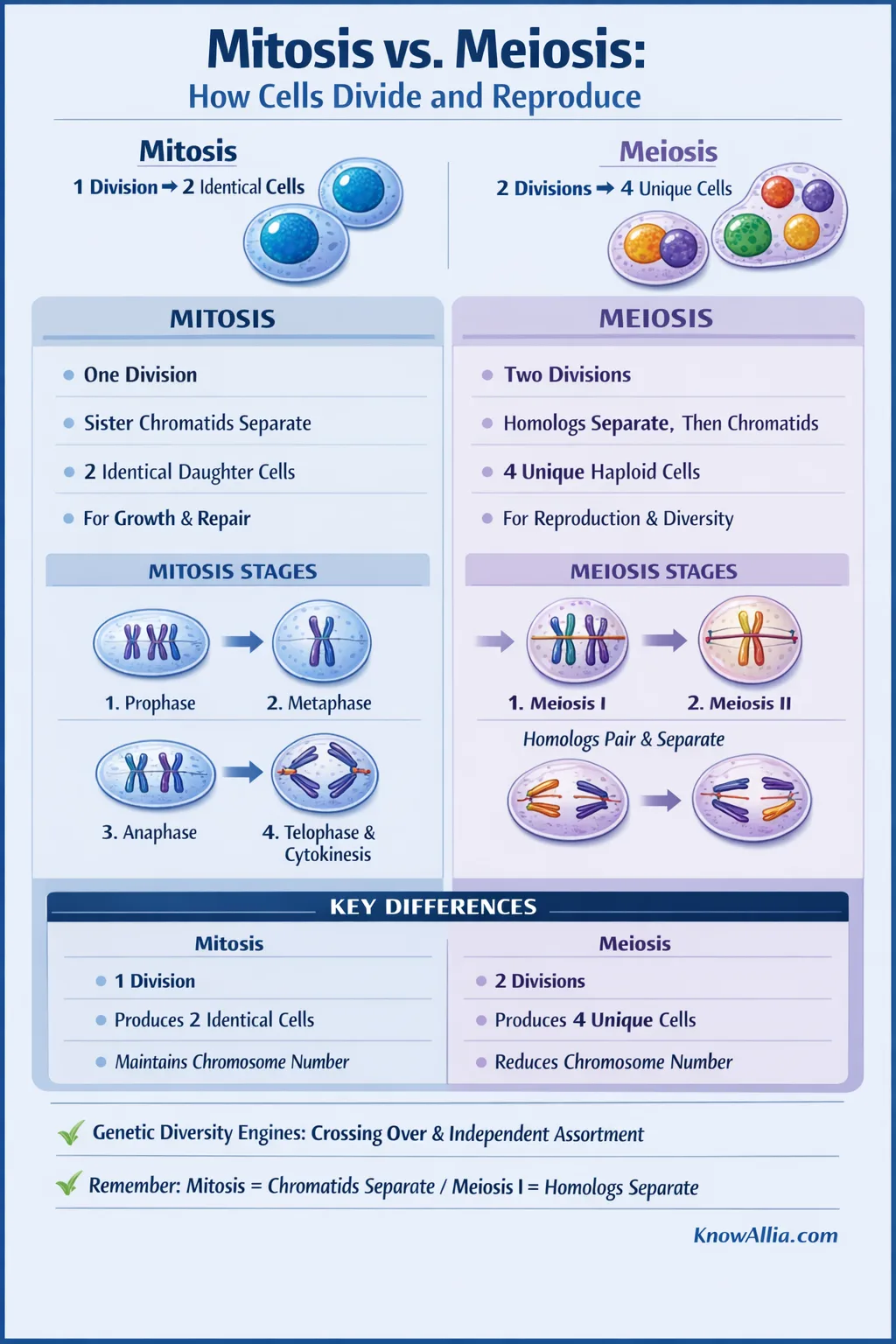
Mitosis and meiosis are two ways eukaryotic cells divide their DNA. Mitosis makes two matching cells for growth and routine renewal, while meiosis makes reproductive cells (and, in many organisms, spores) by halving the chromosome set and mixing genetic material so new individuals start with a fresh combination.[c]↗
A Clear Way to Think About It
Mitosis is about keeping things consistent: same chromosome set in, same chromosome set out. Meiosis is about preparing for a new generation: it reduces chromosome number and builds genetic variety.
- Mitosis: one division → 2 genetically matching daughter cells
- Meiosis: two divisions → usually 4 genetically unique cells with half the chromosome set
- Big reason meiosis matters: it creates genetic diversity for reproduction
What you’ll learn here: how each process works step by step, what’s truly different (and what’s the same), why meiosis has two rounds of division, where genetic variety actually comes from, and the common spots where people get tripped up.
The Core Idea: Same Toolkit, Different Outcomes
Both processes sit inside the cell cycle, where cells grow, copy DNA, and then split. The important pattern is simple: DNA is copied once in a dedicated phase, then chromosomes are separated by a spindle and the cell divides.[d]↗
Two words that prevent a lot of confusion:
- Chromosome
- A DNA package counted by its centromere. A chromosome can be made of one chromatid or two, depending on timing.
- Chromatid
- One of the two identical DNA copies made during replication and held together until separation.
Chromosome Math Without Headaches (2n, n, and DNA Amount)
2n vs n tells you how many sets of chromosomes a cell has (two sets vs one set). Separate from that, a cell can temporarily have extra DNA because each chromosome may be duplicated into two chromatids before they split.
- Right after DNA replication, the cell still has the same chromosome sets (2n or n), but each chromosome is duplicated into two sister chromatids.
- Chromosome number changes only when whole sets are separated (that’s the special move in meiosis I).
- Chromatids split in mitosis and in meiosis II.
Mitosis: One Division, Two Matching Cells
Mitosis is the standard “copy and split” routine for body (somatic) cells. The goal is continuity: the daughter cells keep the same chromosome set as the parent cell.[a]↗
- One nuclear division
- Sister chromatids separate
- Two genetically matching nuclei
- Supports growth and renewal
Mitosis Stages in Plain English
- Prophase: chromosomes condense; the spindle begins to form.
- Metaphase: chromosomes line up in the cell’s middle, attached to spindle fibers.
- Anaphase: sister chromatids split and move to opposite sides.
- Telophase: two nuclei reform; chromosomes relax.
- Cytokinesis: the cell physically pinches (or builds a cell plate in plants) to make two cells.
Real-world example: when a scrape heals, many of the new skin cells are produced through mitosis. The point is not variety—it’s making reliable replacements that “match the original.”
Meiosis: Two Divisions, New Combinations
Meiosis is a specialized type of cell division used to make cells that carry half the chromosome set. It’s closely tied to reproduction because it sets up a “half + half = full set” starting point when two reproductive cells combine.[b]↗
- Two nuclear divisions
- Homologs separate, then chromatids
- Usually four unique outcomes
- Builds genetic variety
Why Two Rounds of Division?
- Meiosis I (reductional division): homologous chromosomes separate, cutting the chromosome set in half.
- Meiosis II (equational division): sister chromatids separate, much like a mitosis-like split.
- Key timing detail: DNA is copied once before meiosis starts; there’s no full DNA replication between meiosis I and II.
Where Genetic Variety Actually Comes From
Two mechanisms do most of the work. First, crossing over swaps DNA segments between paired homologous chromosomes, creating new combinations on a single chromosome.[e]↗ Second, homologous pairs line up randomly in the middle of the cell, so whole chromosomes are mixed into new sets—this is independent assortment.[f]↗
If you want one analogy that sticks: meiosis is like shuffling a deck and dealing hands. Crossing over is the shuffle that changes what’s on the cards, and independent assortment is the deal that decides which cards end up together. The result is that each “hand” (each haploid cell) is very unlikely to match another.
A Detail Many Pages Skip: Meiosis Does Not Always Make Four “Equal” Cells
In many animals, egg formation uses unequal divisions: one cell keeps most of the cytoplasm and becomes the egg, while smaller cells (often called polar bodies) carry extra chromosome sets away.[i]↗ The chromosome math still follows meiosis rules—the “packaging” into usable cells can differ by organism and cell type.
Another often-missed point: in plants, meiosis commonly makes spores, not gametes. Gametes can be produced later by mitosis in the haploid generation, depending on the life cycle.[g]↗
Key Differences and Similarities (Without Fluff)
| Feature | Mitosis | Meiosis |
|---|---|---|
| Primary goal | Maintain the same chromosome set for growth and renewal | Reduce chromosome set and create new combinations for reproduction |
| Number of nuclear divisions | 1 | 2 (I and II) |
| What separates | Sister chromatids | Homologous chromosomes in I, then sister chromatids in II |
| Homolog pairing (synapsis) | No | Yes (early meiosis I) |
| Crossing over | Not part of normal mitosis | Common in meiosis I (major source of variation) |
| Typical outputs | 2 daughter cells, genetically matching | Usually 4 haploid products, genetically unique |
| Where it happens (typical) | Somatic tissues (and many unicellular eukaryotes) | Germline tissues; in plants/fungi, often tied to spores |
Similarities You Can Count On
- Both use a spindle to move chromosomes.
- Both rely on organized attachment points on chromosomes (kinetochores) to pull DNA to opposite sides.
- Both end with cytokinesis in most cells: the physical split into separate cells.
Common Confusions People Run Into
This topic gets messy when similar words get used for different ideas (chromosome set vs DNA amount, homologs vs chromatids). Here are the clean corrections.
Key Terms You’ll See Everywhere
- Diploid (2n)
- Two chromosome sets. Typical for many body cells in animals.
- Haploid (n)
- One chromosome set. Typical for gametes; also common as a life stage in plants and fungi.
- Homologous Chromosomes
- A matched pair carrying the same genes in the same order, one inherited from each parent.
- Sister Chromatids
- Duplicated copies of the same chromosome made during DNA replication.
- Synapsis
- Homologs pair tightly in early meiosis I.
- Chiasma
- The visible “cross” point where crossing over occurred and homologs remain linked.
- Independent Assortment
- Random orientation of homolog pairs during meiosis I that mixes whole chromosomes into new sets.
- Cytokinesis
- The physical split of the cell after nuclear division.
Built-In Accuracy: How Cells Avoid Premature Separation
Cells don’t just “hope” chromosomes separate correctly. They use checkpoints that can pause the cycle until attachments are right. A well-known example is the spindle assembly checkpoint, which monitors whether kinetochores are properly connected to spindle microtubules before the cell commits to pulling chromosomes apart.[h]↗
- Why it matters in mitosis: chromatids must be pulled cleanly to opposite sides so both daughter cells keep a complete set.
- Why it matters in meiosis: cells must separate the right things at the right time (homologs first, chromatids second).
- Practical takeaway: when diagrams show “lines” from chromosomes to poles, those lines represent real physical checks that the cell’s machinery depends on.
Mitosis vs Meiosis, Visual Summary
Two Cell Divisions, Two Very Different Goals
Mitosis preserves a chromosome set for reliable growth. Meiosis reduces the set and reshuffles DNA so new individuals begin with new combinations.
Mitosis Is For Continuity
Best thought of as making reliable replacements: same set of chromosomes, same instructions.
Meiosis Is For New Starts
Reduces chromosome sets and reshuffles DNA so offspring begin with new combinations.
Genetic Variety Has Two Engines
Crossing over changes chromosomes; independent assortment mixes whole chromosomes into fresh sets.
Limitations and What We Don’t Fully Know Yet
Most intro explanations focus on the “big moves” (pair, line up, separate). That’s accurate, but it hides some real-world complexity.
- Where crossovers happen is not random; genomes have hotspots, but the detailed rules vary across species and are still actively studied.
- Checkpoint signaling is highly dynamic; researchers continue refining models of how the spindle checkpoint turns on, scales, and shuts off in real time.
- Life cycles differ across plants, fungi, and single-celled eukaryotes, so “meiosis makes gametes” is true for many animals but not a universal sentence.
If something you read elsewhere feels contradictory, it’s often because the author is describing a different organism, a different life stage, or they’re mixing “chromosome sets” with “DNA amount.” Keeping those categories separate clears up most confusion fast.
FAQ
Answers to the Questions People Actually Ask
Is meiosis basically “mitosis twice”?
Only halfway. The second division is mitosis-like (chromatids separate), but the first division is special: homologous chromosomes pair, recombine, and then separate, which changes chromosome set size and creates variety.
Why does meiosis need crossing over?
Crossing over swaps DNA segments between homologs. That creates new allele combinations on the same chromosome and helps make each haploid outcome more unique.
Does mitosis only happen in diploid cells?
No. Mitosis is about keeping chromosome sets the same from parent cell to daughter cells. Many organisms have haploid life stages where mitosis still happens, especially in plants and fungi.
When does independent assortment happen?
During metaphase I of meiosis, homologous pairs line up randomly. That random orientation mixes whole chromosomes into new combinations before the cell splits them apart.
What’s the simplest way to remember what separates?
Mitosis: chromatids. Meiosis I: homologs. Meiosis II: chromatids.
Why do some diagrams show four products, but egg formation seems different?
The chromosome divisions still follow meiosis, but the cytoplasm can be distributed unevenly. In many animals, one cell becomes the main egg while smaller polar bodies receive the extra chromosome sets.
Sources
- NHGRI (Genome.gov) – “Mitosis” (Definition and core outcome of mitosis) [a]↩
- NHGRI (Genome.gov) – “Meiosis” (Definition and purpose of meiosis) [b]↩
- NIH (NIGMS) – “Make Like a Cell and Split: Comparing Mitosis and Meiosis” (Clear comparison used in the opening definition) [c]↩
- NHGRI (Genome.gov) – “Cell Cycle” (Cell cycle framing: growth, DNA replication, division) [d]↩
- NHGRI (Genome.gov) – “Crossing Over” (Mechanism and meaning of crossing over in meiosis) [e]↩
- OpenStax Biology 2e – “11.1 The Process of Meiosis” (Independent assortment and the 2^n combinations example) [f]↩
- Georgia Tech – “Plant Reproduction: Alternation of Generations” (Plants: meiosis often produces spores; gametes may be produced by mitosis in haploid generation) [g]↩
- Nature Reviews Molecular Cell Biology – “Principles and Dynamics of Spindle Assembly Checkpoint Signalling” (Checkpoint overview: waiting for correct attachments before separation) [h]↩
- Encyclopaedia Britannica – “Oogenesis” (Unequal packaging in egg formation and polar bodies) [i]↩