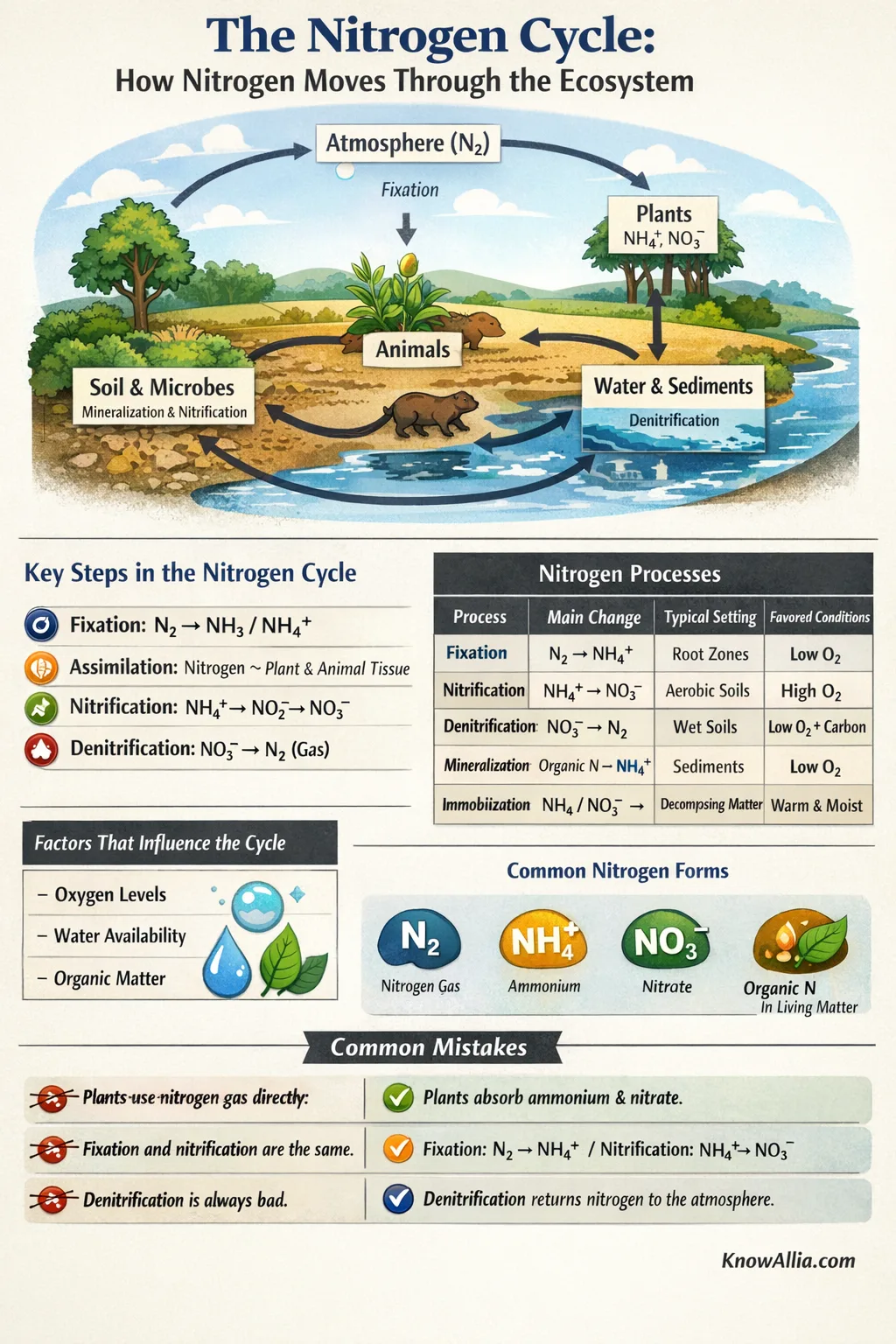
The nitrogen cycle is the natural way nitrogen moves between the air, living things, soil, and water by changing chemical form—most often from inert N2 into “usable” forms like ammonium and nitrate, then back again.[a] 🔗
A Clear Picture First
Nitrogen is everywhere, but life can’t use most of it directly. Ecosystems rely on microbes to “translate” nitrogen into forms plants can absorb, then recycle it through food webs and decomposition. When conditions change—like oxygen levels in soil—the cycle can shift fast.
- Atmosphere is the biggest nitrogen reservoir, mostly as N2.
- Plants mainly take up nitrogen as NH4+ (ammonium) and NO3− (nitrate).
- Microbes drive the key conversions: fixation, mineralization, nitrification, and denitrification.
Here’s what you’ll come away with: how nitrogen changes form, why soil and water conditions matter so much, where nitrogen “leaks” out of ecosystems, and the terms you’ll see in diagrams (without the confusing fluff).
Nitrogen Basics
Nitrogen is a key component of proteins and DNA, so every ecosystem needs a steady supply. The twist is that the atmosphere is packed with nitrogen gas (N2), but most organisms can’t use it as-is. In many places, the “available” nitrogen supply can limit how much plants grow, even when sunlight and water are plentiful.[b] 🔗
Why Nitrogen Needs A Translator
Think of atmospheric N2 like money sealed in a vault: it’s abundant, but you can’t spend it. Microbes act like the currency exchange—turning “vault nitrogen” into spendable forms (mainly ammonium and nitrate) that plants can actually use.
- N2 (nitrogen gas)
- NH4+ (ammonium)
- NO2− (nitrite)
- NO3− (nitrate)
- Organic N (in living tissue & soil organic matter)
In soils, the dominant inorganic forms are usually ammonium and nitrate, and plants tend to rely on those two for uptake. Nitrite shows up too, but typically in smaller amounts because it’s often a short-lived intermediate in microbial reactions.[h] 🔗
How the Cycle Works: Core Steps
Most diagrams show a loop. Real ecosystems look more like a network with side paths, shortcuts, and “holding tanks” in soils and sediments. Still, these core steps show up almost everywhere.
- Nitrogen Fixation: turning N2 into reactive nitrogen (often ammonia).
- Assimilation: plants (and microbes) build nitrogen into living tissue.
- Decomposition & Mineralization: organic nitrogen is converted back into ammonium.
- Nitrification: ammonium is converted into nitrite and then nitrate.
- Denitrification: nitrate is converted back toward gases (often N2), returning nitrogen to the atmosphere.
One detail many charts skip: soils can also “lock up” available nitrogen through immobilization—microbes temporarily taking up ammonium or nitrate as they grow. It’s not gone; it’s just parked inside microbial biomass until conditions shift.[n] 🔗
| Process | Main Change | Typical Setting | Often Favored When | Why It Matters |
|---|---|---|---|---|
| Fixation | N2 → NH3/NH4+ | Soil & root zones, some waters | Biological fixation where specialized microbes thrive | Creates “new” usable nitrogen for ecosystems |
| Mineralization | Organic N → NH4+ | Soils, litter, sediments | Active decomposition (warmth + moisture help) | Releases nitrogen back into plant-available pools |
| Immobilization | NH4+/NO3− → Microbial biomass | Soils, organic-rich zones | Microbes growing fast and needing nitrogen | Temporarily reduces what plants can grab |
| Nitrification | NH4+ → NO2− → NO3− | Oxygenated soils and waters | Enough oxygen in pores or water column | Makes nitrate, which moves easily with water |
| Denitrification | NO3− → N2 (and sometimes N2O) | Wet soils, sediments, low-oxygen pockets | Low oxygen and available organic carbon | Returns nitrogen to the atmosphere; can also form N2O |
| Anammox | NH4+ + NO2− → N2 | Oxygen-poor waters and sediments | Low oxygen; nitrite and ammonium present | Another major pathway that removes reactive nitrogen |
Fixation: The Entry Point
Biological nitrogen fixation is performed by a special group of microbes (often called diazotrophs) that can break the strong bond in N2. Some live freely in soils; others form partnerships with plants—most famously the legume–rhizobia relationship, where nodules on roots host nitrogen-fixing bacteria.[l] 🔗
Nitrification and Denitrification: A Fast Back-And-Forth
Nitrification generally happens in oxygenated conditions, turning ammonium into nitrate through microbial steps. Denitrification tends to appear when soils or sediments become low in oxygen—microbes use nitrate in ways that ultimately push nitrogen back toward gases. In many soils, these two processes can alternate in the same spot over days or even hours as moisture and oxygen change.[u] 🔗
The Microbial Switchboard: What Controls Each Step
If the nitrogen cycle had a control panel, it would be labeled oxygen, water, and carbon. Microbes respond to those conditions, and the chemistry follows.
Conditions That Often Push Toward Nitrate
- Oxygen available in soil pores or water.
- Active conversion of ammonium via nitrification.
- Nitrate becomes the mobile form—easy to move with water.
Conditions That Often Push Toward Nitrogen Gases
- Low oxygen (waterlogged soil, dense sediments).
- Microbes use nitrate or nitrite in ways that produce N2 (and sometimes N2O).
- Reactive nitrogen is removed from the system.
Soil texture, drainage, temperature, and moisture can speed up or slow down mineralization, nitrification, and nitrogen losses like leaching and volatilization. That’s one reason nitrogen can be hard to “predict” in real landscapes—it changes quickly as conditions shift.[nrcs] 🔗
Example you can picture: After a heavy rain, soil pores can fill with water and oxygen drops. In those pockets, denitrification becomes more likely. When the soil dries and oxygen returns, nitrification can ramp up again. Same field, same week—different nitrogen chemistry.
How Nitrogen Moves Through Ecosystems
Nitrogen doesn’t just change form; it also moves location. A simple way to follow it is: plants → animals → decomposers → soil/water, with microbes constantly reshaping the chemistry in the background.
- Plants absorb ammonium and nitrate, then build amino acids, proteins, and chlorophyll.
- Animals get nitrogen by eating plants (or other animals) and rebuilding it into their own tissues.
- Waste and dead material return nitrogen to the decomposer system, where mineralization releases ammonium again.
Soil, Groundwater, Rivers, And Coasts
Nitrate is especially mobile in water. When it moves beyond the root zone, it can enter groundwater or travel to streams and lakes. In aquatic ecosystems, extra nitrogen can shift which organisms thrive, sometimes fueling fast growth of algae and plant-like microbes.[usgs] 🔗
Air Pathways: Gases And Tiny Losses
Nitrogen also returns to the air through denitrification (as N2) and through volatilization (as ammonia) under certain conditions. These pathways are normal parts of the cycle—nature’s way of balancing the books.
Nitrogen in Human Systems
Modern life moves a lot of reactive nitrogen around: fertilizers support food production, wastewater systems concentrate nutrients, and some combustion processes produce nitrogen oxides in the air. The science term you’ll sometimes see is reactive nitrogen—nitrogen compounds that participate easily in biological and chemical reactions (unlike atmospheric N2).[nature] 🔗
Everyday Places the Nitrogen Cycle Shows Up
- Legume roots: nodules hosting bacteria that supply nitrogen to the plant.
- Compost and leaf litter: decomposition releases ammonium during mineralization.
- Aquariums and ponds: microbes convert ammonia to nitrite and nitrate as part of nitrification.
- Wetlands and sediments: low-oxygen zones can convert nitrate back to nitrogen gas.
Common Misconceptions and Confusions
The nitrogen cycle gets confusing because several steps sound similar. Here are a few mix-ups that show up often, with a clean correction.
Key Terms Mini Glossary
- Reactive Nitrogen
- Nitrogen compounds that readily participate in reactions (like ammonium, nitrate, nitrogen oxides), unlike atmospheric N2.
- Nitrogen Fixation
- Conversion of N2 into ammonia/ammonium or other reactive forms—mainly by specialized microbes.
- Mineralization (Ammonification)
- Decomposers convert organic nitrogen in dead material and waste into ammonium.
- Nitrification
- Microbial conversion of ammonium into nitrite and then nitrate, typically where oxygen is available.
- Denitrification
- Microbial conversion of nitrate toward nitrogen gases (often N2), common in low-oxygen zones.
- Anammox
- A pathway in oxygen-poor environments where ammonium and nitrite combine to form nitrogen gas (N2).
Nitrogen’s Journey Through Ecosystems
From Air to Life to Soil to Water (And Back Again)
Nitrogen travels in different chemical forms. Microbes do most of the converting, plants do most of the building, and soil and water conditions decide which pathways dominate.
Major Pools and Conversions
What Usually Decides the Path
Oxygen-rich zones favor nitrification; low-oxygen pockets favor denitrification and anammox.
Nitrate travels easily with water, connecting soils to groundwater, rivers, and coasts.
Decomposition releases ammonium; fast microbial growth can immobilize nitrogen temporarily.
Some steps shift in hours (after rain); others store nitrogen for seasons (soil organic matter).
Most Nitrogen Is “Locked”
The atmosphere holds an enormous amount of N₂, but only specialized microbes can convert it into biologically useful forms.
Plants Use Two Main Forms
Across many soils, ammonium and nitrate are the dominant inorganic forms used for plant uptake.
More Than One “Return Route”
Denitrification and anammox both turn reactive nitrogen back into N₂, especially in low-oxygen settings.
Limits and What We Still Don’t Know
The nitrogen cycle is well understood in principle, but real-world rates can be hard to pin down. Microbial communities differ by location, soils have tiny oxygen-rich and oxygen-poor pockets right next to each other, and water movement can reroute nitrogen quickly. That’s why many nitrogen “budgets” are best read as careful estimates, not absolute numbers.
Another honest limitation: simple diagrams often imply one neat loop, but ecosystems run multiple pathways at once (including “parking” nitrogen in organic matter or microbial biomass). If you want a more faithful mental model, picture a roundabout with several exits—not a single-track racetrack.
FAQ
Why can’t most organisms use atmospheric N₂ directly?
N₂ is very stable. Most organisms lack the specialized enzymes needed to break its strong bond, so ecosystems rely on certain microbes to convert N₂ into reactive forms like ammonia.
What forms of nitrogen do plants absorb most often?
In many soils, plants mainly absorb nitrogen as ammonium (NH₄⁺) and nitrate (NO₃⁻). Which one dominates depends on soil oxygen, moisture, and microbial activity.
Is nitrification always a good thing for plants?
Nitrification creates nitrate, which plants can use. But nitrate is also highly mobile in water, so it can move out of root zones more easily than ammonium in some settings.
What is the difference between denitrification and anammox?
Both can produce nitrogen gas (N₂) in low-oxygen environments. Denitrification starts from nitrate, while anammox combines ammonium and nitrite to form N₂.
Why does the nitrogen cycle change so fast after rain?
Rain can fill soil pores with water and reduce oxygen. That can suppress nitrification and make low-oxygen pathways more likely until the soil drains and oxygen returns.
Does the nitrogen cycle happen in oceans too?
Yes. Marine microbes and plankton depend on nitrogen chemistry, and low-oxygen sediments can host pathways that return reactive nitrogen to N₂.
Sources
- Encyclopaedia Britannica – Nitrogen Cycle (clear definition, key steps, and the “78% atmosphere” context) [a]
- University of California (Understanding Global Change) – Nitrogen (why nitrogen availability can limit ecosystem productivity; clear overview of the nitrogen cycle) [b]
- University of Nebraska–Lincoln (PASSel) – Forms of Nitrogen in the Soil (soil nitrogen forms and a more complete list of cycle steps, including immobilization) [h]
- USDA NRCS – Soil Health: Nitrogen (PDF) (how soil conditions affect mineralization, leaching, volatilization, and denitrification) [nrcs]
- University of Florida IFAS – Mitigating Nitrogen Losses in Row Crop Production Systems (definitions and conditions linked to volatilization, leaching, and denitrification; nitrification inhibitor concept) [u]
- U.S. Geological Survey – Nitrogen and Water (how nitrogen moves with water and why nitrate mobility matters) [usgs]
- Nature Education (Scitable) – The Nitrogen Cycle: Processes, Players, and Human Impact (reactive nitrogen framing and the cycle’s key biological players) [nature]
- University of Hawaiʻi (CTAHR) – The Legume-Rhizobia Symbiosis (PDF) (how nodules form and why the partnership matters for biological nitrogen fixation) [l]
- Michigan State University (KBS LTER) – Nitrogen Transformations (PDF) (the “transformations” view: multiple pathways operating simultaneously) [n]