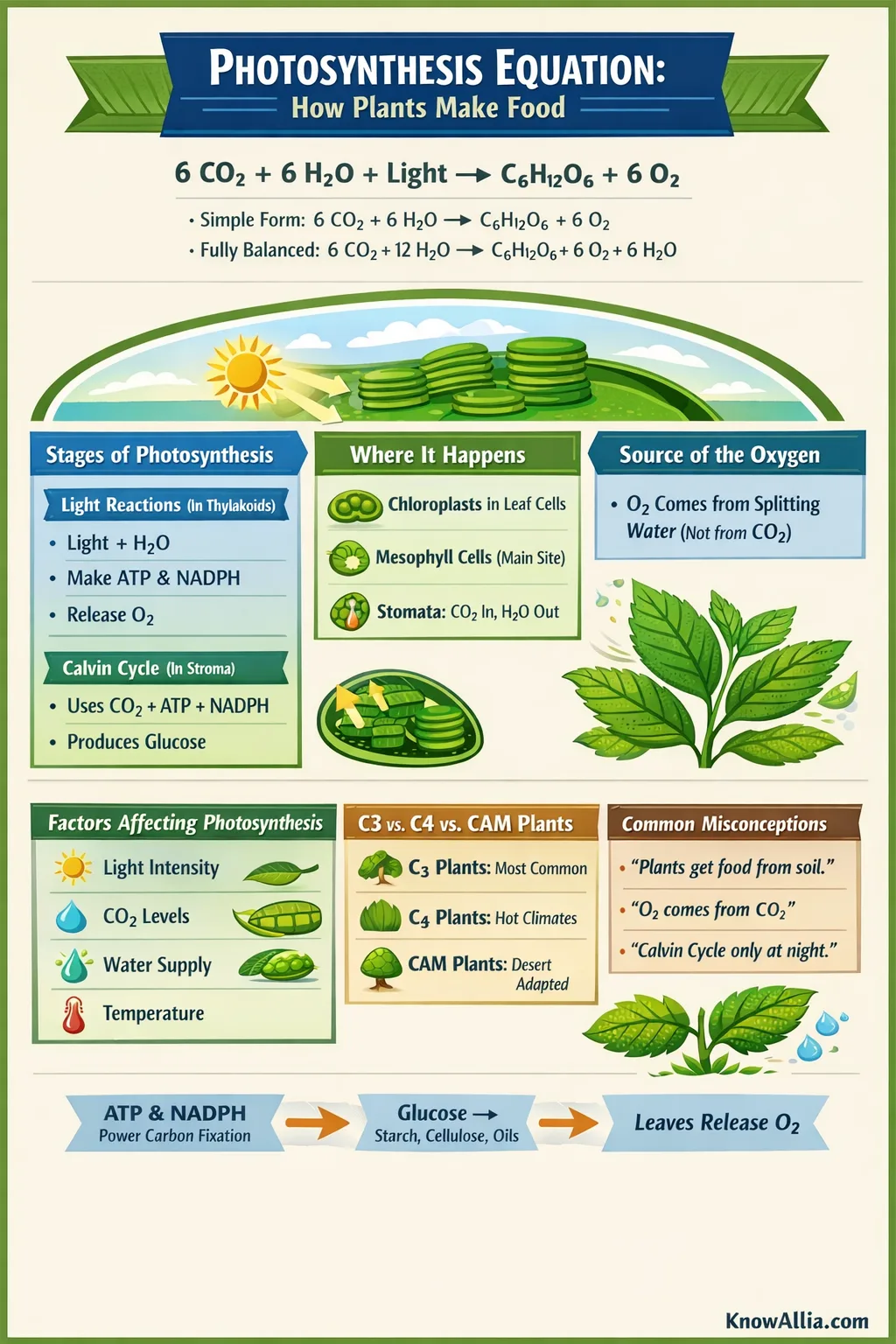
Photosynthesis is the way plants, algae, and some bacteria make sugars from light—using carbon dioxide and water, and releasing oxygen along the way [a].
A Practical Way to Think About It
The famous photosynthesis equation is a net summary: it’s the “receipt” for a long chain of reactions inside chloroplasts. In a real leaf, those reactions happen in two linked stages, and they’re tightly shaped by light, water flow, and gas exchange.
- What goes in: CO2, H2O, and light energy
- What comes out: sugars (energy-rich carbon compounds) and O2
- Where it happens: mostly in leaf cells inside chloroplasts
In this article, you’ll see what the photosynthesis equation really says (and what it leaves out), how the process is split into stages, why the oxygen you breathe comes from water rather than CO2, and how different plants (C3, C4, CAM) tweak the same core chemistry [b].
The Photosynthesis Equation
The best-known “equation” is a simplified, net reaction. It tells you what the overall chemistry adds up to, not every step in between. In many textbooks you’ll see:
Two details matter a lot:
- Light is energy input, not a “stuff” molecule. The plant uses photons to push electrons into higher-energy states.
- “Glucose” is simply a practical example of a broader concept: photosynthesis produces reduced carbon compounds (sugars and related molecules). Leaves often convert these compounds into starch, cellulose, oils, and many other materials.
An easy analogy: a leaf is like a solar-powered kitchen. The raw ingredients are invisible gas (CO2) and water. Sunlight is the stove. The output is energy-rich “food” the plant can store and reshape into whatever it needs.
Where Photosynthesis Happens
In plants and algae, most photosynthesis happens in chloroplasts. Inside them, there’s a clear division of labor: thylakoid membranes handle the light-capturing chemistry, while the surrounding fluid (the stroma) runs the carbon-building reactions [c].
Inside a Leaf
- Mesophyll cells: packed with chloroplasts, where most reactions occur
- Veins: deliver water and carry away sugars
- Stomata: tiny pores that let CO2 in and water vapor out [e]
That last part—stomata—is a built-in tradeoff. A plant opens “valves” to pull in CO2, and it can lose water at the same time. NASA’s Earth Observatory describes these pores as valve-like openings that admit carbon dioxide and allow water to escape [e].
Two Stages That Work as One System
Photosynthesis is often taught as two big stages. That split is useful, as long as you remember they’re interdependent. The first stage captures energy; the second stage spends it to build carbon compounds [b].
| Stage | Main Location | Key Inputs | Key Outputs |
|---|---|---|---|
| Light-Dependent Reactions | Thylakoid membranes | Light, H2O, ADP + Pi, NADP+ | O2, ATP, NADPH |
| Calvin Cycle (Carbon Fixation) | Stroma | CO2, ATP, NADPH | 3-carbon sugars (used to build larger sugars), ADP, NADP+ |
Stage 1: Light-Dependent Reactions
In simple terms, the plant uses light to charge up chemical carriers. A big moment here is the splitting of water. The University of South Carolina’s overview notes that the oxygen released in green-plant photosynthesis comes from water, while carbon from CO2 ends up inside organic molecules [b].
- Water is split: oxygen gas is released, and electrons become available for energy capture [b]
- ATP is made: the cell’s quick-access energy currency
- NADPH is made: a high-energy electron carrier used to reduce carbon later [c]
Stage 2: The Calvin Cycle (Carbon Fixation)
The Calvin cycle is where the plant takes CO2 and converts that carbon into sugar molecules. It doesn’t “run on sunshine” directly; it runs on ATP and NADPH made in the light reactions. Arizona State University’s Ask A Biologist explains that the Calvin cycle uses ATP and NADPH from the light-dependent reactions and takes place in chloroplasts (outside the thylakoids) [f].
A small but important clarity: “Light-independent” doesn’t mean “night-only.” It means the reactions don’t need photons at that exact moment. In living leaves, the Calvin cycle usually slows in darkness because the supply of ATP and NADPH drops, and many enzymes are regulated by light-linked signals [b].
Photosynthesis, Mapped Out
How Light Becomes Sugar Inside a Leaf
A chloroplast carries out two connected processes: one captures energy (ATP/NADPH), and the other uses that energy to convert CO2 into sugar molecules. Oxygen is released as a byproduct when water is split.
Inside the Chloroplast
What the Equation Is Really Summarizing
In green plants, the O2 released is tied to splitting water molecules, not stripping oxygen from CO2.
They carry energy and high-energy electrons from the light reactions into carbon fixation.
CO2 enters through pores that can also let water vapor escape.
Inputs That Usually Limit Real Leaves
Light intensity, CO2 availability, leaf temperature, and water status all interact—changing how fast the pipeline runs.
“Glucose” Is a Shortcut
Plants often produce and shuffle smaller sugars first, then build starch, cellulose, oils, and many other molecules.
Same Chemistry, Different Strategies
C3, C4, and CAM plants keep the core equation but handle CO2 capture differently.
What Changes the Photosynthesis Rate
The equation looks clean, but real photosynthesis is more like a set of dials that move together. If one dial is low, the whole system slows. Here are the big levers most often discussed:
- Light: more light can raise the rate up to a point; different pigments absorb different wavelengths.
- CO2 supply: carbon dioxide is the carbon source for sugars, and plants take it in through stomata [e].
- Water availability: water is both a reactant and a “cooling / transport” medium in plants; closing stomata to save water can also restrict CO2 entry [e].
- Temperature: enzyme-driven steps tend to speed up with warmth until heat stress or enzyme limits show up.
- Nutrients: building chlorophyll, proteins, and membranes requires mineral nutrients; a shortage can indirectly lower photosynthesis.
At the ecosystem scale, photosynthesis is also a core part of the carbon cycle: NASA notes that plants absorb carbon dioxide and sunlight to create fuel—glucose and other sugars—for building plant structures [d].
C3, C4, and CAM: Same Goal, Different CO2 Handling
Most plants you see every day use the C3 pathway, which feeds CO2 directly into the Calvin cycle. Some plants, especially in hot or dry settings, use alternative strategies that change how CO2 is captured before it enters the Calvin cycle.
C4 Plants
C4 plants use a two-step CO2 concentrating approach and a specialized leaf layout. Georgia Tech describes the hallmark anatomy: mesophyll cells near stomata and bundle sheath cells deeper in the leaf, where key carbon-fixation steps are separated [g].
- Why it helps: can reduce wasteful side reactions under hot conditions
- What changes: CO2 is “shuttled” into a concentrated zone before entering the Calvin cycle
CAM Plants
CAM plants change the timing of gas exchange. Ask A Biologist explains the core idea in plain terms: many CAM plants open stomata at night—when it’s cooler and often less drying—so they lose less water while still getting CO2 [h].
- Why it helps: reduces water loss tied to daytime stomata opening
- What changes: CO2 is temporarily stored, then used during the day for sugar-building steps
Photosynthesis in Water: Algae, Plankton, and Oxygen
“Plants” aren’t the whole story. A large share of global photosynthesis is done by marine photosynthesizers—especially tiny plankton. NOAA’s Ocean Service states that at least half of the oxygen produced on Earth comes from the ocean, mostly from photosynthesizing plankton [i].
In rivers, lakes, and coastal waters, photosynthesis also shapes local chemistry. The U.S. Geological Survey notes that photosynthesis is a primary process affecting dissolved oxygen patterns in water, alongside factors like sunlight and water clarity [j].
Common Misconceptions and Mix-Ups
Soil supplies water and minerals, but the carbon in sugars mainly comes from CO2 in the air [b].
In green plants, the released O2 is tied to splitting water [b].
It’s called “light-independent” because it doesn’t need photons directly. In normal leaf life, it usually runs when the light reactions are supplying ATP and NADPH [f].
Opening stomata can raise CO2 intake, but it can also increase water loss—so plants balance both needs [e].
Key Terms
- Photosynthesis Equation
- The net chemical summary of turning CO2 and water into sugars using light energy, with oxygen released.
- Chloroplast
- The organelle where most photosynthesis happens in plants and algae.
- Thylakoid
- Internal membranes in chloroplasts where the light-dependent reactions occur [c].
- Stroma
- The fluid region around thylakoids where carbon fixation reactions build sugar backbones [c].
- Chlorophyll
- A key pigment that helps absorb light energy for photosynthesis.
- ATP / NADPH
- Energy carriers made during light reactions; they provide energy and high-energy electrons for the Calvin cycle [f].
- Calvin Cycle
- A cycle of reactions that fixes CO2 into sugar molecules, using ATP and NADPH [f].
- Stomata
- Tiny pores that regulate CO2 entry and water vapor loss from leaves [e].
- C3 / C4 / CAM
- Different ways plants manage CO2 capture and delivery to the Calvin cycle, often reflecting local climate and water conditions [g] [h].
Limitations and What We Don’t Know Yet
The photosynthesis equation is powerful because it’s simple. That’s also its biggest limitation. It hides dozens of intermediate molecules and the fact that plants often make many carbon products, not just “glucose.”
In real ecosystems, measuring “the photosynthesis rate” is tricky because it changes minute by minute with light, CO2, water status, and temperature. Even in a single leaf, different cells can be running at slightly different speeds. Scientists build models to connect leaf chemistry to whole-plant growth and ecosystem carbon flow, but those links still carry uncertainty—especially outdoors, where conditions keep shifting.
And when people talk about oxygen production (especially in oceans), the conversation can get confusing because oxygen is also constantly being used by respiration and decomposition. That’s why trustworthy sources often phrase it carefully—like “at least half” from marine photosynthesizers [i].
So yes, the equation is real—and it’s one of the cleanest summaries in biology. But the living process is more like a busy network than a single line of chemistry, and that’s exactly what makes it fascinating.
FAQ
Photosynthesis Questions People Ask All the Time
Is the photosynthesis equation always the same?
The net idea is consistent: CO2 and water become energy-rich carbon compounds using light, with oxygen released. But the exact way it’s written can vary (for example, some versions show extra water molecules to keep every atom perfectly balanced).
Why is light written in the equation if it isn’t a molecule?
Because the process needs energy input. Light provides the energy that lets the chloroplast move electrons into high-energy states, which then gets stored in chemical carriers.
Does photosynthesis make “food” directly?
It produces sugar molecules and related carbon compounds. Plants then convert these into various forms used for energy and structure, including transport sugars, starch for storage, and cellulose for cell walls.
Do plants photosynthesize at night?
In most plants, the light reactions stop in darkness because they need photons. Some plants (CAM plants) open stomata at night to take in CO2 and store it, then use it during the day for sugar-building reactions.
What part of the leaf does most photosynthesis?
Most happens in mesophyll cells, which are packed with chloroplasts. CO2 enters through stomata, and water arrives through veins.
Do algae and ocean plankton use the same equation?
Many do the same overall oxygenic photosynthesis: using light to build carbon compounds from CO2 and releasing oxygen. That’s why ocean photosynthesizers are a major source of Earth’s oxygen production.
Sources
- [a] Encyclopaedia Britannica – Photosynthesis (Core definition and the commonly shown net equation)
- [b] University of South Carolina – Photosynthesis Overview (PDF) (Balanced equation details; oxygen from water; carbon from CO2; two-stage framing)
- [c] UC Davis – Chapter 10: Photosynthesis (PDF) (Thylakoids vs stroma roles; ATP/NADPH; oxygen liberation from water)
- [d] NASA Science – The Carbon Cycle (Plants absorb CO2 and sunlight to create glucose and other sugars)
- [e] NASA Earth Observatory – Changing Global Land Surface (Stomata) (Stomata as valve-like pores for CO2 entry and water loss)
- [f] Arizona State University – Ask A Biologist: Photosynthesis (Calvin cycle location; ATP/NADPH use; clear stage relationship)
- [g] Georgia Tech – Biological Principles: C4 Plants (C4 leaf anatomy and CO2 handling)
- [h] Arizona State University – Ask A Biologist: CAM Plants (Night stomata opening and water-loss tradeoff in CAM strategy)
- [i] NOAA Ocean Service – How Much Oxygen Comes From the Ocean? (At least half of Earth’s oxygen production linked to ocean photosynthesizers)
- [j] U.S. Geological Survey – Dissolved Oxygen and Water (Photosynthesis as a key driver of dissolved oxygen patterns in water)