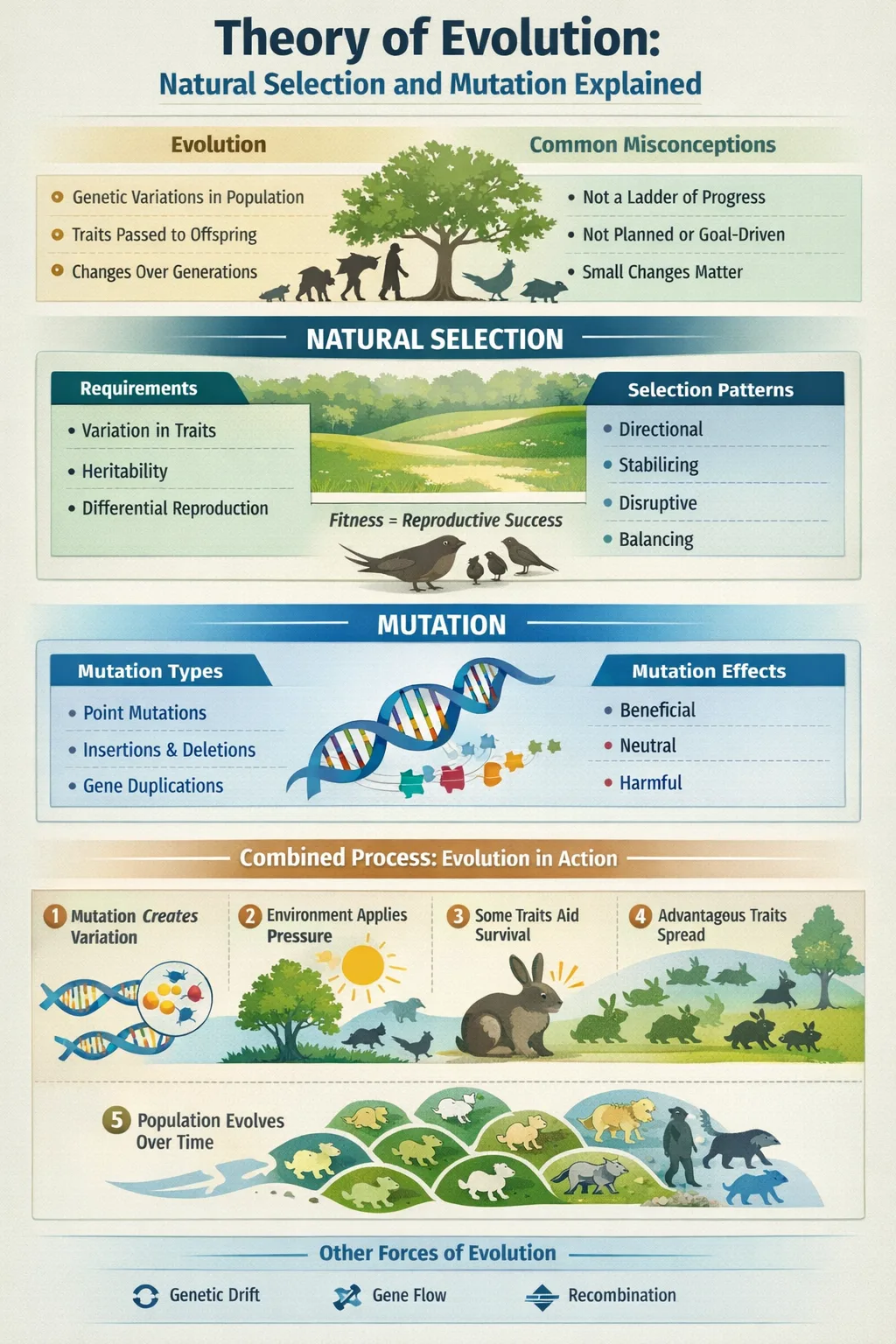
The theory of evolution explains how populations of living organisms change over generations as genetic variation is produced and filtered by processes such as natural selection and mutation.[Source-1]✓
What Evolution Means in Biology
In biology, evolution is tracked at the population level, not as a planned change inside a single individual. A practical way to describe it is a shift in allele frequencies (versions of a gene) across generations.[Source-2]✓
You can think of evolution as the long-run outcome of many small genetic differences being inherited, combined, and sorted by survival and reproduction.
What Changes Over Time
- Gene variants in a population become more or less common.
- Traits tied to those variants can shift in average size, frequency, timing, or behavior.
- Some changes are visible; many are molecular and only detected through DNA or protein data.
What Evolution Is Not
- It is not a ladder of “better” and “worse.” It describes fit to a context.
- It is not a process with foresight. Genetic changes do not “know” what will be useful later.
- It is not only about dramatic transformations; small shifts can matter.
Natural Selection: How Inherited Differences Become Common
Natural selection is the differential survival or reproduction of individuals with different inherited traits, leading to changes in gene frequencies in a population over time.[Source-3]✓
- Selection Works When These Conditions Line Up
- Variation exists: individuals differ in traits.
- Heredity exists: some differences are passed to offspring.
- Unequal reproduction occurs: some variants leave more descendants.
- Time passes: shifts accumulate over generations.
- What Gets “Selected”
- Selection acts on phenotypes (traits you can measure), while inheritance is carried by genotypes (DNA variants).
Selection does not require perfection. It only requires that some heritable trait differences consistently affect the number of surviving, reproducing descendants.
Patterns of Natural Selection
| Pattern | What It Tends to Do | What You Often Observe |
|---|---|---|
| Directional | Favors one end of a trait range over the other. | A steady shift in the trait average toward one side. |
| Stabilizing | Favors intermediate forms and reduces extremes. | Less variation around a common “middle” value. |
| Disruptive (Diversifying) | Favors extremes and makes intermediate forms less common. | Two trait peaks can appear in the same population. |
| Balancing | Maintains multiple variants in the population. | More than one version remains common, often due to context. |
Fitness in evolutionary biology means reproductive success relative to others in the same population and environment. It is measured by the number of viable, reproducing descendants, not by strength, size, or any social idea of “worth.”
Mutation: How New Genetic Variants Appear
A mutation is a change in a DNA sequence. Mutations can come from copying errors during cell division or from exposure to certain environmental factors, including some forms of radiation and chemical mutagens.[Source-5]✓
Where Mutations Matter for Evolution
- Germline mutations (in eggs or sperm) can be inherited and contribute to evolutionary change.
- Somatic mutations (in body cells) can affect an individual organism but are not usually passed to offspring.
- Most new variants start rare. Their fate depends on inheritance, chance, and selection.
Gene Variant vs. Mutation
Many scientific and medical resources use gene variant to describe DNA differences without implying they are harmful. Variants can be inherited, can arise newly in a child, or can occur after conception in some cells.[Source-6]✓
Types of Mutations You Will See in Biology
- Single-base changes (often called point mutations) that swap one DNA “letter” for another.
- Insertions and deletions that add or remove DNA letters; these can sometimes shift how a gene is read.
- Duplications that copy segments of DNA, creating extra gene material that may later diverge.
- Rearrangements that move or flip DNA segments, changing where genes sit or how they are regulated.
Mutations can have different functional outcomes. Some are neutral, some are beneficial in a specific context, and some can be harmful for certain cell functions.[Source-7]✓
How Mutation and Natural Selection Work Together
Mutation introduces new variants; natural selection shifts which variants become more common. The combined result is a steady, testable change in populations—sometimes subtle, sometimes fast.
A Simple Step-by-Step View
- New variation appears through mutation (and through the reshuffling of existing variants during reproduction).
- Traits differ because genotypes differ; environments create different outcomes for those traits.
- Some individuals leave more offspring because certain inherited traits fit the current conditions better.
- Allele frequencies shift as successful variants become more common in the next generation.
- Over time, populations can become better matched to their surroundings, and lineages can diverge.
Selection is often described as “non-random,” while mutation is typically treated as “random with respect to need.” That pairing is important: selection gives direction to the population-level outcome, even though the raw material comes from many small, unpredictable changes.
In many real systems, selection is not the only force at work. Chance and movement between populations can also influence which variants are present and how common they become.
Evolution Also Includes More Than Selection
| Process | What It Does | Why It Matters |
|---|---|---|
| Mutation | Creates new DNA variants. | Supplies fresh material that selection and chance can act on. |
| Natural Selection | Changes variant frequencies through differential reproduction. | Can produce adaptations when variants affect reproductive success. |
| Genetic Drift | Shifts frequencies due to chance events, especially in small populations. | Can make variants common or rare without a consistent advantage. |
| Gene Flow | Moves variants between populations through migration and reproduction. | Can spread helpful variants or reduce differences between populations. |
| Recombination | Re-shuffles existing variants into new combinations. | Creates new trait combinations without creating new DNA letters. |
How Scientists Study Evolution Today
Fossils and Deep Time
Fossils document past biodiversity and show how groups appear, change, and diversify across geological layers. Museums and research collections use this record to study major transitions and patterns through time.[Source-8]✓
Genetics and Measurable Change
- DNA sequencing can reveal shared ancestry and the history of genetic branching.
- Population studies can track allele-frequency shifts across generations.
- Laboratory and field work can directly measure survival and reproduction differences among variants.
The strongest evolutionary explanations connect multiple lines of evidence at once—genes, traits, environments, and time. When these pieces agree, the result is a coherent account that can be tested and refined.
Essential Terms
| Term | Meaning in Evolutionary Biology |
|---|---|
| Allele | A version of a gene; populations can contain multiple alleles for the same gene. |
| Genotype | The genetic makeup (specific alleles) an organism carries. |
| Phenotype | Measurable traits (shape, color, behavior, physiology) produced by genes and environment. |
| Fitness | Relative reproductive success: how many viable, reproducing descendants are produced. |
| Selection Pressure | An environmental factor that changes which traits increase reproductive success. |
| Adaptation | A heritable trait that tends to improve fitness in a specific context. |
| Mutation | A DNA sequence change that can create a new variant. |
| Genetic Drift | Chance-driven changes in allele frequencies, often strongest in small populations. |
| Gene Flow | Movement of alleles between populations via migration and reproduction. |
Evolutionary theory stays practical when it is grounded in measurable pieces: inherited variation, differences in reproductive success, and clear evidence for change across generations. Natural selection and mutation sit at the center of that picture, one generating options and the other shaping outcomes.
Frequently Asked Questions
FAQ
Does natural selection create mutations?
No. Mutations are changes in DNA that can occur through copying errors or other causes. Natural selection changes which existing variants become more common by favoring those linked to higher reproductive success in a given environment.
Are mutations always harmful?
No. Mutations can be beneficial, neutral, or harmful depending on how they affect function and context. Many DNA changes have little measurable effect, while a smaller fraction influences traits in noticeable ways.
Can evolution happen without natural selection?
Yes. Populations can change through genetic drift and gene flow even when no variant has a consistent advantage. Natural selection is the main process that can produce adaptation, but it is not the only source of change.
What does “fitness” mean in this context?
Fitness is relative reproductive success. It refers to how many viable, reproducing descendants an organism leaves compared with others in the same population and environment.
Do organisms evolve because they “need to”?
Evolution does not require intention or foresight. Variation arises through genetic processes, and environments influence which inherited variants become more common over time.
Why do scientists call evolution a “theory”?
In science, a theory is a well-supported explanatory model that ties together evidence and makes testable predictions. Evolutionary theory connects genetics, inheritance, variation, and population change into one coherent explanation.