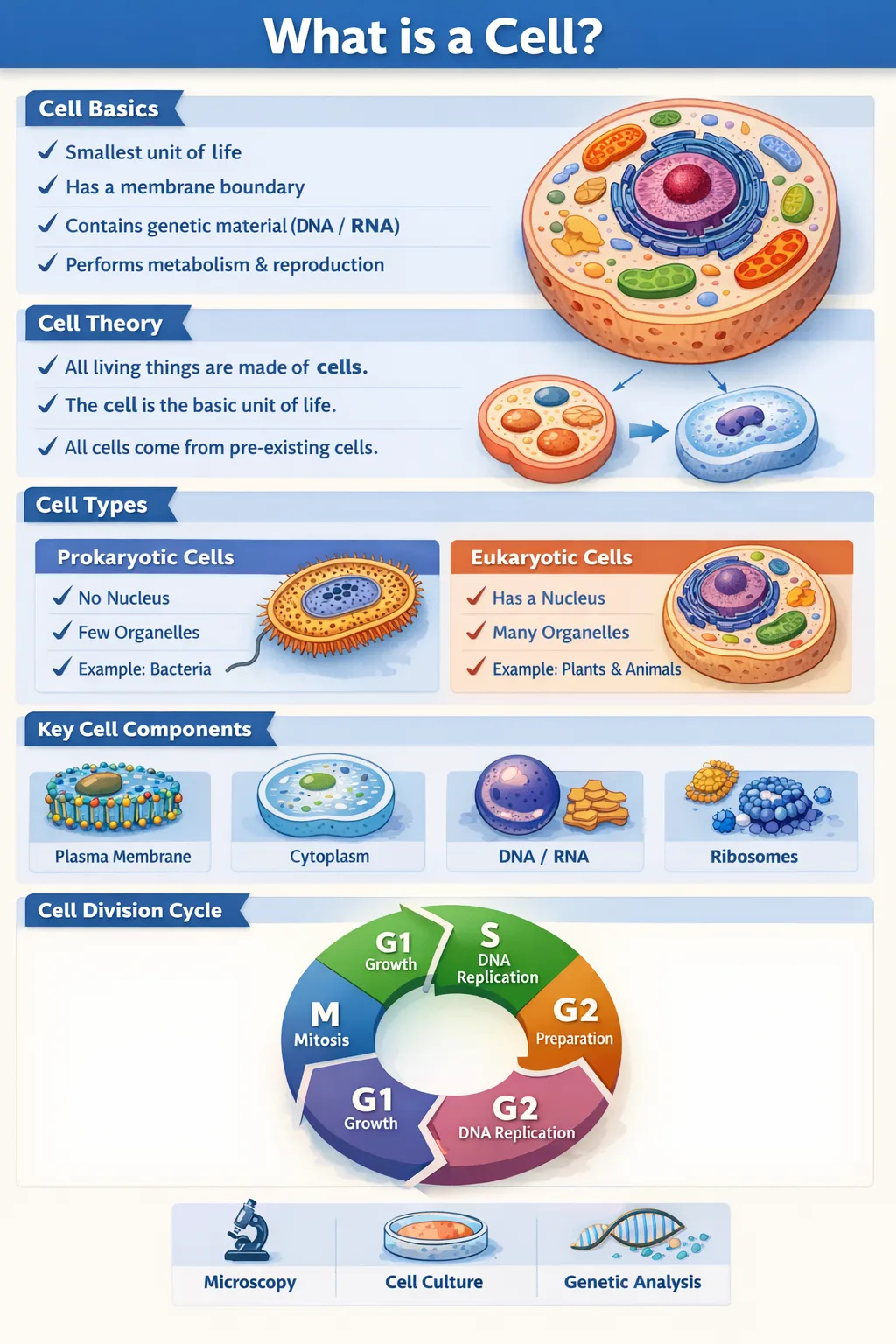
A cell is the smallest unit of life that can carry out the basic functions needed to sustain an organism, and it forms the basic structural and functional unit of all living organisms.[Source-1]✓
A Practical Way to Think About Cells
A working cell is a self-maintaining system: it keeps its inside stable, uses energy, reads genetic instructions, and builds the molecules it needs. In complex organisms, specialized cells coordinate so tissues and organs can function reliably.
Core Idea
Structure and function are inseparable in cell biology.
Why It Matters
Understanding cell parts explains how living systems grow, repair, and adapt.
What Makes Something a Cell?
A cell is not defined by one “magic” feature. It is defined by a set of capabilities that work together in a bounded space. The most useful way to recognize a cell is to look for these essentials.
- Boundary: a physical boundary (typically a plasma membrane) that separates inside from outside.
- Information: genetic instructions (DNA or RNA) that can be copied and used to make functional molecules.
- Metabolism: chemical reactions that build, break down, and transform molecules to keep the system running.
- Regulation: the ability to sense changes and adjust internal activity.
- Reproduction: producing new cells by division, passing information forward.
Useful nuance: cells can be simple or complex, but the definition stays centered on function and self-contained organization, not on how many parts are visible under a microscope.
Cell Theory in Modern Terms
Cell theory is a scientific explanation that places cells at the center of biology. Historically, it emerged as microscopes improved and scientists compared living tissues across many organisms.[Source-2]✓
Three Statements That Capture the Idea
- All living organisms are made of one or more cells.
- The cell is the basic unit where structure and function come together.
- New cells arise from existing cells through division.
Two Broad Cell Types: Prokaryotes and Eukaryotes
Across life, cells are commonly grouped into prokaryotic and eukaryotic types. A practical difference is whether DNA is held inside a membrane-bound nucleus, and whether the cell contains many membrane-bound compartments (organelles).[Source-3]✓
| Feature | Prokaryotic Cells | Eukaryotic Cells |
|---|---|---|
| DNA location | In a nucleoid region (no nucleus) | In a nucleus enclosed by a membrane |
| Membrane-bound organelles | Typically absent | Common (e.g., mitochondria, ER, Golgi) |
| Typical complexity | Generally simpler internal compartmentalization | More internal compartments; specialized functions separated into organelles |
| Examples | Bacteria and archaea | Plants, animals, fungi, many protists |
The Core Parts Found in Most Cells
Even though cell types vary widely, many cells share a recognizable “core toolkit.” A helpful way to learn cell structure is to separate universal parts from specialized organelles.
Core Components and What They Do
- Plasma Membrane
- A selective boundary that regulates what enters and leaves.
- Cytoplasm
- The internal fluid and dissolved molecules where many reactions occur.
- Genetic Material
- Instructions (DNA, or RNA in some organisms) that guide building and regulation.
- Ribosomes
- Molecular machines that assemble proteins from amino acids.
Organelles: Specialized Parts Inside Many Cells
An organelle is a specialized structure within a cell that carries out a particular role, helping the cell “divide up” complex work into manageable compartments.[Source-4]✓
Some organelles are enclosed by membranes; others are organized complexes without a surrounding membrane. Either way, the purpose is the same: efficient, controlled chemistry inside a small space.
| Organelle / Part | Main Job | Typical Presence |
|---|---|---|
| Cell Membrane | Separates the cell from its environment and regulates transport | Most cells |
| Nucleus | Stores DNA and helps coordinate gene expression | Most eukaryotes |
| Ribosomes | Build proteins | Most cells |
| Rough ER | Moves and processes proteins destined for membranes or export | Many eukaryotes |
| Golgi Body | Modifies, sorts, and ships proteins and lipids | Many eukaryotes |
| Mitochondria | Helps generate usable cellular energy (ATP) from nutrients | Most eukaryotes |
| Chloroplasts | Capture light energy for photosynthesis | Plants and some algae |
| Lysosomes | Break down and recycle cellular material | Many animal cells; related compartments in others |
| Peroxisomes | Contain enzymes (including catalase/peroxidases) for specific chemical reactions | Many eukaryotes |
| Vacuoles / Vesicles | Storage, transport, and maintaining internal balance | Many eukaryotes (often prominent in plants) |
| Centrioles (Part of a Centrosome) | Help organize microtubules during division | Many animal cells |
Cell Membrane: Boundary and Gatekeeper
The cell membrane (plasma membrane) is found in all cells. It separates the cell’s interior from its outside environment and acts as a selective barrier made of a semipermeable lipid bilayer.[Source-5]✓
What the Membrane Controls
- Intake of water, ions, and nutrients
- Exit of waste products
- Communication via receptor proteins
- Attachment to other cells or surfaces
Common Transport Routes
- Passive transport: movement down a concentration gradient
- Active transport: uses energy to move against a gradient
- Vesicle transport: larger cargo moved in membrane-bound sacs
Cytoplasm: Where Many Reactions Happen
Cytoplasm is the gel-like interior of the cell, largely water with salts and organic molecules. Many reactions happen here, and some organelles are kept separate from the cytoplasm by membranes.[Source-6]✓
Nucleus: Genetic Control Center in Many Eukaryotes
The nucleus is a membrane-bound structure that houses most of a eukaryotic cell’s DNA and helps regulate how genetic instructions are used to build proteins and other molecules.[Source-7]✓
Common terms: DNA is packaged with proteins as chromatin, and a dense region called the nucleolus is involved in making components of ribosomes.
Ribosomes: Protein-Building Machines
Ribosomes assemble proteins by reading genetic instructions (via messenger RNA) and linking amino acids in the correct order. This is one reason ribosomes are considered indispensable in most living cells.[Source-8]✓
Rough Endoplasmic Reticulum: Proteins on the Move
Rough endoplasmic reticulum (rough ER) is a network of internal membranes. It looks “rough” because ribosomes attach to it when they build proteins that will become part of the cell membrane or be exported from the cell.[Source-9]✓
Golgi Body: Sorting and Shipping
The Golgi body (Golgi apparatus) acts like a processing and distribution center. It modifies, sorts, and packages proteins and lipids for transport to their correct destinations inside or outside the cell.[Source-10]✓
A Simple “Protein Pathway” to Remember
- DNA instructions are used to make messenger RNA (mRNA).
- Ribosomes read mRNA and build a protein chain.
- Proteins headed for membranes/export are built on the rough ER.
- The Golgi modifies and sorts them.
- Vesicles deliver them to a membrane, an organelle, or outside the cell.
Mitochondria: Energy Conversion for Many Eukaryotes
Mitochondria are organelles that help convert energy from nutrients into ATP, a molecule cells use as a direct energy source for many processes. They are widely found in eukaryotic cells that rely on oxygen-based metabolism.[Source-11]✓
Chloroplasts: Photosynthesis in Plant Cells
Chloroplasts are organelles in plants (and some algae) where photosynthesis takes place. Internally, they include structures such as thylakoids (membrane sacs) and stroma (the surrounding fluid).[Source-12]✓
Lysosomes: Recycling and Breakdown
Lysosomes are membrane-bound compartments that contain enzymes for breaking down large molecules and worn-out cell components, supporting reuse and cleanup inside the cell.[Source-13]✓
Peroxisomes: Enzyme-Focused Microbodies
Peroxisomes are microbodies found in many eukaryotic cells. They contain enzymes such as peroxidases and catalase, supporting specialized chemical reactions in the cell.[Source-14]✓
Vacuoles and Vesicles: Storage and Transport
Vacuoles are membrane-bound sacs that often handle storage and internal balance. In many plant cells, a large central vacuole can be especially prominent and helps maintain cell pressure and structure.[Source-15]✓
Centrioles and the Cytoskeleton: Shape, Movement, and Division
The cytoskeleton is a network of protein fibers that helps determine cell shape, enables movement, and supports internal organization. In many animal cells, centrioles play a role in organizing microtubules, especially during cell division.[Source-16]✓
How Cells Grow and Divide: The Cell Cycle
The cell cycle is the repeating series of steps a cell uses to grow and divide into two daughter cells. It includes preparation phases and a division phase, with checkpoints that help maintain orderly progression.[Source-17]✓
Interphase
- G1: growth and normal function
- S: DNA is replicated
- G2: final preparation for division
Division Phase
- M: genetic material is separated
- Cytokinesis: the cell splits into two cells
Learning the cell cycle is easier when you connect it to structure: membranes reshape, the cytoskeleton reorganizes, and organelles are distributed so each new cell can function independently.
How Scientists Study Cells
Modern cell biology combines observation with measurement. The goal is to link what we see (structure) with what we can quantify (function).
Seeing Structure
- Light microscopy for living cells and general organization
- Fluorescence labeling to track specific molecules
- Electron microscopy for fine internal detail
Measuring Function
- Cell culture to test conditions in controlled environments
- Flow cytometry to analyze large numbers of cells quickly
- Sequencing to read genetic and expression information
Why techniques matter: a cell is dynamic. Methods that capture time, location, and amount help explain how organelles coordinate rather than operate in isolation.
When you bring all these pieces together, “cell structure” stops being a list of parts. It becomes an organized map of how living systems manage information, energy, and materials in a remarkably small space.
FAQ
Common Questions About Cells and Organelles
Are all cells the same size?
No. Cell size varies widely by organism and cell type. Size is closely tied to how efficiently a cell can exchange materials across its membrane and how much internal organization it needs.
Do all cells have a nucleus?
No. Prokaryotic cells do not have a nucleus. Many eukaryotic cells do, and the nucleus is where most DNA is housed and regulated.
Why do cells have organelles at all?
Organelles let cells separate tasks into specialized spaces. This supports efficiency, protects sensitive reactions, and helps coordinate complex workflows like protein processing and energy conversion.
What is the difference between a vesicle and a vacuole?
Both are membrane-bound sacs. A vesicle often refers to transport (moving cargo), while a vacuole often refers to storage and internal balance. The terms can overlap depending on context.
Are ribosomes considered organelles?
Ribosomes are essential cell structures that build proteins. They are sometimes described as organelles, although they are not enclosed by a membrane.
What happens if the cell membrane is damaged?
The membrane maintains a controlled internal environment. If it is severely compromised, the cell may lose balance in ions and water, disrupting key reactions and overall function.
Is the cell cycle the same as cell division?
Cell division is part of the cell cycle. The full cell cycle includes growth, DNA replication, preparation steps, and the actual division into two cells.