Skip to content

Space

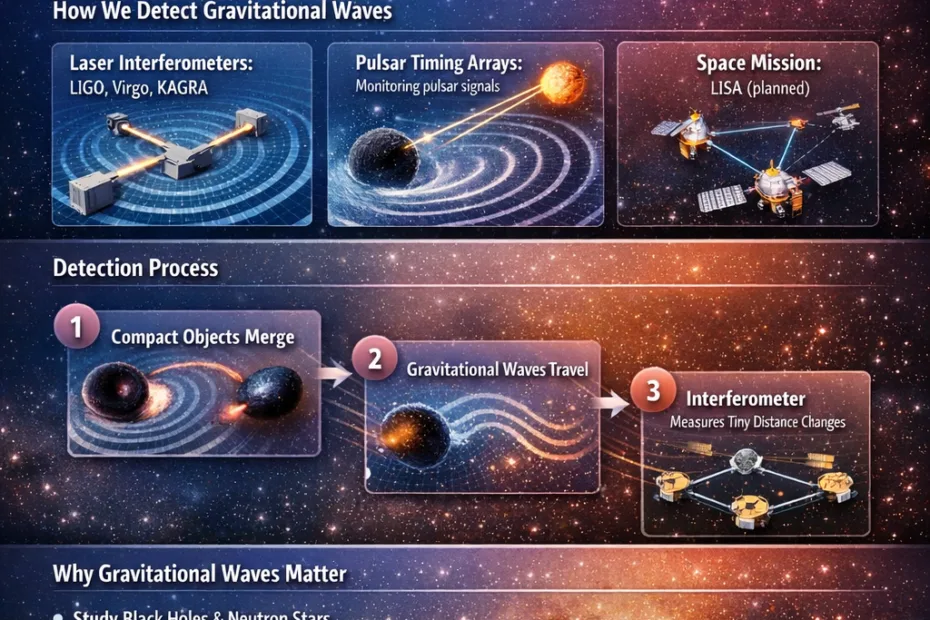
L-shaped detectors like LIGO observe ripples in spacetime caused by gravitational waves, shown as waves passing through Earth.

Gravitational Waves: What They Are and How We Detect Them

Gravitational waves are tiny stretches and squeezes of space-time produced when massive objects accelerate, especially in tight, fast systems such as merging black holes or neutron stars. They travel at the speed of light and carry direct information about motion, mass, and gravity that ordinary light cannot always provide on its own.[a] A Clear Starting Point These waves are not light, sound, or particles. They… Gravitational Waves: What They Are and How We Detect Them
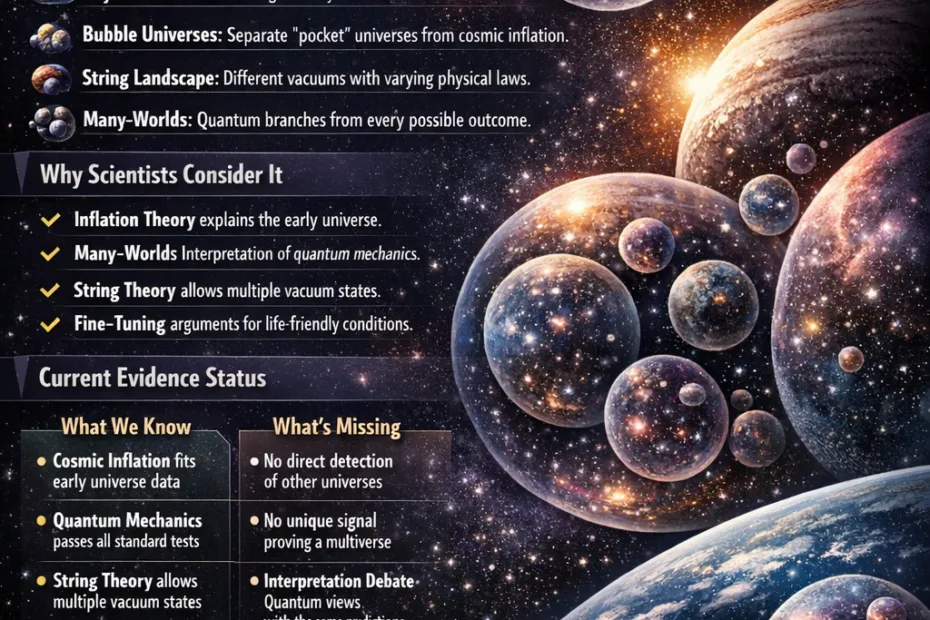
Multiple bubbles labeled with different universes float against a cosmic background illustrating the multiverse theory.

What Is the Multiverse? Theories and Scientific Evidence

The multiverse is a broad label for ideas suggesting that our observable universe may be only one part of a larger reality. In some models, other universes lie far beyond our cosmic horizon; in others, they appear as separate bubble regions born from inflation; in the many-worlds reading of quantum mechanics, they are branching outcomes of one quantum state. The most important point is simple:… What Is the Multiverse? Theories and Scientific Evidence

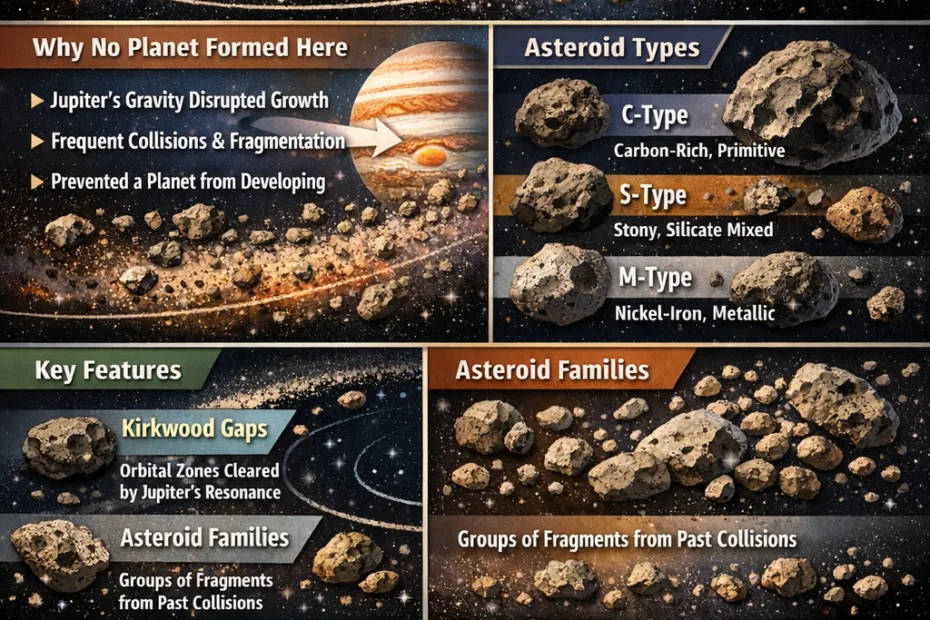
A detailed infographic about the asteroid belt with images of planets and asteroids illustrating its location and composition.

The Asteroid Belt: What It Is and Why It Matters

The asteroid belt is the broad band of rocky bodies that orbits the Sun between Mars and Jupiter. It matters because it preserves leftover material from early solar-system formation, feeds some of the meteorites studied on Earth, and helps scientists trace how small bodies move from stable orbits into planet-crossing ones.[a] A Short Opening View This region is not a solid ring and not a… The Asteroid Belt: What It Is and Why It Matters

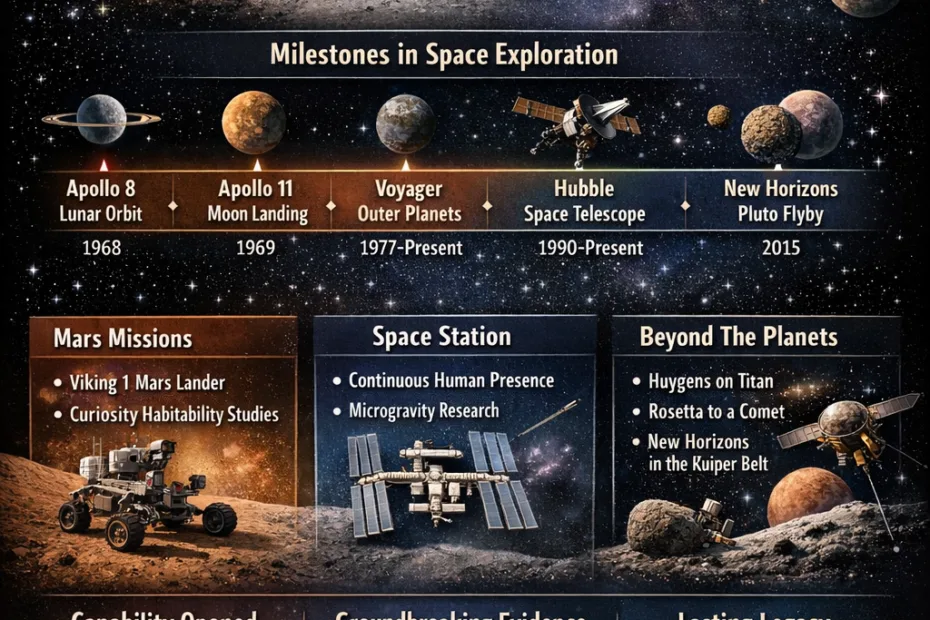
A timeline of space missions that changed history, featuring a rocket launching into space and a distant planet in the background.

Space Missions That Changed History: From Apollo to Voyager

A history-changing space mission is one that opens a new capability, returns evidence nobody had before, or changes how later missions are designed. By that standard, Apollo and Voyager sit at the center of space history, but they are part of a longer chain that also includes Mars landers, space telescopes, orbital laboratories, and frontier probes that pushed the map outward. Why These Missions Still… Space Missions That Changed History: From Apollo to Voyager

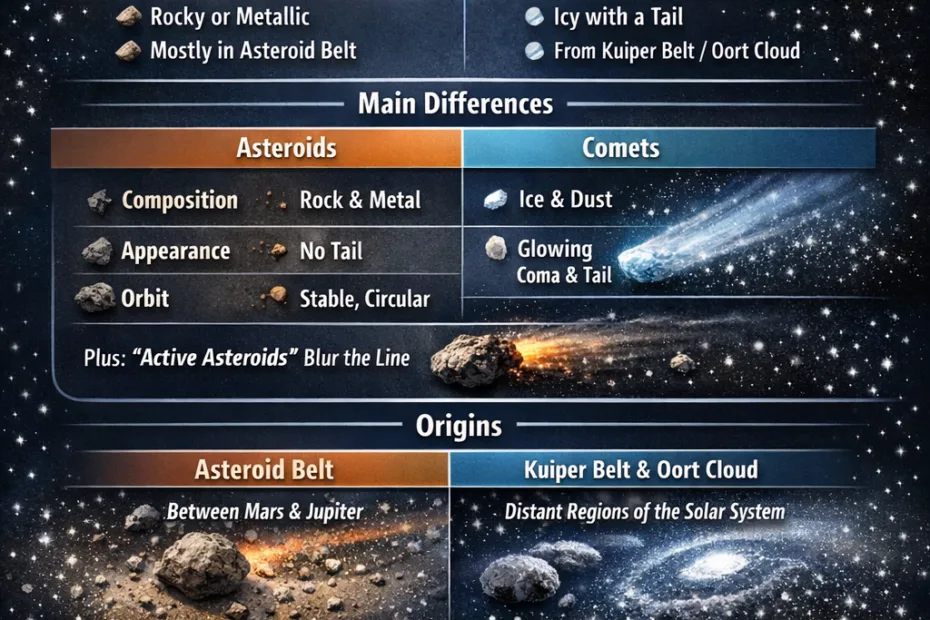
An infographic highlighting the main differences between comets and asteroids, featuring images of a comet with a tail and an aste…

What Are Comets and Asteroids? Differences and Key Facts

Comets and asteroids are small bodies that orbit the Sun, but they are not the same kind of object. In simple terms, asteroids are usually more rock-heavy, while comets contain more ice and can release gas and dust when sunlight warms them. Both preserve very old material from the early solar system, so they help explain what the solar system was made of before the… What Are Comets and Asteroids? Differences and Key Facts

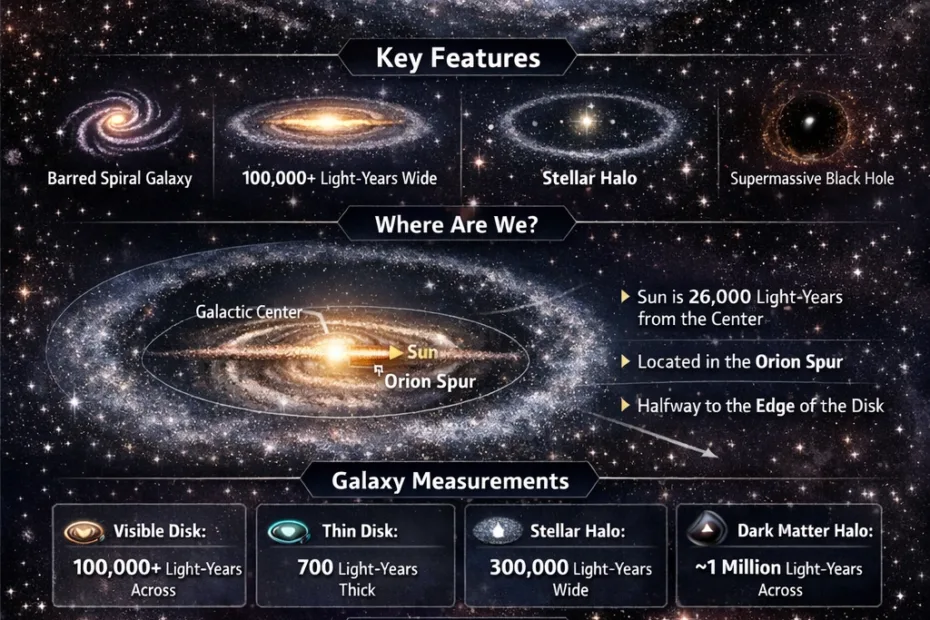
The infographic shows the Milky Way galaxy's spiral arms and a detailed size comparison with other galaxies.

The Milky Way Galaxy: Structure, Size, and Our Place in It

The Milky Way is a barred spiral galaxy that contains the Solar System. Its bright disk stretches a little over 100,000 light-years, holds a few hundred billion stars, and places the Sun in the Orion Spur rather than near the center.[a][c] The Picture That Matters First The Milky Way is not just the pale band seen in the night sky. That band is the inside… The Milky Way Galaxy: Structure, Size, and Our Place in It

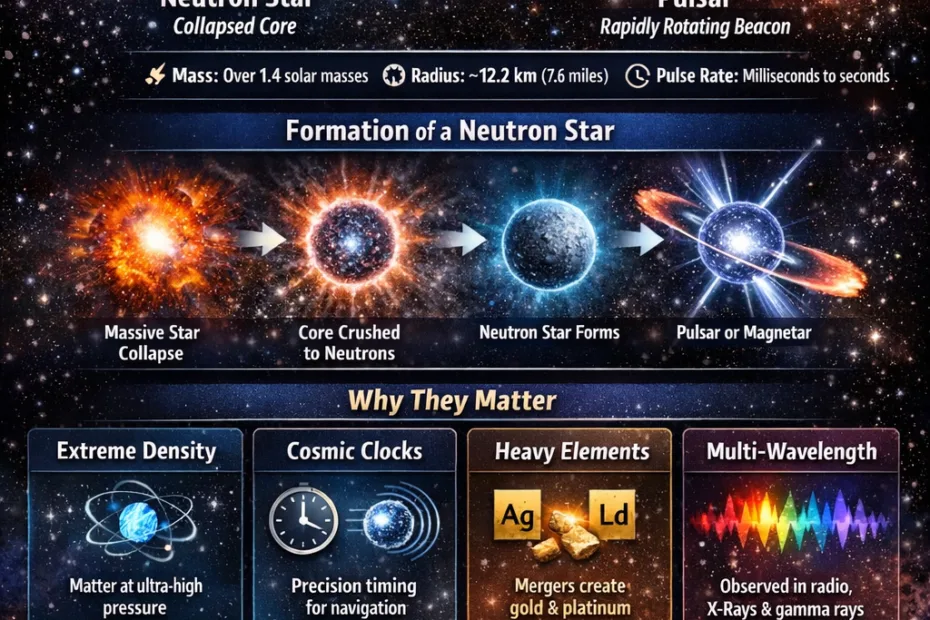
A diagram showing a neutron star emitting beams of radiation, illustrating pulsars' rotating magnetic fields in the universe.

Neutron Stars and Pulsars: The Densest Objects in the Universe

Neutron stars are collapsed stellar remnants left behind after certain massive stars explode, and they pack more than the Sun’s mass into a body only about 20–25 kilometers across. That makes them the densest stable objects astronomers can study directly. A pulsar is not a different material or a separate cosmic species; it is a neutron star whose radiation beam sweeps across Earth with such… Neutron Stars and Pulsars: The Densest Objects in the Universe

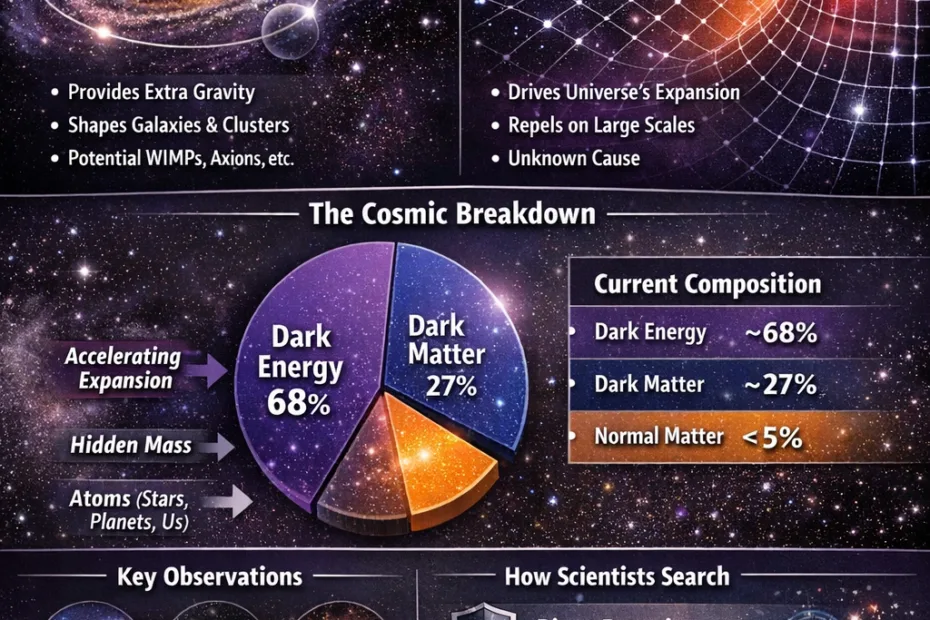
A pie chart shows dark matter at 27% and dark energy at 68% of the universe in an infographic about dark matte…

Dark Matter and Dark Energy: The Invisible 95% of the Universe

Dark matter and dark energy are umbrella names for two big unknowns in modern cosmology: one that acts like extra gravity (dark matter) and one that is tied to the Universe’s accelerating expansion (dark energy). In today’s standard picture, together they account for roughly 95% of the Universe’s total “energy budget,” while the atoms that make stars, planets, and people are the small remainder.[a]🔗 This… Dark Matter and Dark Energy: The Invisible 95% of the Universe

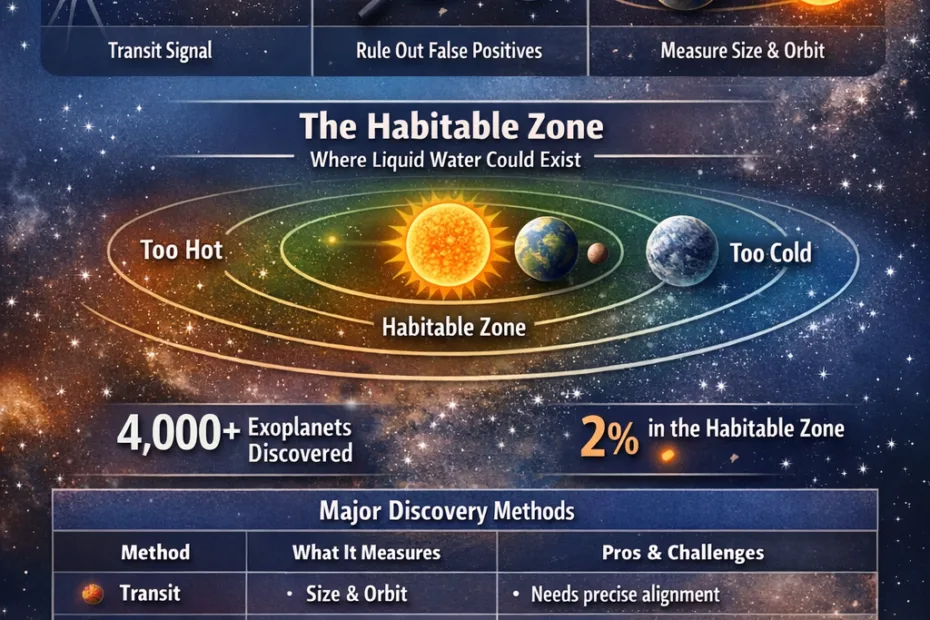
A diagram shows a planet in the habitable zone orbiting a star with Earth-like planets nearby.

Exoplanets: Searching for Earth-like Planets Beyond Our Solar System

An exoplanet is a planet beyond our Solar System, orbiting another star. The search for Earth-like exoplanets is really a search for measurable “Earth-ish” clues—size, orbit, starlight, and sometimes atmosphere—without pretending we already know what the surface is like. [a] ⓘ A Clear Starting Point Most “Earth-like” headlines boil down to three things: small (likely rocky), temperate (not too hot or cold from starlight), and… Exoplanets: Searching for Earth-like Planets Beyond Our Solar System