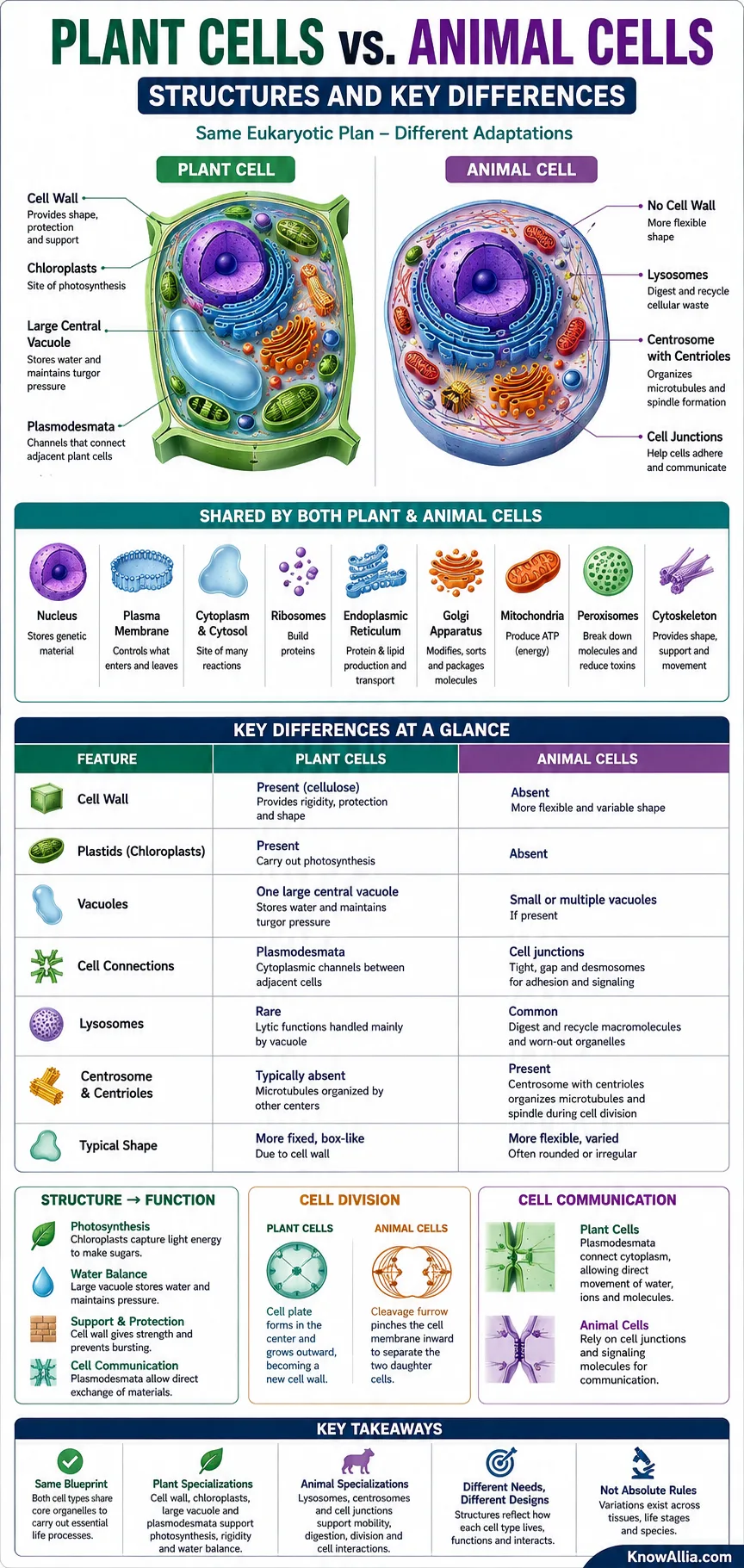
Plant cells and animal cells are both eukaryotic cells, meaning that their DNA is enclosed within a nucleus and many cellular jobs occur inside membrane-bound organelles. Their shared plan is extensive, but the two cell types are adapted to different ways of living. A typical plant cell adds a cell wall, plastids such as chloroplasts, a large central vacuole, and plasmodesmata. A typical animal cell lacks a cell wall, usually has a more flexible outline, and commonly organizes microtubules through a centrosome containing centrioles.
The Main Distinction
Plant and animal cells use many of the same organelles to store DNA, build proteins, process molecules, and release usable energy. The clearest differences come from the structures that support photosynthesis, water balance, tissue support, movement, division, and communication.
- Shared: nucleus, plasma membrane, cytoplasm, ribosomes, mitochondria, endoplasmic reticulum, Golgi apparatus, peroxisomes, and cytoskeleton.
- Typical plant-cell features: cellulose-containing cell wall, plastids, central vacuole, and plasmodesmata.
- Typical animal-cell features: no cell wall, prominent lysosomes, centrosomes with centrioles, and several kinds of cell junctions.
These are textbook patterns, not rules without exceptions. Cell structure changes with tissue, developmental stage, and function.
Structures Shared by Plant and Animal Cells
Plant and animal cells belong to the same broad cellular category. Both are eukaryotic, so they separate genetic material from most of the cytoplasm with a nuclear envelope. They also divide cellular work among specialized compartments. This arrangement allows many chemical processes to occur at the same time without mixing every reaction together.
- Plasma membrane: a selectively permeable boundary that controls the movement of water, ions, nutrients, gases, and wastes.
- Cytoplasm and cytosol: the internal material in which organelles are suspended and many reactions occur.
- Nucleus: the main compartment containing chromosomal DNA in a typical cell.
- Ribosomes: molecular machines that assemble proteins from amino acids.
- Rough and smooth endoplasmic reticulum: membrane networks involved in protein production, lipid production, transport, and chemical processing.
- Golgi apparatus: stacked membranes that modify, sort, and package proteins and lipids.
- Mitochondria: organelles that support aerobic cellular respiration and ATP production.
- Peroxisomes: compartments involved in oxidation reactions and the controlled breakdown of certain molecules.
- Cytoskeleton: networks of protein filaments that organize the cell, move materials, and help control shape.
The shared organelles matter more than the familiar differences. A leaf cell and a muscle cell look unlike each other, yet both must copy DNA, make proteins, maintain membranes, manage chemical energy, and respond to their surroundings. Their distinctive structures change how these tasks are carried out, not whether the tasks exist.
Structures Typical of Plant Cells
Cell Wall Outside the Plasma Membrane
A plant cell has a plasma membrane and a cell wall. The wall does not replace the membrane. It lies outside it and forms a strong extracellular layer made mainly from cellulose together with other polysaccharides and proteins. Primary cell walls can stretch during growth, while some specialized cells later develop thicker secondary walls.
The wall helps a cell resist excessive expansion when water enters. It also contributes to tissue shape and allows neighboring cells to press against one another without merging. Plant-cell walls are not identical throughout a plant; their thickness, chemistry, and architecture vary with the work performed by each cell type.
Chloroplasts and Other Plastids
Chloroplasts are plastids that contain chlorophyll and the internal membrane systems used for photosynthesis. They convert light energy into chemical forms that can be used to produce carbohydrates. Chloroplasts also take part in other metabolic processes, but photosynthesis is their most familiar role.
Not every plant cell contains chloroplasts. Cells in well-lit green tissues may contain many, while cells deep inside stems, storage organs, or roots may contain few or none. Those cells can contain other plastids, such as starch-storing amyloplasts.
Plant cells also contain mitochondria. Chloroplasts capture and convert light energy, while mitochondria release usable energy from organic molecules through cellular respiration. Treating chloroplasts as a plant substitute for mitochondria is therefore incorrect.
Large Central Vacuole
A mature plant cell often has one large central vacuole surrounded by a membrane called the tonoplast. The vacuole can occupy much of the cell interior. It stores water, ions, pigments, metabolites, and other substances; helps regulate acidity; and participates in the breakdown and recycling of cellular material.
Water entering the vacuole produces turgor pressure, which pushes the plasma membrane against the cell wall. A simple analogy is a water-filled inner bag pressing against a firm outer container: the internal pressure supports the shape, while the outer layer limits expansion. This pressure contributes to the firmness of many non-woody plant tissues.
Plasmodesmata Between Neighboring Cells
Plant cell walls would block direct cytoplasmic contact if they were completely continuous. Plasmodesmata solve this problem by forming narrow, membrane-lined channels through walls between neighboring living cells. They allow regulated movement of selected small molecules and signals, linking cells into coordinated tissues.
Structures Typical of Animal Cells
A Flexible Boundary Without a Cell Wall
Animal cells are enclosed by a plasma membrane but do not normally make a cellulose cell wall. Their shape is supported by the cytoskeleton, attachment to neighboring cells, and an extracellular matrix made largely from proteins and carbohydrates. This permits many animal cells to change outline, migrate, engulf material, or form curved and folded surfaces.
Flexibility does not mean that animal cells lack structure. Epithelial cells can form tightly organized sheets, nerve cells can extend long projections, and muscle cells can adopt elongated shapes. The common classroom picture of a round animal cell is only a simplified model.
Lysosomes and Intracellular Recycling
Many animal cells contain prominent lysosomes, acidic membrane-bound compartments filled with enzymes that break down macromolecules, damaged structures, and material taken into the cell. Plant cells perform many comparable digestive and recycling tasks inside lytic vacuoles. For that reason, “animals have lysosomes and plants do not” is useful only as a simplified classroom distinction.
Centrosomes and Centrioles
A typical animal cell has a centrosome near the nucleus. It contains a pair of centrioles and acts as a major microtubule-organizing center, helping arrange the cytoskeleton and mitotic spindle. Most flowering-plant cells do not have this canonical centriole-containing centrosome, although they still organize microtubules through other sites and proteins.
Several Types of Cell Junctions
Animal tissues use several junction types. Tight junctions limit passage between adjacent cells, desmosomes provide strong attachment, and gap junctions create channels for ions and small molecules. The mix depends on the tissue. These connections work with the extracellular matrix to organize cells that do not have rigid walls.
Plant and Animal Cell Organelle Comparison
| Structure | Plant Cells | Animal Cells | Main Role |
|---|---|---|---|
| Plasma membrane | Present, inside the wall | Present, outer cellular boundary | Controls transport and cell signaling |
| Cell wall | Present in typical cells | Absent | Support, protection, shape, and resistance to overexpansion |
| Nucleus | Present in typical living cells | Present in typical living cells | Stores most chromosomal DNA and regulates gene activity |
| Mitochondria | Present | Present | Cellular respiration and ATP production |
| Chloroplasts | Present in photosynthetic cells | Absent | Photosynthesis and related metabolism |
| Central vacuole | Often one large compartment in mature cells | No equivalent large central compartment; smaller vesicles or vacuoles may occur | Water balance, storage, turgor, recycling, and pH control |
| Lysosomal system | Many digestive roles handled by lytic vacuoles | Prominent lysosomes are common | Breakdown and recycling of cellular material |
| Golgi apparatus | Present; also processes many wall materials | Present | Modifies, sorts, and packages proteins and lipids |
| Centrioles | Absent from most flowering-plant cells | Common in centrosomes | Microtubule organization and roles linked to division or cilia |
| Cell-to-cell channels | Plasmodesmata | Gap junctions in many tissues | Regulated communication between adjacent cells |
| Storage carbohydrate | Commonly starch | Commonly glycogen | Stores chemical energy in polymer form |
| Cytokinesis | Cell plate grows outward | Cleavage furrow pinches inward | Separates one cell into two daughter cells |
How Structure Changes Cell Behavior
The same eukaryotic machinery operates inside both cell types, while a few added or modified structures alter support, energy capture, storage, division, and tissue organization.
Plant-Cell Pattern
Provides an external load-bearing layer and limits expansion as water enters.
Stores water and solutes while helping produce pressure against the wall.
Capture light energy and support carbohydrate production.
Cross cell walls to connect the interiors of neighboring living cells.
Animal-Cell Pattern
Allows varied shapes, membrane folding, movement, and engulfment of material.
Provides tissue support and communicates with membrane receptors.
Acts as a main microtubule-organizing region in many animal cells.
Seal, anchor, or connect cells according to tissue needs.
Shared Energy System
Both use mitochondria. Plant cells with chloroplasts use both photosynthesis and cellular respiration.
Shared Protein Pathway
Ribosomes, endoplasmic reticulum, and Golgi membranes cooperate in protein production and delivery.
Shared Genetic Control
A nucleus stores most DNA and coordinates gene expression in typical cells of both groups.
How Structural Differences Affect Cell Function
- Water balance produces different mechanical outcomes. Water entering a plant cell can enlarge the vacuole and raise turgor pressure against the wall. An animal cell has no wall to resist unlimited swelling, so control of membrane transport and the surrounding fluid is especially important.
- Growth occurs by different physical routes. Plant cells often enlarge partly by taking water into the vacuole while selectively loosening and extending the wall. Animal cells expand by producing more membrane, cytoplasm, proteins, and organelles without having to remodel a cellulose wall.
- Shape is constrained in different ways. Plant-cell walls limit how individual cells can move after they are built into tissues. Animal cells can rearrange their contacts and, in many tissues, migrate or change form more freely.
- Energy capture is separated from energy release. Photosynthetic plant cells use chloroplasts to convert light energy into chemical forms. Their mitochondria then participate in extracting usable energy from organic molecules. Animal cells depend on organic molecules obtained from their surroundings and use mitochondria for aerobic respiration.
- Communication must cross different boundaries. Plasmodesmata pass through plant walls, while animal gap junctions align protein channels across adjacent plasma membranes. Both support direct exchange, but their construction is different.
How Plant and Animal Cells Divide
The major stages of mitosis follow the same broad sequence in typical plant and animal cells: duplicated chromosomes condense, align, separate, and are enclosed within daughter nuclei. The strongest visible difference appears during cytokinesis, when the cytoplasm is physically divided.
Animal-Cell Cytokinesis
An actin-based contractile ring tightens beneath the plasma membrane. This produces a cleavage furrow that moves inward until the cell separates.
Plant-Cell Cytokinesis
Membrane vesicles gather near the center and fuse into a cell plate. The plate expands outward and becomes new plasma membranes plus the beginning of a wall between the daughter cells.
A plant cell cannot simply pinch through an existing wall. It must construct a new partition from the inside. This is why cell-plate formation is more than a different visual shape; it is a direct response to the presence of a rigid extracellular boundary.
How Cells Connect Within Tissues
Multicellular life requires cells to exchange information and coordinate activity. Plant and animal tissues both do this, but their contacts reflect their different outer structures.
Plasmodesmata and gap junctions are often compared because both allow direct exchange between adjacent cells. They are not the same structure. A plasmodesma crosses a wall and is lined by plasma membrane, while a gap junction is assembled from channel proteins connecting two closely opposed animal-cell membranes.
Common Cell Comparisons That Need More Precision
“Plant Cells Have Chloroplasts; Animal Cells Have Mitochondria”
Inaccurate Plant cells usually have mitochondria as well. Only photosynthetic plant cells contain active chloroplasts in the familiar sense.
“Every Plant Cell Is Rectangular”
Inaccurate Walls often produce angular outlines in packed tissues, but plant cells can be elongated, curved, branched, kidney-shaped, or irregular.
“Every Animal Cell Is Round”
Inaccurate Animal cells include flat epithelial cells, long neurons, elongated muscle cells, disc-shaped blood cells, and many other forms.
“A Plant Cell Wall Replaces the Cell Membrane”
Inaccurate Plant cells have both. The plasma membrane controls transport; the wall forms an external support layer.
“Plant Cells Do Not Break Down Worn Material”
Inaccurate Plant vacuoles perform many acidic digestive and recycling functions comparable to work done by lysosomes in animal cells.
“Cells of One Group All Look the Same”
Inaccurate A root hair cell, guard cell, leaf mesophyll cell, neuron, muscle cell, and intestinal cell are specialized for very different tasks.
Cell Biology Terms in Plain Language
- Eukaryotic Cell
- A cell with DNA enclosed in a nucleus and with internal membrane-bound compartments.
- Organelle
- A specialized structure inside a cell that performs one or more cellular jobs.
- Plasma Membrane
- The selectively permeable lipid membrane that separates the cell interior from its surroundings.
- Cell Wall
- A strong extracellular layer outside the plasma membrane; in plants it contains cellulose and other materials.
- Plastid
- A family of plant-cell organelles that includes chloroplasts and several storage or pigment-containing forms.
- Chloroplast
- A photosynthetic plastid containing chlorophyll and internal thylakoid membranes.
- Central Vacuole
- A large plant-cell compartment involved in storage, water balance, pressure, recycling, and chemical control.
- Turgor Pressure
- Pressure produced as the cell contents push the plasma membrane against the wall.
- Plasmodesma
- A membrane-lined channel connecting neighboring plant cells through their walls.
- Gap Junction
- A group of protein channels that connects the interiors of adjacent animal cells.
- Centrosome
- A microtubule-organizing region that usually contains two centrioles in animal cells.
- Cytokinesis
- The physical division of a cell’s cytoplasm into two daughter cells.
Where the Comparison Has Limits
Diagrams labeled “plant cell” and “animal cell” show idealized examples. Real cells are three-dimensional, crowded, dynamic, and specialized. Organelle number can change with age, activity, tissue, light exposure, nutrient conditions, and developmental state. Some mature cells also lose structures that were present earlier in development.
Several terms describe broad tendencies rather than universal boundaries. Lysosomes and lytic vacuoles overlap in function. Not all plant cells contain chloroplasts. Not every animal cell has a typical centriole-containing centrosome at every stage. Size alone cannot reliably identify a cell as plant or animal, and shape alone is even less dependable.
The most reliable identification uses several features together: look for a cell wall, plastids, a large central vacuole, junction type, tissue context, and the organization of division. One feature by itself can mislead.
Questions About Plant and Animal Cells
Frequently Asked Questions
What is the main difference between plant and animal cells?
Typical plant cells have a cellulose-containing cell wall, plastids, a large central vacuole, and plasmodesmata. Typical animal cells lack a cell wall, have a more flexible outer boundary, and commonly use centrosomes and several forms of cell junction.
Do plant cells have mitochondria?
Yes. Plant cells use mitochondria for cellular respiration. Photosynthetic cells also contain chloroplasts, so the two organelles perform related but different energy-conversion tasks.
Do all plant cells have chloroplasts?
No. Chloroplasts are abundant in many green, light-exposed tissues. Root cells and cells in some internal or storage tissues may have few or no chloroplasts, although they can contain other plastids.
Do animal cells have vacuoles?
Animal cells can contain small vacuoles and many related membrane-bound vesicles. They generally do not have the single large central vacuole typical of many mature plant cells.
Why do plant cells have a cell wall?
The wall supports the cell, shapes tissues, protects the cell surface, and limits expansion as water enters. It also provides an extracellular route through which tissues can transmit mechanical forces.
Why are plant cells often drawn as boxes?
Cell walls can produce angular outlines when cells are tightly packed. The box shape is convenient for teaching, but many real plant cells are curved, elongated, lobed, branched, or otherwise irregular.
How does cell division differ?
Animal-cell cytokinesis usually forms a cleavage furrow that pinches inward. Plant cells build a cell plate near the center, and it grows outward to establish new membranes and a wall between the daughter cells.
Which structures are found in both cell types?
Both typically contain a plasma membrane, cytoplasm, nucleus, ribosomes, mitochondria, endoplasmic reticulum, Golgi apparatus, peroxisomes, vesicles, and a cytoskeleton.
Sources
- OpenStax – Eukaryotic Cells — peer-reviewed textbook coverage of shared organelles and standard plant–animal cell distinctions.
- OpenStax – The Cell Cycle — explanation of cleavage-furrow and cell-plate formation during cytokinesis.
- National Human Genome Research Institute – Vacuole — official definition and comparison of vacuoles in plant and animal cells.
- NCBI Bookshelf – The Plant Cell Wall — academic discussion of wall structure, composition, growth, and specialization.
- NCBI Bookshelf – Cell Junctions — detailed comparison of animal gap junctions and plant plasmodesmata.
- University of Minnesota – Plant Cells and Tissues — university material showing how chloroplast abundance varies among plant tissues.