Skip to content

Physics

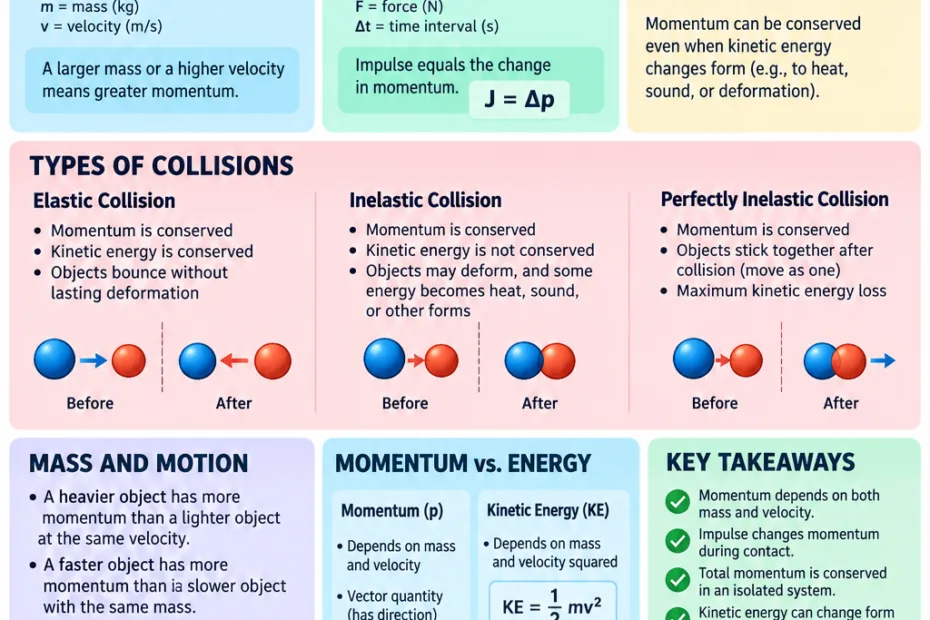
A clear visual explaining momentum and collisions, showing how motion transfers between objects in different collision types.

Momentum and Collisions: How Motion Is Transferred

Momentum is a measure of motion that depends on both an object’s mass and velocity. In a collision, interacting objects exert forces on each other for a short time, changing their individual momenta. People often describe this as motion being transferred from one object to another. More precisely, momentum and energy are redistributed during the interaction, while the total momentum of an isolated system remains… 
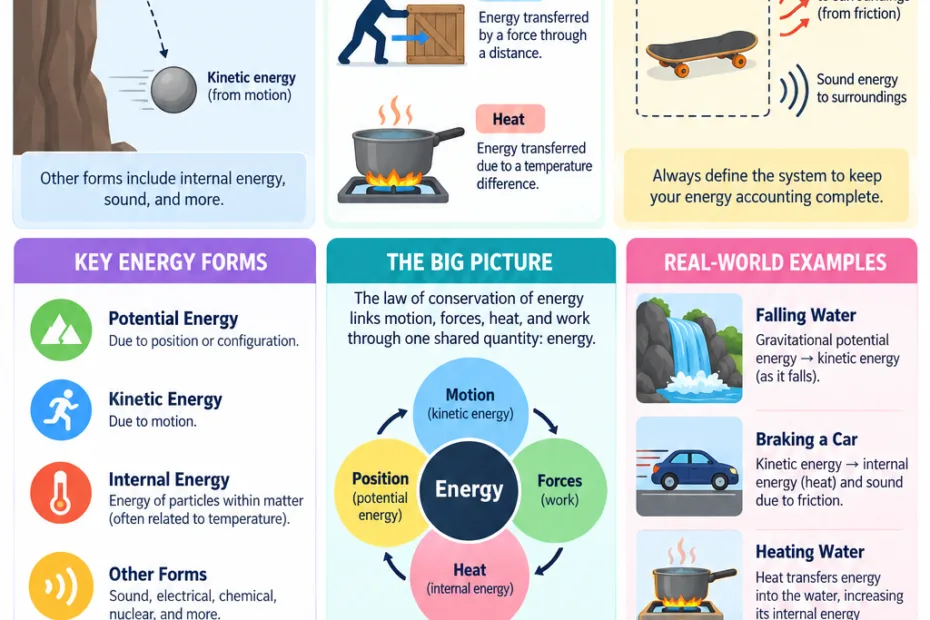
Conservation of energy explained, showing how energy transforms between motion, heat, and work in various systems.

Conservation of Energy: The Law Behind Motion, Heat, and Work

Conservation of energy is the physical law that says energy can be transferred or transformed, but the total amount is conserved. A falling object can turn gravitational potential energy into kinetic energy. Friction can turn organized motion into internal energy. Heating can transfer energy into matter, while work can transfer energy into or out of a system. The forms and locations change; the energy accounting… 

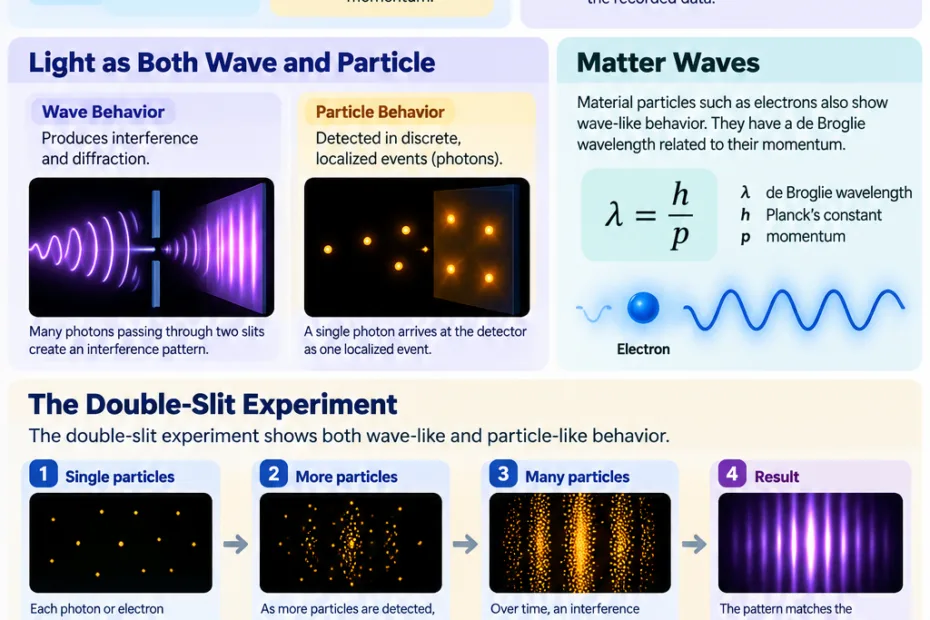
Wave-particle duality explained shows how light and matter behave both as waves and particles in quantum physics.

Wave-Particle Duality: Why Light and Matter Behave Strangely

Wave-particle duality is the quantum behavior in which light and matter produce wave-like effects such as interference and diffraction, yet are detected or exchanged in discrete, particle-like events. A photon can arrive at a detector as one localized event while many photons sent through two slits build an interference pattern. Electrons can do the same. Quantum mechanics describes these observations without requiring a photon or… 

String theory explained, illustrating how physics may be based on tiny vibrating strings rather than point particles

String Theory: The Idea That Physics Is Made of Strings

String theory is a mathematical idea in physics that treats the smallest particles not as dimensionless points, but as extremely tiny one-dimensional strings. In this view, an electron, a quark, or a possible graviton would not be a hard little bead. It would be a different vibration pattern of the same basic kind of object. The idea is bold, but it is not a proven… 

Sound waves: how frequency and amplitude shape what we hear and affect our perception of sound.

Sound Waves: Frequency, Amplitude, and How We Hear

Sound waves are moving pressure changes that travel through a material such as air, water, or solid matter. In everyday hearing, they reach the ear as tiny patterns of compression and rarefaction, then the auditory system turns those patterns into pitch, loudness, tone color, and location. Frequency mainly shapes pitch, amplitude is closely tied to loudness, and the ear and brain do the difficult work…