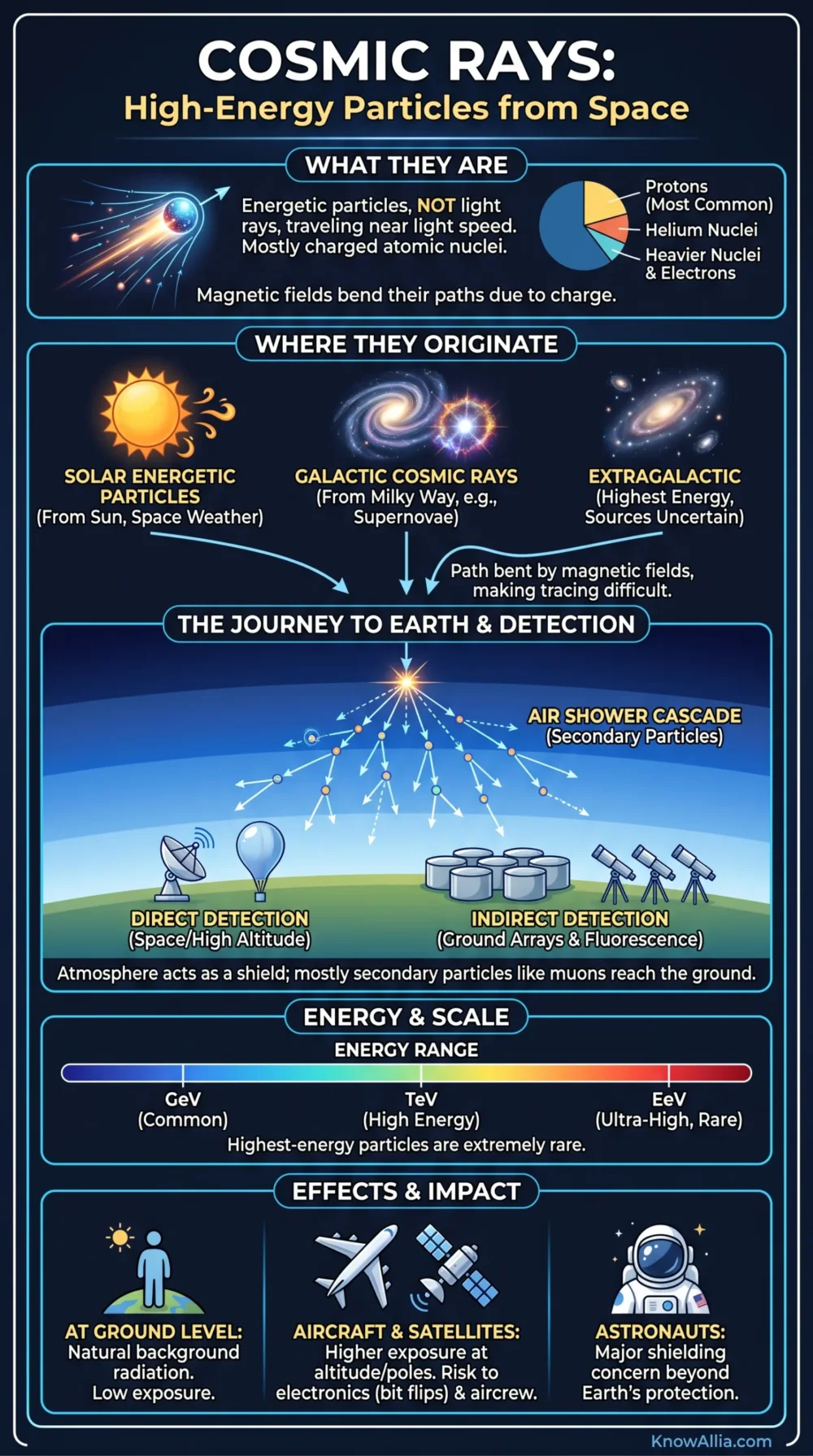
Cosmic rays are high-energy particles from space that travel through the universe at speeds close to the speed of light. Despite the name, most cosmic rays are not rays of light. They are usually charged atomic nuclei, especially protons, along with helium nuclei, heavier nuclei, electrons, and a smaller set of other particles. NASA describes them as one of the few direct samples of matter reaching us from beyond the solar system.[Source-a]
The Core Idea in Plain Language
Cosmic rays are fast particles, not visible beams. They come from the Sun, our galaxy, and likely far beyond it. When they hit Earth’s atmosphere, they create showers of secondary particles, many of which never reach the ground.
- Most are charged particles, so magnetic fields bend their paths.
- Earth’s atmosphere and magnetic field reduce much of the exposure at ground level.
- The highest-energy cosmic rays are rare, hard to trace, and still not fully explained.
Readers should come away with a clear answer to four questions: what cosmic rays are, how they move through space, what happens when they meet Earth’s atmosphere, and why scientists still study them with satellites, balloons, mountaintop detectors, and giant observatories spread across wide areas.
What Cosmic Rays Are
A cosmic ray is best understood as an energetic particle traveling through space. The word “ray” remains from early research, when the nature of the radiation was not yet known. Today, scientists know that many cosmic rays are atomic nuclei stripped of their electrons. A hydrogen nucleus is a proton, so protons are the most common type.
The term can also include other particles found in cosmic radiation, such as electrons, positrons, neutrons produced in interactions, and heavier nuclei. Gamma rays and neutrinos are often discussed beside cosmic rays because they can point back to energetic cosmic events more directly, but they are different messengers: gamma rays are high-energy photons, and neutrinos are nearly massless neutral particles.
Simple analogy: tracing a charged cosmic ray back to its source is like trying to identify where a leaf came from after it has been blown through a twisting city street. The leaf arrived, but the path has been bent many times. Cosmic rays are bent by magnetic fields instead of wind.
The Name Is Historical
The discovery story explains the name. In 1912, Victor Hess measured ionization during balloon flights and found that radiation increased at higher altitude. He concluded that part of the radiation came from space, not from Earth’s surface. Hess later received the 1936 Nobel Prize in Physics for the discovery of cosmic radiation.[Source-b]
Particles and Energy
Cosmic rays cover a wide energy range. Some particles have energies similar to those studied in smaller particle accelerators. Others reach energies far beyond what human-made accelerators can produce. CERN notes that primary cosmic rays range from around 1 GeV to as high as 108 TeV, with the highest-energy particles arriving extremely rarely.[Source-c]
An electron volt, written as eV, is a unit of energy used in particle physics. One eV is tiny in everyday terms, but a single subatomic particle with ultra-high energy can carry an unusual amount of energy concentrated into an extremely small object. This is one reason cosmic rays are useful for studying nature’s most energetic particle accelerators.
| Term | Meaning | Why It Matters |
|---|---|---|
| Primary Cosmic Ray | A particle that arrives from space before hitting Earth’s atmosphere. | It carries information about acceleration, travel path, and possible source region. |
| Secondary Particle | A particle made when a primary cosmic ray collides with atoms in the atmosphere. | Many ground detectors observe these secondaries rather than the original particle. |
| GeV | Giga-electron volt, or one billion electron volts. | Common scale for lower-energy cosmic ray measurements. |
| TeV | Tera-electron volt, or one trillion electron volts. | Used for very energetic particles and gamma-ray astronomy. |
| EeV | Exa-electron volt, or one quintillion electron volts. | Used for ultra-high-energy cosmic rays, the rarest class observed at Earth. |
| Air Shower | A cascade of secondary particles made in the atmosphere. | It lets scientists infer the energy and arrival direction of particles too rare to catch directly. |
Composition: More Than Just Protons
Many cosmic rays are protons, but the mix also includes helium nuclei and heavier atomic nuclei. Some nuclei are heavy enough to show that cosmic rays carry material connected to stellar processes. Scientists study the composition because different elements and isotopes act like fingerprints of where the particles may have been made, accelerated, or changed during travel.
A particle’s electric charge matters. Charged particles are easier to steer with magnetic fields, so a proton, an iron nucleus, and an electron do not travel through cosmic magnetic fields in exactly the same way. The heavier and more charged the particle is, the more its path can differ from a straight line at the same energy.
Where Cosmic Rays May Come from
Cosmic rays do not all share one origin. Some come from the Sun as solar energetic particles. Many galactic cosmic rays are thought to be linked to energetic events in the Milky Way, including supernova remnants. The most energetic particles may come from outside our galaxy, but exact source tracing remains difficult because charged particles twist through magnetic fields before reaching Earth.
Solar Energetic Particles
These particles come from solar activity. They can arrive quickly after strong solar events and are part of space weather. They are especially important for spacecraft operations and astronaut safety beyond Earth’s lower protective environment.
Galactic Cosmic Rays
These particles originate outside the solar system. NASA’s Space Radiation Analysis Group describes galactic cosmic rays as fully ionized atoms, from protons up to very heavy nuclei, influenced by the Sun’s extended magnetic field.[Source-d]
Primary and secondary categories also matter. Primary cosmic rays are made or accelerated in cosmic source regions. Secondary cosmic rays form when primary cosmic rays collide with gas, dust, or radiation during travel. Modern instruments such as the Alpha Magnetic Spectrometer on the International Space Station measure many elements to separate these histories with better detail.
In June 2026, CERN reported new AMS measurements of phosphorus, chlorine, argon, potassium, and calcium collected over 13.5 years, adding more detail to how scientists classify cosmic ray elements and their primary or secondary components.[Source-e]
Why Sources Are Hard to Pin Down
Light travels in straight lines unless gravity bends it slightly. Charged cosmic rays are different. Galactic, solar, and planetary magnetic fields can bend them so much that the arrival direction at Earth is often not the original source direction. That is why scientists combine particle measurements with gamma rays, neutrinos, magnetic field models, and air shower patterns.
A careful wording point: it is fair to say that supernova remnants are strong candidates for many galactic cosmic rays. It is not fair to say that every cosmic ray comes from a supernova. The Sun, interstellar collisions, and possible extragalactic accelerators all belong in the picture.
How Cosmic Rays Meet Earth
When a primary cosmic ray enters the atmosphere, it can collide with nitrogen or oxygen nuclei high above the ground. That collision breaks energy into a cascade of new particles. This cascade is called an air shower. Very high-energy cosmic rays can create huge showers containing billions of secondary particles spread across large ground areas.
The atmosphere acts like a natural detector and a shield. Many secondary particles decay or lose energy before reaching sea level. Some particles, especially muons, are more penetrating and can reach the ground. Muons are one reason simple cosmic ray detectors can record particle events even at Earth’s surface.
Cosmic Ray Journey: Particle to Air Shower
A high-energy particle enters the atmosphere, collides with air molecules, and produces a cascade of secondary particles. Most energy is absorbed or transformed before reaching the ground.
Path Through the Atmosphere
A proton or atomic nucleus arrives from space at near-light speed.
The particle hits an atmospheric nucleus, usually high above the surface.
Pions, kaons, photons, electrons, positrons, neutrinos, and muons may appear in the shower.
Detectors record timing, particle density, light flashes, or muons to reconstruct the original event.
What Changes the Signal
Higher energy usually makes a larger shower and a wider detectable footprint.
A proton shower and a heavy-nucleus shower can develop differently.
Altitude, density, and viewing conditions affect what detectors can measure.
Charged
Most cosmic rays carry charge, so magnetic fields bend their paths.
Fast
Many travel close to light speed before interacting with matter.
Natural
They are part of Earth’s normal radiation environment.
Earth’s Magnetic Field and Latitude
Earth’s magnetic field gives more protection near equatorial regions and less near polar regions. NOAA notes that galactic cosmic rays at high latitudes and altitudes can raise exposure for aircrew and passengers, and that energetic particles can affect spacecraft electronics by depositing energy in satellite systems.[Source-f]
This does not mean ordinary life at ground level is unsafe. Cosmic radiation is part of natural background radiation. Exposure changes with altitude, latitude, flight duration, and solar activity. The CDC describes radiation from air travel as low, while noting that dose increases with longer flights, higher altitude, and higher latitude.[Source-g]
The Solar Cycle Changes the Background
The Sun affects cosmic ray levels near Earth. During solar maximum, the Sun’s magnetic activity tends to reduce the flux of galactic cosmic rays reaching the inner solar system. During solar minimum, galactic cosmic ray levels near Earth often rise. Solar energetic particle events follow their own timing and can temporarily change the radiation environment in space and near polar regions.
How Scientists Detect Cosmic Rays
Cosmic rays can be measured directly or indirectly. Direct detection means catching the particle before it is changed by the atmosphere. Indirect detection means measuring the secondary particles or light made after the atmospheric collision.
| Method | Where It Works | What It Measures | Main Strength |
|---|---|---|---|
| Satellite Detectors | Above most of the atmosphere | Charge, energy, direction, and composition of incoming particles | Direct particle identification before atmospheric breakup |
| Balloon Instruments | High atmosphere | Cosmic ray particles with less atmospheric interference than at ground level | Useful for temporary high-altitude campaigns |
| Ground Arrays | Large areas on Earth’s surface | Secondary particles from air showers | Large collecting area for rare, high-energy events |
| Fluorescence Telescopes | Dark, clear atmospheric conditions | Ultraviolet light from excited nitrogen in air showers | Tracks shower development through the atmosphere |
| Muon Detectors | Ground level or underground | Penetrating secondary muons | Shows the long-lived part of the cascade that reaches detectors |
The Pierre Auger Observatory is a well-known example of indirect detection. It uses a hybrid approach: surface detector tanks record particles at ground level, while fluorescence detectors observe ultraviolet light produced as air showers develop in the atmosphere.[Source-h]
What Detectors Reconstruct
- Arrival direction: estimated from timing differences across detectors.
- Energy: inferred from shower size, light output, or direct particle measurement.
- Mass composition: estimated from shower depth, muon content, and particle signatures.
- Flux: the number of particles crossing a given area over time.
- Rigidity: a measure connected to momentum and charge, useful because magnetic fields bend particles according to rigidity.
Effects on Earth, Technology, and Spaceflight
Cosmic rays are scientifically useful, but they also matter for practical reasons. They are part of the radiation environment around Earth, in aircraft routes, and in space. The effect depends on altitude, shielding, particle type, energy, and exposure time.
- At Sea Level
- Cosmic radiation is normally a small part of natural background exposure. Most primary particles never reach the ground unchanged.
- At Aircraft Altitude
- Less atmosphere remains above the aircraft, so exposure is higher than at sea level. Route, latitude, altitude, and flight duration all matter.
- For Satellites
- Energetic particles can affect electronics, sensors, memory states, and solar panels, especially during stronger space weather conditions.
- For Astronauts
- Beyond Earth’s lower protective environment, galactic cosmic rays and solar energetic particles become a major design issue for mission planning and shielding.
NOAA’s space weather scale separates solar radiation storms by intensity. At stronger levels, astronauts outside protective spacecraft shielding and high-latitude aircraft operations can require added attention. This is about risk management, not panic: agencies monitor space weather so operators can make informed decisions.[Source-i]
Cosmic Rays and Electronics
A high-energy particle can sometimes deposit charge in a microelectronic circuit. In spacecraft, this may cause a temporary bit flip, sensor noise, or other single-event effect. Engineers reduce risk through shielding, redundant systems, error correction, hardened components, and operational planning.
Common Mix-Ups About Cosmic Rays
“They Are Beams of Light”
Usually not. Most cosmic rays are particles with mass and charge. Gamma rays are photons and are often studied beside cosmic rays, but they are not the same thing.
“They All Come from Deep Space”
Not all. Some energetic particles come from the Sun. Galactic cosmic rays come from outside the solar system, and ultra-high-energy cosmic rays may involve sources beyond the Milky Way.
“They Point Back to Their Source”
Charged particles are bent by magnetic fields. Their arrival direction can be misleading, especially after long travel through interstellar space.
“They Are Always Dangerous at Ground Level”
Cosmic radiation is part of natural background radiation. At sea level, the atmosphere has already absorbed or transformed much of the incoming particle energy.
Useful Terms
- Cosmic Ray
- A high-energy particle or particle cluster arriving from space.
- Galactic Cosmic Ray
- A cosmic ray that originates outside the solar system, often linked to energetic processes in the galaxy.
- Solar Energetic Particle
- A high-energy particle released by solar activity and space weather events.
- Muon
- A short-lived charged particle often produced in air showers. Muons can reach the ground because they are relatively penetrating.
- Flux
- The number of particles passing through a given area in a given time.
- Rigidity
- A particle property related to momentum divided by electric charge. It helps describe how strongly magnetic fields bend the particle path.
- Air Shower
- A cascade of secondary particles created when a cosmic ray collides with atmospheric atoms.
- Solar Modulation
- The way the Sun’s magnetic activity changes the number of galactic cosmic rays reaching near-Earth space.
What We Do Not Know Yet
Cosmic ray science has strong measurements, but several questions remain open. The uncertainty is not a weakness; it is part of why cosmic rays are useful. They test particle physics, magnetic field models, stellar explosion physics, space weather, and the behavior of matter at energies that are hard to reproduce on Earth.
- Exact sources of the highest-energy particles: the rarest events are difficult to connect to a single object or region.
- Composition at ultra-high energies: scientists still refine how much comes from protons versus heavier nuclei at the top end of the spectrum.
- Magnetic field paths: galactic and extragalactic magnetic fields are not mapped perfectly, so backtracking charged particles remains uncertain.
- Muon counts in air showers: some measurements show differences from model predictions, so particle interaction models continue to be tested.
- Long-duration spaceflight exposure: shielding design for deep-space missions still requires careful modeling of galactic cosmic rays and solar events.
Why Cosmic Rays Still Matter
Cosmic rays connect astronomy with particle physics. They carry information about energetic regions of space, but they also interact with the atmosphere, spacecraft, and detectors in measurable ways. Their chemical mix helps scientists study how particles move through the galaxy. Their air showers help test high-energy particle interactions. Their radiation effects matter for satellites, aviation, and human spaceflight.
A balanced view is best: cosmic rays are not a mysterious threat raining down without protection, and they are not fully solved either. They are a natural part of space, a source of scientific data, and a reminder that Earth’s atmosphere and magnetic field are active parts of our planet’s environment.
FAQ About Cosmic Rays
Are Cosmic Rays Actually Rays?
Most cosmic rays are not rays of light. They are high-energy particles, often protons or atomic nuclei. The name comes from early research, before scientists knew the radiation was mainly particle-based.
Do Cosmic Rays Reach the Ground?
The original primary particle usually does not reach the ground unchanged. It often collides with atmospheric atoms and creates secondary particles. Some secondaries, especially muons, can reach Earth’s surface.
Where Do Cosmic Rays Come from?
Some come from the Sun, many galactic cosmic rays come from outside the solar system, and the highest-energy particles may come from extragalactic sources. Exact origins can be hard to identify because magnetic fields bend charged particles during travel.
Are Cosmic Rays Dangerous to People on Earth?
At ground level, cosmic radiation is part of natural background radiation. Earth’s atmosphere and magnetic field reduce much of the exposure. Exposure is higher at aircraft altitude and in space, so aviation and spaceflight use monitoring and radiation planning.
Why Do Scientists Use Huge Ground Detectors?
The highest-energy cosmic rays are extremely rare. Large detector arrays cover wide areas so they can catch the secondary particle showers produced when one of these rare particles hits the atmosphere.
What Is the Difference Between Cosmic Rays and Solar Radiation?
Solar energetic particles come from the Sun and are tied to solar activity. Galactic cosmic rays come from outside the solar system. Both are part of the space radiation environment, but they differ in origin, timing, and energy behavior.
Sources
- [Source-a] NASA Imagine the Universe – Cosmic Rays Introduction — Used for the basic definition, near-light-speed motion, particle composition, and magnetic deflection context.
- [Source-b] Nobel Prize – Victor F. Hess Facts — Used for the discovery history and Hess’s balloon-flight evidence.
- [Source-c] CERN – Cosmic Rays: Particles from Outer Space — Used for energy range, rarity of the highest-energy particles, and atmospheric shower scale.
- [Source-d] NASA Space Radiation Analysis Group – What Is Space Radiation? — Used for the distinction between solar energetic particles, galactic cosmic rays, and trapped radiation.
- [Source-e] CERN – AMS Releases New Cosmic-Ray Measurements — Used for recent Alpha Magnetic Spectrometer measurements and primary/secondary cosmic ray classification details.
- [Source-f] NOAA Space Weather Prediction Center – Galactic Cosmic Rays — Used for high-latitude exposure, satellite electronics, and Earth’s magnetic shielding context.
- [Source-g] CDC – Facts About Radiation from Air Travel — Used for air travel dose factors such as altitude, latitude, and flight duration.
- [Source-h] Pierre Auger Observatory – Ultra-High-Energy Cosmic Rays — Used for hybrid detection methods involving surface detectors and fluorescence observations.
- [Source-i] NOAA Space Weather Prediction Center – NOAA Space Weather Scales — Used for solar radiation storm effects on astronauts, satellites, high-latitude aviation, radio, and navigation systems.