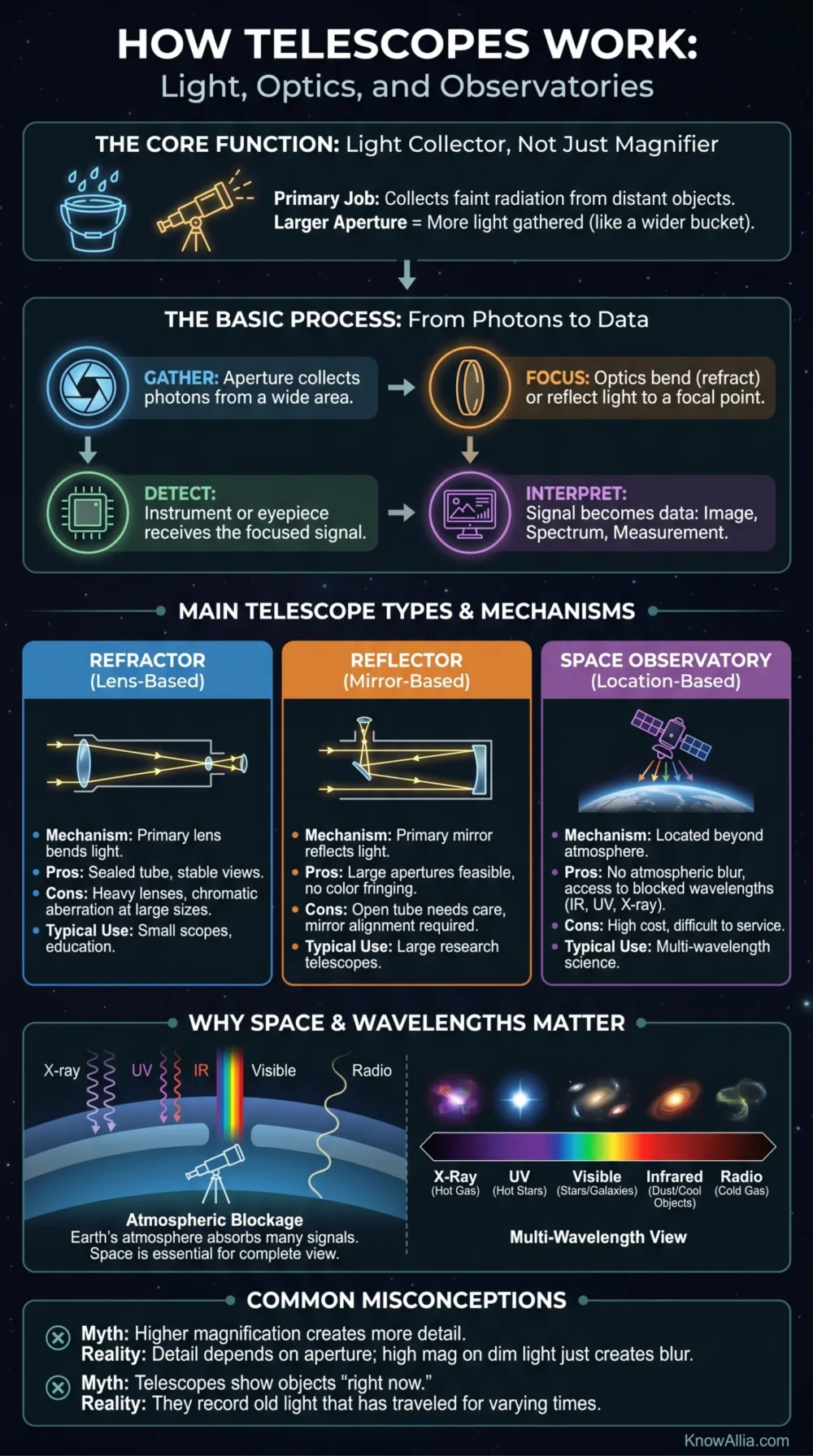
A telescope is an instrument that collects radiation from distant objects, brings that radiation to a focus, and turns it into something people can study: an image, a measurement, or a spectrum. In everyday astronomy, the word usually means an optical telescope that works with visible light, but modern observatories also study infrared, ultraviolet, radio waves, X-rays, and other parts of the electromagnetic spectrum. A telescope does not “pull” objects closer. It gathers weak signals and organizes them with lenses, mirrors, detectors, and careful pointing systems.[Source-1]
The Cleanest Way to Understand It
A telescope is best understood as a light collector first and a magnifier second. A larger opening gathers more light, a well-shaped lens or mirror focuses that light, and a detector or eyepiece makes the focused signal usable.
- Refractors use lenses to bend and focus light.
- Reflectors use curved mirrors to gather and focus light.
- Space observatories place telescopes above much of Earth’s atmosphere so they can see steadier light and, in many cases, wavelengths blocked from the ground.
This page explains how the main telescope designs work, why aperture matters more than advertised magnification, how observatories record data, and why different wavelengths need different telescope designs. The goal is simple: after reading, refractor, reflector, and space observatory should feel like clear ideas, not labels on a product box.
What a Telescope Actually Does
The main job of a telescope is to collect more light than the human eye can collect. Your pupil is only a small opening. A telescope’s aperture is much larger, so it gathers more light from faint objects such as nebulae, galaxies, star clusters, moons, planets, and distant galaxies. NASA describes most modern telescopes, especially large ones, as systems that use curved mirrors to gather and focus light from the sky.[Source-2]
Think of aperture like a rain bucket. A wider bucket catches more raindrops in the same amount of time. A wider telescope aperture catches more photons in the same amount of time. This is why a larger mirror or lens can reveal fainter objects and finer detail when the atmosphere, optics, and detector allow it.
- Collection: light enters through the aperture.
- Focus: a lens or mirror bends or reflects that light toward a focal point.
- Detection: an eyepiece, camera, spectrograph, or sensor receives the focused light.
- Interpretation: the recorded data becomes an image, brightness measurement, spectrum, or time-based observation.
Magnification is not the whole story. A telescope can be given a very high magnification with an eyepiece, but that does not create new detail by itself. Detail depends strongly on aperture, optical quality, wavelength, focus, detector performance, tracking, and atmospheric steadiness.
The Main Parts of a Working Telescope
Different telescope designs look different, but most share a few basic ideas. The telescope must gather light, form a focused image, stay pointed at the target, and send the signal to a viewer or instrument.
Aperture
The aperture is the opening or light-collecting diameter of the main lens or mirror. OpenStax explains that light-gathering ability is set by the collecting area, which grows with the square of diameter. A 4-meter telescope collects 16 times as much light as a 1-meter telescope of the same basic type.[Source-3]
Focal Length
Focal length is the distance over which the optical system brings incoming light to focus. Longer focal lengths often give larger image scale. Shorter focal lengths often show wider areas of sky. Neither is “better” alone; the right choice depends on the target and instrument.
Optics
The optics are the shaped glass or mirror surfaces that control the light path. In a refractor, the main optic is a lens. In a reflector, the main optic is a mirror. Many research telescopes add more optical elements to improve field shape, focus, or instrument placement.
Detector or Eyepiece
An eyepiece lets a person view the focused image directly. Research observatories usually send the light to electronic detectors or instruments. A camera records where light lands; a spectrograph spreads light into wavelengths so astronomers can study composition, temperature, motion, and other properties.
One part is easy to overlook: the mount. A telescope must follow Earth’s rotation, hold the target steady, and avoid vibration. For long exposures, pointing can matter as much as the mirror or lens. A fine optical system cannot produce clean data if it is shaking, drifting, or slightly out of focus.
How Light Becomes Telescope Data
A telescope turns a faint natural signal into a focused record by controlling light at each step.
Gather
The aperture collects photons from a wider area than the eye can manage.
Focus
Lenses refract light or mirrors reflect it toward a focal point.
Record
An eyepiece, camera, or science instrument receives the focused signal.
Measure
Images and spectra reveal brightness, color, position, motion, and composition.
How Refracting Telescopes Work
A refracting telescope, or refractor, uses a lens as its main optical element. Light enters the front of the tube, passes through a curved objective lens, bends toward a focus, and is then viewed through an eyepiece or recorded by a camera. NASA describes refractors as telescopes whose lenses bend, or refract, light passing through them.[Source-4]
Basic Light Path in a Refractor
- Parallel light from a distant object enters the front objective lens.
- The curved lens bends the light inward.
- The light forms a focused image inside the telescope tube.
- An eyepiece magnifies the focused image for the eye, or a camera records it.
Refractors can produce sharp, high-contrast views when well made. Their closed tubes help keep dust away from the main optical surface. Many small educational and backyard telescopes use this layout because the path is easy to understand and the optical tube can be simple to handle.
Why Very Large Refractors Are Rare
The weakness of a refractor appears when the objective lens becomes very large. A lens must be transparent all the way through, must be supported mostly around its edge, and can become heavy. Glass also bends different wavelengths by slightly different amounts, which can create chromatic aberration, a color-fringe effect. Designers can reduce this with added lens elements, but that adds cost, weight, and complexity.
Useful distinction: a refractor bends light through glass; a reflector bounces light from a coated surface. That one difference changes weight, size limits, color behavior, and how large the telescope can be built.
How Reflecting Telescopes Work
A reflecting telescope, or reflector, uses a mirror as its main optical element. A curved primary mirror collects incoming light and reflects it toward a focus. Many modern research telescopes are reflectors because large mirrors can be made thinner and lighter than lenses of the same diameter, which makes them better suited to large observatories and space missions.[Source-5]
Basic Light Path in a Reflector
- Light enters the open end of the telescope tube.
- A concave primary mirror reflects the light inward.
- A secondary mirror may redirect the focused light to the side, back, or an instrument bay.
- The eyepiece, camera, or scientific instrument receives the focused light.
Reflectors avoid chromatic aberration because reflection does not split visible colors in the same way a simple lens can. They also allow large apertures, and large aperture is central to faint-object astronomy. This is why major optical and infrared observatories usually depend on mirror systems rather than giant front lenses.
Common Reflector Layouts
- Newtonian reflector: a primary mirror sends light to a small diagonal secondary mirror, which directs the image to the side of the tube.
- Cassegrain-style reflector: a secondary mirror sends light back through or behind the primary mirror area, which gives a compact path for long focal lengths.
- Segmented-mirror reflector: many mirror segments work together as one larger mirror, useful when a single mirror would be too large to build, transport, or launch.
Reflectors need careful alignment. That alignment is called collimation. If the mirrors are not aimed at the same optical path, the image can lose sharpness even when the mirror itself is well made.
How Space Observatories Work
A space observatory is a telescope system placed beyond the ground, usually in Earth orbit or a solar orbit. The telescope still gathers and focuses radiation, but it also needs spacecraft systems: power, communication, thermal control, onboard computers, attitude control, and protection from the space environment.
Hubble shows one major reason to put a telescope above Earth’s atmosphere. Air moves, bends light, and makes stars appear to twinkle. Above most of the atmosphere, Hubble can observe steadier light and reach higher angular resolution than the same telescope would from the ground under ordinary conditions.[Source-6]
Space also opens wavelength access. ESA notes that Earth’s atmosphere hides much of the electromagnetic radiation arriving from space, while visible light, some infrared frequencies, and radio waves can reach the surface more easily.[Source-7] This is why some observatories must work from space: the signal simply cannot reach ground instruments in a usable form.
What a Space Observatory Must Control
- Pointing: the observatory must aim with great precision and keep the target steady.
- Temperature: instruments may need stable or very cold conditions, especially for infrared observations.
- Data handling: detectors collect data, spacecraft computers store it, and antennas send it back to Earth.
- Orbit and visibility: the observatory can only view targets allowed by its orbit, Sun angle, Earth angle, and instrument limits.
- Calibration: instruments need repeated checks so measurements stay reliable over time.
The James Webb Space Telescope is a clear example of a space observatory designed around wavelength and temperature. Webb’s primary mirror collects red and infrared light and sends it to science instruments; NASA lists its wavelength range as 0.6–28.8 microns. Its segmented mirror and cold operating design are matched to infrared astronomy.[Source-8]
Because Webb observes faint infrared signals, its own warmth can interfere with the measurements. Its sunshield protects the telescope from light and heat from the Sun, Earth, Moon, and the observatory itself; NASA describes this cooling need as part of Webb’s infrared design.[Source-9]
Why Wavelength Changes the Telescope
Not all telescopes “see” the same kind of light. A visible-light telescope, an infrared telescope, a radio telescope, and an X-ray telescope are all gathering electromagnetic radiation, but their optics and detectors can be very different. The wavelength decides what materials work, what shapes are possible, and whether the telescope can operate on the ground.
| Wavelength Region | What It Often Reveals | Typical Telescope Approach | Why Location Matters |
|---|---|---|---|
| Visible Light | Stars, planets, galaxies, reflected light, glowing gas | Refractors and reflectors with optical lenses, mirrors, cameras, or eyepieces | Can be observed from the ground, but air motion reduces sharpness |
| Infrared | Cooler objects, dust-hidden regions, redshifted distant galaxies | Often mirror-based systems with infrared detectors and cooling | Some infrared reaches high, dry ground sites; much infrared work benefits from space |
| Ultraviolet | Hot stars, energetic gas, certain planetary and stellar processes | Special mirrors, coatings, and detectors | Much ultraviolet light is blocked or absorbed by Earth’s atmosphere |
| X-Ray | Very hot gas, compact objects, supernova remnants, galaxy clusters | Grazing-incidence mirrors and X-ray detectors | X-rays from space are blocked by the atmosphere, so observatories must be above it |
| Radio | Cold gas, pulsars, molecular clouds, some energetic sources | Large dish antennas or arrays | Many radio wavelengths can be observed from the ground |
X-ray astronomy makes the location issue especially clear. NASA explains that Earth’s atmosphere blocks X-ray radiation, so telescopes with X-ray detectors must be placed above the atmosphere.[Source-10] Chandra, for example, is a space telescope built to detect X-ray emissions from energetic cosmic environments.[Source-11]
Refractors, Reflectors, and Space Observatories Compared
The three categories are not equal opposites. Refractor and reflector describe optical design. Space observatory describes location and mission system. A space observatory can use a reflecting telescope, and most large space telescopes do.
| Category | Main Optical Method | Strengths | Trade-Offs | Typical Use |
|---|---|---|---|---|
| Refractor | Lenses bend light toward a focus | Simple light path, sealed tube, crisp views when well made | Large lenses become heavy; color correction can require extra glass | Education, small observatories, lunar and planetary viewing, wide-field imaging with suitable optics |
| Reflector | Curved mirrors reflect light toward a focus | Large apertures are more practical; no basic color fringing from reflection | Needs mirror alignment; open designs may need more care | Large research telescopes, deep-sky observing, many space telescope designs |
| Space Observatory | Depends on mission; often mirrors plus detectors | Can avoid much atmospheric blur and access blocked wavelengths | Hard to service, costly to launch, limited by orbit, heat, power, and communication | High-resolution imaging, infrared astronomy, ultraviolet astronomy, X-ray astronomy, long sky surveys |
Why Mirrors Dominate Large Research Telescopes
Mirrors can be supported from behind, made thinner than large lenses, and shaped in ways that suit large instruments. NASA’s Webb telescope shows the idea clearly: its large segmented primary mirror collects infrared light and reflects it through a controlled path to science instruments. Segmentation also lets a mirror too large for a rocket fit into a launch vehicle and unfold in space.
Why Refractors Still Matter
Refractors are not outdated. A well-built refractor can give clean, stable views with low maintenance. Their limits show up mainly at large size and in color correction, not because the idea is weak. For many learners, a refractor is the easiest design to understand because the light path is nearly straight.
Why Space Telescopes Are Not Automatically Better at Everything
Space observatories have rare advantages, but they are not magic. Ground observatories can be larger, repaired more easily, upgraded more often, and used with advanced adaptive optics. Space telescopes win when the target needs a blocked wavelength, steadier seeing, a dark thermal environment, or a long observing plan that space can provide.
Examples of Major Space Observatories
Space telescopes are usually built for a specific wavelength range and science purpose. This is why Hubble, Webb, and Chandra do not replace one another. They observe different parts of the same universe.
- Hubble Space Telescope: observes mainly visible light, along with some ultraviolet and infrared. STScI describes Hubble as a space-based observatory that works across ultraviolet, visible, and near-infrared wavelengths.[Source-12]
- James Webb Space Telescope: observes red and infrared light with a large segmented mirror and cold instruments.
- Chandra X-Ray Observatory: detects X-ray emissions from energetic cosmic environments, using mirror designs made for X-rays rather than ordinary visible light.
- Nancy Grace Roman Space Telescope: NASA states that Roman is set to launch on August 30, 2026, and is designed for wide-field infrared surveys from the second Sun-Earth Lagrange point.[Source-13]
Common Confusion About Telescopes
“A stronger telescope means higher magnification.”
Not exactly. Higher magnification can make an image larger, but it cannot add detail that the aperture, optics, atmosphere, and detector did not capture. A dim, blurry image at high magnification is still dim and blurry.
“A refractor is always sharper than a reflector.”
No. A well-made refractor can be excellent, but a well-made reflector can also be very sharp. The result depends on aperture, optical quality, alignment, thermal stability, detector choice, and observing conditions.
“Space telescopes only take pretty pictures.”
Images are only one output. Space observatories also measure brightness changes, positions, spectra, temperatures, chemical fingerprints, and timing patterns. Many discoveries come from measurements that do not look like familiar color images.
“A telescope shows objects as they look right now.”
Telescopes record light that has traveled across space. The farther away the object is, the older the arriving light is. For nearby planets this delay can be minutes or hours; for distant galaxies, it can be millions or billions of years.
Key Terms for Understanding Telescopes
- Aperture
- The diameter of the main light-collecting opening, lens, or mirror. Larger aperture gathers more light.
- Objective
- The main light-gathering lens or mirror in a telescope.
- Primary Mirror
- The main mirror in a reflecting telescope. It collects and focuses incoming light.
- Secondary Mirror
- A smaller mirror that redirects light from the primary mirror toward an eyepiece, camera, or instrument.
- Focal Point
- The place where the telescope brings light together to form a focused image.
- Focal Length
- The optical distance between the main lens or mirror and the focal point.
- Resolution
- The ability to separate fine details or distinguish two close objects.
- Chromatic Aberration
- A color-fringe problem caused when a lens bends different wavelengths by different amounts.
- Collimation
- The alignment of optical elements so the telescope focuses light properly.
- Spectrum
- Light spread by wavelength. Spectra help reveal composition, temperature, motion, and other physical information.
What Telescopes Still Cannot Tell Us Perfectly
Even the best observatory has limits. A telescope measures incoming radiation; it does not directly hand over a complete explanation. Astronomers compare observations with physics, models, repeated measurements, and data from other instruments. Some details remain uncertain until more observations are available.
- Distance can be hard to measure: some methods work well nearby, while distant objects need indirect methods.
- Dust can hide or alter signals: infrared can help, but not every dusty region becomes fully transparent.
- Images can need processing: many space images combine filtered data, calibration steps, and assigned colors to show information clearly.
- One wavelength rarely tells the full story: visible, infrared, radio, ultraviolet, and X-ray data often reveal different layers of the same object.
- Observing time is limited: major observatories cannot point everywhere at once, and many targets compete for scheduled time.
This is why modern astronomy often uses multi-wavelength observing. A galaxy, star-forming cloud, planet, or supernova remnant may look different in visible light, infrared, radio, and X-rays. Each wavelength adds a different piece of evidence.
FAQ About How Telescopes Work
Common Questions
Do telescopes work by magnifying objects?
They can magnify, but their first job is collecting light. Magnification makes the focused image appear larger. Aperture, optical quality, focus, wavelength, and viewing conditions decide how much useful detail is present.
What is the difference between a refractor and a reflector?
A refractor uses a lens to bend light toward a focus. A reflector uses a curved mirror to reflect light toward a focus. Refractors are common in small telescopes; reflectors are common in large research instruments.
Why do large telescopes usually use mirrors?
Large mirrors can be made thinner and supported from behind. Large lenses become heavy, must be clear through their full thickness, and can create color-related optical problems unless corrected with extra glass.
Why are some telescopes placed in space?
Space observatories avoid much atmospheric blur and can observe wavelengths that Earth’s atmosphere blocks or partly absorbs. They also provide stable conditions for certain long or cold observations.
Can a telescope see through walls, clouds, or any object?
No. Telescopes detect radiation that reaches them. Some wavelengths pass through certain materials better than others, but no telescope sees through every barrier. Clouds, dust, atmosphere, and the object’s own brightness all matter.
Are space telescope images real colors?
Some are close to visible-light color. Others use assigned colors to represent wavelengths the human eye cannot see, such as infrared or X-rays. The colors are chosen to make measured data understandable, not to invent the data.
Sources
- [Source-1] Britannica – Telescope: History, Types, and Facts — used for the broad definition of a telescope as an instrument for magnified images and radiation analysis.
- [Source-2] NASA Space Place – How Do Telescopes Work? — used for the plain explanation that modern telescopes gather and focus light with curved optics.
- [Source-3] OpenStax Astronomy 2e – 6.1 Telescopes — used for aperture, light-gathering area, and the 4-meter versus 1-meter collection example.
- [Source-4] NASA Science – Telescopes 101 — used for refracting and reflecting telescope definitions.
- [Source-5] NASA Science – Telescopes 101 — used for the mirror-based explanation of reflectors and why mirrors suit large telescopes.
- [Source-6] NASA Science – Why Have a Telescope in Space? — used for atmosphere, twinkling, and Hubble’s above-atmosphere advantage.
- [Source-7] ESA – The Electromagnetic Spectrum — used for the explanation that Earth’s atmosphere blocks much of the electromagnetic spectrum.
- [Source-8] NASA Science – Webb Telescope Overview — used for Webb’s mirror, light path, collecting area, and infrared wavelength range.
- [Source-9] NASA Science – Webb’s Sunshield — used for Webb’s infrared cooling needs and sunshield purpose.
- [Source-10] NASA Science – X-Rays — used for the fact that Earth’s atmosphere blocks X-ray radiation from space.
- [Source-11] NASA Science – Chandra X-Ray Observatory — used for Chandra’s mission as a space telescope for X-ray emissions.
- [Source-12] Space Telescope Science Institute – Hubble Space Telescope — used for Hubble’s ultraviolet, visible, and near-infrared observing role.
- [Source-13] NASA Science – Roman Space Telescope Launch Update — used for Roman’s stated August 30, 2026 launch date and L2 destination.