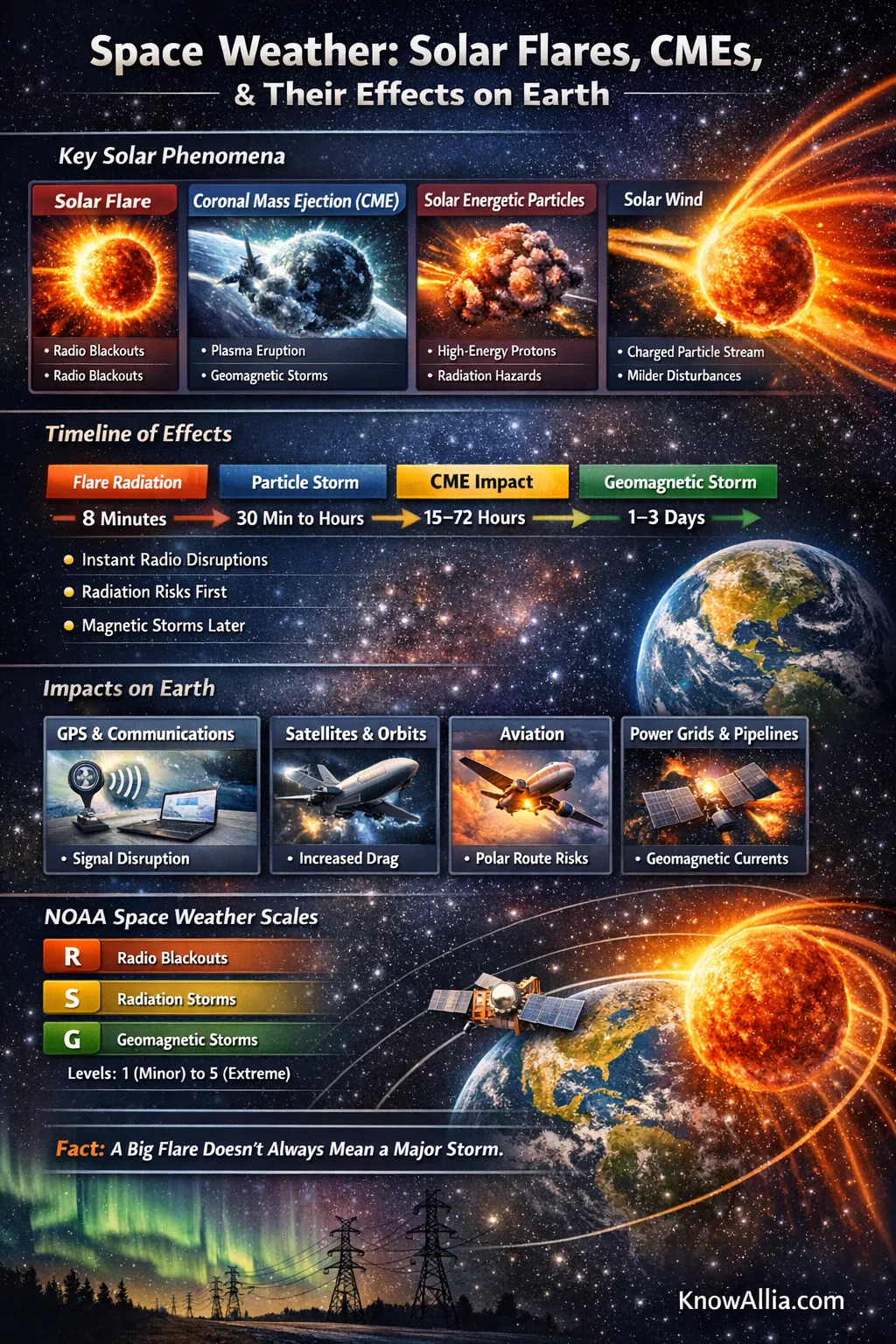
Space weather is the changing state of the space environment around Earth, driven mainly by the Sun. The two names people hear most are solar flares, which are bursts of radiation, and coronal mass ejections, or CMEs, which are expanding clouds of plasma and magnetic field. When the timing, direction, and magnetic setup line up, those solar events can disturb radio links, navigation signals, satellite operations, aviation routes, and long wired systems on the ground.[b]↗ [d]↗ [e]↗
What Matters Most
Space weather is not one single thing. It is a chain of events that begins with solar magnetic activity and ends with a response in Earth’s magnetosphere, ionosphere, and upper atmosphere. The practical question is not just whether the Sun erupts, but what reaches Earth, how fast it gets here, and what systems are exposed.
- Flares are radiation bursts, so their main Earthside effect is fast radio disruption.
- CMEs are plasma clouds, and the strongest geomagnetic storms usually come from Earth-directed CMEs.
- For most people at ground level, direct physical danger stays low, but technology exposure can rise fast in space, at high latitudes, and in long conductive networks.
You will see the full chain here: where flares and CMEs start, how they travel, why some storms stay mild, why others disturb GPS, HF radio, satellites, aviation, and power systems, and where forecast confidence still drops.
- Solar Flares
- CMEs
- Radiation Storms
- Geomagnetic Storms
- Ionosphere
- GNSS
- Power Grids
- Auroras
What Space Weather Means
Space weather starts with solar magnetic activity. Sunspots mark active regions where magnetic fields are twisted, compressed, and rearranged. When that stored magnetic energy is released, the Sun can produce a flare, a burst of fast particles, a CME, or several of them together. The Sun entered the solar maximum period of Solar Cycle 25 in October 2024, which means active regions and solar eruptions occur more often than they do near solar minimum.[i]↗
Earth does not simply “get hit” by solar activity in one uniform way. The response depends on several layers working together:
- The solar wind carries particles and magnetic fields away from the Sun.
- Earth’s magnetosphere deflects much of that flow but can also absorb energy from it.
- The ionosphere changes how radio waves travel.
- The thermosphere heats up and expands, which changes satellite drag.
- The ground can feel the result through geomagnetically induced currents in long conductive systems.
That layered response is why two solar eruptions with similar headlines can have very different outcomes on Earth.
Solar Flares vs. CMEs
A solar flare is an intense burst of radiation. A CME is an enormous cloud of plasma and magnetic field ejected from the Sun’s outer atmosphere. They often happen together, especially in stronger events, but they are not the same thing and they do not travel the same way.[c]↗
One simple analogy helps: a flare is like the flash from a camera, while a CME is the moving cloud that leaves the scene afterward. The flash arrives almost at once. The cloud takes time, changes shape, and may or may not be aimed in a way that matters for Earth.
The distinction matters because many articles flatten space weather into one idea. In practice, timing, magnetic orientation, and what part of the event reaches Earth decide the effect.
| Solar Signal | What It Is | Typical Earth Arrival | Main Earthside Effect |
|---|---|---|---|
| Flare Radiation | X-rays, extreme ultraviolet, and other electromagnetic radiation | About 8 minutes | Fast radio blackout effects on the sunlit side of Earth |
| Solar Energetic Particles | High-speed protons and other charged particles accelerated by solar eruptions | About 30 minutes to several hours | Radiation exposure concerns for spacecraft, astronauts, and high-latitude aviation |
| Earth-Directed CME | Expanding cloud of plasma plus embedded magnetic field | 15–18 hours for the fastest, often several days | Geomagnetic storms, auroras, GNSS errors, satellite drag, grid and pipeline current effects |
| High-Speed Solar Wind Stream | Fast solar wind from coronal holes, often with co-rotating interaction regions | Recurring pattern tied to solar rotation | Usually milder but sometimes long-lasting geomagnetic activity |
Fast flare radiation reaches Earth almost immediately, the fastest particles can arrive in roughly half an hour, and Earth-directed CMEs need far longer. High-speed streams from coronal holes can also drive geomagnetic activity, usually less intense than major CME storms but sometimes more persistent over time.[f]↗
How a Solar Event Reaches Earth
The easiest way to understand space weather is to follow the order in which Earth feels it. First comes light, then sometimes fast particles, then sometimes a CME, and finally Earth’s magnetic field and upper atmosphere reorganize in response.
From Sun to Earth: Three Different Clocks
The same solar outburst can send out radiation, energetic particles, and a CME, but those signals do not arrive together and they do not create the same kind of disturbance.
Arrival Pattern
0 8 min 30 min Hours 1–2 days Several days Flare Radiation Radio blackout effects can begin fast About 8 minutes Fast Particles Radiation storm effects can start early ~30 minutes to hours Earth-Directed CME Geomagnetic storm setup 15–18 hours to several days Storm strength depends on magnetic orientationFlares mainly matter first through radiation. That is why radio effects can begin before any plasma cloud arrives.
Fast protons can raise radiation exposure concerns for spacecraft, astronauts, and polar aviation before a CME reaches Earth.
A CME can produce a strong geomagnetic storm only if its magnetic field couples efficiently with Earth’s field.
A bright flare does not guarantee a strong geomagnetic storm, and an Earthward CME does not guarantee one either.
Earliest Warning
Flare radiation can reach Earth in about eight minutes, so the first effects can be nearly immediate.
Largest Technical Reach
Major geomagnetic storms can affect GNSS, HF radio, satellite drag, power transmission, and pipelines at the same time.
Why Forecasts Swing
The hardest part is often the CME magnetic field orientation, because that controls how strongly Earth’s magnetosphere is forced.
This timing difference is the reason a single headline like “solar storm” often hides several separate processes. It also explains why forecasters can know something is on the way well before they know how hard Earth will respond.[l]↗
What Changes Above and Around Earth
Most solar events have little or no effect on daily life for most people on the ground. Still, when space weather grows strong, the systems that depend on radio propagation, precise timing, orbital drag forecasts, or long conductive lines are the first to notice it.[k]↗
Radio, Navigation, and Timing
Solar flares can disturb the ionosphere almost at once, which is why the NOAA R-scale is about radio blackouts. Geomagnetic storms can also roughen and heat the ionosphere, bending or delaying radio signals and creating positioning errors for GPS and other GNSS systems. That matters not just for maps on phones, but also for timing, aviation, shipping, surveying, and machine guidance.[g]↗
Satellites, Orbits, and Spacecraft Health
During geomagnetic storms, the upper atmosphere heats and expands. That makes the thermosphere denser, which means satellites in low Earth orbit feel more drag and can lose altitude faster than expected. ESA notes that thermosphere density can rise by a few hundred percent within hours during strong space weather, which is why orbit prediction and collision avoidance can become harder during active periods.[q]↗
Radiation storms add another layer. Energetic protons can damage electronics, degrade solar panels, and raise risk for astronauts outside Earth’s shielding. Operators often switch spacecraft into safer modes when forecast conditions worsen.[o]↗
Aviation and High-Latitude Exposure
Polar and oceanic routes rely heavily on long-range communication and satellite navigation. The FAA notes that solar radiation storms can make HF communication inoperable on polar flights, while solar flare X-rays can produce radio blackouts on Earth’s dayside. Radiation exposure also rises most at high latitudes because Earth’s magnetic shielding is weaker there.[r]↗
Power Grids, Pipelines, and Ground Currents
When geomagnetic disturbances rapidly change Earth’s magnetic field, they induce electric fields in the ground. Those fields can drive geomagnetically induced currents, or GICs, through long conductors such as transmission lines and pipelines. USGS describes these currents as a source of power and communications interruption during geomagnetic disturbances.[h]↗
A well-known historical example came on March 13, 1989, when a geomagnetic storm caused a nine-hour blackout that left about six million people in Quebec without electricity. That event is still used because it shows how a space event can become a ground infrastructure problem within minutes.[p]↗
Auroras Are the Visible Part, Not the Whole Story
Auroras are the most public-facing sign of geomagnetic activity, but they are not the full event. The same magnetic setup that widens the auroral oval can also be pushing GNSS errors upward, increasing satellite drag, and loading extra current into long networks. A bright aurora is beautiful; it is also evidence that the magnetosphere and upper atmosphere are doing a lot of electrical work.
A Useful Modern Example: NASA described the May 2024 event as the first G5 geomagnetic storm in over two decades, with multiple strong flares and at least seven CMEs reaching Earth. NOAA later noted that GPS disruption during the same storm affected planting operations and was tied to more than $500 million in potential profit impact for U.S. farmers. That is a clear reminder that space weather is not only about aurora photos.[j]↗
How Space Weather Is Ranked
NOAA uses three public severity scales so that users do not need to read raw space physics data every time the Sun becomes active. The scales cover radio blackouts, solar radiation storms, and geomagnetic storms.[a]↗
- R1–R5: radio blackout scale, tied to flare X-ray output.
- S1–S5: solar radiation storm scale, tied mainly to energetic proton flux.
- G1–G5: geomagnetic storm scale, tied to planetary geomagnetic disturbance.
These labels are useful because different sectors care about different hazards. A strong R event can matter right away for radio users. A strong S event matters for radiation exposure and spacecraft. A strong G event matters for magnetosphere-ionosphere coupling, satellite drag, GNSS errors, and ground currents.
One Common Reading Error: A higher flare class does not automatically mean a higher geomagnetic storm level. A bright X-class flare may cause a strong radio blackout yet still fail to produce a strong geomagnetic storm if the CME is absent, not Earth-directed, or magnetically unfavorable when it arrives.
How Forecasting Works
Forecasting space weather is a mix of solar imaging, in-space measurements, and Earthside response models. Forecasters watch active regions on the Sun, track flare output, image CMEs as they expand, and then measure the solar wind and magnetic field upstream of Earth.
One of the most useful warning outposts is DSCOVR at the Sun–Earth L1 point, about 1 million miles from Earth. NASA describes it as a solar-wind monitoring station that can give forecasters roughly 15 to 60 minutes of warning before solar storm conditions reach Earth.[m]↗
NOAA’s newer SWFO-L1 system is designed to sharpen the operational side of that work. NOAA says its coronagraph imagery can reach forecasters within about 30 minutes of acquisition, and its in-situ solar wind and magnetic field data can be available within about 5 minutes. Faster delivery matters because minutes can make a real difference for grid operations, satellite mode changes, and flight planning.[n]↗
At the public level, NOAA’s Space Weather Prediction Center is the official U.S. source for alerts, watches, and warnings. That is the operational endpoint most users care about, even though the science behind those alerts starts much farther upstream.[s]↗
Where Confusion Starts
“A Flare and a CME Are the Same Thing.”
No. A flare is radiation. A CME is moving plasma plus magnetic field. They can occur together, but one is not the other.
“A Bigger X Number Means a Worse Geomagnetic Storm.”
Not always. The flare class says a lot about the radiation burst, not the later magnetic coupling at Earth.
“Only Satellites Need to Care.”
Also false. GNSS, aviation, HF radio, power transmission, pipelines, and precision timing can all be affected.
“Aurora Means the Event Is Harmless.”
Aurora means energy is entering the upper atmosphere. It can happen alongside radio, navigation, drag, and current effects.
These misunderstandings are common because many summaries merge different solar signals into one label. The cleaner way is to ask three questions in order: Was there a flare? Was there a CME? How did Earth’s magnetic field and upper atmosphere respond?
Terms You Will See Often
- Solar Flare
- A burst of radiation released when magnetic energy is rapidly rearranged in the solar atmosphere.
- Coronal Mass Ejection (CME)
- An expanding cloud of solar plasma and magnetic field launched from the corona.
- Solar Radiation Storm
- A space weather event marked by enhanced fluxes of energetic particles, mainly protons, near Earth.
- Geomagnetic Storm
- A major disturbance of Earth’s magnetosphere caused by efficient energy transfer from the solar wind.
- Ionosphere
- An electrically active upper-atmosphere region that strongly affects radio propagation and GNSS signals.
- Thermosphere
- A high atmospheric layer that heats and expands during geomagnetic activity, changing satellite drag.
- GIC
- Geomagnetically induced current driven through long conductive networks during magnetic disturbances.
- L1
- The Sun–Earth Lagrange Point 1, a useful place for spacecraft that monitor incoming solar wind before it reaches Earth.
What Scientists Still Cannot Pin Down
Forecasting has improved a lot, but there are still honest limits.
- Exact flare onset is not yet predictable. NASA says scientists cannot forecast when a specific flare will happen, even though active regions can be monitored for higher likelihood.[t]↗
- CME arrival time is still fuzzy. ESA reports that single-viewpoint CME forecasts typically carry an average uncertainty of about ±12 hours, and some individual cases are worse.[l]↗
- Storm strength is harder than storm arrival. The hardest missing piece is often the CME magnetic orientation, which controls how strongly it couples to Earth’s field.
- Local impact varies. Latitude, ground conductivity, system design, route geometry, and operational backup options all shape the real-world outcome.
What We Know Well: the Sun produces flares, particles, and CMEs; those signals reach Earth on different clocks; and the ionosphere, thermosphere, magnetosphere, and ground networks can all respond. What stays harder: the exact magnetic structure of an incoming CME and the exact local effect on a given system before the event is very close.
FAQ
Common Questions
Are solar flares dangerous to people on the ground?
Usually not in a direct physical sense. Earth’s atmosphere and magnetic field block most harmful radiation from reaching people at the surface. The main concern on the ground is usually technology disruption rather than direct injury.
What is the difference between a solar flare and a CME?
A solar flare is a burst of radiation. A CME is a cloud of plasma and magnetic field. A flare can affect Earth within minutes. A CME usually takes many hours to days.
Does every X-class flare cause a geomagnetic storm?
No. A strong flare can create a strong radio blackout without producing a strong geomagnetic storm. A later geomagnetic storm depends heavily on whether a CME is launched, whether it is Earth-directed, and how its magnetic field is oriented when it arrives.
How long does a CME take to reach Earth?
The fastest Earth-directed CMEs can arrive in roughly 15 to 18 hours. Slower ones can take several days.
Why do airlines care about space weather?
High-latitude flights can lose HF communication during radiation storms, navigation performance can degrade, and radiation exposure can rise for crews and passengers on polar routes.
Why are auroras sometimes seen far from the poles?
During stronger geomagnetic storms, the auroral oval expands away from the poles. That lets auroras become visible at lower latitudes than usual.
Sources
- NOAA / NWS Space Weather Prediction Center – NOAA Space Weather Scales — Used for the public R, S, and G severity scale definitions. ↩
- NASA Science – Solar Storms and Flares — Used for the flare, particle, and CME sequence, including the eight-minute flare timing. ↩
- NASA Science – Solar Flares FAQs — Used for the flare-versus-CME distinction and the note that exact flare timing is not yet predictable. ↩
- NOAA / NWS Space Weather Prediction Center – Coronal Mass Ejections — Used for CME travel times and Earth-directed CME behavior. ↩
- NOAA / NWS Space Weather Prediction Center – Geomagnetic Storms — Used for geomagnetic storm drivers, GNSS errors, thermospheric drag, pipelines, and power-grid effects. ↩
- NOAA / NWS Space Weather Prediction Center – Solar Radiation Storm — Used for proton-storm timing and high-latitude aviation and spacecraft radiation effects. ↩
- Federal Aviation Administration – Space Weather — Used for aviation communication and navigation effects, especially HF and GNSS dependence. ↩
- U.S. Geological Survey – Geomagnetically Induced Currents — Used for ground-current impacts in power and communications systems. ↩
- NASA Science – NASA, NOAA: Sun Reaches Maximum Phase in 11-Year Solar Cycle — Used for Solar Cycle 25 maximum-period timing and current active-phase context. ↩
- NASA Science – How NASA Tracked the Most Intense Solar Storm in Decades — Used for the May 2024 G5 event and the multi-CME modern example. ↩
- European Space Agency – Space Weather and Its Hazards — Used for the broad statement that most events have little effect on daily ground life while some sectors remain exposed. ↩
- ESA Space Weather Service – Use of L5 Data in CME Propagation Models — Used for forecast uncertainty and the average single-viewpoint CME timing error. ↩
- NASA Science – DSCOVR — Used for L1 monitoring and the typical 15 to 60 minute upstream warning window. ↩
- NOAA NESDIS – Space Weather Follow On–Lagrange 1 (SWFO-L1) — Used for operational data delivery times and newer warning-system capability. ↩
- NOAA NESDIS – Safeguarding Satellites: How NOAA Monitors Space Weather to Prevent Disruptions — Used for operator responses, satellite safe modes, and the 2024 farming-related GPS disruption example. ↩
- National Weather Service – Space Weather and Safety — Used for the March 13, 1989 Quebec blackout example. ↩
- ESA Space Weather Service – Ionospheric Weather — Used for ionospheric GNSS effects and the statement that thermosphere density can rise by a few hundred percent during strong events. ↩
- Federal Aviation Administration – Space Weather — Used for polar HF communication loss and aviation radiation context. ↩
- NASA Science – Solar Flares FAQs — Used for NOAA SWPC as the official U.S. source of alerts, watches, and warnings. ↩
- NASA Science – Solar Flares FAQs — Used for the note that a specific flare cannot yet be predicted in advance. ↩