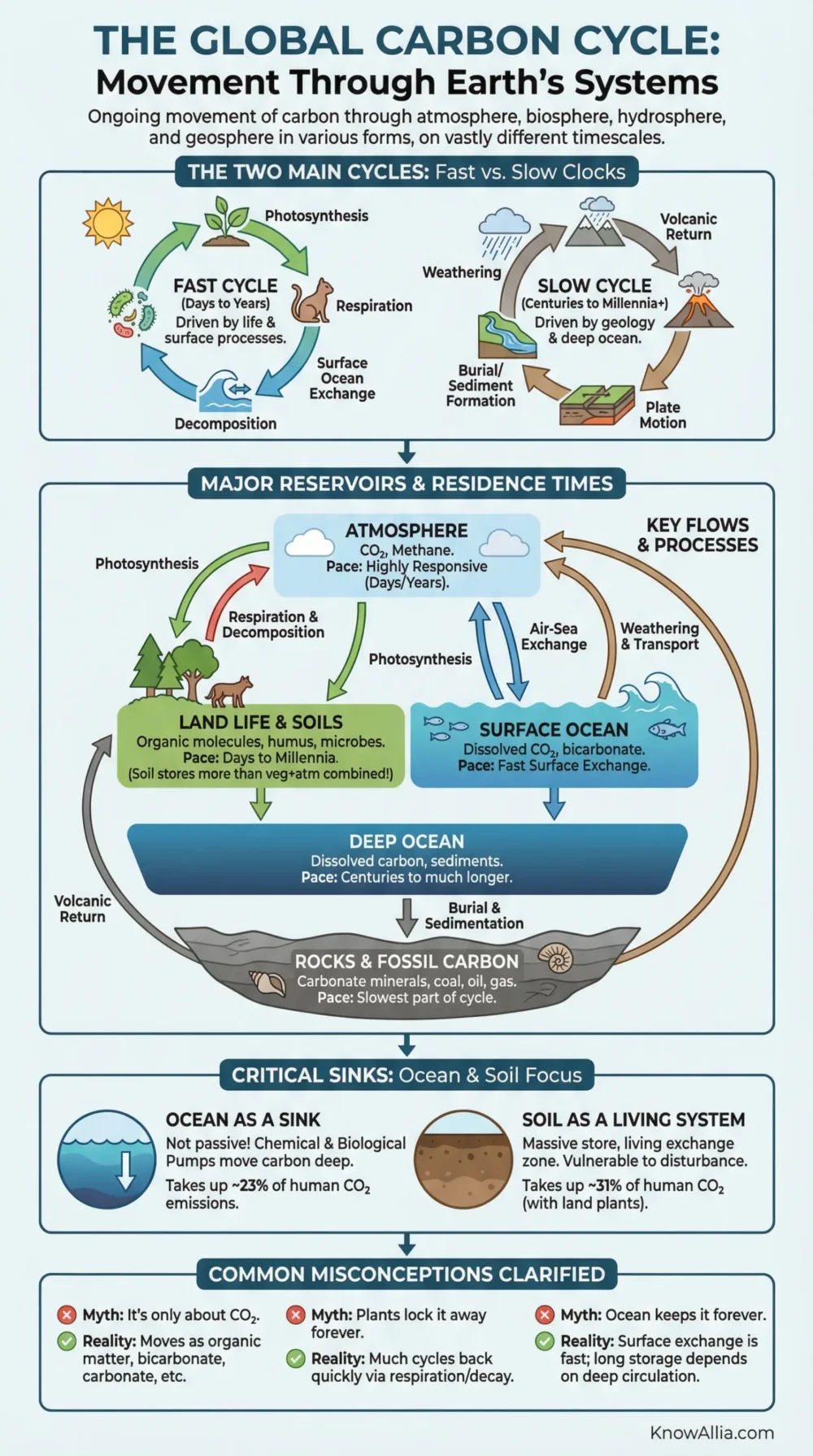
The carbon cycle is the ongoing movement of carbon through the atmosphere, living things, soils, oceans, and rocks. Carbon changes form as it moves: it can be carbon dioxide in air, sugar in a leaf, organic matter in soil, bicarbonate in seawater, or carbonate minerals in sediment. The same atom can move through several of these stores, but not on one single timetable; some transfers happen in days or seasons, while others take centuries or far longer.[a][b][c]
A Clear Starting Point
Carbon does not sit still on Earth. It cycles between air, water, life, and geology, and the pace of that movement helps shape ecosystems, ocean chemistry, and long-term temperature balance. A good explanation has to show where carbon is stored, how it moves, and why time scale matters.
- The fast cycle is driven by photosynthesis, respiration, decomposition, and surface ocean exchange.
- The slow cycle includes weathering, burial, sediment formation, plate motion, and volcanic return.
- In the 2010–2019 average, natural land and ocean sinks took up about 31% and 23% of human CO2 emissions, so the atmosphere is only part of the story.[d]
This article explains what carbon is doing in Earth’s main reservoirs, why the ocean and soil deserve more attention than many summaries give them, and where current science still works with ranges instead of one fixed answer.
What the Carbon Cycle Covers
The carbon cycle includes both reservoirs and fluxes. A reservoir is a place where carbon is stored for some length of time. A flux is a transfer from one reservoir to another. Earth’s main reservoirs are the air, living organisms, soils, oceans, sediments, rocks, and fossil carbon stored underground.[j][c]
- Atmosphere
- Biosphere
- Hydrosphere
- Geosphere
That matters because the cycle is not just about CO2 floating in the air. Carbon also travels as organic molecules in plants and animals, as dissolved inorganic carbon in water, and as carbonate rock in Earth’s crust. If a page reduces the topic to “plants take in CO2 and animals breathe it out,” it leaves out most of the long-storage story.[a][e]
Main Reservoirs and What They Hold
| Reservoir | Common Carbon Form | How Carbon Usually Leaves | Typical Pace |
|---|---|---|---|
| Atmosphere | Mostly carbon dioxide, with smaller amounts of methane and other carbon gases | Photosynthesis, dissolution into surface ocean | Highly responsive over days to years |
| Plants and Animals | Sugars, cellulose, lipids, proteins, tissues | Respiration, grazing, death, decomposition, fire | Days to centuries |
| Soils | Litter, humus, microbial biomass, soil carbonates | Decomposition, erosion, leaching, fire | Days to millennia |
| Surface Ocean | Dissolved CO2, bicarbonate, carbonate | Outgassing, plankton uptake, mixing downward | Fast exchange at the surface |
| Deep Ocean and Seafloor | Dissolved inorganic carbon, sinking particles, buried sediments | Upwelling, sediment processes, very slow return pathways | Centuries to much longer |
| Rocks and Fossil Carbon | Carbonate minerals, coal, oil, natural gas | Weathering, combustion, metamorphism, volcanism | Slowest part of the cycle |
The biggest lesson from this table is simple: not all stored carbon behaves the same way. Carbon in a leaf can return to the atmosphere within a season. Carbon in limestone may stay out of active circulation for immense spans of time. A useful analogy is a set of linked bank accounts: some are checked every day, while others are locked for ages. Moving carbon from coal, oil, or gas into the air is like breaking open a long-term vault and spending it in real time.[a]
How Carbon Actually Moves
- Photosynthesis: Land plants and marine phytoplankton pull carbon from CO2 and turn it into organic matter.[b][e]
- Respiration: Plants, animals, and microbes return part of that carbon to the air or water as they use energy.
- Decomposition: When organisms die, microbes break down tissue and move carbon back into soil, water, or the atmosphere.[b]
- Air–Sea Exchange: Surface ocean water both absorbs and releases CO2, depending on temperature, chemistry, and circulation.[e]
- Weathering and River Transport: Carbon dioxide reacts with water and minerals during weathering, and some of that carbon moves toward the ocean as dissolved ions, especially bicarbonate.[a]
- Burial, Sediment Formation, and Volcanic Return: Some carbon becomes locked into marine sediments and rocks, while tectonics and volcanism slowly return part of it to the atmosphere.[a]
One point that often gets missed: the cycle is not a neat loop with equal arrows. Some transfers are large and fast, some are small and slow, and the same transfer can change direction with season, chemistry, or circulation.
Fast and Slow Carbon Clocks
The fast carbon cycle is mostly the movement of carbon through living systems and the upper ocean. It includes photosynthesis, feeding, respiration, decomposition, and seasonal changes in vegetation. NASA notes that these seasonal shifts are large enough to show up in atmospheric CO2 records, especially in the Northern Hemisphere, where plant growth in spring and summer draws carbon out of the air and decay returns it later in the year.[a]
The slow carbon cycle works through weathering, sedimentation, rock formation, plate motion, and volcanism. That is why the same topic has to be read on two clocks at once: one tied to seasons and ecosystems, the other tied to oceans, sediments, and geology. When these two clocks are mixed together without explanation, the topic feels confusing even when each piece is correct on its own.[a]
Soil sits between those clocks. It is part of the active surface system, but much of its carbon can stay in place far longer than vegetation carbon. USDA material notes that soils store more carbon than the atmosphere and vegetation combined, and that soil carbon residence times can range from decades to millennia.[g]
Where Carbon Goes and How Long It Stays
Carbon moves through connected stores that run on very different clocks, from seasonal plant growth to long-term burial in rock.
Fast Loop
Leaves, plankton, roots, microbes, and surface seawater move carbon on short timetables that people can measure over seasons and years.
Ocean Chemistry
Once CO2 enters seawater, part of the story becomes chemistry: carbon shifts among dissolved CO2, bicarbonate, and carbonate.
Soil Storage
Soils are not just a temporary stop. Some soil carbon turns over quickly, while some remains for very long periods.
Slow Loop
Burial, rock formation, plate motion, and volcanism move carbon on the longest timetable in the cycle.
What Leaves the Air Fastest
Photosynthesis and surface ocean uptake can move carbon quickly, but they do not all produce long-term storage.
What Holds Carbon Longer
Deep ocean water, mineral carbon in soils, marine sediments, and carbonate rocks usually hold carbon longer than leaves or surface litter.
Why Timing Changes the Meaning
A reservoir can be large, but what matters for the cycle is both size and how quickly carbon can leave and return.
Why the Ocean and Soil Matter More Than Many Short Summaries Suggest
The Ocean Is Not Just a Passive Sink
The ocean does not simply “soak up CO2” and stop there. Surface waters exchange gases with the atmosphere, and once carbon enters seawater it can shift into different dissolved forms. That chemistry affects how much more CO2 the ocean can take in and also affects carbonate availability for shell-forming organisms.[i][a]
The ocean also has a biological carbon pump. Phytoplankton fix carbon near the surface, and part of that carbon later sinks as particles or enters deeper waters through food-web processes. Some is recycled quickly. A smaller share reaches deeper storage or burial in sediment.[e]
Soil Is a Living Carbon System
Soil carbon is often treated like a footnote, but it is one of the biggest surface stores in the cycle. Carbon enters soil through roots, litter, microbial products, and in some places carbonate minerals. It leaves through decomposition, fire, erosion, and transport in water.[f][g]
This is why soil is better understood as a living exchange zone rather than a static box. A field, forest floor, peatland, or grassland can all hold carbon, but not in the same form and not for the same length of time.
Another detail worth keeping: long storage is not the same as permanent storage. Carbon in deep water can return through circulation. Carbon in soil can be lost through warming, disturbance, or fire. Carbon in rock is slower still, but even that store is part of the larger loop through weathering and volcanism.[a][h]
Common Misconceptions and Points of Confusion
Some plant carbon stays in wood or soil, but a large share cycles back through respiration, grazing, decomposition, or fire on much shorter timetables.[b]
Terms That Make the Topic Easier to Read
- Reservoir
- A place where carbon is stored for some period of time, such as the atmosphere, soils, ocean, or rock.
- Flux
- A transfer of carbon from one reservoir to another, such as photosynthesis or ocean uptake.
- Carbon Sink
- A reservoir or process that removes more carbon from the atmosphere than it releases over a given period.
- Carbon Source
- A reservoir or process that releases more carbon than it removes over that same period.
- Dissolved Inorganic Carbon
- Carbon in water in the form of dissolved CO2, bicarbonate, and carbonate ions.
- Biological Carbon Pump
- The set of ocean biological processes that move some carbon from surface waters toward deeper layers and sediments.
- Sequestration
- Storage of carbon for a longer period, whether in vegetation, soils, sediments, deep ocean water, or geologic formations.
What Science Still Cannot Pin Down Exactly
Scientists can measure the major directions of the carbon cycle with confidence, but some parts still come with ranges rather than one fixed number. The future size of land and ocean sinks can shift with warming, rainfall patterns, nutrient supply, ecosystem change, wildfire, and ocean circulation. Regional responses can differ even when the global pattern is clear.[d][h]
There is also a timing problem. Deep ocean response is slow, and long-term rock-cycle feedbacks are slower still, so no short observational record can show the full end point of those pathways. That does not mean the science is uncertain in a vague way; it means some parts of the system are measured directly over years, while others are inferred across much longer spans of time.[a][e]
FAQ
Questions Readers Often Have
Is the Carbon Cycle Only a Climate Topic?
No. It is also a biology, ocean, soil, and geology topic. Climate matters because atmospheric carbon affects heat balance, but the cycle also explains how carbon supports life, moves through food webs, enters soil, and becomes part of marine sediments and rock.
What Is the Difference Between the Fast and Slow Carbon Cycle?
The fast cycle moves carbon through plants, animals, microbes, and the upper ocean over short spans such as days, seasons, or years. The slow cycle works through weathering, burial, sediment formation, tectonics, and volcanism over much longer spans.
Why Is the Ocean Such a Large Carbon Sink?
The ocean has direct contact with the atmosphere, large water volume, and chemistry that converts dissolved CO2 into other forms such as bicarbonate. Biology also helps by moving some carbon from surface waters into deeper layers and sediments.
Can Soil Hold More Carbon Than Vegetation?
Yes. Soil is one of the largest surface stores in the cycle, and some soil carbon can remain much longer than plant carbon. The amount and stability depend on climate, vegetation, mineral content, microbes, and disturbance.
Does Every Carbon Atom Stay in One Place for the Same Length of Time?
No. Residence time depends on the reservoir and process. Carbon in a leaf may return quickly, while carbon in deep ocean water, mineral-rich soil, or carbonate rock may remain far longer before re-entering active circulation.
Sources
- [a] NASA Science – The Carbon Cycle — Used for the fast and slow cycle, weathering, burial, ocean chemistry, and volcanic return. ↩
- [b] NOAA – Carbon Cycle — Supports the broad movement of carbon among reservoirs and the role of photosynthesis, respiration, and decomposition. ↩
- [c] U.S. Department of Energy – DOE Explains…the Carbon Cycle — Used for the reservoir idea, sinks, and carbon movement among life, minerals, and the atmosphere. ↩
- [d] IPCC AR6 WGI FAQ Chapter 5 – Remaining Carbon Budget and Natural Sinks — Used for the recent land and ocean sink shares of human CO2 emissions and for uncertainty ranges in future sink strength. ↩
- [e] Woods Hole Oceanographic Institution – Carbon Cycle — Used for ocean gas exchange, phytoplankton uptake, sinking material, and deep-water storage. ↩
- [f] USDA Climate Hubs – Soil Carbon in the Northwest — Used for how carbon enters and leaves soil through plants, decomposition, fire, and related soil processes. ↩
- [g] USDA Climate Hubs – Climate and Management Effects on Soil Organic Carbon in Temperate Managed Ecosystems — Used for soil storage size and the longer residence time of soil carbon. ↩
- [h] NOAA Research – Understanding the Basics of Carbon Dioxide — Used for the broad point that land and ocean together absorb about half of human CO2 emissions and for sink behavior over time. ↩
- [i] NOAA – Ocean Acidification — Used for the chemistry of dissolved CO2 in seawater and the connection to carbonate availability. ↩
- [j] Encyclopaedia Britannica – Carbon Cycle — Used as a reference-style source for reservoir, sink, and cycle terminology. ↩