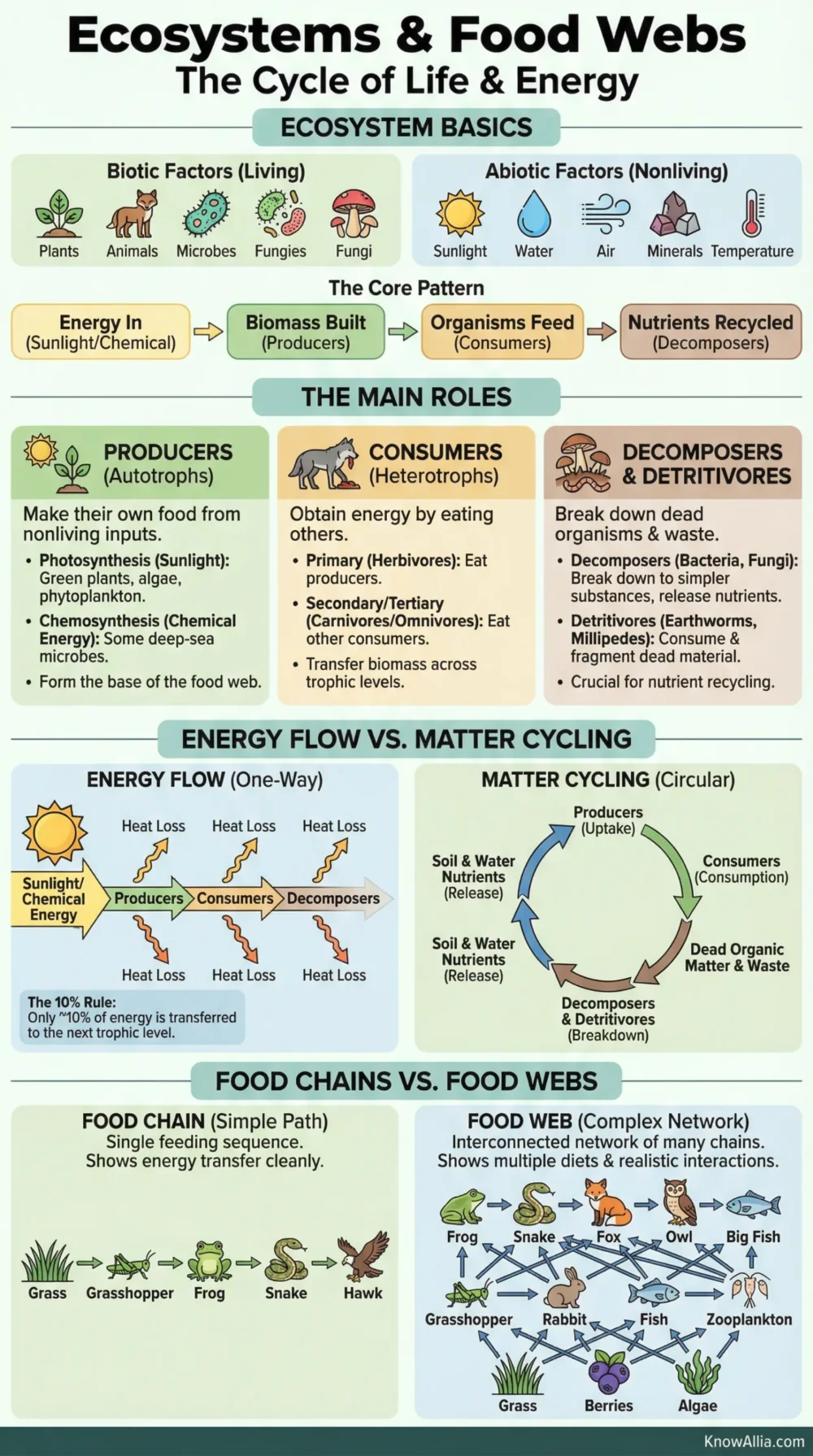
Ecosystems are living systems made of organisms and the nonliving conditions around them, all linked by the movement of energy and matter. A food web is the feeding network inside that system: producers make biomass, consumers move it, and decomposers return usable nutrients to soil or water.[a][b]
A Straight Starting Point
Most ecosystems run on one repeating pattern: energy enters, biomass is built, organisms feed, and nutrients are recycled. The basic labels look simple, but the real picture is broader than “plants, animals, and decay.” Algae, microbes, detritivores, soil organisms, and marine plankton all matter.
- Producers capture energy and turn it into living tissue.
- Consumers move that stored energy through feeding links.
- Decomposers and detritivores break down remains and help restart growth.
This article explains how food webs are built, why energy flow is not the same as nutrient cycling, where producers exist beyond land plants, and why decomposers are more than the “last step” in a diagram.
Explore the Main Sections
Ecosystem Basics
An ecosystem includes biotic factors such as plants, animals, fungi, and microbes, plus abiotic factors such as light, water, air, temperature, and minerals. It is not just a place on a map. It is the set of relationships that lets living things grow, feed, decompose, and reproduce in a shared environment.[c]
- Biotic Factors
- Abiotic Factors
- Biomass
- Trophic Levels
- Nutrient Cycling
- Soil Food Web
Seen this way, a food web is one part of the larger ecosystem story. It tracks who gets energy from whom, but it also hints at something else: how matter moves through bodies, wastes, detritus, soil, and water before it enters new life again.
What Keeps an Ecosystem Running?
- Energy enters the system, usually as sunlight and, in a few places, as chemical energy.
- Primary producers turn that energy into organic matter.
- Consumers feed at one or more trophic levels.
- Dead material and waste enter the detrital side of the web.
- Decomposers release nutrients in forms producers can use again.
Producers, Consumers, and Decomposers
Producers
Producers, also called autotrophs, make their own food from nonliving inputs. On land, the familiar examples are green plants. In water, algae, phytoplankton, and some bacteria do the same job. Most producers use photosynthesis, but some microbes use chemosynthesis, which means they build food from chemical energy rather than sunlight.[d][e]
That point matters because many basic articles quietly treat producers as “plants only.” That is too narrow. In lakes, oceans, wetlands, and deep-sea vents, tiny producers can support entire feeding networks even when they are nearly invisible to the eye.
Consumers
Consumers, or heterotrophs, cannot make their own food. They obtain energy by eating producers, other consumers, or both. The usual labels are primary consumers for herbivores, secondary consumers for animals that eat herbivores, and tertiary consumers or apex predators higher up the feeding network.[f]
Real ecosystems are less tidy than textbook ladders. Many species feed at more than one level. A bear may eat berries, fish, and carrion. A young frog eats differently from an adult frog. That is one reason food webs are more useful than single chains.
Decomposers and Detritivores
Decomposers break down dead organisms and waste into simpler substances. Bacteria and fungi are the main examples. Detritivores are slightly different: they eat dead organic material directly. Earthworms, millipedes, and many soil invertebrates fragment leaves, wood, and waste into smaller pieces, which makes microbial decomposition easier.[g]
A simple way to picture it: a food chain is not a neat dinner table with a last seat marked “decomposer.” It is closer to a busy cleanup and recycling network running beside every feeding link. Without it, nutrients stay locked inside dead material and new growth slows down.
| Role | What It Does | Main Energy or Food Source | Typical Examples |
|---|---|---|---|
| Producers | Build organic matter from nonliving inputs | Sunlight or chemical energy | Grasses, trees, algae, phytoplankton, chemosynthetic microbes |
| Consumers | Transfer biomass by feeding on other organisms | Plants, algae, animals, fungi, or mixed diets | Deer, krill, fish, owls, foxes, sea stars, humans |
| Decomposers | Break dead matter into simpler substances and release nutrients | Detritus and organic waste | Fungi, bacteria, many microbes |
| Detritivores | Consume and fragment dead material | Leaf litter, carcasses, feces, dead wood | Earthworms, millipedes, dung beetles, some crustaceans |
How Energy and Matter Move
Energy and matter do not behave the same way in ecosystems. Energy flows through the web and is gradually lost as heat during life processes. Matter cycles through organisms and the environment, returning as carbon compounds, minerals, water, and other usable substances.[h][i]
That distinction is often blurred, but it changes how food webs should be read. If you only follow who eats whom, you see energy transfer. If you also follow wastes, carcasses, leaf litter, and microbial activity, you see nutrient cycling. Both views are needed to understand how ecosystems keep working.
The 10 percent rule is a useful average for classroom thinking, not an exact value for every link. It means that only a small share of energy at one trophic level becomes biomass available to the next level, which is why higher levels usually support fewer organisms and less total biomass.[f]
How Food Web Roles Keep an Ecosystem Alive
Energy enters, biomass moves, and nutrients return. The loop looks simple on paper, but each step depends on the others.
Producers
Plants, algae, phytoplankton,
and some microbes
Consumers
Primary, secondary, tertiary,
omnivores, and apex predators
Detritus
Dead tissue, litter,
and organic waste
Decomposers
Fungi, bacteria, and the
microbial part of the soil web
Biomass Transfer
Feeding Links
Breakdown and Recycling
Nutrients Back to Growth
Energy Enters the Web Through Primary Production
Primary Production
Most food webs begin with sunlight captured by photosynthesis. A smaller set begins with chemical energy used by microbes.
Two Linked Pathways
The grazing side follows living producers and consumers. The detrital side follows dead material, waste, and decomposition.
Why Recycling Matters
Without decomposition and mineral release, producers lose access to many of the nutrients needed for new tissue.
Food Chains and Food Webs
A food chain is one feeding path. A food web is the larger network made by many overlapping chains. A chain is useful for clarity. A web is better for real ecosystems, because most species have more than one food source and more than one predator.[b]
A good analogy is a transport map. One road can show how to get from one town to the next, but it cannot explain the whole city. A food chain is that single road. A food web is the full map, with side routes, shared stops, and traffic moving in more than one direction.
What a Food Chain Shows Well
- One clean feeding sequence
- The basic idea of trophic levels
- How energy passes from one link to the next
What a Food Web Shows Better
- Multiple diets and shared prey
- Omnivory and life-stage shifts
- How local change can ripple through the network
Food webs also help explain why the loss or gain of one species can affect many others. Those effects may be direct, such as a predator eating prey, or indirect, such as a drop in herbivores allowing producer biomass to recover.
How This Looks in Real Ecosystems
Forest Floor
Trees, shrubs, and grasses capture energy. Insects, deer, and small mammals feed on that plant tissue. Birds, foxes, snakes, and other predators feed higher up. At the same time, fallen leaves, bark, fungi, and soil microbes drive a second stream of activity below the obvious one. In many forests, the soil food web is doing as much quiet work as the larger animals above ground.
Pond or Coastal Water
In water, producers are often tiny. Phytoplankton and algae feed zooplankton, insect larvae, shellfish, or small fish. Those organisms feed larger fish, birds, reptiles, or mammals. Because the first producers are microscopic, people often miss the base of the system even though it supports nearly everything above it.
Deep-Sea Vent Community
Some ocean ecosystems operate without sunlight. Near hydrothermal vents, chemosynthetic microbes use chemicals released from the seafloor and support dense communities of grazers and predators. That does not overturn the usual rule that producers form the base. It shows that the base can be built in more than one way.[e]
Common Misconceptions
Key Terms
- Autotroph
- An organism that makes its own food from nonliving materials.
- Heterotroph
- An organism that gets food by eating other organisms or their products.
- Trophic Level
- A feeding position in a chain or web, such as producer, primary consumer, or tertiary consumer.
- Biomass
- The living material stored in organisms; it represents stored chemical energy in the web.
- Detritus
- Dead organic material such as leaf litter, dead wood, feces, and carcasses.
- Mineralization
- The release of nutrients from decomposing organic matter into forms producers can use.
- Primary Productivity
- The rate at which producers create new organic matter.
Where the Simplified Picture Stops
Ecology uses labels such as producer, consumer, and decomposer because they are useful. Still, real organisms do not always stay in one box. Some switch diets with age, season, or habitat. Some species feed across several trophic levels. Even the 10 percent rule is a rough teaching average rather than a fixed value for every ecosystem.
Food webs also change over time. Rainfall, temperature, nutrient supply, life stage, disease, and migration can alter who feeds on whom and how much biomass is available. That is why local field studies matter when scientists map a real ecosystem instead of a classroom example.
FAQ
Why are decomposers needed if producers can already make food?
Producers need access to usable nutrients such as nitrogen and phosphorus. Decomposers help release those nutrients from dead tissue and waste, which keeps new growth going.
Are fungi always decomposers?
Many fungi are decomposers, but fungi are a broad group. Some live in mutual relationships with plants, and others have different ecological roles.
Can one organism belong to more than one trophic level?
Yes. Omnivores often feed at several trophic levels, and the same species may shift diets during different life stages or seasons.
Do all food webs begin with sunlight?
No. Most do, but some deep-sea ecosystems begin with chemosynthetic microbes that use chemical energy instead of light.
Is a food web the same as an energy pyramid?
No. A food web shows feeding connections. An energy pyramid shows how available energy tends to shrink at higher trophic levels.
Sources
- [a] National Geographic Society – Ecosystem — ecosystem definition and the link between living and nonliving parts.
- [b] National Geographic Society – Food Web — food webs, trophic levels, biomass, and decomposer roles.
- [c] USDA NIFA – Ecosystems — ecosystem balance and interaction between organisms and surroundings.
- [d] National Geographic Society – Food Chain — producer examples, trophic levels, and the distinction between detritivores and decomposers.
- [e] NOAA PMEL – Chemosynthesis — deep-sea microbial production without sunlight.
- [f] National Geographic Society – Energy Flow and the 10 Percent Rule — consumer levels, energy transfer, and why biomass shrinks upward.
- [g] National Geographic Society – Decomposers — decomposer examples and nutrient return to soil or water.
- [h] U.S. National Park Service – Matter in Motion — how matter cycles among plants, animals, decomposers, air, and soil.
- [i] FAO – The Importance of Soil Organic Matter — mineralization, soil food webs, and nutrient release into plant-usable forms.
The article uses broad ecological rules that fit many ecosystems well. Exact feeding links, trophic positions, and biomass patterns vary by habitat, season, and the species present in a given place.