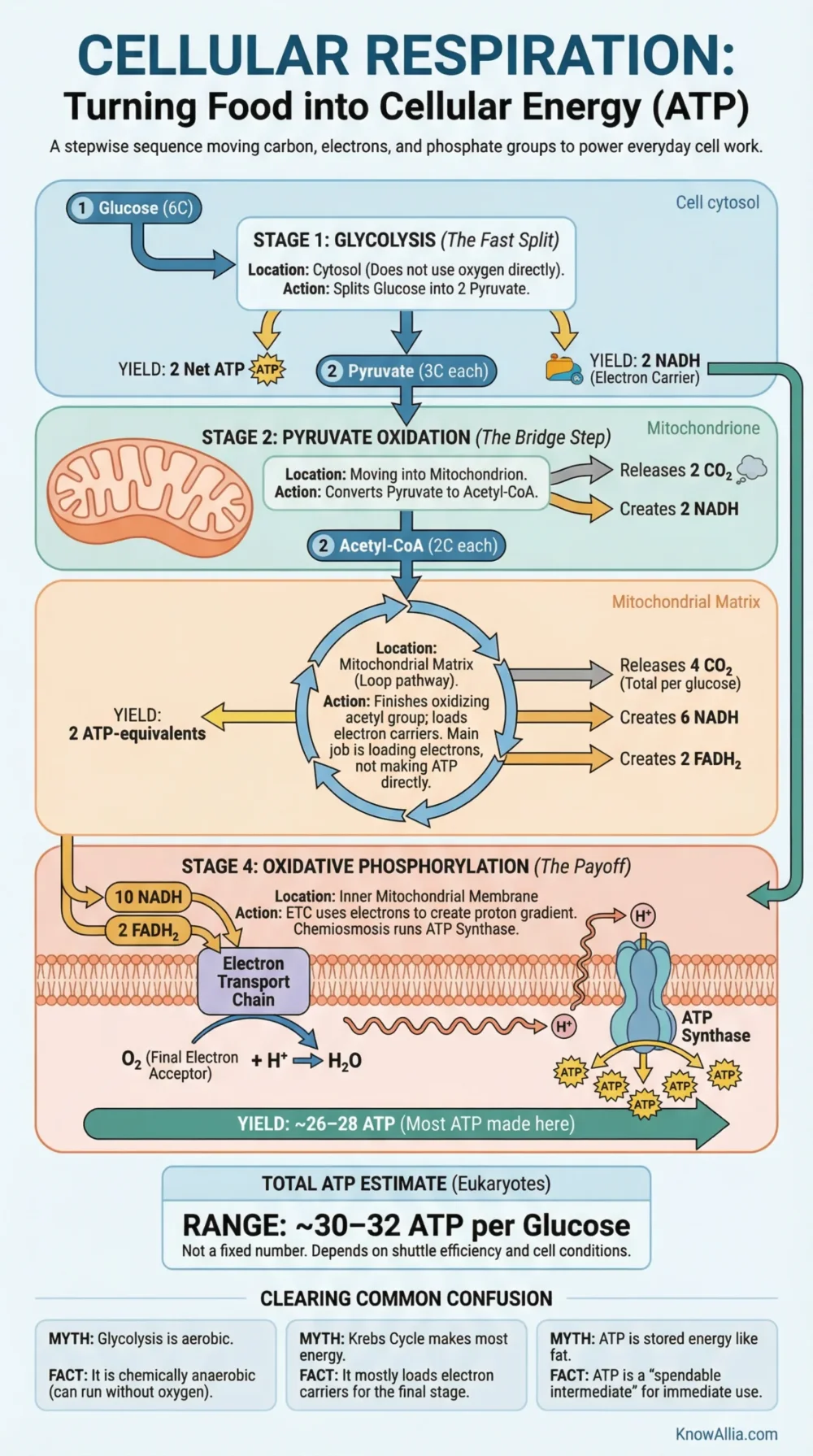
Cellular respiration is the linked set of reactions cells use to turn the chemical energy in food into ATP, the molecule that powers everyday cell work. In eukaryotes, the process starts with glycolysis in the cytosol, moves through pyruvate processing and the Krebs cycle in the mitochondrial matrix, and ends with oxidative phosphorylation on the inner mitochondrial membrane.[b][c][d]
A Clear Way to Read the Process
Cellular respiration is not one reaction. It is a sequence that moves carbon, electrons, and phosphate groups through different steps. A small amount of ATP appears early, but most ATP is made at the end, after electrons stored in NADH and FADH2 reach the electron transport chain.[g][i]
This article will help you separate three ideas that often get blended together: where carbon atoms go, where electrons go, and where ATP is actually made. That split matters, because many short summaries leave out the bridge step between glycolysis and the Krebs cycle, treat oxygen as if it is used in every step, or give one fixed ATP total as if every cell counts it the same way.
- ATP
- Glycolysis
- Pyruvate
- Acetyl-CoA
- Krebs Cycle
- NADH
- FADH2
- Electron Transport Chain
- Chemiosmosis
How Cellular Respiration Fits Together
At a simple level, cellular respiration breaks down fuel molecules and captures part of that released energy in ATP. At a more exact level, it does something smarter: it removes electrons in a stepwise way, stores them on carriers such as NADH and FADH2, and then uses those electrons to drive ATP production. That stepwise design keeps energy transfer controlled rather than wasteful.[g][d]
- Glycolysis splits glucose into two pyruvate in the cytosol and gives a small ATP return.
- Pyruvate oxidation turns each pyruvate into acetyl-CoA, releasing carbon dioxide and making NADH.
- The Krebs cycle finishes the oxidation of the acetyl group, releases more carbon dioxide, and loads more electron carriers.
- Oxidative phosphorylation uses those loaded carriers to build a proton gradient that powers ATP synthase.[c][d]
That second step is worth slowing down for. Many pages teach cellular respiration as “three stages,” which is a useful shortcut, but it often hides the bridge step that prepares pyruvate for the Krebs cycle. If you skip that handoff, the pathway feels cleaner than it really is, and the carbon story becomes harder to follow.[c][h]
| Stage | Main Location | Main Carbon Output | Reduced Carriers Made | Direct ATP Made |
|---|---|---|---|---|
| Glycolysis | Cytosol | 2 pyruvate | 2 NADH | 2 net ATP |
| Pyruvate Oxidation | Mitochondrial matrix | 2 acetyl-CoA + 2 CO2 | 2 NADH | 0 |
| Krebs Cycle | Mitochondrial matrix | 4 CO2 | 6 NADH + 2 FADH2 | 2 ATP-equivalents |
| Oxidative Phosphorylation | Inner mitochondrial membrane | H2O forms when oxygen accepts electrons | Uses NADH and FADH2 | About 26–28 ATP |
One glucose molecule is therefore not “burned” in one place. Its carbons are split, reshaped, carried into the mitochondrion, and released as CO2 over more than one stage. Meanwhile, the largest ATP output comes later, after electron carriers hand off their energy to the membrane system that runs ATP synthase.[f][i]
What ATP Is and What It Is Not
ATP, short for adenosine triphosphate, is the cell’s short-term working energy carrier. Cells use it for ion transport, biosynthesis, signaling, muscle contraction, nerve activity, and many other tasks. It is made and used so often that the human body turns over a very large amount of ATP every day.[a][i]
It helps to treat ATP as a spendable intermediate, not as stored body energy in the same sense as fat or glycogen. Cellular respiration keeps rebuilding ATP from ADP and inorganic phosphate, and that constant rebuilding is the point of the pathway. Food carries the incoming chemical energy; ATP is the form that cells can use right away.[a][i]
One useful distinction: ATP production and ATP use are not the same event. Respiration makes ATP. Transport proteins, enzymes, motors, and signaling systems then spend it.
Glycolysis: The Fast Split in the Cytosol
Glycolysis is the first stage of glucose breakdown. It takes place in the cytosol of both prokaryotic and eukaryotic cells, and it does not use oxygen directly. That detail matters, because people often say glycolysis is “aerobic” when oxygen is present. A better way to say it is that glycolysis can run with or without oxygen; oxygen matters later because it allows the cell to keep reoxidizing NADH efficiently.[b][e]
The pathway has an investment phase and a payoff phase. Two ATP are used early to reshape and activate glucose, then four ATP are produced later, leaving a net gain of 2 ATP. Glycolysis also produces 2 NADH and 2 pyruvate from each glucose molecule.[b]
- Input: 1 glucose
- Main products: 2 pyruvate, 2 NADH, 2 net ATP
- Location: cytosol
- ATP type: substrate-level phosphorylation
Glycolysis is also one reason cellular respiration is broader than a mitochondria-only story. Mature mammalian red blood cells do not have mitochondria, so glycolysis is their sole source of ATP. That example shows why glycolysis is not a minor preface; in some cells, it is the whole ATP story.[b]
When oxygen is limited, cells can keep glycolysis running by regenerating NAD+ through fermentation. That does not match the ATP output of aerobic respiration, but it prevents glycolysis from stalling when the electron transport chain cannot keep up.[b]
The Bridge Step and the Krebs Cycle
Before pyruvate can enter the Krebs cycle, it must be converted to acetyl-CoA. In eukaryotic cells, pyruvate moves into the mitochondrion, one carbon is released as CO2, NAD+ is reduced to NADH, and the remaining two-carbon acetyl group is attached to coenzyme A. Because each glucose produces two pyruvate, this bridge step happens twice per glucose.[c][h]
The Krebs cycle, also called the citric acid cycle or TCA cycle, is a loop rather than a straight line. Acetyl-CoA joins a four-carbon molecule, the cycle runs through a set of reactions, and the starting four-carbon acceptor is regenerated. Per turn, the cycle releases two CO2, makes three NADH, one FADH2, and one ATP-equivalent. Since one glucose yields two acetyl groups, the totals per glucose are doubled.[c][h]
This is another place where short summaries can mislead. The Krebs cycle does not make most ATP directly. Its main job is to strip electrons from the acetyl group and load them onto carriers that will be used later. In other words, the cycle is less like the finish line and more like the loading dock for the last stage.[d][f]
The cycle is also a metabolic hub. Intermediates from glycolysis and the Krebs cycle feed the synthesis of amino acids, nucleotides, and lipids, which is why respiration is tied to biosynthesis as well as ATP supply.[g][h]
How One Glucose Feeds ATP Production
Carbon leaves as CO2 in the bridge step and the Krebs cycle, while most ATP appears only after NADH and FADH2 reach the electron transport chain.
All 6 carbons from glucose leave as CO2 by the end of pyruvate oxidation plus the Krebs cycle.
NADH and FADH2 carry the high-energy electrons that drive the last ATP-producing stage.
Only a little ATP is made directly in glycolysis and the Krebs cycle. Most of it appears after chemiosmosis.
Why the Bridge Step Matters
It explains where the first mitochondrial CO2 comes from and why acetyl-CoA, not pyruvate itself, enters the cycle.
Why Oxygen Matters
Oxygen is the final electron acceptor, which keeps the electron transport chain moving and allows NADH to be reoxidized.
Why ATP Totals Vary
Different shuttle systems and cell contexts change how much ATP is gained from cytosolic NADH in eukaryotic cells.
Where Most ATP Is Made
Most ATP from aerobic respiration is made during oxidative phosphorylation. Electrons from NADH and FADH2 move through the electron transport chain, and the released energy is used to pump protons across the inner mitochondrial membrane. Those protons then flow back through ATP synthase, which phosphorylates ADP to ATP.[d][i]
A good analogy is a hydroelectric dam: electron transport uses energy to move protons “uphill,” storing potential energy, and ATP synthase captures the return flow. This is why chemiosmosis matters so much. The membrane is not just scenery around the pathway; it is part of the machine.[d][h]
Oxygen’s role is often oversimplified. Oxygen is not there to split glucose during glycolysis. Its main role in aerobic respiration is to serve as the final electron acceptor at the end of the chain. Without that final handoff, NADH and FADH2 cannot unload their electrons efficiently, the chain backs up, and ATP production by oxidative phosphorylation falls sharply.[d][h]
For eukaryotic cells, modern teaching often gives an overall yield of about 30–32 ATP per glucose, not one universal number for every case. The range comes from how reducing equivalents from cytosolic NADH are transferred into mitochondria and from other cell-level differences. Older textbook totals such as 36 or 38 ATP still appear online, which is one reason this topic stays confusing.[f][i]
How Cells Tune the Pathway
Cellular respiration is not locked at one speed. Cells adjust it to match ATP demand and biosynthetic needs. When ATP is already abundant, early control points such as phosphofructokinase slow glycolysis. When ADP and AMP rise, the cell reads that as a need for more usable energy and pushes catabolism forward.[b][e]
- Fuel entry: glucose must reach the cell and cross the membrane through transport systems such as GLUT proteins in many tissues.[e]
- Redox balance: glycolysis depends on enough NAD+ being regenerated so that electron transfer can continue.[b]
- Enzyme control: some reactions act as pace-setting points rather than passive handoffs.[e]
- Carbon sharing: intermediates may be diverted into amino acid, lipid, or nucleotide synthesis instead of being used only for ATP production.[g]
This is why respiration is not only an ATP pathway. It is also part of how cells balance growth, maintenance, repair, and biosynthesis. The same molecules that help make ATP can also supply material for other parts of metabolism.[g][e]
Where Confusion Usually Starts
“The Krebs Cycle Makes Most ATP.”
The cycle makes only a small amount directly. Its bigger job is to produce NADH and FADH2, which later support the main ATP yield during oxidative phosphorylation.[d]
“Glycolysis Needs Oxygen.”
It does not use oxygen directly. Glycolysis is chemically anaerobic, even though it can run while oxygen is present in the cell’s environment.[b]
One more common mix-up is treating cellular respiration as if it were only about glucose. Glucose is the classic teaching example, but respiration is connected to the breakdown of fats and amino acids as well. Acetyl-CoA sits near that junction, which is one reason it appears so often in metabolism diagrams.[g][i]
Key Terms That Make the Topic Easier
- ATP
- The immediate energy carrier cells spend on work such as transport, synthesis, and signaling.[a]
- Pyruvate
- The three-carbon end product of glycolysis and the starting point for the bridge step under aerobic conditions.[c]
- Acetyl-CoA
- The two-carbon carrier that enters the Krebs cycle after pyruvate is processed.[c]
- NADH and FADH2
- Reduced electron carriers that deliver high-energy electrons to the electron transport chain.[d]
- Substrate-Level Phosphorylation
- ATP formation by direct phosphate transfer from a metabolic intermediate, seen in glycolysis and the Krebs cycle.[h]
- Chemiosmosis
- ATP production driven by a proton gradient across a membrane, with ATP synthase capturing the return flow.[d]
What Stays Approximate
ATP totals are estimates, not a hard-coded scoreboard. The often-cited 30–32 ATP per glucose is a useful teaching range for many eukaryotic cells, but real totals can shift with shuttle systems, tissue type, and how tightly respiration is coupled. Short summaries also hide some details by folding pyruvate oxidation into the Krebs cycle or by leaving out how carbon intermediates are borrowed for biosynthesis.[f][g]
Once these pieces are separated, the pathway becomes easier to read: glycolysis starts the split, the bridge step makes acetyl-CoA, the Krebs cycle loads electron carriers, and oxidative phosphorylation produces most ATP. That sequence is the cleanest way to connect ATP, glycolysis, and the Krebs cycle without flattening the biology.
FAQ
Is Cellular Respiration the Same as Breathing?
No. Breathing moves gases in and out of an organism. Cellular respiration is the set of chemical reactions inside cells that uses those gases, along with fuel molecules, to make ATP.
Does Glycolysis Need Oxygen?
No. Glycolysis does not use oxygen directly. It can run when oxygen is present, but its chemistry does not require oxygen in the way oxidative phosphorylation does.
Why Is the ATP Yield Often Given as 30–32?
Because the total depends on how electrons from cytosolic NADH are moved into the mitochondrion and on cell-level conditions. That is why modern summaries often use a range instead of one exact number.
Is the Krebs Cycle the Same as the Citric Acid Cycle?
Yes. Krebs cycle, citric acid cycle, and TCA cycle all refer to the same pathway.
Where Does Cellular Respiration Happen in Bacteria?
Glycolysis and the Krebs cycle occur in the cytoplasm, and the electron transport chain is placed on the cell membrane because bacteria do not have mitochondria.
Why Can Red Blood Cells Rely Only on Glycolysis?
Mature mammalian red blood cells do not have mitochondria, so they cannot run oxidative phosphorylation. Glycolysis is therefore their sole ATP source.
Sources
- National Institute of General Medical Sciences – Science Snippet: ATP’s Amazing Power — ATP as the cell’s working energy carrier and its rapid turnover. ↩
- OpenStax Biology 2e – 7.2 Glycolysis — glycolysis location, outputs, ATP investment and payoff, and the red blood cell example. ↩
- OpenStax Biology 2e – 7.3 Oxidation of Pyruvate and the Citric Acid Cycle — the bridge step, acetyl-CoA formation, and the carbon flow into the cycle. ↩
- OpenStax Biology 2e – 7.4 Oxidative Phosphorylation — proton gradients, ATP synthase, and why most ATP appears at the end of the pathway. ↩
- OpenStax Biology 2e – 7.7 Regulation of Cellular Respiration — pathway control, GLUT transporters, and why ATP demand changes respiratory flow. ↩
- Monash University – The Process of Aerobic Respiration — stage-by-stage ATP yield and the commonly taught 30–32 ATP range. ↩
- NCBI Bookshelf – How Cells Obtain Energy from Food — how glycolysis and the citric acid cycle sit at the center of metabolism and feed biosynthesis. ↩
- OpenStax Microbiology – 8.3 Cellular Respiration — prokaryote versus eukaryote location, final electron acceptors, and electron transport. ↩
- NCBI Bookshelf – Physiology, Adenosine Triphosphate — ATP hydrolysis, ATP demand, and the often-cited approximate ATP total per glucose. ↩