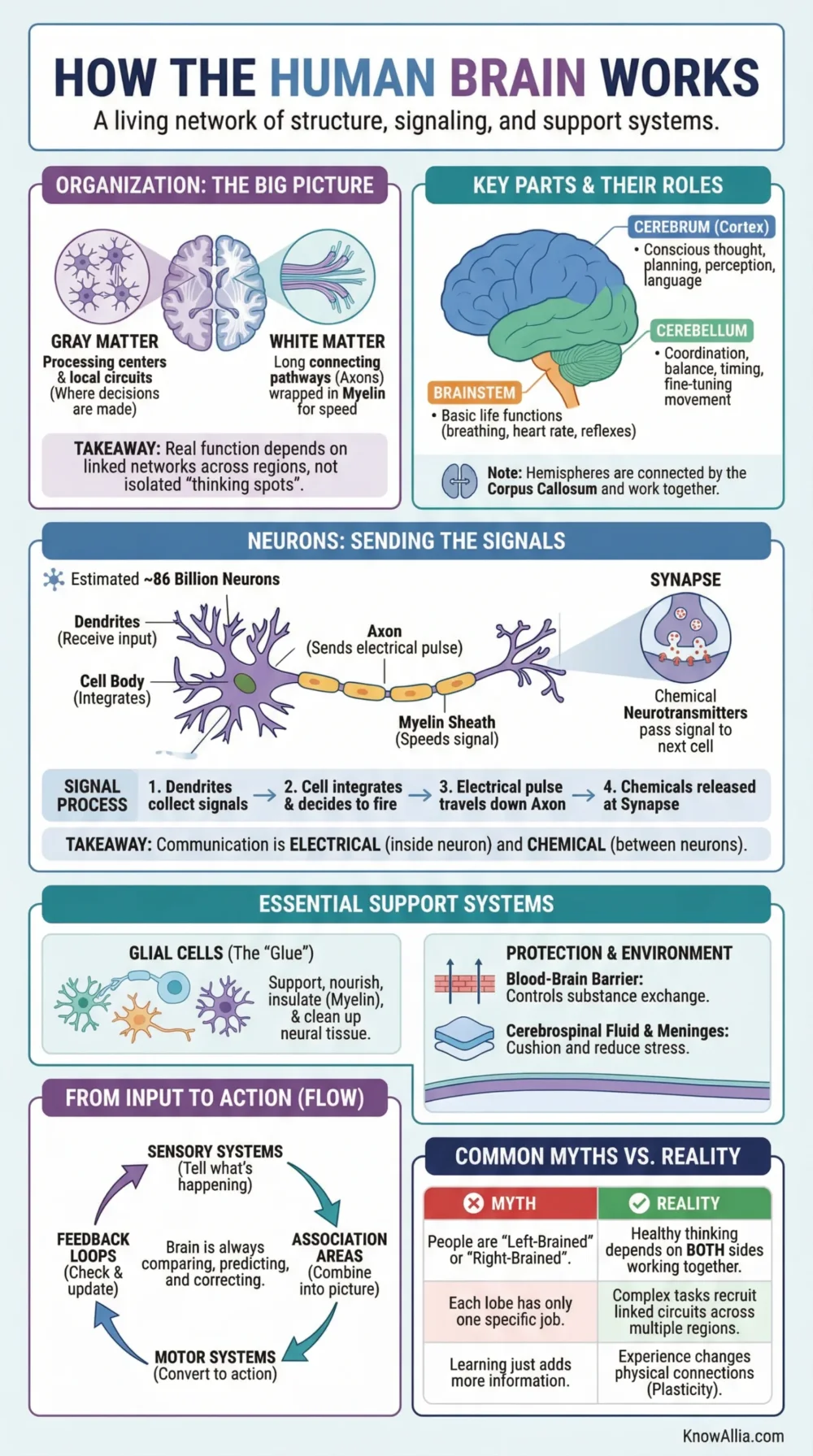
The human brain is the control organ of the nervous system. It receives signals from the body and the outside world, compares them with stored patterns, sends instructions, and keeps basic life functions running even when you are not thinking about them. It does this through connected regions, electrically active cells called neurons, and support cells that keep the whole system stable and fast.[a]
Start Here
The brain is not a stack of separate boxes. It is a living network in which structure, cell signaling, and support systems work together all the time. To understand how it works, it helps to look at three layers at once: the large parts you can name, the cells that carry signals, and the circuits that turn input into action.
- The outer and inner parts of the brain do different jobs, but they depend on each other.
- Neurons send messages, while glial cells help feed, insulate, protect, and tune the system.
- Learning is possible because connections can change with use, a property called plasticity.
You will see how the main brain regions fit together, how a neuron passes a message along, why gray matter and white matter are both needed, and where popular oversimplifications miss what actually happens.
- Cortex
- Brainstem
- Cerebellum
- Neurons
- Synapses
- Myelin
- Plasticity
Contents
How the Brain Is Organized
A useful way to think about the brain is to separate gray matter from white matter, then put them back together. Gray matter contains many neuron cell bodies and local processing areas. White matter contains long fibers, called axons, that connect one region to another and are often wrapped in myelin, which helps messages move faster.[d]
If gray matter is like the city blocks where decisions are made, white matter is the road system that lets those districts talk to each other. That analogy is simple, but it captures something important: the brain works because local processing and long-distance communication happen together.
Most explanations stop at “the brain has lobes.” That is only part of the picture. Real function depends on regions, cell types, and timing. A thought, a memory, or a movement is usually the product of several areas acting in sequence or in parallel, not one labeled spot working alone.
What the Main Parts Actually Do
The largest broad divisions are the cerebrum, the cerebellum, and the brainstem. Within the cerebrum sit the cortex and deeper relay and control centers. The brainstem links the brain to the spinal cord and handles many automatic life-sustaining jobs. The cerebellum fine-tunes movement and also helps with timing and prediction.[c]
| Region | Where It Sits | What It Mostly Helps With | What to Remember |
|---|---|---|---|
| Cerebral Cortex | Outer layer of the cerebrum | Perception, language, planning, voluntary movement, conscious thought | Different zones lean toward different tasks, but most real tasks use networks. |
| Frontal Lobe | Front of the cortex | Decision-making, attention, motor planning, speech production | Not just “personality”; it also helps turn intention into action. |
| Parietal Lobe | Upper rear cortex | Touch, body position, spatial awareness, sensory integration | It helps map where your body is and what it is touching. |
| Temporal Lobe | Side of the cortex | Hearing, language understanding, memory-related processing | It contributes to meaning, not only sound. |
| Occipital Lobe | Back of the cortex | Visual processing | Seeing begins here, but recognition draws on wider circuits. |
| Thalamus | Deep central region | Relay of sensory and motor information | It helps route signals rather than simply “passing them through.” |
| Hypothalamus | Below the thalamus | Temperature, hunger, thirst, hormone-linked control, daily rhythms | It connects the nervous system with body regulation. |
| Cerebellum | Back and lower part of the brain | Coordination, balance, timing, error correction during movement | It is smaller than the cerebrum but packed with neurons. |
| Brainstem | Base of the brain above the spinal cord | Breathing, heart rate, arousal, reflex control, relay to the body | It keeps basic life functions steady. |
| Corpus Callosum | Deep between the two hemispheres | Communication between left and right hemispheres | The hemispheres are linked, not isolated. |
One detail worth keeping in mind: textbook labels are helpful, but they are not hard walls. Reading, speaking, catching a ball, or recalling a face all recruit more than one region at a time.
How Neurons Send Messages
The human brain is commonly described as having about 86 billion neurons. That number is an estimate, not a household-style headcount, but it gives a realistic sense of scale.[i]
A neuron is a signal-carrying cell. Most neurons have three familiar parts: dendrites, which receive input; a cell body or soma, which handles the cell’s core functions; and an axon, which sends output to other cells. Neurons communicate at synapses, tiny junctions where one cell influences the next.[b]
- Dendrites collect incoming signals from many other neurons.
- The neuron integrates those inputs and decides whether to fire.
- An electrical pulse travels down the axon.
- At the synapse, chemical messengers called neurotransmitters are released.
- The next cell changes its own activity in response.
This is why brain communication is both electrical and chemical. The signal inside a neuron is electrical. The handoff between neurons is usually chemical. In daily life, that fast handoff is what lets you notice a sound, recognize it, and respond before you stop to narrate what happened.
From Input to Response
A brain signal usually moves through relay centers, local processing areas, and output pathways rather than one isolated point.
No Single “Thinking Spot”
Most behavior comes from linked circuits, not a lone area acting by itself.
Speed Has a Physical Basis
Fast signaling depends on axons, myelin, and good coordination between regions.
Support Cells Matter
Glial cells help make brain signaling stable, nourished, and repair-ready.
What Happens Between Input and Action
Take a simple example: a mug starts to slip from your hand. Visual and touch signals rise through sensory pathways. The brain compares that incoming information with body position and stored movement patterns. Motor areas send a correction, the cerebellum helps fine-tune timing and force, and descending pathways carry the final command to muscles. That whole sequence can feel immediate because the brain is built for fast, layered coordination.
- Sensory systems tell the brain what is happening.
- Association areas combine pieces into a usable picture.
- Motor systems convert that picture into action.
- Feedback loops check whether the action matched the goal.
This is one reason a clean “input area” and “output area” story is never enough. The brain is always comparing, predicting, correcting, and updating while signals move through it.
The Support Systems Many Articles Skip
Neurons get most of the attention, but they do not work alone. Glial cells help create the chemical conditions neurons need, support metabolism, form myelin, and take part in cleanup and immune defense. In the mature central nervous system, the main named groups are astrocytes, oligodendrocytes, and microglia.[f]
Why These Cells Matter
- Astrocytes help stabilize the local chemical environment around neurons.
- Oligodendrocytes wrap axons in myelin inside the brain and spinal cord.
- Microglia act as resident immune cells and help clear debris.
The brain also depends on physical protection and controlled exchange. The blood-brain barrier is a tightly regulated border that controls the movement of substances between blood and brain tissue, helping shield delicate neural tissue while still allowing needed nutrients through.[e]
Around that system sit the meninges and cerebrospinal fluid. Together they help cushion the brain, support buoyancy, and reduce mechanical stress inside the skull.[j]
A more complete picture of brain function: named regions matter, but support cells, myelin, blood supply, and protective barriers matter too. Leaving them out makes the brain look simpler than it is.
Where People Often Get Mixed Up
“Each Lobe Has One Job”
Too simple.
Some regions lean toward certain functions, but reading, planning, speech, and movement recruit linked circuits.
“Neurons Do Everything”
Not by themselves.
Glia help maintain signaling conditions, support myelin, and keep the tissue healthy enough for neurons to do their work.
“People Are Left-Brained or Right-Brained”
Not in that simple way.
The two hemispheres do show some specialization, but healthy human thinking depends on both sides working together.[h]
“Learning Just Adds More Information”
It also changes connections.
Experience can alter synaptic strength and circuit behavior, which is one reason practice matters.[g]
Terms Worth Knowing
- Cerebral Cortex
- The folded outer layer of the cerebrum, rich in gray matter and linked with perception, voluntary movement, language, and higher-order thinking.
- Neuron
- A specialized cell that receives input, processes it, and sends output to other cells.
- Synapse
- The junction where one neuron influences another cell, usually by releasing neurotransmitters.
- Neurotransmitter
- A chemical messenger used at synapses to change the activity of the next cell.
- Gray Matter
- Tissue that contains many neuron cell bodies and local processing circuits.
- White Matter
- Tissue made largely of axons, many of them myelinated, that link distant areas of the nervous system.
- Myelin
- A fatty insulating layer around certain axons that helps speed signal conduction.
- Glia
- Support cells that help nourish, insulate, protect, and regulate neural tissue.
- Plasticity
- The brain’s ability to change its connections or activity with experience, use, and learning.
What Science Still Cannot Draw With Sharp Edges
Brain science knows a great deal, but some boundaries remain fuzzy. The exact total number of neurons is still an estimate, brain functions often overlap across networks, and plasticity has real limits even though it is very real.[i]
- Maps of brain function are getting better, but they are not final.
- One named area rarely explains a full human ability on its own.
- Experience can reshape circuits, though not every function can move freely anywhere in the brain.
Seen from a distance, the brain looks like a set of labeled parts. Up close, it behaves more like a linked system of cells, pathways, and protective layers that are always exchanging information. That is what makes it so efficient: structure gives routes, neurons carry signals, and support systems keep the whole network workable.
FAQ
What is the brain’s main job?
The brain receives information, interprets it, makes decisions, sends commands, and keeps automatic body functions stable. It helps with movement, perception, memory, language, emotion, and basic life regulation.
What do neurons actually do?
Neurons receive input, integrate it, and send output. They pass signals through electrical activity inside the cell and chemical signaling at synapses.
What is the difference between gray matter and white matter?
Gray matter contains many neuron cell bodies and local processing networks. White matter contains long axons that connect distant regions, often wrapped in myelin to help signals travel faster.
Does each hemisphere have its own separate personality or thinking style?
No. The two hemispheres do have some specialization, but most normal human thinking and behavior depend on both sides working together through connecting pathways such as the corpus callosum.
Why is myelin important?
Myelin insulates many axons and helps electrical signals move more efficiently. That makes long-range communication across the nervous system faster and more reliable.
How does the brain change when you learn something?
Learning can alter the strength of synapses and the behavior of circuits. Repeated use, attention, sleep, and practice all help shape those changes over time.
Sources
- [a] National Institute of Neurological Disorders and Stroke – Brain Basics: Know Your Brain — Used for the overall definition of how the brain works and the broad structure overview.
- [b] National Institute of Neurological Disorders and Stroke – Brain Basics: The Life and Death of a Neuron — Used for neuron structure, signaling basics, and synapses.
- [c] NCBI Bookshelf – Major Structures and Functions of the Brain — Used for the main large-scale regions, including the brainstem and survival-related control.
- [d] MedlinePlus – White Matter of the Brain — Used for white matter, axons, and myelin-related explanation.
- [e] National Institute of Neurological Disorders and Stroke – Glossary of Neurological Terms — Used for the blood-brain barrier definition and protective exchange control.
- [f] NCBI Bookshelf – Neuroglial Cells — Used for astrocytes, oligodendrocytes, microglia, and their support roles.
- [g] NCBI Bookshelf – Synaptic Plasticity as a Model for Learning and Memory — Used for learning-related changes in synaptic connections.
- [h] BrainFacts – Are People Either “Right-Brained” or “Left-Brained”? — Used for the section on hemisphere myths and oversimplified labels.
- [i] NIH Research Matters – Scientists Build Largest Maps to Date of Cells in Human Brain — Used for the current “about 86 billion neurons” scale reference.
- [j] NCBI Bookshelf – Anatomy, Central Nervous System — Used for the protective role of the skull, meninges, cerebrospinal fluid, and related support context.