A Clear Starting Point
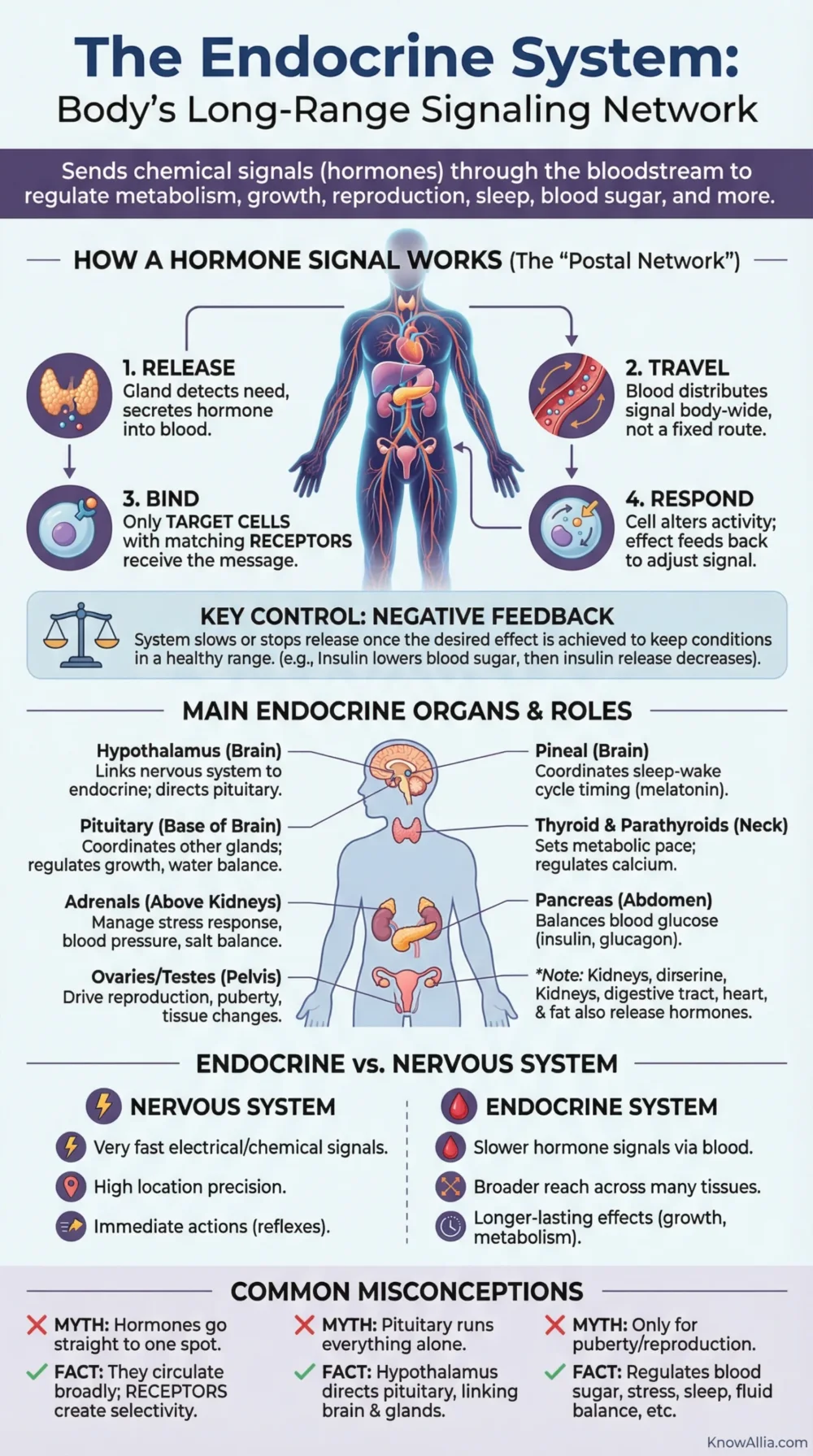
The endocrine system is the body’s long-range signaling network. It releases hormones into the bloodstream, and those hormones change what selected cells do when the cells carry the right receptor.[a][c]
That sounds simple, but the logic is elegant. A gland sends a message, blood distributes it, target cells read it, and feedback loops decide whether the message should rise, fall, or stop.[g]
The endocrine system is a network of glands, organs, and hormone-making tissues that sends chemical signals through the blood. Those signals help regulate metabolism, growth, reproduction, fluid balance, sleep timing, blood sugar, blood pressure, and many day-to-day adjustments that keep the body steady.[a][b][f]
You will see how hormone messages are made, how target cells read them, why the endocrine and nervous systems work as a pair, and where people often get confused. You will also see why a simple list of glands is not enough to explain how hormone signaling really works.
What the Endocrine System Is
The endocrine system has three linked parts: the glands or tissues that release hormones, the hormones themselves, and the target cells that can read those messages.[c] Hormones are chemical messengers, not electrical impulses. They move through the bloodstream, so they can reach many parts of the body at once.[a][c]
This is one reason the system is so useful. A pancreas does not need a separate wire to every muscle and liver cell when blood sugar rises. It can release insulin into the blood, and cells with the right receptor can respond across the body.[c][f]
- Chemical Signaling
- Bloodstream Delivery
- Receptor Selectivity
- Feedback Control
- Brain–Gland Coordination
The part worth keeping in mind is how the message gains precision. Blood carries a hormone almost everywhere, but only receptive cells can act on it. That is what makes a body-wide delivery system behave with local accuracy.[c][d]
How a Hormone Signal Works
A hormone message usually follows the same path, even when the hormone and target organ change.
- A gland or hormone-making tissue detects a need — such as high blood sugar, low calcium, stress, or a signal from the brain.[f][g]
- The hormone enters the bloodstream and circulates widely rather than traveling on a fixed route.[a][c]
- Target cells bind the hormone through receptors on the cell surface or inside the cell.[d]
- The cell changes its activity, and that change often feeds back into the system so the signal can be adjusted.[g]
A useful analogy: the endocrine system works less like a phone call and more like a postal network. The bloodstream is the delivery route, the hormone is the message, and the receptor is the address label that tells a cell, “This message is for you.”
How a Hormone Message Moves Through the Body
One signal can travel widely, but only cells with the matching receptor can read it and change their behavior.
Wide Delivery, Selective Effect
Hormones do not steer themselves to a destination. Receptors are what make the message selective.
Different Speeds
Some hormone effects start quickly, while others take longer because they alter protein production or gene activity.
Many Tissues, One Logic
The same signaling pattern can regulate blood sugar, sleep timing, growth, stress responses, and reproduction.
Lists of glands are useful, but they do not show the actual logic of signaling: release, distribution, receptor binding, and feedback.
The Main Organs and What They Do
Classic gland lists usually include the pituitary, thyroid, parathyroids, adrenals, pancreas, pineal gland, ovaries, and testes. That is correct, but it is not the whole story. The hypothalamus links the endocrine and nervous systems, and other organs such as the kidneys and parts of the digestive tract also release hormones.[b][f]
| Organ or Tissue | Example Hormones | Main Signaling Role |
|---|---|---|
| Hypothalamus | Releasing and inhibiting hormones; also makes oxytocin and vasopressin that are stored and released through the posterior pituitary | Links the brain to endocrine control and tells the pituitary when to raise or lower other hormone signals.[b][e] |
| Pituitary Gland | Growth hormone, ACTH, TSH, LH, FSH, prolactin; releases oxytocin and vasopressin from the posterior lobe | Coordinates other glands and helps regulate growth, reproduction, lactation, and water balance.[b][e] |
| Thyroid Gland | T4 and T3 | Helps set metabolic pace and supports growth, development, and energy use.[f] |
| Parathyroid Glands | Parathyroid hormone | Helps keep blood calcium within range.[b] |
| Adrenal Glands | Cortisol, aldosterone, epinephrine, norepinephrine | Help regulate stress responses, blood pressure, salt and water balance, and glucose handling.[b][f] |
| Pancreas | Insulin and glucagon | Balances blood glucose by pushing it down or raising it when needed.[b][f] |
| Pineal Gland | Melatonin | Helps coordinate timing cues linked to the sleep-wake cycle.[b][e] |
| Ovaries and Testes | Estrogen, progesterone, testosterone | Shape puberty, reproduction, and many tissue-level changes in bone, muscle, and reproductive organs.[b] |
| Kidneys and Digestive Tract | Renin, erythropoietin, gastrin, ghrelin | Show that endocrine signaling is broader than the classic gland list and also helps control blood pressure, red cell production, digestion, and appetite.[b] |
That last row matters because hormone signaling is more distributed than a short gland list suggests. The body uses classic glands, mixed-function organs, and local hormone-making tissues to coordinate internal conditions.[b]
Why Only Some Cells Respond
A hormone can circulate almost everywhere and still affect only selected tissues because target cells carry the matching receptor. Without that receptor, the message passes by with little or no effect.[c][d]
A cell does not respond just because a hormone is present. It responds because a receptor binds that hormone and starts a change inside the cell. With many protein and peptide hormones, the receptor sits on the cell surface and triggers an internal chain reaction. With many steroid hormones, the hormone can move through the cell membrane and bind a receptor inside the cell, often affecting gene activity more directly.[d]
The same hormone can also produce different outcomes in different tissues. That happens because tissues can carry different receptor amounts, different receptor types, or different downstream machinery. In plain terms, the message may be the same, but the receiving equipment is not.[c][d]
A Practical Example
Insulin is a clear example of selective signaling. It enters the blood broadly, but its best-known metabolic effects depend on responsive tissues such as liver, muscle, and fat. Those tissues do not all handle the message in exactly the same way, yet the same hormone helps coordinate a shared result: bringing blood glucose back toward a healthier range.[f]
How the Body Keeps Hormones in Range
Hormone control is rarely a one-way command. Most systems use negative feedback. When the hormone effect has done enough, the system slows down or stops further release. That is how the body avoids drifting too far in one direction.[g][f]
Examples are easier to remember than definitions. When blood sugar rises, insulin release helps bring it down. When blood sugar falls, glucagon helps move it back up. Calcium control and many brain-pituitary-gland pathways also depend on feedback logic.[g][f]
Positive feedback exists too, but it is less common and usually tied to short, bounded events. Oxytocin during labor is a classic example: pressure leads to more oxytocin release, which strengthens contractions, which creates more pressure, until the event ends and the loop breaks.[g]
Feedback is why hormone control should not be pictured as a simple on/off switch. The body is always measuring, comparing, and adjusting.
How This System Works With the Nervous System
The endocrine and nervous systems are the body’s two major communication networks. They do different jobs well, and they often work together rather than separately.[c][b]
Nervous System
- Very fast electrical and chemical signaling
- High location precision
- Well suited for immediate actions such as balance, reflexes, and rapid responses[c]
The hypothalamus is the clearest bridge between the two. It is part of the brain, yet it helps direct hormone output by controlling the pituitary. That is why many hormone pathways are best understood as brain-and-gland circuits, not as isolated glands working on their own.[b][e]
Common Misconceptions and Mix-Ups
- “Hormones go straight to the right place.” Not exactly. They circulate broadly. Receptors are what create selectivity.[c][d]
- “Hormones are always slow.” They are slower than nerve impulses as a system, but some hormone effects begin quickly. The broader point is that endocrine effects often last longer and can shape many tissues at once.[a][c]
- “The pituitary runs everything by itself.” The pituitary matters a lot, but the hypothalamus helps direct it and links endocrine control to the nervous system.[b][e]
- “The endocrine system is mostly about puberty and reproduction.” It also helps regulate blood sugar, sleep timing, fluid balance, blood pressure, metabolism, growth, and stress responses.[a][f]
- “Only classic glands matter.” The pancreas, kidneys, and digestive tract also release hormones, so the signaling network is broader than the textbook gland list many people memorize first.[b]
Terms Worth Knowing
- Hormone
- A chemical messenger released by cells into body fluids, usually blood, to change the activity of other cells or tissues.[a]
- Endocrine Gland
- A gland that releases hormones directly into the bloodstream rather than through a duct.[b]
- Target Cell
- A cell that can respond to a hormone because it has the matching receptor.[c]
- Receptor
- A protein on or inside a cell that binds a hormone and starts a biological response.[d]
- Negative Feedback
- A control pattern in which the outcome of a process slows or stops further action, helping keep internal conditions in range.[g]
- Positive Feedback
- A shorter-lived loop in which the outcome of a process strengthens the next round of signaling, as in labor-related oxytocin release.[g]
- Peptide or Protein Hormone
- A hormone that usually binds receptors on the cell surface and starts a signaling cascade inside the cell.[d]
- Steroid Hormone
- A hormone derived from cholesterol that can often enter cells and bind receptors inside them.[d]
What Is Still Being Studied
Not every part of endocrine biology is mapped with the same level of detail. The broad rules of hormone signaling, target-cell receptors, and feedback control are well established. Still, researchers are still studying some finer points, including the full range of functions linked to the pineal gland and melatonin beyond their best-known role in timing and sleep-related rhythms.[e]
There is also ongoing work on how different tissues tune the same hormone signal in slightly different ways. That does not change the basics. It simply means the body’s messaging system is layered, and some parts are clearer than others.
If you keep one idea in mind, make it this: hormones are not random chemicals drifting through the body. They are timed messages sent through blood, read by receptors, shaped by feedback, and tied closely to the brain and other organs. That is how the body sends signals without relying on wires alone.
FAQ
What is the main job of the endocrine system?
How are hormones different from nerve signals?
Why does one hormone not affect every cell in the body?
Is the pituitary really the “master gland”?
Do only glands make hormones?
No. Classic endocrine glands matter, but other organs and tissues also release hormones. Examples include the pancreas, kidneys, and parts of the digestive tract.[b]
What does negative feedback mean in simple terms?
It means the body reduces a hormone signal once enough effect has been produced. This helps keep internal conditions within a healthy range instead of letting them keep rising or falling without control.[g]
Sources
- [a] MedlinePlus – Hormones | Endocrine Glands — definitions of hormones, major endocrine glands, and the idea that small hormone amounts can produce large effects.
- [b] Cleveland Clinic – Endocrine System: What It Is, Function, Organs & Diseases — endocrine organs, endocrine-related tissues, and how target cells receive hormone messages.
- [c] Society for Endocrinology – Endocrine System: KS4 — how hormones act as chemical messengers, how the endocrine and nervous systems differ, and why target cells matter.
- [d] Society for Endocrinology – Why Do We Need Hormones? — receptor action, chain reactions inside cells, and the difference between protein and steroid hormone signaling.
- [e] Endocrine Society – Brain Hormones — hypothalamus-pituitary control and current limits around the full role of the pineal gland and melatonin.
- [f] US EPA – Overview of the Endocrine System — thyroid, adrenal, pancreas, and whole-body roles of endocrine signaling across life stages.
- [g] Society for Endocrinology – Feedback Loops — negative feedback, positive feedback, and simple examples such as insulin, glucagon, and oxytocin.