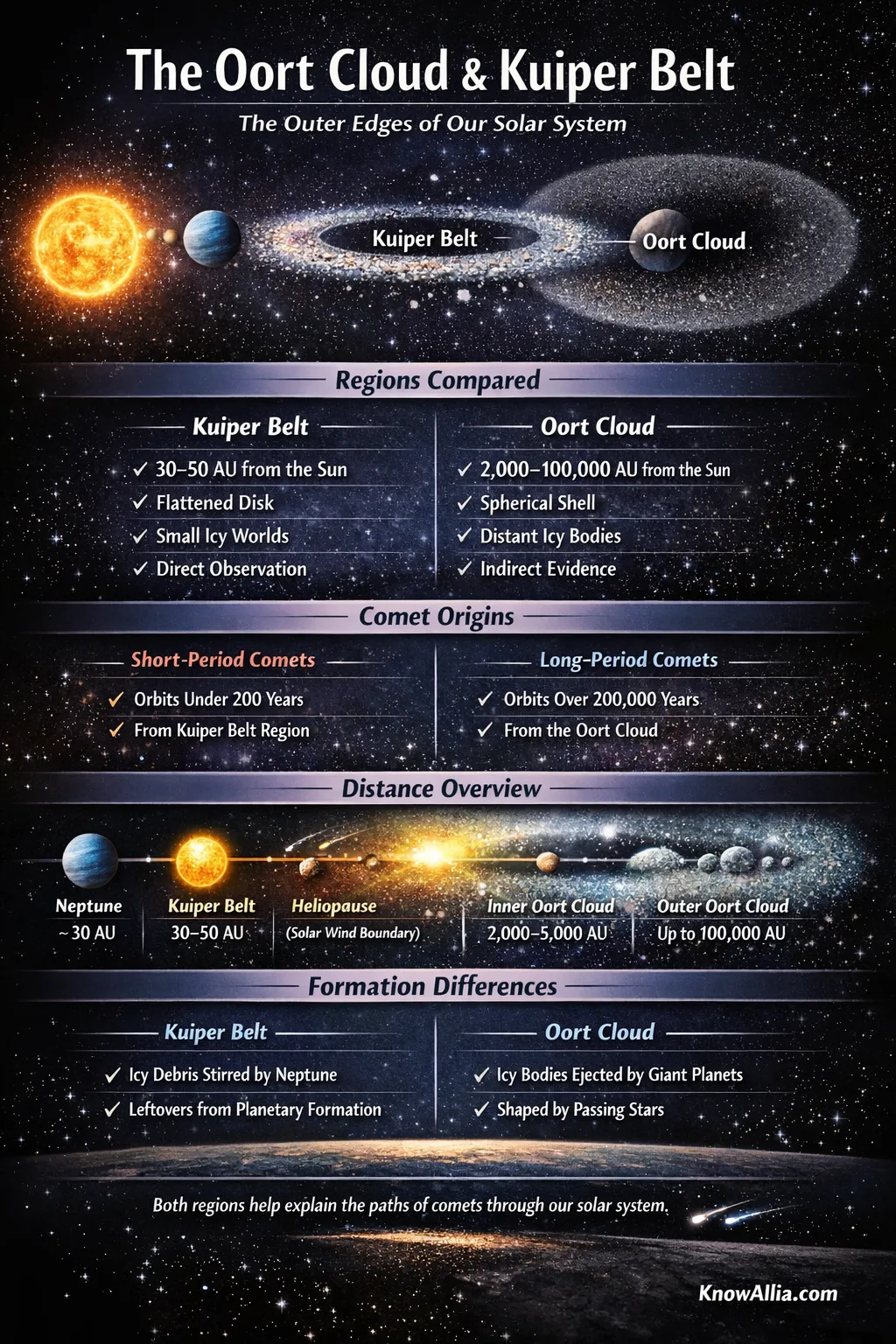
The Kuiper Belt is a broad disk of icy bodies beyond Neptune, while the Oort Cloud is a far larger spherical shell of icy objects far beyond that. Together, they mark the outer small-body reservoirs of the solar system and help explain where many comets come from.[a][b]
A Clear Starting Point
The Kuiper Belt is observed directly through telescopes and spacecraft data. The Oort Cloud is still a strongly supported idea rather than a photographed place, because it is so remote and its objects are so dim.[h]
- The main Kuiper Belt lies roughly 30 to 50 AU from the Sun, with the scattered disk reaching much farther outward.[a]
- The Oort Cloud is thought to begin a few thousand AU away and extend perhaps to 100,000 AU.[b]
- These regions matter because they preserve old material and help explain the different paths of short-period and long-period comets.[c]
This article explains how these regions differ in shape, distance, formation, and evidence, and why the phrase “edge of the solar system” has more than one valid meaning.
- Trans-Neptunian Objects
- Dwarf Planets
- Scattered Disk
- Long-Period Comets
- Neptune Migration
- Heliopause
What They Are
The Kuiper Belt is a thick, doughnut-like region beyond Neptune filled with icy worlds, dwarf planets, and smaller debris. Pluto belongs here, and so does Arrokoth, the small red object visited by New Horizons in 2019. Because these bodies are close enough to detect directly, the Kuiper Belt is an observed part of the solar system rather than a purely inferred one.[e]
The Oort Cloud, by contrast, is thought to be a huge spherical shell surrounding the Sun, the planets, and the Kuiper Belt. Scientists infer its existence from the orbits of long-period comets and from models of how the early solar system scattered icy leftovers outward. NASA states plainly that it has no direct images of the Oort Cloud.[h]
What We Can Study Directly
The Kuiper Belt can be traced with telescopes, orbital surveys, and spacecraft results. Its overall shape, many of its members, and broad orbital families are known from direct observation.[a]
What We Infer From Motion
The Oort Cloud is supported by comet trajectories and solar-system dynamics. Its distance, inner structure, and total population remain estimates rather than a full census.[b]
Main Differences
The shortest way to separate these regions is to compare geometry, distance, orbital behavior, and how we know they are there.
- Shape: the Kuiper Belt is a flattened disk; the Oort Cloud is a three-dimensional shell around the solar system.[a][b]
- Distance: the Kuiper Belt starts near Neptune at about 30 AU, while the Oort Cloud is thought to begin thousands of AU away.[a][b]
- Orbital Pattern: Kuiper Belt objects still broadly follow the solar system’s flattened plane, while Oort Cloud objects can arrive from almost any direction.[b]
- Evidence: the Kuiper Belt is observed; the Oort Cloud is inferred from comet paths and dynamical modeling.[h]
The comparison above uses NASA’s current distance summaries for the main Kuiper Belt, the heliopause, and the Oort Cloud. It also reflects the difference between a region we can observe directly and one we mostly reconstruct from orbital evidence.[d]
| Region | Typical Distance From the Sun | Overall Shape | What It Contains | Comet Connection | How It Is Studied |
|---|---|---|---|---|---|
| Kuiper Belt | About 30–50 AU for the main belt; the scattered disk reaches much farther | Thick disk or doughnut | Pluto, Arrokoth, many small icy worlds, several dwarf planets | Associated with many short-period comets, especially through the more disturbed outer populations | Direct observation by telescopes and spacecraft |
| Oort Cloud | Often described as beginning around 2,000–5,000 AU and extending perhaps to 100,000 AU | Spherical shell | Vast numbers of distant icy bodies, mostly unseen individually | Best-known source of long-period comets | Inferred from comet orbits and solar-system dynamics |
How Distance Changes the Outer Solar System
These regions are often placed in one sentence, but they sit on very different scales. The Kuiper Belt is outer solar-system terrain. The Oort Cloud belongs to the Sun’s far gravitational outskirts.
The modern planetary system ends here in a simple planet-by-planet sense.
~30 AU
A wide disk of icy objects, dwarf planets, and debris beyond Neptune.
~30–50 AU
The Sun’s particle bubble ends here; interstellar space begins beyond it.
~120 AU
A distant zone often described as the start of the Sun’s outer comet reservoir.
~2,000–5,000 AU
The Sun’s gravity still matters here, but outside influences grow much stronger.
Up to ~100,000 AU
One useful comparison: sunlight reaches Neptune in about 4.5 hours, the heliopause in about 17 hours, and the inner Oort region only after many more days.
What the Kuiper Belt Preserves
Many objects there have stayed cold and lightly altered, so they preserve early outer-solar-system material.
Why the Oort Cloud Is Hard to Picture
Its bodies are tiny, dark, and spread across a huge volume, so the cloud is not mapped the way the Kuiper Belt is.
Why These Distances Matter
The farther out you go, the less the story is about planets alone and the more it is about the Sun’s gravity, passing stars, and galactic tides.
The distance ladder in the infographic combines NASA’s current summaries for the Kuiper Belt, the heliopause, and the Oort Cloud. The values are rounded because these boundaries are described as ranges rather than crisp lines.[a][b][f]
How They Formed
Both regions are tied to the early solar system, but they were not shaped in the same way. The Kuiper Belt is usually described as leftover icy material that never merged into a full planet because Neptune’s gravity stirred the region too strongly. The Oort Cloud is thought to be made of icy bodies that formed much closer in and were later thrown outward by the giant planets, then settled into distant orbits under the extra pull of passing stars and the Milky Way’s tidal field.[a][b]
That difference matters. The Kuiper Belt is not just a remote storage ring. It is also a record of planetary migration. NASA’s current summary of the region explains that the outward movement of the giant planets, especially Neptune, helped place icy bodies into the orbital families seen today, while Jupiter flung many others into distant space or out of the solar system entirely.[a]
Arrokoth is a useful example because it appears to preserve a very gentle formation history. New Horizons data suggest that its two lobes formed close together and merged at low speed, which tells us that at least some Kuiper Belt bodies kept an unusually calm early record.[e]
One often-missed point: the Kuiper Belt does not simply “turn into” the Oort Cloud as a neat, continuous band. Between them lie more complex orbital populations, including the scattered disk and detached objects. That makes the outer solar system look less like a single shelf and more like layered neighborhoods with different histories.
Sedna sits in this gray area. It is often discussed as a possible inner Oort Cloud object because its orbit is so distant and unusual, but that placement is still part of an active scientific discussion rather than a settled label.[g]
Comets and Paths
Many pages reduce the story to “Kuiper Belt equals comets” and “Oort Cloud equals comets,” but the details are more useful than that. In broad terms, short-period comets are linked to the trans-Neptunian region beyond Neptune, while long-period comets are linked to the Oort Cloud. The distinction comes from orbital period, orbital tilt, and the direction from which these objects enter the inner solar system.[c][b]
- Short-Period Comets return in less than 200 years and are tied to the outer solar system beyond Neptune.[c]
- Long-Period Comets can take thousands, even millions, of years to complete one orbit and are best explained by the Oort Cloud.[c]
- Direction Matters: Oort Cloud comets can approach from almost any angle because the cloud is thought to be spherical rather than flattened.[b]
Two examples NASA uses are C/2012 S1 (ISON) and C/2013 A1 Siding Spring, both tied to the long-period population. ISON broke apart during its close solar passage; Siding Spring survived its trip inward and will not return for roughly 740,000 years.[b]
This is also where the scattered disk becomes useful. The main Kuiper Belt is only part of the outer trans-Neptunian picture. The more disturbed outer populations provide a better pathway for sending icy bodies inward, which helps explain why a simple flat belt alone does not tell the whole comet story.[a]
Where the Edge Is
Think of the solar system less like a fence and more like overlapping zones of influence. If you mean the outer limit of the major planets, you stop near Neptune and the Kuiper Belt. If you mean the end of the Sun’s outward solar wind bubble, you stop at the heliopause. If you mean the far reach of the Sun’s gravity, you are talking about the Oort Cloud.[d]
That distinction is worth keeping because the phrase “outer edge of the solar system” is often used too loosely. Voyager 1 and Voyager 2 crossed into interstellar space in 2012 and 2018 by passing beyond the heliosphere, but they have not reached the Oort Cloud. NASA notes that Voyager 1 would need about 300 years even to enter the Oort Cloud, and about 30,000 years to pass out the far side.[f][b]
Where Confusion Starts
- The Kuiper Belt Is the Final Boundary of the Solar System.
- Only in a limited, planet-centered sense. The Sun’s particle bubble ends farther out, and the Sun’s gravitational reach extends much farther still.[d]
- The Oort Cloud Has Been Photographed.
- No. Scientists support it strongly, but they do not yet have direct images of the cloud as a mapped structure.[h]
- All Outer-Solar-System Comets Come From One Place.
- No. The broad trans-Neptunian region and the Oort Cloud are linked to different comet populations and different orbital patterns.[c]
- The Space Between the Kuiper Belt and Oort Cloud Is Empty.
- No. Detached objects, the scattered disk, and transitional populations show that the outer solar system is structured rather than blank.[a][g]
Terms Worth Knowing
- Astronomical Unit (AU)
- The average distance between Earth and the Sun. It is the standard ruler for distances inside the solar system.
- Trans-Neptunian Object (TNO)
- Any natural body orbiting the Sun beyond Neptune. Kuiper Belt objects are one major branch of this larger family.[a]
- Scattered Disk
- A more extended and dynamically disturbed outer population that overlaps the outer Kuiper Belt and stretches much farther away from the Sun.[a]
- Long-Period Comet
- A comet with an orbital period longer than 200 years, usually linked to the Oort Cloud.[c]
- Heliopause
- The outer boundary of the heliosphere, where the Sun’s outward flow meets interstellar space.[f]
What the Evidence Supports — and What It Does Not
The broad picture is strong: a directly observed Kuiper Belt, a strongly supported but still unseen Oort Cloud, and a comet record that fits those reservoirs well. Even so, a few parts remain open.
- The exact outer limit of the Oort Cloud is not pinned down.
- The inner Oort region and its boundary with detached or scattered populations are still being worked out.
- The total number of bodies in both regions is estimated, not counted object by object.
- The possibility that the Oort Cloud contains some captured extrasolar material is discussed in current models, but it is not settled fact.[b]
Seen together, the Kuiper Belt and Oort Cloud are not just faraway storage zones. They are the solar system’s long-memory archives: one close enough to inspect in detail, the other distant enough that we still read it mostly through the comets it sends inward.
Questions Readers Often Have
FAQ
Is the Kuiper Belt the End of the Solar System?
Not in every sense. It is near the outer edge of the major planetary system, but the heliosphere reaches farther, and the Sun’s gravitational reach extends farther still into the Oort Cloud.
Has the Oort Cloud Ever Been Seen Directly?
No. The Oort Cloud is a well-supported scientific idea based on comet orbits and dynamical models, but it has not been imaged as a directly mapped structure.
Why Is the Oort Cloud Round While the Kuiper Belt Is Flat?
The Kuiper Belt still reflects the flattened plane of the solar system. The Oort Cloud is thought to have been reshaped over long spans of time by gravitational nudges from the giant planets, passing stars, and galactic tides, which produce a much more spherical distribution.
What Is the Scattered Disk?
It is a more extended, more dynamically disturbed outer population that overlaps the outer Kuiper Belt and reaches much farther from the Sun. It helps connect the flat trans-Neptunian region with the solar system’s broader comet story.
Is Pluto Part of the Kuiper Belt?
Yes. Pluto is one of the best-known Kuiper Belt worlds and remains central to how astronomers explain the outer trans-Neptunian region.
Could Sedna Belong to the Inner Oort Cloud?
Possibly. Sedna is often discussed that way because of its extreme orbit, but its exact placement remains part of ongoing scientific work.
Sources
- NASA Science – Kuiper Belt: Facts — Distances, structure, scattered disk, and the role of Neptune in shaping the region. ↩
- NASA Science – Oort Cloud: Facts — Distance ranges, likely formation, spherical geometry, and long-period comet origin. ↩
- NASA Science – Comet Facts — Short-period versus long-period comets and the broad connection to outer reservoirs. ↩
- NASA Science – Where Is the Edge of the Solar System? — Why the solar system has more than one meaningful outer boundary. ↩
- NASA – New Horizons Team Uncovers a Critical Piece of the Planetary Formation Puzzle — What Arrokoth reveals about gentle early growth in the Kuiper Belt. ↩
- NASA Science – Interstellar Mission — Voyager, the heliopause, and the difference between interstellar space and the Oort Cloud. ↩
- Caltech – Sedna (2003 VB12) — Sedna’s unusual orbit and why it is often discussed in relation to the inner Oort region. ↩
- NASA Science – Oort Cloud — Overview page noting the cloud’s broad geometry and the lack of direct images. ↩