The Big Picture
The human digestive system is a coordinated passage of organs and helper glands that turns food into absorbable molecules, moves those molecules into blood or lymph, and removes what the body does not use.
Most short explainers stop at naming organs. The fuller story is about movement, timed chemical handoffs, selective absorption, and the quiet work of the small intestine, liver, pancreas, gallbladder, nerves, hormones, and gut bacteria.
- Where each stage starts, what changes there, and what moves forward next
- Why the small intestine is the main absorption site, not the stomach
- How bile, enzymes, blood flow, lymph flow, and motility shape the final result
The digestive system is a long, connected tract from the mouth to the anus, plus solid organs that add digestive fluids along the way. Its job is not only to break food apart, but also to decide what can cross into the body, where those molecules travel next, and what should leave as stool.[a]
You will see how a bite of food becomes a bolus, then chyme, then simple sugars, amino acids, fatty acids, and other small units the body can use. You will also see why digestion, absorption, and transport are three different jobs, even though many articles blur them together.
What This Article Covers
This article follows the process in order, explains what each organ adds, clears up common mix-ups, and shows where broad rules end and person-to-person variation begins. The aim is clarity: not more words, just better ones.
Step-by-Step Process
The sequence below follows a normal meal through the body. The order is stable. What changes from person to person is mostly the speed, not the map.[a]
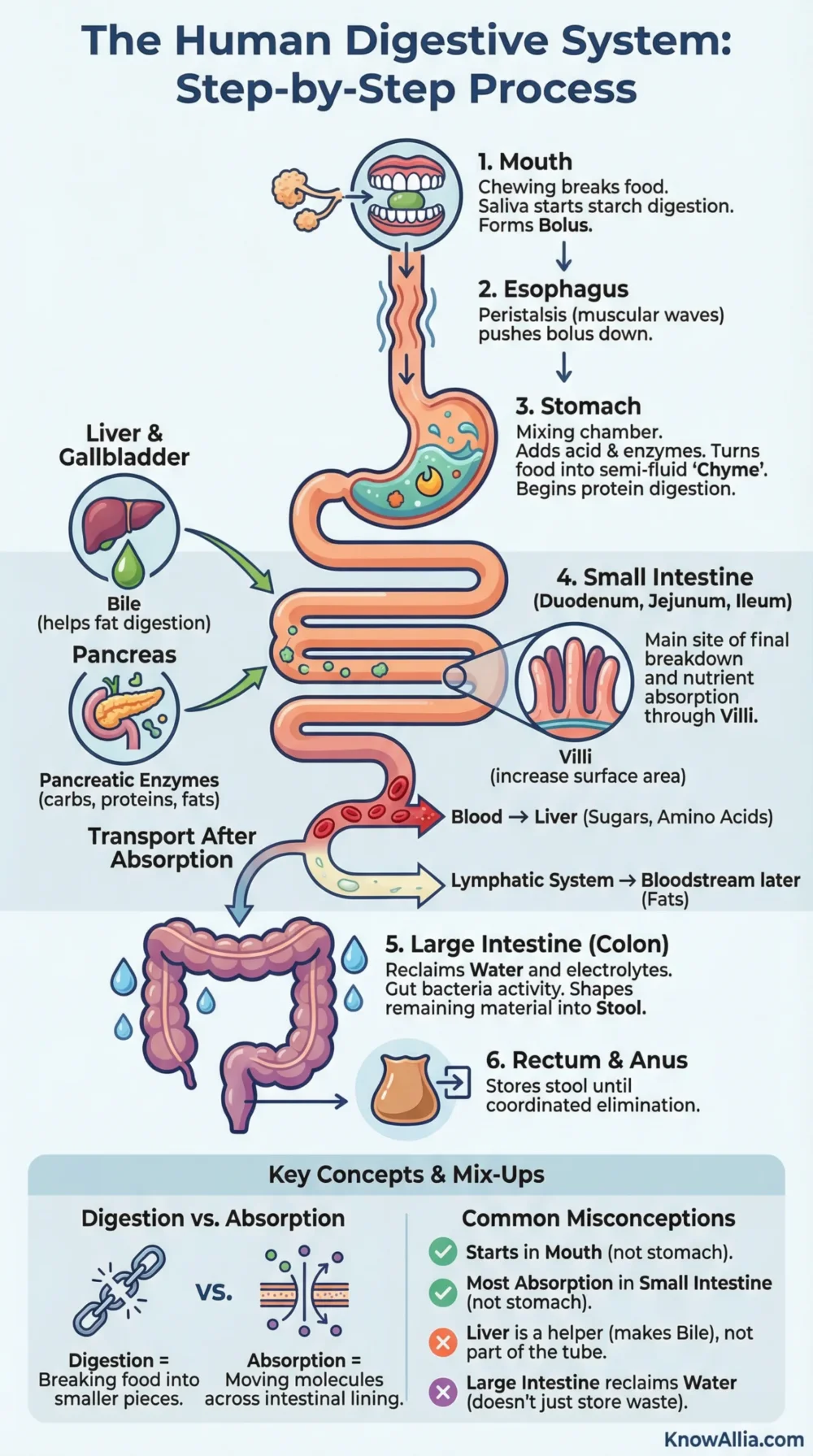
- Mouth: Digestion starts the moment food enters the mouth. Teeth break it into smaller pieces, the tongue positions it, and saliva moistens it so swallowing is easier. Saliva also begins the digestion of starch, so chemistry starts before the food ever reaches the stomach.[a]
- Swallowing and Esophagus: The tongue pushes food backward, the epiglottis helps keep it out of the airway, and the food moves into the esophagus. From there, peristalsis pushes it downward in coordinated waves rather than by gravity alone.[b]
- Stomach: The stomach acts as a muscular mixing chamber. It stores incoming food for a time, adds acid and enzymes, and churns the meal until it becomes a semi-fluid mixture called chyme. This stage matters a lot for protein digestion and for turning a solid meal into something the small intestine can handle.[f]
- Duodenum: This first part of the small intestine receives chyme from the stomach, bile from the liver and gallbladder, and enzyme-rich juice from the pancreas. Bile helps with fat digestion, while pancreatic enzymes work on carbohydrates, proteins, and fats.[c][d]
- Jejunum and Ileum: Most chemical breakdown finishes here, and this is where the body does most of its harvesting. The inner surface of the small intestine is covered with villi, which expand the absorptive area and help move nutrients into circulation.[h]
- Transport After Absorption: Once nutrients cross the intestinal lining, they do not all take the same road. Simple sugars and amino acids move into blood and then toward the liver, while many fat products are packaged and routed into the lymphatic system first.[e][a]
- Large Intestine: By the time material reaches the colon, most nutrient absorption is already over. The large intestine mainly reclaims water and electrolytes, supports bacterial activity, and reshapes the leftover material into stool. Gut bacteria here also help produce certain vitamins, including vitamin K, and the colon absorbs some of what they make.[i]
- Rectum and Anus: The rectum stores stool until coordinated muscular action allows elimination. This is the last step of the process, but it depends on everything upstream having moved in the right order.[a]
One helpful analogy: digestion works more like a relay than a blender. Each segment changes the meal in its own way, then passes it forward. No single organ does everything.
How Food Changes Form as It Moves Through the Body
The digestive system does not treat a meal as one single object. It changes the meal step by step, turning it from a chewable mass into absorbable molecules and then into the leftover material that leaves the body.
Bolus
In the mouth, chewing and saliva turn food into a soft mass that is easy to swallow.
- Mechanical breakdown begins
- Saliva starts starch digestion
- The tongue helps shape and move it
Chyme
In the stomach, acid, enzymes, and muscular mixing turn the meal into a semi-fluid mixture.
- Protein digestion becomes active
- Food is mixed, stored, and released in portions
- The pyloric sphincter controls exit
Absorbable Units
In the small intestine, bile and pancreatic enzymes help reduce food to molecules that can cross the intestinal wall.
- Carbohydrates → simple sugars
- Proteins → amino acids
- Fats → fatty products for absorption
Residue and Stool
In the large intestine, water is reclaimed and the remaining material is shaped into stool for elimination.
- Water and electrolytes are reclaimed
- Bacterial activity continues
- The rectum stores stool before release
Where Most Absorption Happens
The small intestine is the main site where nutrients cross into the body.
Why Helper Organs Matter
The liver, pancreas, and gallbladder are not side notes. Without their secretions, digestion would be incomplete.
Why the Colon Still Matters
Even after most nutrients are absorbed, the colon still manages water balance, bacterial activity, and stool formation.
Where the Work Happens
Many pages describe digestion as if it were one long blur. It is easier to understand when each segment is matched with its main task, the fluid it adds, and the form that food takes at that moment.
| Site | Main Job | What Gets Added or Changed | What Happens Next |
|---|---|---|---|
| Mouth | Chewing and early chemical digestion | Saliva moistens food and starts breaking down starch | Food becomes a bolus and is swallowed |
| Esophagus | Propulsion | No major digestive juice is added here | Peristalsis moves the bolus into the stomach |
| Stomach | Mixing, storage, and acid-driven digestion | Acid and enzymes begin more protein digestion | The meal becomes chyme |
| Duodenum | Chemical handoff | Bile and pancreatic juice enter | Fats, proteins, and carbohydrates are broken down further |
| Jejunum and Ileum | Absorption | Digested molecules cross through villi into blood or lymph | Nutrients leave the gut wall and enter circulation |
| Large Intestine | Water recovery and stool formation | Bacterial activity continues; water and electrolytes are reclaimed | Residue thickens into stool |
| Rectum and Anus | Storage and elimination | Stool is held until release is coordinated | The process ends with defecation |
Digestion, Absorption, and Transport Are Not the Same Thing
Digestion means breaking food into smaller pieces. Absorption means moving those smaller pieces across the intestinal lining. Transport means carrying them through blood or lymph to where the body will use, store, or process them. Those three jobs happen in order, and mixing them together hides how the system really works.[a][e]
- Carbohydrates end up as simple sugars that move into blood.
- Proteins end up as amino acids that also move into blood.
- Fats need extra handling because they do not mix well with water. Bile helps them, and many long-chain fat products leave the intestine through lymph before joining the bloodstream later.[c][e]
The small intestine is where most of this crossing happens. Villi expand the available surface, and the body uses that surface with care rather than letting everything pass freely. That is why the intestine is not just a tube. It is a highly selective border between the gut lumen and the rest of the body.[h]
One detail many summaries leave out is what happens after absorption. Blood from the intestine goes to the liver, where nutrients can be stored, modified, or redirected. Many absorbed fats take a different route first and enter lymphatic vessels called lacteals, which is why fat handling follows its own path rather than the same route used by sugars and amino acids.[a][e]
How the System Times Itself
Digestion is not only about organs. It is also about timing. Before the first bite is swallowed, the brain can already start the process by stimulating saliva and preparing the gut for incoming food. Once the meal enters the tract, local nerves inside the gut wall and hormone signals help decide what should speed up, what should slow down, and when digestive juices should appear.[a][g]
- Gastrin supports stomach activity after food arrives.
- Secretin helps coordinate responses to acidic chyme entering the small intestine.
- Cholecystokinin (CCK) helps bring bile and pancreatic secretions into play.
- Motilin supports movement patterns that help push contents forward.
You also have an enteric nervous system inside the gut wall. When food stretches part of the tract, those nerves can change muscular movement and fluid release without waiting for every instruction from the brain. That local control is one reason the digestive system can stay coordinated even though different regions are doing different jobs at the same time.[a]
Common Misconceptions and Mix-Ups
Key Terms in Plain English
- Bolus
- The soft mass of chewed food that is ready to be swallowed.
- Peristalsis
- The wave-like muscular motion that pushes material forward through the tract.[b]
- Chyme
- The semi-fluid mixture made when the stomach blends food with acid and digestive juices.[f]
- Bile
- A fluid made by the liver and stored in the gallbladder that helps digest fat in the small intestine.[c]
- Villi
- Finger-like projections in the small intestine that help absorb nutrients into the body.[h]
- Sphincter
- A ring of muscle that opens or closes to control movement between sections of the tract.
- Enteric Nervous System
- The network of nerves within the gut wall that helps regulate movement and secretion locally.[a]
- Lacteals
- Small lymphatic vessels inside intestinal villi that help carry absorbed fat products away from the gut.[e]
What Varies From Person to Person
The broad sequence of digestion is stable, but the timing is not identical for every meal or every person. Stomach emptying can slow when fats and acids are present in the duodenum, and it can also change with hormones, stress, exercise, and other normal body signals. The same is true farther down the tract: colon handling depends partly on how much water and residue arrive there in the first place.[f][i]
- Meal size changes how much the stomach has to process.
- Fat-rich meals often move more slowly out of the stomach.
- Water balance changes how the colon shapes stool.
- Nerve and hormone signals make digestion dynamic rather than fixed.
This is also where honest limits belong. There is no single universal clock that fits every meal. The better way to explain digestion is to describe the route clearly and treat exact speed as variable.
Frequently Asked Questions
Answers to the Most Common Questions
Where does digestion actually begin?
Digestion begins in the mouth. Chewing breaks food into smaller pieces, and saliva starts breaking down starch before the food reaches the stomach.
Is the stomach the main site of nutrient absorption?
No. The stomach is mainly a mixer and chemical chamber. Most nutrient absorption happens in the small intestine, especially across its villi.
What does bile do in digestion?
Bile helps the body digest fat. It is made by the liver, stored in the gallbladder, and released into the small intestine when needed.
Why is the small intestine so important?
It is the main place where digestion is finished and where most nutrients cross into the body. Its villi expand the surface that makes absorption possible.
Does fat follow the same route as sugar after absorption?
Not exactly. Sugars and amino acids usually move into blood quickly, while many fat products are packaged and sent into lymphatic vessels first before joining the bloodstream later.
Does the large intestine still do useful work after most nutrients are absorbed?
Yes. The colon reclaims water and electrolytes, supports bacterial activity, helps with vitamin production and absorption, and shapes residue into stool.
Sources
- NIDDK – Your Digestive System & How it Works — Used for the overall organ map, food movement, absorption basics, microbiome note, and hormone-and-nerve control. ↩ [a]
- National Cancer Institute – Definition of Peristalsis — Used for the definition of peristalsis and the esophagus movement step. ↩ [b]
- National Cancer Institute – Definition of Bile — Used for the role of bile in fat digestion. ↩ [c]
- NCBI Bookshelf – Physiology, Gastrointestinal — Used for duodenal secretions, bile action, pancreatic enzymes, and small-intestine digestive chemistry. ↩ [d]
- NCBI Bookshelf – Physiology, Nutrient Absorption — Used for the distinction between blood and lymph routes, including fat absorption through lacteals. ↩ [e]
- NCBI Bookshelf – Physiology, Stomach — Used for stomach mixing, chyme formation, and why emptying speed varies. ↩ [f]
- NCBI Bookshelf – Physiology, Gastrointestinal Hormonal Control — Used for the hormone section, including gastrin, secretin, CCK, and motilin. ↩ [g]
- NCBI Bookshelf – Chapter 12 Digestive System Terminology — Used for villi, chyme wording, and the point that most absorption happens in the small intestine. ↩ [h]
- NCBI Bookshelf – Physiology, Large Intestine — Used for colon functions: water and electrolyte recovery, vitamin handling, bacterial activity, and stool formation. ↩ [i]